
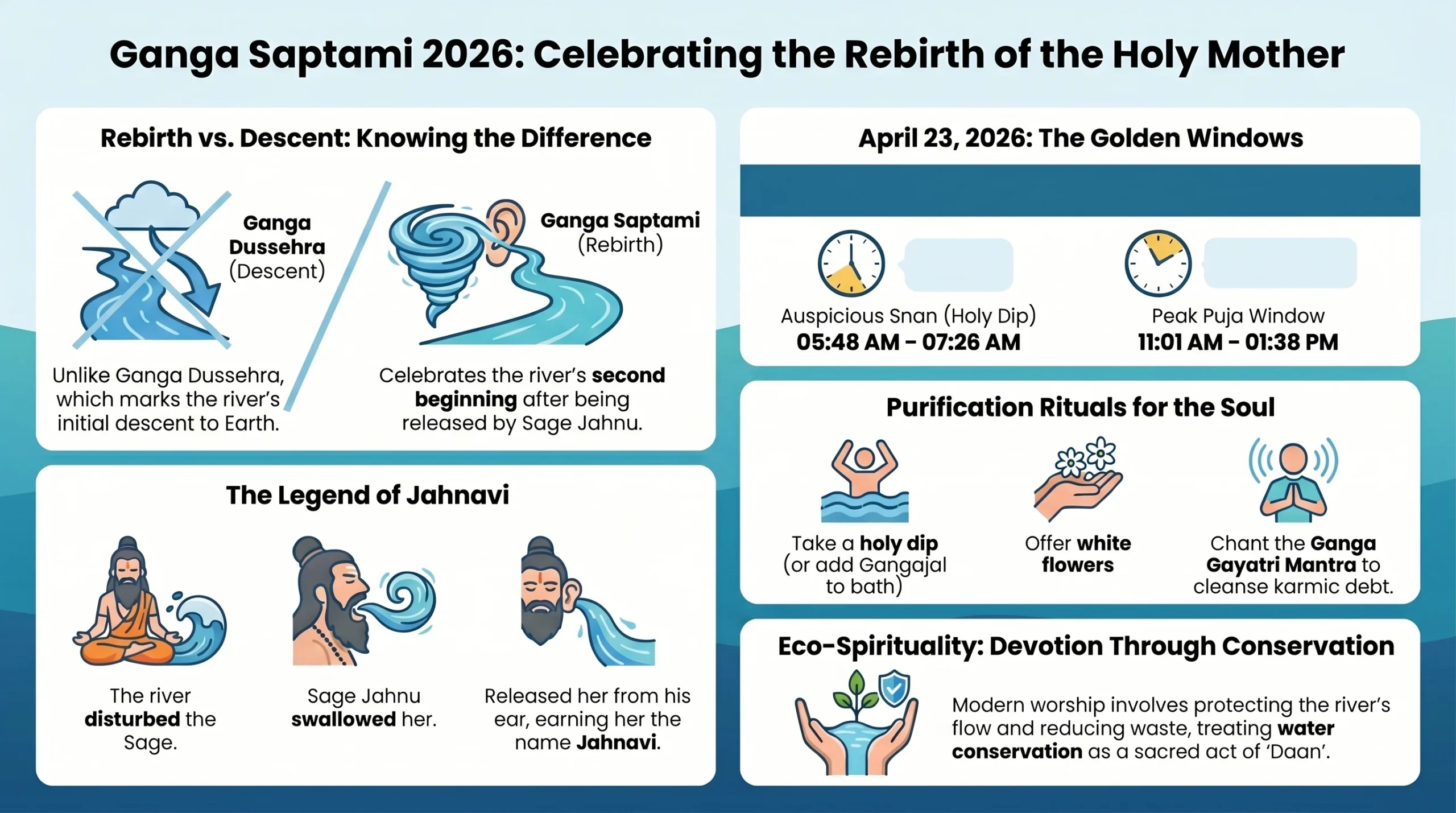
Ganga Saptami: Celebrating the Rebirth of the Holy Ganges
For millions across the Indian subcontinent, the Ganges is not merely a body of flowing water; she is Maa Ganga, a living, breathing mother who sustains life, purifies the soul, and absorbs the burdens of humanity. While Ganga Dussehra commemorates the day this mighty river first descended from the heavens, Ganga Saptami (also widely known as Ganga Jayanti) holds a uniquely profound and emotional resonance. It is the day we celebrate her dramatic rebirth.
As we look toward Ganga Saptami 2026, which auspiciously falls on Thursday, April 23, devotees and spiritual seekers are already preparing to honor this sacred occasion. Observed on the seventh day (Saptami Tithi) of the bright half of the Vaishakha month, this festival invites us to reflect on themes of resilience, purification, and the profound historical relationship between humanity and nature.
To truly understand the rebirth of the Ganges, we have to dive into one of the most captivating narratives in Puranic lore. The legend tells us that King Bhagiratha, through immense penance, succeeded in bringing the celestial river down to Earth to liberate the souls of his ancestors. However, as the torrential waters surged across the plains, their fierce momentum swept away the tranquil ashram of the meditating Sage Jahnu. Enraged by the destruction of his sanctuary, the powerful sage drank the entire river in a single, wrathful gulp.
The world was suddenly bereft of its life source. It was only after the desperate pleas of King Bhagiratha and the celestial gods that Sage Jahnu relented. His anger cooled by their devotion, the sage gently released the river from his ear. Because she was reborn from Sage Jahnu, the river earned the beautiful epithet Jahnavi, and the day of her release became eternalised as Jahnu Saptami.
Yet, beyond the spiritual allegory, this mythological descent and the subsequent taming of the river holds a fascinating mirror to early human ingenuity. Many historians and scholars view the epic of Bhagiratha not just as a divine miracle, but as an allegorical record of monumental ancient river engineering. The careful channeling of the Ganges from the treacherous Himalayan gorges down to the plains represents one of earliest and most ambitious feats of water management. The reverence built into Ganga Saptami subtly echoes how ancient civilizations respected the sheer force of water, designing intricate conservation methods to harness, rather than fight, the natural flow.
Today, observing Ganga Saptami is about reconnecting with that ancient reverence. For those seeking spiritual renewal, taking a holy dip in the Ganges on this day is believed to wash away karmic debts and cleanse the aura of past misdeeds. Even for those miles away from the bustling ghats of Varanasi or Haridwar, chanting the Ganga Ashtakshara Mantra and mixing a few drops of sacred Gangajal into their daily bath water brings the essence of the river right into their homes.
Ultimately, celebrating Ganga Saptami is a powerful reminder of nature’s cyclical power. It teaches us that even the most unstoppable forces can be calmed by devotion, and that spiritual purity, much like the holy waters of Maa Ganga, is always capable of flowing anew.
The Epic Mythology Behind Ganga Saptami: The Story of Sage Jahnu
To create truly engaging content, we must lean into the power of storytelling. The history of Ganga Saptami is not just a collection of dates; it is a dramatic epic of determination, ego, wrath, and ultimate redemption. Understanding the story of Jahnu Rishi and King Bhagiratha is essential to grasping why this festival holds such immense spiritual gravity.
The narrative originates with the great King Bhagiratha of the Ikshvaku dynasty. His ancestors had been reduced to ashes by the fiery gaze of Sage Kapila, and their souls were trapped in the netherworld, unable to attain Moksha (liberation). The only way to purify their ashes and grant them peace was to bring the celestial river, Ganga, down from the heavens to the earthly realm.
Through centuries of gruelling penance, Bhagiratha succeeded. However, the descent of the Ganges was fraught with danger. The river was wild, powerful, and arrogant. Had she fallen directly onto the Earth, her sheer force would have shattered the planet. To prevent this cataclysm, Lord Shiva intercepted her torrential flow within his matted locks, releasing her gently into the Himalayas.
Yet, as the river flowed down from the mountains and onto the vast northern plains, her waters swelled with a renewed sense of pride and unstoppable momentum.
This is where the specific mythology of Ganga Saptami unfolds. As the mighty river carved her path through the subcontinent, she surged violently toward the tranquil ashram of the revered Sage Jahnu. The sage was deeply immersed in profound meditation and performing sacred yajnas (fire rituals). Without warning, the roaring currents of the Ganges breached his sanctuary, sweeping away his sacred implements, disrupting his rituals, and completely submerging his hermitage.
Infuriated by the river’s destructive arrogance and lack of respect for his spiritual practice, Sage Jahnu invoked his immense yogic power. In a single, breathtaking display of wrath, the sage drank the entire Ganges in one gulp.
Suddenly, the roaring river vanished. The plains went dry, and the world was left in a state of absolute shock. King Bhagiratha, whose lifelong mission had been thwarted in an instant, fell at the feet of Sage Jahnu. Along with the celestial deities, the king pleaded for the sage’s mercy, explaining that the river’s descent was not meant for destruction, but for the salvation of his ancestors and the nourishment of the earth.
Moved by Bhagiratha’s selfless devotion and the desperate prayers of the gods, Sage Jahnu’s anger subsided. On the seventh day of the bright half of the Vaishakha month—the day we now celebrate as Ganga Jayanti—he relented. To purify the river of her earlier arrogance, he did not release her from his mouth; instead, he gently let her flow out from his right ear.
Through this act, the river was fundamentally transformed. She was reborn not just as a celestial stream, but as the daughter of the sage. This miraculous rebirth earned her the beautiful and revered name, Jahnavi.
This epic tale remains deeply relevant for modern readers. Beyond the vivid mythology, it serves as a powerful allegory about the necessity of humility. It teaches that even the most formidable, life-giving forces of nature must be approached with respect, and that unchecked power—whether a raging river —ultimately requires containment and purification to truly serve the world.
Ganga Saptami vs. Ganga Dussehra: Clearing the Confusion
In the vast landscape of Indian festivals, few questions arise as frequently as the distinction between Ganga Saptami and Ganga Dussehra. While both festivals center on the reverence of the holy river, they commemorate two entirely different milestones in her journey to Earth. For any spiritual seeker or traveler planning a trip to the ghats, understanding these nuances is key to appreciating the rituals.
The Core Significance: Descent vs. Rebirth
The primary difference lies in the mythological event being celebrated:
- Ganga Dussehra: This marks the original descent (Avataran) of the Ganges from the heavens. After King Bhagiratha’s grueling penance, the river finally touched the Earth, landing first in the matted locks of Lord Shiva to break her fall. It is effectively the Earthly Birthday of the river.
- Ganga Saptami (Ganga Jayanti): This marks her rebirth. As the legend goes, after her descent, she was swallowed by Sage Jahnu for her arrogance. On this day, she was released from the sage’s ear, signifying a second, purified beginning. This is why she is called Jahnavi (daughter of Jahnu) on this specific day.
The Calendar Dates
Because they celebrate different events, they occur in different months:
- Ganga Saptami: Celebrated on the Saptami (7th day) of the Shukla Paksha (waxing moon) in the month of Vaishakha. In 2026, this falls on April 23.
- Ganga Dussehra: Observed on the Dashami (10th day) of the Shukla Paksha in the month of Jyeshtha (usually late May or June). It occurs roughly a month after Ganga Saptami.
Comparative Table: At a Glance
| Feature | Ganga Saptami (Ganga Jayanti) | Ganga Dussehra |
| Meaning | The Rebirth of Ganga from Sage Jahnu | The Descent of Ganga to Earth |
| 2026 Date | April 23, 2026 | May 26, 2026 |
| Key Name | Jahnu Saptami / Jahnavi Jayanti | Gangavataran |
| Spiritual Focus | Purification of Ego & Rebirth | Salvation of Ancestors & Removal of 10 Sins |
| Primary Ritual | Deep meditation & “Ear” offerings | Taking 10 dips to wash away 10 types of sins |
Why the Distinction Matters for SEO and Devotion
From a search perspective, many users mistakenly search for Ganga’s birthday on both dates. However, Ganga Saptami is often viewed as a more intimate, internal purification festival—focusing on the taming of the river’s ego by Sage Jahnu. Conversely, Ganga Dussehra is a grander, external celebration of the river’s physical arrival on the plains, often associated with the washing away of ten specific types of sins (Dasha = Ten; Hara = Destroyer).
Whether you are witnessing the Haridwar Ganga Aarti during the spring heat of April or the peak summer of June, knowing these stories adds a layer of soul to the experience. While one celebrates her arrival, the other celebrates her resilience and her status as a sage’s daughter.
Ganga Saptami 2026: Dates, Timings, and Shubh Muhurat
To maximise the spiritual benefits of this sacred day, it is essential to align your rituals with the specific celestial timings of the Saptami Tithi. Whether you are planning a trip for a holy dip or performing a Manas Puja (mental worship) from home, here are the precise timings for Ganga Saptami 2026.
The Most Auspicious Date
In 2026, Ganga Saptami will be observed on Thursday, April 23.
While the Tithi (lunar day) actually begins late on the night of April 22nd, Hindu festivals are traditionally celebrated based on the Udaya Tithi (the Tithi prevailing at sunrise). Therefore, the entire day of April 23rd is dedicated to the worship of Maa Ganga.
Detailed Tithi Timings for 2026
- Saptami Tithi Begins: 10:49 PM on Wednesday, April 22, 2026
- Saptami Tithi Ends: 08:49 PM on Thursday, April 23, 2026
Shubh Muhurat: The Golden Window for Puja
While the whole day is considered holy, the Madhyahna Kaal (midday) is the most powerful time for performing the Ganga Puja rituals, as it is believed the river was reborn during this period.
- Ganga Saptami Madhyahna Muhurat: 11:01 AM to 01:38 PM
- Total Duration: 02 Hours 37 Minutes
- Auspicious Snan (Bathing) Time: 05:48 AM to 07:26 AM (Ideal for those visiting Haridwar, Varanasi, or Rishikesh)
Why These Timings Matter
In Vedic astrology, the Saptami of Vaishakha Shukla Paksha is a high-energy portal. Performing rituals during the Madhyahna window is said to multiply the karmic rewards of your prayers.
- Ganga Snan at Home: Wake up during the early morning Snan window (before 7:30 AM).
- The Ritual: Add a few drops of Gangajal into your bathing water while chanting Gange Cha Yamune Chaiva Godavari Saraswati.
- The Midday Puja: Set aside the midday window (11:01 AM – 1:38 PM) for quiet meditation, lighting a diya, and offering white flowers to a representation of the Ganges.
Ganga Saptami 2026 celebration is both traditionally accurate and spiritually fulfilling.
Step-by-Step Puja Vidhi: How to Observe Ganga Saptami
Performing the Ganga Saptami Puja is a deeply personal and spiritual process. Whether you are standing on the ancient stone steps of a ghat in Varanasi or observing the day from the quiet comfort of your home, the essence lies in your devotion (Bhava).
Since Ganga Saptami 2026 falls on a Thursday, an already auspicious day for spiritual growth, following these steps will help you align with the river’s purifying energy.
The Pre-Dawn Preparation (Brahma Muhurta)
Spiritual energy is at its peak between 4:00 AM and 6:00 AM.
- The Wake-up Call: Rise during the Brahma Muhurta. This symbolizes waking up your internal consciousness.
- The Intent (Sankalpa): Before beginning, take a moment of silence. Hold a little water in your right palm and make a mental resolve: Today, on Ganga Saptami, I perform this puja to seek purification and the grace of Maa Ganga.
The Sacred Bath (Ganga Snan)
The most vital ritual of the day is the holy dip.
- At the River: If you are at a holy site like Haridwar or Rishikesh, immerse yourself three times while facing East.
- At Home (The Gangajal Method): You don’t need to be at the river to receive its blessing. Add a few drops of Gangajal (sacred Ganges water) to your regular bathing water. As you bathe, chant this powerful mantra to invoke the presence of all holy rivers:
“Gange cha Yamune chaiva Godavari Saraswati |
Narmade Sindhu Kaveri Jalesmin Sannidhim Kuru ||”
Surya Arghya (Offering to the Sun)
After your bath, offer water to the rising Sun. Fill a copper pot (Lota) with water, add a few red flower petals and a pinch of Akshat (unbroken rice), and slowly pour it toward the Sun while chanting the Surya Mantra. This aligns the lunar energy of the Saptami with the solar energy of the day.
The Main Puja Rituals (Madhyahna Kaal)
The most auspicious window for the main puja in 2026 is between 11:01 AM and 01:38 PM.
- Setting the Altar: Place an idol or a picture of Goddess Ganga (depicted riding a crocodile/Makara). If you don’t have one, a kalash (brass pot) filled with water and a coconut on top represents the Goddess.
- Offerings: Offer white flowers, as white symbolizes the purity of the Ganges. Offer sandalwood paste (Chandan), incense, and a ghee lamp.
- The Bhog (Food Offering): Prepare a simple Satvik offering. Traditional choices include Kheer (rice pudding) or white sweets like Peda, signifying the milky-white froth of the flowing river.
Chanting and Meditation
During the midday Muhurat, sit in a quiet corner and chant the Ganga Gayatri Mantra:
Om Tapaswiniye Vidmahe, Shuchi-dharyai Dhimahi, Tanno Gange Prachodayat.
The Evening Deepdan (Offering of Lamps)
As the sun sets on April 23, 2026, perform a small Aarti.
- Floating Lamps: If you are near a water body, light a small leaf-cup lamp (Diya) and gently set it afloat.
- At Home: Light a lamp near a Tulsi plant or in your puja room. This represents the light of knowledge flowing through the river of your life.
Charity and Daan (The Final Step)
No Hindu ritual is complete without selfless giving. On Ganga Saptami, it is highly meritorious to donate:
- Water: Setting up a drinking water station (Pyaau) for travelers.
- Food: Donating seasonal fruits like watermelons or muskmelons to the needy.
- Clothes: Specifically white cotton clothes to Brahmins or the underprivileged.
Top 4 Spiritual Destinations to Experience Ganga Saptami
To truly absorb the energy of Ganga Saptami 2026, there is no substitute for being physically present where the river’s history breathes. While the entire 2,525 km stretch of the Ganges is sacred, these four destinations offer the most profound spiritual atmosphere for celebrating the river’s rebirth.
Varanasi (Kashi): The City of Eternal Light
Varanasi is widely considered the spiritual capital of India, and on Ganga Saptami, the city transforms. The central focus is Dashashwamedh Ghat, where the morning and evening rituals reach a crescendo.
- The Experience: Witness the Maha Aarti, a choreographed symphony of fire, incense, and chanting. On this day, devotees often string massive marigold garlands across the river using boats, literally decorating the Goddess.
- Highlight: Taking a boat ride at dawn to see the sun rise over the crescent-shaped bank as thousands of pilgrims perform Arghya (water offerings).
Haridwar: The Gateway to the Gods
Haridwar is where the Ganges officially leaves the mountains and enters the plains. For Ganga Saptami, the energy at Har Ki Pauri (the Footstep of God) is electric.
- The Experience: This is the site where the Ganga Shobha Yatra (a grand procession) often takes place. The Brahmakund area is believed to be the spot where the celestial nectar fell, making a holy dip here on Saptami exceptionally meritorious.
- Highlight: The sight of thousands of floating leaf diyas (Deepdan) at dusk, turning the river into a flowing mirror of the starry sky.
Rishikesh: The Serene Abode of Sages
If you seek a more meditative and quiet celebration, Rishikesh is the ideal choice. The air here is crisper, and the river flows with a turquoise clarity.
- The Experience: Head to Triveni Ghat, the confluence of the Ganga, Yamuna, and Saraswati. The evening Aarti at Parmarth Niketan Ashram is famous for its soulful, Vedic chanting led by young scholars.
- Highlight: Participating in a group meditation on the white sand beaches of the Ganges, reflecting on the theme of rebirth and internal purification.
Gangotri: The Source of Purity
For the ultimate pilgrimage, one must travel to the high-altitude shrine of Gangotri in the Himalayas. Ganga Saptami is particularly significant here as it falls shortly after the temple gates open for the summer season.
- The Experience: Standing near the Bhagirath Shila—the stone where King Bhagiratha is said to have meditated—brings the mythology of the river’s descent to life. The water here is icy and pristine, representing the Jahnavi form of the river in its purest state.
- Highlight: The intimate temple rituals where the idol of Goddess Ganga is dressed in exquisite silks and offered special Shringar to celebrate her rebirth.
Traveller’s Note for 2026: Since Ganga Saptami (April 23) falls during the transition to summer, the weather in Haridwar and Varanasi will be warm. However, in Gangotri and Rishikesh, the evenings remain cool and pleasant, making them the sweet spot for travellers looking to combine spirituality with comfortable weather.
Top 4 Spiritual Destinations to Experience Ganga Saptami
To absorb the energy of Ganga Saptami 2026, there is no substitute for being physically present where the river’s history breathes. While the entire 2,525 km stretch of the Ganges is sacred, these four destinations offer the most profound spiritual atmosphere for celebrating the river’s rebirth on Thursday, April 23, 2026.
Varanasi (Kashi): The City of Eternal Light
Varanasi is widely considered the spiritual capital of India, and on Ganga Saptami, the city transforms into a theatre of devotion. The central focus is Dashashwamedh Ghat, where the morning and evening rituals reach a crescendo.
- The Experience: Witness the Maha Aarti, a choreographed symphony of fire, incense, and chanting. On this day, devotees often string massive marigold garlands across the river using boats, literally decorating the Goddess.
- Highlight: Taking a boat ride at dawn to see the sun rise over the crescent-shaped bank as thousands of pilgrims perform Arghya (water offerings) to the Sun and the River simultaneously.
Haridwar: The Gateway to the Gods
Haridwar is where the Ganges officially leaves the mountains and enters the plains. For Ganga Saptami, the energy at Har Ki Pauri (the Footstep of God) is electric, as it is one of the most significant sites for a holy dip.
- The Experience: This is a primary site for the Deepdan (offering of lamps) ceremony. The Brahmakund area is believed to be the spot where celestial nectar fell, making a holy dip here on Saptami exceptionally meritorious for soul purification.
- Highlight: The sight of thousands of floating leaf diyas at dusk, turning the river into a flowing mirror of the starry sky.
Rishikesh: The Serene Abode of Sages
Rishikesh is the ideal choice. The air is crisper, and the river flows with a turquoise clarity that reflects its Himalayan origin.
- The Experience: Head to Triveni Ghat, the famous confluence point. The evening Aarti at Parmarth Niketan Ashram is world-renowned for its soulful, Vedic chanting led by young scholars (rishikumars), providing a deeply and emotional connection to the river.
- Highlight: Participating in a group meditation on the white sand beaches of the Ganges, reflecting on the theme of rebirth and internal renewal away from the urban bustle.
Prayagraj (Allahabad): The Sacred Confluence
Prayagraj, the site of the Triveni Sangam, holds a unique place in Ganga Saptami celebrations. It is here that the Ganges meets the Yamuna and the mythical Saraswati.
- The Experience: Rituals at the Sangam are focused on the Jahnavi aspect of the river. Devotees hire traditional wooden boats to reach the exact point of confluence for a dip, believing the combined power of the three rivers on this day grants unparalleled spiritual merit.
- Highlight: The massive religious fairs (Melas) often organized on the riverbanks, where you can witness local folklore, traditional music, and spiritual discourses.
Traveller’s Note for 2026
Since Ganga Saptami 2026 falls on April 23, it coincides with the transition into the Indian summer.
- Weather Tip: Haridwar and Varanasi will be warm, so plan your Snan (bath) for the early morning hours (5:48 AM – 7:26 AM).
- The Sweet Spot: For those sensitive to heat, Rishikesh remains the most comfortable destination during this period, offering a refreshing mountain breeze and cooler water temperatures.
The Astrological and Spiritual Significance of Ganga Saptami
Beyond the vibrant rituals and ancient stories, Ganga Saptami holds a deeper, more esoteric power. In the Vedic tradition, this day is viewed as a cosmic portal for purification. Whether you are looking at the alignment of the stars or the cleansing of the soul, the significance of this festival in April 2026 is multi-layered.
The Astrological Power: Taming the Fiery Mars
In Vedic astrology (Jyotish), the month of Vaishakha is ruled by the Sun’s exaltation, but it is also a time of intense heat and energy.
- The Mars Connection: Maa Ganga is often associated with the cooling of “Pitta” or fiery energy. For those with a heavy Mars (Mangal) influence in their birth charts—which can lead to impulsiveness or anger—worshipping the Ganges on this day is believed to provide a cooling effect.
- Lunar Strength: As the festival falls on the Saptami (7th day) of the waxing moon, it represents a balance between the mind (Moon) and the soul (Sun). Performing the Ganga Snan during this Tithi is said to harmonise these two internal forces, leading to mental clarity.
The Spiritual Essence: The Yoga of Rebirth
The story of Sage Jahnu swallowing the river and releasing her from his ear is a powerful spiritual metaphor for the transformation of the ego.
- Internalising the Legend: Just as the river’s destructive pride was consumed and then released in a purified, humbler form, Ganga Saptami invites us to consume our own negative traits—pride, greed, and anger—and be reborn with a clearer purpose.
- The Name Jahnavi: By becoming the daughter of a sage, the river transitioned from a wild natural force to a symbol of divine wisdom. For a seeker, this day is about transitioning from a life of worldly chaos to one of spiritual discipline (Sadhana).
Karmic Cleansing: Washing Away the Prarabdha
It is a common belief that a dip in the Ganges on this day washes away the sins of many lifetimes. But what does this mean in a modern context?
- Emotional Detoxing: Water is the element of emotion. Devotees believe that the vibrations of the Ganges on Saptami help dissolve Karmic imprints or stagnant emotional baggage.
- The Power of Sankalpa: When you step into the river (or use Gangajal at home) with a clear intention (Sankalpa), you are essentially hitting a spiritual reset button. It is a day to let go of the past and flow forward, much like the river itself.
Connection to Prosperity and Longevity
In many regional traditions, Ganga Saptami is also linked to the health and longevity of the family.
- Abundance: Because the river is the lifeline of the plains, she is worshipped as Annapurna (the provider of food).
- Ancestor Healing: Similar to Pitru Paksha, performing small rituals for one’s ancestors on this day is believed to bring peace to their souls, as the river’s primary purpose for descending was the salvation of the 60,000 sons of King Sagara.
Modern Relevance Honouring Maa Ganga Through Water Conservation
In our fast-paced, digital world, the rituals of Ganga Saptami might seem like echoes of a distant past. However, the true essence of this festival—the taming and rebirth of a wild river—has never been more relevant. Today, honouring Maa Ganga is not just about lighting a lamp; it is about protecting the very life force that sustains over 400 million people.
As we look toward Ganga Saptami 2026, the spiritual celebration is increasingly merging with a global movement for eco-spirituality and sustainable water management.
From Mythology to Modern Engineering
The legend of King Bhagiratha and Sage Jahnu is a powerful allegory for intervention in nature. Ancient Indian civilisations were masters of water management, as seen in the intricate architecture of historical stepwells (Baoris) and temple tanks. These structures weren’t just functional; they were sacred spaces designed to harvest every drop of monsoon rain.
On Ganga Saptami, we celebrate the river’s disciplined flow. In a modern context, this translates to:
- Restoring Ancient Wisdom: Reviving local water bodies and traditional desilting methods that allowed rivers to breathe.
- Controlled Flow: Balancing our need for hydroelectric power and irrigation with the river’s need for an Aviral Dhara (continuous, natural flow).
The Jahnavi Mindset: Taming Our Ecological Ego
Just as Sage Jahnu consumed”the river to teach her humility, modern humanity is at a crossroads where we must consume our own greed. The pollution of the Ganges is a reflection of our collective ecological ego—the belief that natural resources are infinite and ours to exploit.
- The Namami Gange Impact: Modern initiatives like the National Mission for Clean Ganga are working to ensure that the river is Nirmal (unpolluted). Celebrating Ganga Saptami in 2026 means supporting these efforts by reducing the flow of industrial waste and untreated sewage into the holy waters.
Actionable Devotion: How to Celebrate Sustainably
For the modern devotee, Puja and Prakriti (nature) are one and the same.
Zero-Waste Rituals: Opt for clay diyas and natural flower offerings instead of plastic-wrapped incense or non-biodegradable decorations.
- The Gangajal Conservation: If you have sacred Ganges water at home, use it sparingly and with intention. Treat every drop as a precious resource, echoing the ancient belief that water is the first form of God.
- Community Clean-ups: Many ashrams in Rishikesh and Haridwar now organise Shramdaan (voluntary labour) on Ganga Saptami to clear plastic from the riverbanks. Participating in or donating to these causes is a modern form of Daan (charity).
A River for Future Generations
Ganga Saptami reminds us that the river was brought to Earth for the salvation of ancestors, but it is our responsibility to preserve it for our descendants. In 2026, the rebirth we celebrate should be a literal one—a commitment to restoring the health of the Ganges so that future generations can also experience the spiritual solace of her banks.
The Takeaway: The most profound way to say Ganga Maiya Ki Jai (Victory to Mother Ganges) in the 21st century is to ensure she remains a living, flowing entity. This year, let your devotion flow into water conservation, turning an ancient ritual into a powerful act of environmental guardianship.
Frequently Asked Questions about Ganga Saptami 2026
1. When is Ganga Saptami in 2026?
Ganga Saptami will be celebrated on Thursday, April 23, 2026. The Saptami Tithi actually begins on the night of April 22 at 10:49 PM and concludes on April 23 at 08:49 PM. Following the Udaya Tithi (sunrise rule), all religious observations and the holy dip should be performed on April 23.
2. Why is Ganga Saptami also called Ganga Jayanti or Jahnu Saptami?
While Jayanti usually refers to a birth anniversary, Ganga Saptami is specifically called Ganga Jayanti because it marks the river’s rebirth. It is called Jahnu Saptami because it commemorates the day Sage Jahnu released the Ganges from his ear after having swallowed her earlier to punish her for her arrogance.
3. What is the difference between Ganga Saptami and Ganga Dussehra?
This is a very common point of confusion. Ganga Dussehra (celebrated in the month of Jyeshtha) marks the day the Ganges first descended from Heaven to Earth. Ganga Saptami (celebrated a month earlier in Vaishakha) marks her rebirth after being swallowed and then released by Sage Jahnu.
4. Can I perform Ganga Saptami Puja at home if I cannot visit the river?
Yes, absolutely. You can perform a symbolic Ganga Snan by adding a few drops of Gangajal (stored holy water) into your regular bathing water while chanting the Ganga Mantra. Afterwards, light a diya in front of an image of Goddess Ganga and offer white flowers and sweets.
5. What is the most auspicious time (Muhurat) for the holy dip in 2026?
For the maximum spiritual benefit, the Brahmakund Snan should be performed during the early morning hours on April 23, between 05:48 AM and 07:26 AM. However, for the specific Puja Vidhi, the Madhyahna Muhurat (midday) from 11:01 AM to 01:38 PM is considered the peak time.
6. Which mantra should be chanted on Ganga Saptami?
The most powerful mantra to chant while bathing or praying is the Ganga Gayatri Mantra:
Om Tapaswiniye Vidmahe, Shuchi-dharyai Dhimahi, Tanno Gange Prachodayat.
Alternatively, the simple but effective Om Namo Gangaye Vishwarupiniye Narayanye Namo Namahis is also widely used.
7. Is fasting (Vrat) required on Ganga Saptami?
While not mandatory, many devotees observe a partial fast (eating only fruits or Satvik food) to purify the body along with the soul. The fast is usually broken after the evening Aarti or after performing charity (Daan) to the needy.
8. What are the benefits of worshipping the Ganges on this day?
According to the Puranas, worshipping Maa Ganga on this Saptami removes the sins of the current and past lives. Astrologically, it is believed to reduce the malefic effects of Mars (Mangal Dosh) and bring mental peace, prosperity, and longevity to the devotee’s family.
9. Why is the Ganges referred to as Jahnavi?
The name Jahnavi literally means the daughter of Jahnu. Since the river was reborn from the ear of Sage Jahnu on this day, he is considered her spiritual father. This name signifies the river’s transition from a wild celestial force to a disciplined, sacred entity.
10. What items should be donated (Daan) on Ganga Saptami?
Donation is a key part of the Vaishakha month rituals. On Ganga Saptami, it is highly auspicious to donate water (setting up water stalls), seasonal fruits (like melons), white clothes, silver items, or barley. Giving to the poor on this day is said to bring Akshaya (everlasting) merit.
Conclusion: Embracing the Pure Flow of Ganga Saptami
Ganga Saptami 2026, we are reminded that this festival is far more than a date on a religious calendar; it is a profound celebration of resilience, humility, and the eternal cycle of rebirth. The journey of Maa Ganga—from her celestial descent to her dramatic re-emergence through the wisdom of Sage Jahnu—mirrors our own human journey toward spiritual clarity and emotional purification.
By observing the rituals of Ganga Jayanti on April 23, we do more than wash away past karmic burdens; we align ourselves with the Jahnavi spirit—a spirit that transforms raw, unchecked power into disciplined, life-giving grace. Whether you find yourself standing amidst the resonant chants of the Varanasi Aarti, taking a meditative dip in the cool currents of Rishikesh, or simply adding a drop of sacred Gangajal to your bath at home, the intention remains the same: to let the purity of the Ganges flow through your own life.
In this modern era, our devotion finds its highest expression in environmental guardianship. Honouring the rebirth of the holy river in the 21st century means committing to her protection, ensuring that the same waters that blessed our ancestors continue to nourish and inspire our descendants.
As the sun sets on Ganga Saptami 2026, let the lamps we set afloat represent a commitment to a clearer mind, a humbler heart, and a cleaner Earth. May the blessings of Maa Ganga bring peace, prosperity, and a renewed sense of purpose to your path.





Leave a Reply