
The Light of Wisdom Understanding the Magnitude of Shankaracharya Jayanti
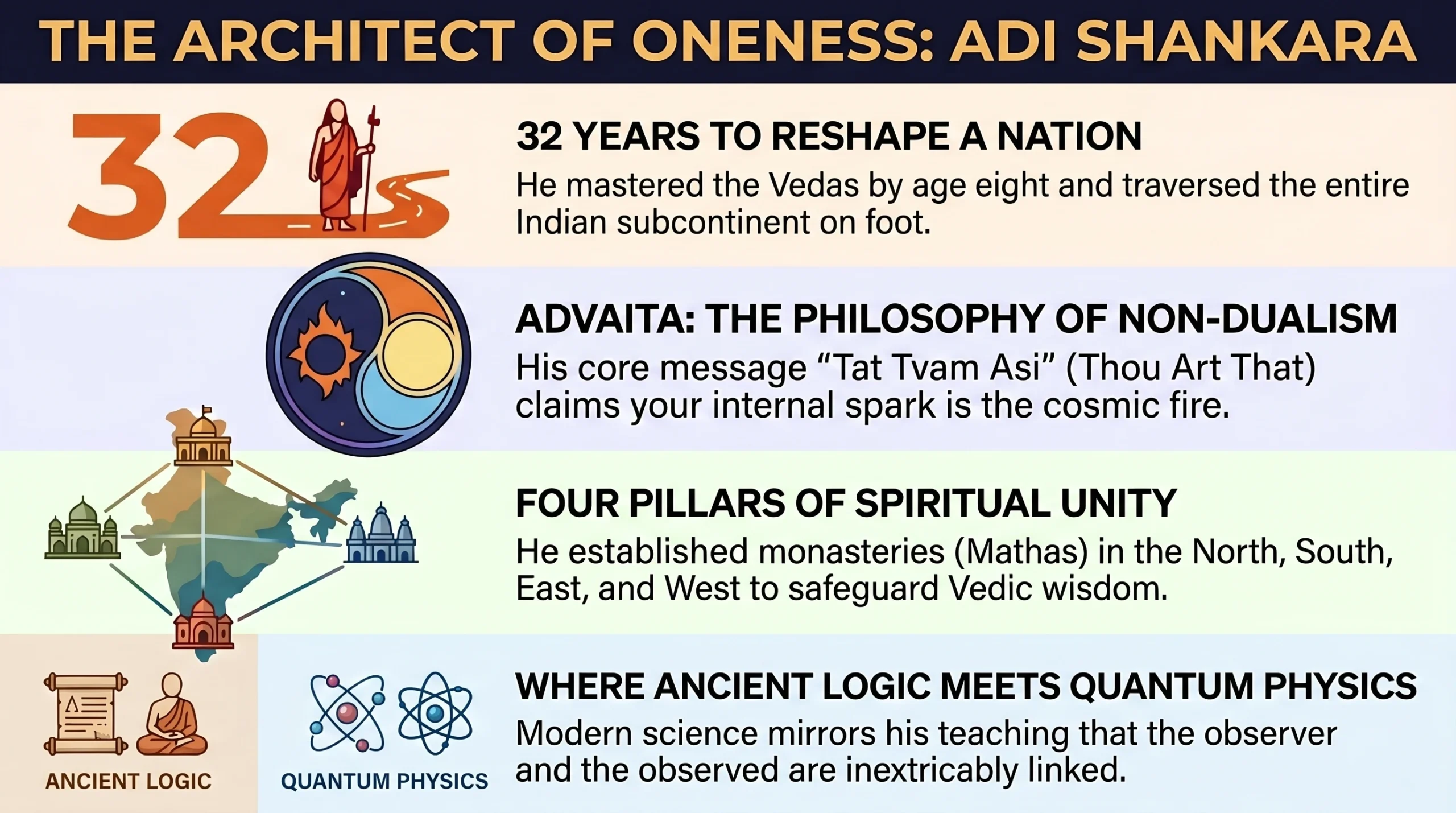
Every once in a few centuries, the world witnesses the arrival of a soul so profound that they don’t just change the course of history—they redefine the very fabric of human consciousness. As we approach Shankaracharya Jayanti 2026, we aren’t merely marking a date on a calendar; we are celebrating the birth of the Jagadguru (the Universal Teacher), Adi Shankara. He was the youthful monk who, in a staggering lifespan of just 32 years, walked across the length and breadth of India to stitch back together the fragmented soul of a nation.
To understand the significance of this day, one must first visualize the landscape of 8th-century India. It was a time of immense intellectual and spiritual turbulence. The ancient Vedic traditions were fading under the weight of empty rituals on one side and a thousand conflicting sectarian ideologies on the other. The core essence of Sanatana Dharma was gasping for air. It was into this atmosphere of spiritual chaos that Adi Shankara appeared, emerging from the small village of Kalady like a brilliant sunrise destined to clear the mist of ignorance (Maya).
Shankaracharya Jayanti is observed on the Vaisakha Shukla Panchami (the fifth day of the waxing moon in the month of Vaisakha). For seekers of truth and students of Indian philosophy, this day represents the Revival of Wisdom. It is a tribute to the man who gave us the most sophisticated psychological and spiritual framework known to man: Advaita Vedanta.
At its heart, Shankara’s message was revolutionary yet elegantly simple. He didn’t ask us to believe in a distant, judgmental deity. Instead, he whispered a truth that still rattles the ego today: Tat Tvam Asi (Thou Art That). He taught that the spark of divinity within you is no different from the cosmic fire that lights the stars. By championing non-dualism, he broke down the barriers between the creator and the created, providing a path to liberation (Mukti) through knowledge and self-realization rather than just ritualistic adherence.
But why does a monk from over a millennium ago trend in our digital age? Because the modern world is currently navigating its own Dark Age of anxiety, division, and existential burnout. The teachings celebrated on Shankaracharya Jayanti offer a timeless mental reset. In a world obsessed with me vs. you, Shankara’s vision of oneness provides the ultimate blueprint for global empathy and internal peace.
Welcome to the ultimate exploration of the Light of Wisdom.
The Life of a Prodigy: From Kalady to Kedarnath
If we find ourselves overwhelmed by the pace of the 21st century, the life of Adi Shankara serves as a staggering reality check. In an era without high-speed rail, digital communication, or even basic maps, this young monk traversed the Indian subcontinent on foot, not once, but multiple times. His life story isn’t just a historical record; it’s a masterclass in purpose, passion, and the sheer power of the human spirit.
A Miraculous Beginning in Kalady
The story begins in a quiet, emerald-green village called Kalady in Kerala. Born to a devout Namboothiri Brahmin couple, Sivaguru and Aryamba, Shankara was often described as a gift from Lord Shiva. However, he wasn’t your average child. While most children were just beginning to grasp their mother tongue, Shankara had reportedly mastered the four Vedas by the age of eight.
His intellect was so sharp it was almost intimidating, yet his heart was set on something far beyond academic prestige. He sought Sanyasa (renunciation)—a path his mother, understandably, was heartbroken to allow.
The Crocodile and the Vow of Renunciation
One of the most dramatic turning points in his life is the legend of the crocodile in the Purna River. As the story goes, while bathing, a crocodile seized Shankara’s leg. Facing certain death, he called out to his mother, pleading for her to let him die as a monk (Aatura Sanyasa). In her desperation to save his life, she relented.
Miraculously, the crocodile let go. Shankara emerged from the water not just a survivor, but a man reborn with a mission. He promised his mother he would return to perform her final rites—a promise that showed his devotion deeply, as monks typically sever all family ties. This blend of spiritual detachment and filial duty is what makes his character so resonant even today.
The Search for the Guru on the Banks of the Narmada
Leaving the lush landscapes of Kerala behind, the young boy-monk walked over 2,000 kilometers to the banks of the River Narmada. Here, he encountered his Guru, Govinda Bhagavatpada.
Legend has it that when the Guru asked, Who are you? the young boy didn’t give his name or lineage. Instead, he recited six verses that we now know as the Nirvana Shatakam (Mano Buddhi Ahankara Chittani Naham...—I am not the mind, nor the intellect, nor the ego…). Impressed by this innate understanding of the self, the Guru initiated him, and the mission to revive Sanatana Dharma officially began.
The Walk of Wisdom: Reclaiming the Soul of India
From that point on, Shankara’s life was a whirlwind of intellectual conquest, known as his Digvijaya. He didn’t use weapons; he used logic, Sanskrit mastery, and an unshakeable calm. He travelled to:
- Varanasi (Kashi): Where he wrote his famous commentaries (Bhashyas) that form the backbone of Indian philosophy.
- The Himalayas: Where he meditated and established the northernmost pillar of his tradition.
- The Four Corners: Creating a spiritual safety net for India by establishing the four Mathas (monasteries).
Kedarnath The Final Ascent
By the age of 32, most people are just starting to figure out their careers. Adi Shankara, however, had already unified a continent’s philosophy, written hundreds of works, and established a lineage that has lasted over 1,200 years.
Feeling his worldly task was complete, he made his final journey to the snowy heights of Kedarnath. It is said that he simply walked into the Himalayan mists and merged with the essence of Shiva. He left behind no physical possessions, only a legacy that continues to guide millions of seekers today.
This journey from the humid tropical heat of Kalady to the eternal snows of Kedarnath is more than a travelogue; it is a metaphor for the human soul’s journey from the small self to the universal consciousness. On Shankaracharya Jayanti, we don’t just remember his birth; we celebrate the fact that such a life was even possible.
Decoding Advaita Vedanta: The Philosophy of Non-Dualism
If you’ve ever felt like there is a deeper connection between you and the universe—a sense that we are all made of the same stuff—you’ve already had a brush with Advaita Vedanta.
While the term sounds like a heavy academic mouthful, Advaita literally translates to not two. It is the pinnacle of Indian philosophical thought, refined and championed by Adi Shankara. At its core, it is the radical, life-altering suggestion that the separation we feel between ourselves, others, and the divine is nothing more than a cosmic misunderstanding.
Let’s break down this profound oneness into digestible
The Core Axiom Real, Unreal, and Everything in Between
Shankara summarised his entire philosophy in one famous Sanskrit verse:
Brahma Satyam Jagan Mithya, Jivo Brahmaiva Naparah
(Brahman is the only truth, the world is an appearance, and the individual self is none other than Brahman.)
To the modern ear, saying the world is an appearance might sound like Shankara was suggesting we live in a simulation. Not quite. He wasn’t saying the world doesn’t exist; he was saying it isn’t ultimately real. It is a relative reality.
The Analogy: The Dreamer and the Dream
To understand Advaita, think about your last vivid dream. While you were sleeping, you were the hero, there was a villain, a beautiful landscape, and perhaps a terrifying storm. In the dream, those were all real entities separate from you.
But the moment you wake up, you realise:
- You were the hero.
- You were the villain.
- You were the storm.
- You were the very space the dream happened in.
Everything was just a projection of your own mind. Advaita Vedanta suggests that our waking life is a long dream. We think we are separate individuals (the Jiva), but when we wake up spiritually, we realise we are the underlying Consciousness (Brahman) that supports the whole show.
The Three Pillars of Advaita
To master the trending discussions around mindfulness and spiritual awakening, you need to understand these three Advaitic concepts:
- Brahman (The Infinite): This isn’t a God sitting on a cloud. Brahman is the nameless, formless, eternal ocean of existence-consciousness-bliss (Sat-Chit-Ananda).
- Atman (The Self): This is the you that is watching your thoughts right now. Advaita’s big reveal? Atman is Brahman. Your internal spark is the same as the universal fire.
- Maya (The Illusion): This is the cosmic dust in our eyes. Maya is the power that makes the one look like many. It’s why we see a thousand different waves instead of just the ocean.
Why Advaita is Trending in the 21st Century
In an era of hyper-individualism and social media comparison, Advaita is the ultimate ego-antidote.
- Mental Wellness: If your true self is eternal and infinite, the stresses of your 9-to-5 job or your social standing become manageable scriptsrather than existential threats.
- Unity in Diversity: When you realize the person sitting across from you is, in essence, another version of You,hate and prejudice become logically impossible.
- Science and Logic: Modern quantum physicists are increasingly fascinated by Advaita, as it mirrors the idea that the observer and the observed are inextricably linked.
The Goal Self-Realisation
Adi Shankara didn’t want followers; he wanted “Realisers. The goal of Advaita isn’t to reach a heaven after death, but to achieve Jivanmukti—liberation while you are still alive. It’s the realisation that you were never bound, never small, and never alone.
Shankaracharya Jayanti, we aren’t just honouring a philosopher; we are honouring the map he left behind—a map that leads us back to our own true, infinite nature.
The Digvijaya: A Spiritual Conquest of India
In the history of world conquerors, we usually hear stories of chariots, swords, and fallen empires. But Adi Shankara’s Digvijaya (conquest of the four directions) was different. He didn’t set out to capture land; he set out to capture minds. Armed with nothing but a staff, a water pot, and an invincible logic, this young monk embarked on a journey that would redefine the cultural and spiritual boundaries of India forever.
The Intellectual “Blitzkrieg”
The term Digvijaya literally means victory over the directions. For Shankara, this wasn’t about ego; it was a necessary cleaning of the house. At the time, India was a chaotic patchwork of over 72 conflicting sects. Some were nihilistic, some were overly ritualistic, and others had drifted into practices that were far removed from the core of Sanatana Dharma.
Shankara’s strategy was the Shastrartha—the ancient Indian tradition of philosophical debate. These weren’t just polite chats; they were high-stakes intellectual duels where the loser would often become the disciple of the winner. It was through these debates that Shankara systematically unified a fragmented nation under the umbrella of Advaita Vedanta.
The Legendary Duel Shankara vs. Mandana Misra
If there’s one story from the Digvijaya that feels like a cinematic masterpiece, it’s the encounter with Mandana Misra, the greatest scholar of the Karma Mimamsa school (which focused strictly on rituals).
The stakes were massive:
- If Shankara lost, he would give up his monkhood and become a householder.
- If Mandana Misra lost, he would renounce his wealth and family to become a wandering monk.
The judge for this epic debate? Mandana Misra’s own wife, Ubhayabharati, a woman of extraordinary intellect. She placed a garland of fresh flowers on both men, declaring that the one whose flowers withered first—due to the heat of rising anger or anxiety—would be the loser.
For weeks, the debate raged on. Shankara’s calm, non-dualistic logic eventually triumphed, and Mandana Misra’s garland withered. But the story has a twist: Ubhayabharati challenged Shankara herself, arguing that as a monk, his knowledge was incomplete until he understood the householder’s life and the complexities of human emotions. This forced Shankara to broaden his horizons even further, proving that even a prodigy must remain a student of life.
The Architect of Unity Shanmatha Sthapana
One of Shankara’s most trending achievements in the context of modern social harmony was the establishment of Shanmatha (six faiths). Before him, followers of Shiva, Vishnu, Shakti, Surya, Ganesha, and Kartikeya were often at odds.
Shankara didn’t tell them they were wrong. Instead, he taught them that these were six different user interfaces for the same underlying operating system—the one Brahman. By synthesizing these paths, he ended centuries of sectarian friction, earning him the title Shanmatha Sthapanacharya.
Walking the Talk A Geographical Legacy
The Digvijaya wasn’t just about ideas; it was a logistical marvel. Shankara walked from the southern tip of Kerala to the frozen heights of the Himalayas, from the western shores of Gujarat to the eastern coast of Odisha.
By physically visiting these remote corners, he created a spiritual map of India. He proved that despite different languages, cuisines, and local deities, there was a single, underlying cultural heartbeat. On Shankaracharya Jayanti, we celebrate this unification. He gave the people a shared identity that was intellectual, spiritual, and geographical all at once.
Why the Digvijaya Still Matters
In an age of echo chambers and cancel culture, the Digvijaya offers a refreshing lesson in intellectual rigor. Shankara didn’t silence his opponents; he sat with them, listened to their arguments, and defeated them with superior reasoning and compassion.
His conquest reminds us that truth doesn’t need to be shouted; it simply needs to be realized. As we reflect on his travels this year, we see a man who turned a subcontinent into a classroom, proving that the greatest power in the world isn’t a weapon—it’s a clear, awakened mind.
The Four Amnaya Mathas Pillars of Sanatana Dharma
Adi Shankara was not just a philosopher and a poet; he was a visionary administrator. He understood a fundamental truth: while ideas can change the world, institutions are required to preserve those ideas for eternity. To ensure that his revival of Sanatana Dharma wouldn’t fade after his passing, he established four Amnaya Mathas (monasteries) in the four corners of India.
These weren’t just buildings; they were spiritual citadels. By placing them in the North, South, East, and West, Shankara effectively “fenced” the subcontinent in a protective grid of wisdom, ensuring that no matter where you were in India, the light of the Vedas was never too far away.
The Blueprint of Spiritual Unity
Each of the four Mathas was assigned a specific Veda to protect, a Mahavakya (Great Saying) to meditate upon, and a primary disciple to lead it. This was the ultimate decentralized system of spiritual governance.
| Matha | Direction | Associated Veda | The Mahavakya (Great Saying) | First Disciple |
| Sringeri Sharada Peetham | South | Yajur Veda | Aham Brahmasmi (I am Brahman) | Sureshwaracharya |
| Dwaraka Sharada Peetham | West | Sama Veda | Tattvamasi (That Thou Art) | Hastamalakacharya |
| Govardhan Matha (Puri) | East | Rig Veda | Prajnanam Brahma (Consciousness is Brahman) | Padmapadacharya |
| Jyotirmath (Badrinath) | North | Atharva Veda | Ayam Atma Brahma (This Self is Brahman) | Totakacharya |
Sringeri Sharada Peetham (The South)
Located in the lush hills of Karnataka on the banks of the Tunga River, Sringeri is perhaps the most famous of the four. Legend says Shankara chose this spot because he saw a cobra shielding a pregnant frog from the hot sun with its hood—a sign of a place where natural enemies live in peace.
- The Vibe: Deeply scholarly and serene. It remains a global hub for the study of Sanskrit and Advaita Vedanta.
- Key Focus: Preservation of the Yajur Veda.
Dwaraka Sharada Peetham (The West)
Situated at the edge of the Arabian Sea in Gujarat, this Matha stands in the kingdom of Lord Krishna. It serves as the western gatekeeper of Vedantic wisdom.
- The Vibe: A blend of Krishna’s Leela and Shankara’s logic.
- Key Focus: Preservation of the Sama Veda, the Veda of melody and chant.
Govardhan Matha, Puri (The East)
Located in Odisha, near the world-famous Jagannath Temple, this Matha connects the philosophy of the One with the vibrant culture of the Lord of the Universe.
- The Vibe: High energy, deeply connected to the masses and the ancient rituals of the East.
- Key Focus: Preservation of the Rig Veda, the oldest of the four Vedas.
Jyotirmath, Joshimath (The North)
Perched high in the Himalayas en route to Badrinath, Jyotirmath is the Matha of Light. For centuries, it faced the harshest conditions, even remaining dormant for a period before being revived.
- The Vibe: Austere, meditative, and towering—much like the peaks that surround it.
- Key Focus: Preservation of the Atharva Veda.
The Dashanami Sampradaya: Organising the Monks
Before Shankara, wandering monks were often unorganised. To bring structure to the monastic life, he created the Dashanami Sampradaya (The Ten Names). Every monk in the Advaita lineage today carries one of these ten surnames, which indicates their specific Matha and branch:
- Saraswati, Bharati, Puri (Sringeri)
- Teertha, Ashrama (Dwaraka)
- Giri, Parvata, Sagara (Jyotirmath)
- Vana, Aranya (Puri)
Why These Mathas Matter Today
In our hyper-connected but often rootless modern world, these four Mathas act as anchors. They are not museums of the past; they are living, breathing universities. When you visit a Matha during Shankaracharya Jayanti, you aren’t just visiting a tourist spot—you are stepping into a 1,200-year-old unbroken lineage of wisdom (Guru-Shishya Parampara).
They remind us that while the world changes—empires fall, technology evolves, and borders shift—the fundamental truths of human consciousness remain as steady as the four pillars Shankara planted in the soil of India.
Literary Masterpieces: The Pen of the Jagadguru
If Adi Shankara’s travels were his body’s mission and the Mathas were his organizational soul, then his writings are his eternal voice. It is almost impossible to fathom that a single individual, who passed away at 32, could produce a body of work so vast, so intellectually rigorous, and yet so breathtakingly poetic.
Shankara’s literary legacy is a rare double threat in world literature. He was a master of cold, hard logic in his commentaries and a master of overflowing devotion in his hymns. Whether you are a scientist looking for a rational framework of reality or a seeker looking for a song to stir the heart, his pen has something for you.
The Prasthanatrayi Bhashya: The Constitution of Vedanta
For any serious student of Indian philosophy, the Prasthanatrayi (The Three Sources) is the ultimate syllabus. Shankara wrote definitive commentaries (Bhashyas) on these three pillars:
- The Upanishads: Unlocking the secret wisdom of the forest sages.
- The Bhagavad Gita: Turning Krishna’s battlefield dialogue into a roadmap for self-realization.
- The Brahma Sutras: Systematizing the scattered thoughts of the Vedas into a logical fortress.
His commentaries are famous for their Purvapaksha style—he would first present his opponent’s argument better than they could themselves, only to systematically dismantle it with a logic so sharp it left no room for doubt.
Devotional Stotras: The Heart of a Mystic
What makes Shankara unique is that he didn’t just stay in the head; he moved to the heart. Despite being the King of Logic, he composed some of the most beautiful Sanskrit hymns (Stotras) ever written.
- Bhaja Govindam: A wake-up call to humanity. In simple, haunting verses, he warns us not to waste our lives chasing fleeting wealth and fame. Seek the Divine now, he urges, for when death comes, grammar rules won’t save you.
- Soundarya Lahari: A masterpiece of Shakta tantra and poetry, celebrating the beauty and power of the Divine Mother.
- Kanakadhara Stotram: Legend says that when Shankara saw the poverty of a woman who gave him her last withered gooseberry, he sang this hymn to Goddess Lakshmi, who then rained down golden gooseberries. It remains a trending chant for prosperity and abundance today.
Prakarana Granthas: The Beginner’s Guides to Enlightenment
Shankara knew that not everyone could spend decades studying the Vedas. So, he wrote introductory texts that condense the highest truths into manageable manuals.
- Vivekachudamani (The Crest Jewel of Discrimination): This is perhaps his most popular work today. It acts as a dialogue between a teacher and a student, explaining how to distinguish the Real from the Unreal.
- Atma Bodha (Self-Knowledge): Using beautiful analogies—like how butter is hidden in milk or how a dream seems real until we wake—he explains the nature of the soul in just 68 verses.
Nirvana Shatakam: The Ultimate Identity Shift
If you’ve ever attended a high-end yoga retreat or a meditation workshop, you’ve likely heard the chanting of Chidananda Rupa Shivoham Shivoham.This is Shankara’s Nirvana Shatakam. In six verses, he strips away every label we give ourselves—I am not the body, not the mind, not my job, not my family, not my sins, not my virtues. What’s left? Pure Consciousness and Bliss.
Why These Texts Trend in 2026
In a world of Information Overload, Shankara’s writings are a Clarity Filter.
- The Science Connection: Modern physicists often quote his Bhashyas when discussing the nature of space-time and the observer effect.
- The Mindfulness Movement: His works on Viveka (Discrimination) are the original blueprints for modern cognitive behavioural therapy and self-inquiry.
- Cultural Pride: As we celebrate Shankaracharya Jayanti, these texts remind us of the intellectual goldmine that forms the foundation of Indian heritage.
Celebrating Shankaracharya Jayanti 2026: Dates, Rituals, and Spiritual Practices
As we move through the spring of 2026, the air carries a distinct spiritual charge. For followers of Advaita Vedanta and seekers of Vedic wisdom, the most significant date on the horizon is April 21, 2026—the day we celebrate Shankaracharya Jayanti.
This day marks the 1238th birth anniversary of the Jagadguru. It is more than just a historical commemoration; it is a “portal” to reconnect with the non-dual essence of our own being. Whether you are at home or visiting a sacred site, here is how you can immerse yourself in the celebration this year.
Important Dates and Tithi for 2026
The birth of Adi Shankara is traditionally observed on the Panchami Tithi (5th day) of the Shukla Paksha (waxing moon) in the month of Vaisakha.
- Shankaracharya Jayanti Date: Tuesday, April 21, 2026
- Panchami Tithi Begins: 04:14 AM on April 21, 2026
- Panchami Tithi Ends: 01:19 AM on April 22, 2026
Rituals and Traditions: How the Day is Observed
The beauty of Shankaracharya Jayanti lies in its intellectual and devotional balance. Unlike festivals that focus solely on outer festivities, this day is deeply contemplative.
The Shodashopachara Puja
Devotees begin the day with a dedicated Puja to Adi Shankaracharya. In many households and temples, a statue or a picture of the Guru is bathed (Abhishekam) and decorated with fresh flowers. Offerings of fruits and sweets are made, accompanied by the lighting of lamps to symbolize the removal of the darkness of ignorance (Avidya).
Recitation of Sacred Texts
Since Shankara was a master of the written word, the most powerful way to honor him is through his own works. Trending practices for 2026 include:
- Chanting the Kanakadhara Stotram: For prosperity and grace.
- Reciting the Nirvana Shatakam: To recalibrate one’s sense of identity.
- Reading the Vivekachudamani: Often done in groups (Satsangs) to discuss the practical application of discrimination in modern life.
Shastrartha and Discourses
In the four Mathas (Sringeri, Dwaraka, Puri, and Joshimath), the day is marked by intense philosophical debates and discourses. Renowned scholars gather to interpret the Bhashyas (commentaries), keeping the tradition of intellectual inquiry alive.
Acts of Seva (Selfless Service)
Reflecting Shankara’s compassion, many organisations organise charitable events on this day. Providing food to the needy (Annadana) or supporting educational initiatives for Sanskrit and Vedic studies are considered highly meritorious acts.
Celebrating in the Modern World: A Digital Jayanti
In 2026, the celebration has expanded beyond physical boundaries. If you cannot visit a Matha, you can still participate:
- Virtual Satsangs: Join live-streamed discourses from Sringeri or Kanchi to hear the current Shankaracharyas speak.
- Meditation Retreats: Many digital wellness platforms offer 24-hour guided meditations focused on Atma Bodha (Self-Knowledge) during this day.
- Social Media Mindfulness: Use the day to share verses from the Bhaja Govindam to inspire your network toward a more meaningful, less materialistic lifestyle.
The Essence of the Celebration
Ultimately, the best way to celebrate Shankaracharya Jayanti 2026 is to take a moment of silence. Ask yourself the question Shankara famously answered: Who am I? Beyond the job, the stress, and the daily hustle, find that quiet oneness that he spent his life pointing toward.
Why Adi Shankara Matters in the 21st Century
In an age of artificial intelligence, space exploration, and a global mental health crisis, why does an 8th-century monk remain one of the most trending figures in philosophy?
Adi Shankara’s relevance in 2026 isn’t just about religious tradition; it’s about his role as the ultimate universal psychologist and a precursor to modern science. His teachings offer a profound software update for the human mind, helping us navigate the complexities of a hyper-connected yet deeply divided world.
The Original Mind-Science: Mental Health & Minimalism
Long before the Mindfulness movement took over Silicon Valley, Shankara was teaching the art of Self-Inquiry.
- Overcoming Anxiety: Advaita Vedanta teaches that most of our stress comes from misidentifying with temporary things—our jobs, our social media following, or our physical ageing. Shankara’s Neti-Neti (Not this, not that) method is the ultimate tool for cognitive distancing, allowing us to remain calm observers of our own chaotic thoughts.
- Spiritual Minimalism: In a consumerist culture, his work Bhaja Govindam serves as a timeless reminder that chasing external stuff is like chasing a mirage. He advocates for an internal wealth that no economic recession can touch.
The Quantum Connection: Advaita and Modern Physics
One of the most fascinating trends in 2026 is the growing dialogue between Vedanta and Quantum Mechanics.
- The Observer Effect: Just as quantum physics suggests that the act of observation changes the reality of a subatomic particle, Shankara argued over a millennium ago that the Seen (the world) cannot exist without the Seer (Consciousness).
- Interconnectedness: Leading physicists like Erwin Schrödinger and Werner Heisenberg were famously influenced by Vedantic thought. The concept of Quantum Entanglement—where particles remain connected across vast distances—rhymes beautifully with Shankara’s non-dualistic vision that everything in the universe is fundamentally one.
Social Reform Beyond Labels and Boundaries
While often portrayed as a traditionalist, Shankara was a radical social unifier.
- The Manisha Panchakam Lesson: Legend tells of an encounter in Varanasi where an untouchable man challenged Shankara’s path. Shankara immediately realized his own error in judgment, prostrated before the man, and composed five verses declaring that anyone who has realized the Oneness of the Self is his Guru—regardless of caste or social standing.
- Global Citizenship: In a world fractured by Us vs. Them politics, the Advaitic view provides a logical foundation for Universal Human Rights. If we are all the same Brahman, harming another is quite literally harming oneself.
Synthesising Science and Spirituality
Shankara was perhaps the first to insist that reason and logic must accompany faith. He famously stated that if a hundred scriptures said that fire is cold, we should reject them, because our direct experience and reason tell us otherwise. This scientific temper makes his philosophy highly attractive to the modern, rational mind that seeks spirituality without superstition.
The Bottom Line A Blueprint for a Conscious Future
Shankaracharya Jayanti 2026, we realize that Shankara wasn’t just a man of the past; he is a man of the future. He provides the missing link between our technological progress and our inner peace.
He matters today because he reminds us that while we may be small waves in the ocean of life, we are, in essence, the Ocean itself. In an era of deep uncertainty, that is the most empowering realization a human being can have.
Frequently Asked Questions about Mastering the Wisdom of Adi Shankara
1. When is Shankaracharya Jayanti 2026?
Shankaracharya Jayanti 2026 will be celebrated on Tuesday, April 21, 2026. The festival falls on the Panchami Tithi during the Shukla Paksha (waxing phase of the moon) in the Hindu month of Vaisakha. This year marks the 1238th birth anniversary of the Jagadguru.
2. Where was Adi Shankaracharya born?
Adi Shankara was born in a small, serene village called Kalady, located on the banks of the Periyar (Purna) River in present-day Kerala, India. His birthplace is now a major pilgrimage site, housing temples dedicated to him and his mother, Aryamba.
3. What is the core philosophy of Advaita Vedanta?
Advaita Vedanta is the philosophy of Non-Dualism. Its core tenet is that the individual soul (Atman) and the Supreme Reality (Brahman) are not two separate entities but are fundamentally one. It teaches that the perceived world of variety is a relative reality (Maya), and liberation (Moksha) is achieved through the direct knowledge of this oneness.
4. Why did Adi Shankara establish four Mathas?
Shankara established the four Amnaya Mathas (monasteries) in the four corners of India—Sringeri (South), Dwaraka (West), Puri (East), and Joshimath (North)—to act as administrative and spiritual hubs. Their purpose was to preserve the four Vedas, organise the monastic order, and ensure the eternal continuity of Sanatana Dharma.
5. What are the major works written by Adi Shankaracharya?
His literary output is vast, but his most influential works include:
- The Prasthanatrayi Bhashya: Commentaries on the Upanishads, Bhagavad Gita, and Brahma Sutras.
- Introductory Texts: Vivekachudamani, Atma Bodha, and Tattva Bodha.
- Devotional Hymns: Bhaja Govindam, Soundarya Lahari, and Kanakadhara Stotram.
6. Is Adi Shankara considered an incarnation of Lord Shiva?
Yes, in traditional Hindu belief, Adi Shankara is revered as an Avatar of Lord Shiva. He is often called Shankara-Loka-Shankara, meaning the Shankara who brings auspiciousness to the whole world, born to restore Vedic wisdom when it was in decline.
7. What is the difference between Advaita and Dvaita philosophy?
While both belong to the Vedanta school, Advaita (Non-Dualism), taught by Shankara, claims that the Soul and God are one. In contrast, Dvaita (Dualism), taught by Madhvacharya, argues that the Soul and God are eternally separate and that the soul is a servant of the Divine.
8. How did Adi Shankara die?
Adi Shankara is believed to have attained Videha Mukti (liberation from the body) at the young age of 32. Traditional accounts state that he made his final journey to Kedarnath in the Himalayas, where he withdrew into a cave and merged with the infinite consciousness.
9. What is the Kanakadhara Stotram story?
This is one of the most beloved legends of his life. As a young boy, Shankara was moved by the poverty of a woman who could only offer him a single withered gooseberry. He composed the Kanakadhara Stotram in praise of Goddess Lakshmi, who was so pleased that she showered the woman’s house with golden gooseberries.
10. How can I celebrate Shankaracharya Jayanti at home?
You can celebrate by:
- Performing a simple Shodashopachara Puja to a picture or idol of Adi Shankara.
- Chanting the Nirvana Shatakam or Bhaja Govindam.
- Reading a chapter of the Bhagavad Gita with Shankara’s commentary.
- Practising meditation focused on the I Am Brahman (Aham Brahmasmi) realisation.
- What are the 5 main contributions of Adi Shankaracharya?
- Is Adi Shankara an incarnation of Shiva?





Leave a Reply