
The Divine Power of Bagalamukhi Jayanti
In today’s hyper-competitive and deeply chaotic world, we are constantly fighting battles. Some of these battles are external—ruthless corporate rivalries, draining legal disputes, deceitful competitors, and sudden crises that threaten to upend our lives and livelihoods. Other battles are intensely internal—the paralyzing grip of self-doubt, overwhelming anxieties, and the relentless, distracting noise of our own racing minds. When the storms of life feel too powerful to navigate, human beings have historically turned to a divine archetype that doesn’t just fight the chaos, but entirely freezes it. Enter the awe-inspiring and protective energy of Goddess Bagalamukhi.
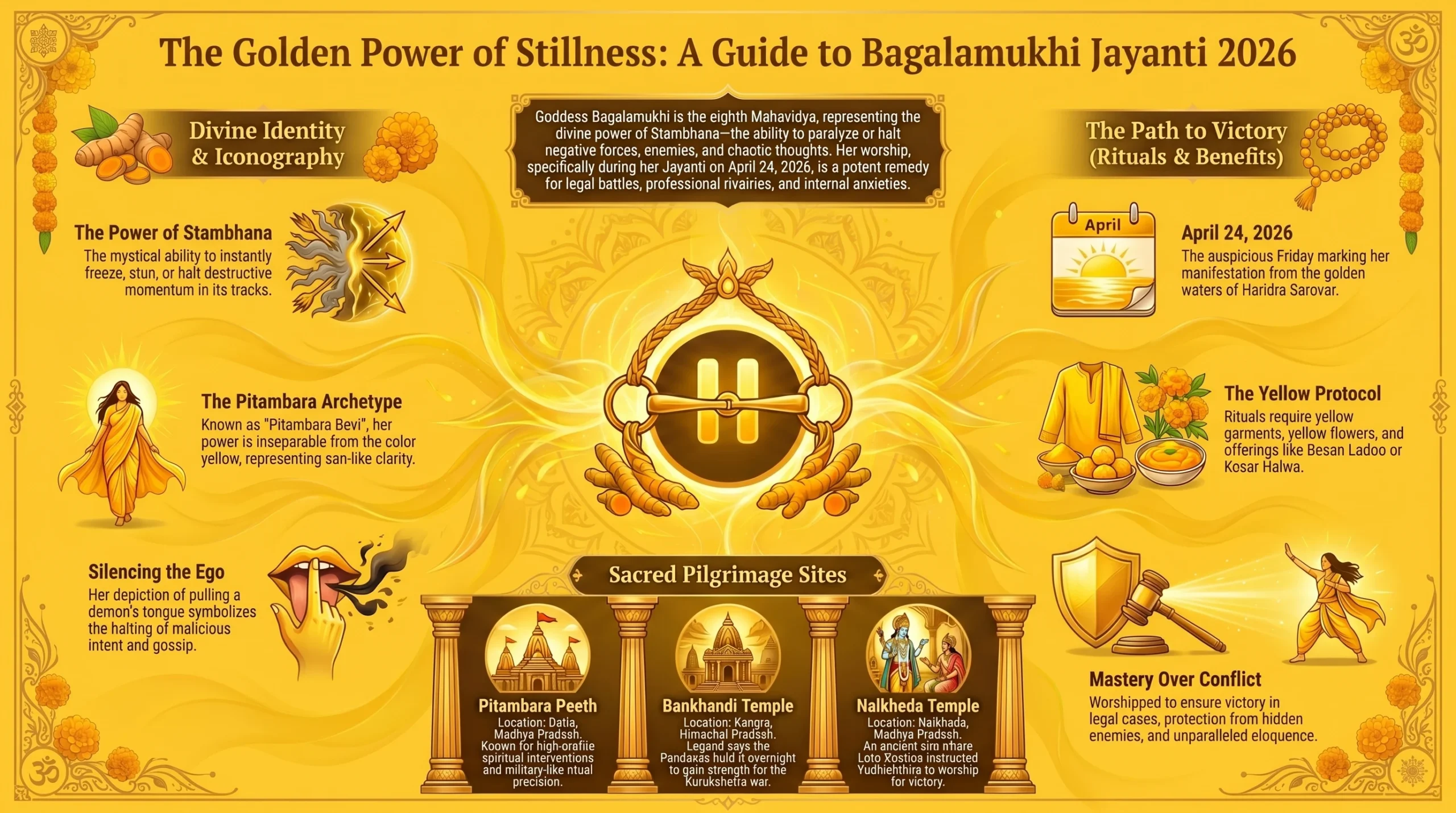
As the eighth of the revered 10 Mahavidyas (the Great Cosmic Wisdoms of Tantric tradition), Goddess Bagalamukhi—lovingly known by her devotees as Pitambara Devi—is the ultimate manifestation of the divine feminine power of Stambhana. In ancient texts, Stambhana is defined as the mystical power to paralyze, stun, or instantly halt. She does not merely engage in prolonged warfare with negative forces; she simply stops them in their tracks. Whether it is silencing the malicious gossip of hidden enemies, freezing the harmful intentions of adversaries, or bringing a sudden halt to our own self-sabotaging thoughts, the core Pitambara Devi significance lies in her unmatched ability to restore absolute stillness and order where there was once undeniable destruction.
This year, millions of spiritual seekers will tap into this profound cosmic energy during Bagalamukhi Jayanti 2026, which falls on the highly auspicious date of Friday, April 24, 2026 (Vaishakha Shukla Ashtami). This sacred day commemorates the exact moment the Goddess first manifested from the golden, turmeric-filled waters of Haridra Sarovar to save the universe from a catastrophic storm. Today, observing a dedicated and focused Maa Baglamukhi Puja on her Jayanti is considered one of the most potent spiritual remedies available for overcoming insurmountable obstacles, guaranteeing victory in court cases, and achieving unmatched eloquence in speech and debate.
However, approaching such a powerful, transformative deity requires more than just passive devotion; it demands precision, immense respect, and the right authentic methodology. That is exactly what this comprehensive pillar guide is designed to provide.
Whether you are a seasoned spiritual practitioner looking to deepen your daily sadhana or someone desperately seeking divine intervention to overcome life’s fiercest worldly challenges, this definitive guide will walk you through everything you need to know. We will explore the deeply human and psychological aspects of her origin story, decode the life-changing Baglamukhi Beej Mantra benefits, and provide a complete, actionable Maa Baglamukhi Puja Prepare to discover how to worship Baglamukhi Mata at home, uncover the sacred rules of using a Haldi Mala for Baglamukhi Jaap, and learn how to safely channel the ultimate power of spiritual and material victory. Let’s dive deep into the golden realm of the Goddess of Stambhana and learn how to permanently silence the storms in your life.
Who is Goddess Bagalamukhi? The Eighth Mahavidya
To understand Goddess Bagalamukhi is to understand the power of the pause. In the vast and intricate pantheon of Hindu wisdom, she holds a singular, formidable position as the eighth of the 10 Mahavidyas. While other forms of the Divine Mother represent creation, destruction, or pure bliss, Bagalamukhi represents the critical moment of intervention. She is the cosmic force that bridles the runaway tongue and halts the momentum of an unstoppable enemy.
The Iconography of Pitambara Devi
The name Bagalamukhi is often a point of fascination. Derived from the Sanskrit word Valga (meaning bridle or bit) and Mukha (face), she is the Goddess whose face has the power to control. She is also affectionately called Pitambara Devi, a name that highlights her inseparable connection to the color yellow (Pita meaning yellow, and Ambara meaning sky or garment).
When you look at her traditional depictions, every element is a lesson in spiritual psychology:
- The Golden Complexion: She radiates a brilliant yellow hue, symbolizing the sun’s power to dispel darkness and the purifying properties of turmeric.
- The Act of Stambhana: Most uniquely, she is depicted pulling the tongue of a demon (Madanasura) with one hand while raising a club to strike him with the other. This isn’t just a physical battle; it represents the silencing of the ego, the halting of malicious speech, and the freezing of harmful intent.
- The Yellow Garments: Every thread she wears is golden-yellow, representing knowledge, prosperity, and the meditative focus required to harness her energy.
The Goddess of Stambhana
In the realm of Tantra, Bagalamukhi is the presiding deity of Stambhana. While this is often translated as paralysis, in a modern context, it refers to the power of restraint. Think of the moments in life where a single word could ruin a relationship, or where a competitor’s momentum feels like a tidal wave. Bagalamukhi is the energy that steps in to freeze that momentum, giving the devotee the upper hand.
She is the goddess of the bridle,reminding us that power isn’t just about moving forward; it’s about having the strength to stop what is wrong. This makes her the go-to deity for those seeking victory in legal battles, protection from hidden enemies, and mastery over their own volatile emotions.
Why She Matters in 2026
In an era of cancel culture, relentless social media noise, and high-stakes professional environments, the energy of Bagalamukhi is more relevant than ever. She is the ultimate guardian of truth. By worshipping her, devotees aren’t just asking for the downfall of others; they are asking for the divine stillness required to see through deception.
She teaches us that the greatest weapon isn’t always a louder voice—sometimes, it is the golden silence that stops an adversary in their tracks. As the Eighth Mahavidya, she serves as the bridge between worldly success and spiritual liberation, proving that when you can control your speech and your mind, you can control your destiny.
The Origin Story: Why is Bagalamukhi Jayanti Celebrated?
Every powerful deity in the Hindu pantheon has a moment of descent—a cosmic crisis that necessitates their manifestation. The story of Maa Baglamukhi is perhaps one of the most dramatic and visually stunning legends in the Puranic texts. It isn’t just a story of a goddess appearing; it is a story of how the universe was saved from total annihilation through the power of divine stillness.
The Cosmic Storm of Destruction
According to the ancient scriptures, during the Satya Yuga (the Age of Truth), a catastrophic cosmic storm began to brew. This wasn’t a typical earthly cyclone; it was a Vat-Vrishti, a celestial tempest of such immense power that it threatened to tear the fabric of the universe apart. Every living being, every planet, and the very structure of the three worlds (Triloka) faced imminent destruction.
The gods, led by Lord Indra, realized that no conventional weapon or elemental power could stop this level of chaos. When the momentum of destruction becomes absolute, you don’t need more force; you need a force that can negate all force.
Lord Vishnu’s Intense Penance
Seeing the impending doom, Lord Vishnu, the Preserver of the Universe, descended to the banks of the Haridra Sarovar (the Lake of Turmeric) located in the Saurashtra region. He knew that only the Supreme Feminine Power (Adi Parashakti) could intervene.
Lord Vishnu began an incredibly rigorous and deep penance. He meditated on the golden, healing, and transformative energy of the turmeric-hued waters. As his meditation reached its peak, the atmosphere changed. The frantic energy of the storm began to vibrate at a different frequency.
The Manifestation of Pitambara Devi
On the midnight of Vaishakha Shukla Ashtami, the water of the Haridra Sarovar began to glow with an intense, golden radiance. From the heart of this Lake of Turmeric, Goddess Bagalamukhi emerged.
She did not arrive with a roar of war, but with a presence that commanded the winds to stop. With a single glance, she paralyzed the cosmic storm, freezing its destructive momentum instantly. This was the first great act of Stambhana. By halting the storm, she restored peace to the cosmos and saved all of creation. This pivotal moment is exactly what we celebrate as Bagalamukhi Jayanti.
The Legend of Madanasura: Silencing the Ego
While the cosmic storm is the macro-reason for her arrival, there is a more legend often told alongside it—the story of the demon Madanasura.
Madanasura had gained a boon where every word he spoke became a reality. He used this gift of Vak-Siddhi (the power of speech) to spread chaos, insult the pious, and conquer the heavens. He was the ultimate representation of a toxic tongue and an unchecked ego.
When Goddess Bagalamukhi confronted him, she didn’t just kill him; she grabbed his tongue. By physically seizing the source of his power, she demonstrated the Pitambara Devi significance of silencing the source of evil rather than just fighting its symptoms. Before she could strike him, Madanasura realised his folly and prayed to her, asking to be depicted at her feet forever as a reminder to the world that speech must be used with wisdom.
Why We Celebrate This Story Today
We celebrate Bagalamukhi Jayanti 2026 to honour this Great Halting. In our modern lives, we all have a Madanasura in our circles-someone who uses words to harm us- or a Cosmic Storm in the form of a sudden life crisis.
By remembering her origin story, we remind ourselves that no matter how fast the world spins out of control, there is a divine power that can hit pause. This legend is the foundation of why thousands of devotees seek her Maa Baglamukhi Puja Vidhi on this day; they aren’t just celebrating an ancient event, they are inviting that same freezing power into their current struggles.
The Spiritual and Worldly Significance of Bagalamukhi Worship
In the realm of spiritual practices, few deities offer a bridge between material success and soul-level liberation as effectively as Maa Bagalamukhi. While many goddesses represent the nurturing or destructive aspects of nature, Bagalamukhi represents strategic power. Her worship isn’t just about blind faith; it is about the targeted application of divine energy to resolve specific, high-stakes human problems. This unique duality is why the Pitambara Devi significance resonates so deeply with both the ascetic and the modern professional.
The Power of Stambhana in Modern Conflict
The primary worldly significance of worshipping Maa Bagalamukhi is the mastery of Stambhana—the power to paralyse or silence. In the 21st century, we rarely fight with swords, but we fight constantly with words, reputation, and legal documents.
- Victory in Legal Battles: For centuries, Bagalamukhi has been the go-to deity for those embroiled in unfair litigation or complex court cases. Devotees believe that by performing a sincere Maa Baglamukhi Puja, the tongues of their adversaries are tied, preventing them from speaking lies or manifesting harm.
- Neutralising Hidden Enemies: We all face secret enemies—competitors who work in the shadows or toxic colleagues who undermine our progress. Bagalamukhi’s energy acts as a protective shield, freezing the ill intentions of others before they can manifest into physical or professional setbacks.
- Success in Competition: Whether it is a high-stakes political election, a corporate takeover, or a competitive examination, her grace provides the edge needed to outshine and outpace the opposition by silencing the chaotic variables that cause failure.
Mastery Over Speech and Communication
In the Vedic tradition, Vak (Speech) is a form of energy. If mismanaged, speech becomes a weapon that destroys us; if mastered, it becomes a tool of creation.
- Eloquence and Debating: Worshipping the Goddess of the Bridle helps a person gain control over their vocal cords and intellect. This leads to unparalleled eloquence, making the devotee persuasive and commanding in debates, public speaking, and negotiations.
- The Wisdom of Silence: Perhaps more importantly, her spiritual significance lies in teaching us when not to speak. By bridling the tongue, she helps us avoid the traps of reactive anger and gossip, preserving our internal ojas (vital energy) for higher purposes.
Psychological Healing and Inner Engineering
The concept of enemies, that our fiercest foes are often internal. This is where the spiritual depth of Bagalamukhi Jayanti 2026 truly shines.
- Paralyzing Self-Doubt: Just as she halted the cosmic storm, her energy can halt the storm of negative thoughts. For those suffering from chronic anxiety, intrusive thoughts, or the inner critic that says you aren’t good enough, her worship provides a mental stop button.
- Breaking Addictions: Addictive patterns are essentially runaway momentum. By invoking the power of Stambhana, a seeker can freeze the urge to engage in harmful habits, creating a space for conscious choice and recovery.
Protection and Fearlessness
Ultimately, the significance of Bagalamukhi worship is the gift of Abhaya (Fearlessness). When you know there is a force capable of stopping any obstacle in its tracks, your approach to life changes. You no longer walk with a victim mindset. Instead, you move through the world with the quiet confidence of someone who is shielded by the Yellow Goddess.
This year, as you prepare for Bagalamukhi Jayanti, remember that her yellow garments aren’t just a ritual requirement; they represent the golden light of truth that paralyzes the darkness of ignorance. Whether you are seeking a breakthrough in a stagnant career or a moment of peace in a turbulent mind, the spiritual and worldly rewards of her grace are profound and immediate.
Complete Bagalamukhi Jayanti Puja Vidhi: A Step-by-Step Guide
Performing the Maa Baglamukhi Puja Vidhi requires more than just devotion; it requires a specific resonance with the Yellow Goddess. Because Bagalamukhi represents the stabilising power of the cosmos, the ritual environment must be one of absolute cleanliness, focus, and adherence to tradition. Whether you are performing this at a temple or learning how to worship Baglamukhi Mata at home, following these steps on Bagalamukhi Jayanti 2026 will help you align with her protective energy.
Preparation and The Yellow Protocol
The most critical element of Bagalamukhi worship is the color yellow. Yellow represents the earth element, stability, and the radiance of the sun—all qualities that freeze chaos.
- Personal Purity: Take a bath early in the morning (Brahmamuhurta is ideal). Wear fresh, unstitched yellow silk or cotton clothes.
- The Altar (Chowki): Clean a wooden platform and cover it with a fresh yellow cloth. Place the altar in the East or North direction of your home.
- The Idol/Yantra: Place a sanctified Bagalamukhi Yantra or a picture/idol of the Goddess on the altar. If you have a Parad (mercury) or turmeric-carved idol, it is considered highly auspicious.
Sankalpa (The Divine Intention)
Take a little water in your right palm, along with some yellow mustard seeds and a coin. Clearly state your name, your lineage (gotra), the date (April 24, 2026), and your specific purpose for the puja—whether it is for protection, victory in a legal matter, or internal peace. Let the water flow onto the ground as a seal of your commitment.
The Core Rituals (Shodashopachara Puja)
- Aavahna (Invocation): Meditate on the golden form of the Goddess emerging from the Haridra Sarovar. Fold your hands and invite her presence into the idol or Yantra.
- Snan (The Holy Bath): If using an idol, perform a symbolic bath using Panchamrit (milk, curd, ghee, honey, and sugar), followed by water infused with turmeric.
- Offerings (Vastram & Gandham): Offer yellow flowers (Marigolds or yellow Oleanders are preferred). Apply a tilak of pure turmeric or Ashtagandha on the Goddess’s forehead and then on your own.
- Dhoop & Deep: Light a lamp using pure cow ghee. Use incense that has a mild, earthy fragrance.
- Naivedya (The Sacred Food): Offer yellow-colored sweets. Traditional choices include Besan Ladoo, Kesar Halwa, or sweetened rice colored with saffron/turmeric.
The Power of the Haldi Mala (Mantra Jaap)
The heart of the Maa Baglamukhi Puja is the chanting. To achieve the frequency of the Goddess, a Haldi Mala for Baglamukhi Jaap (a rosary made of dried turmeric bulbs) is mandatory.
- Sit on a yellow wool or silk mat (Asana).
- Chant the Mool Mantra or the Beej Mantra (Hlreem) at least 108 times (one Mala).
- Ensure your back is straight and your focus is entirely on the Stambhana power—visualizing your obstacles being frozen by her golden light.
The Bagalamukhi Aarti and Pushpanjali
Conclude the ritual by performing the Aarti with a camphor flame. Sing her praises with deep humility. After the Aarti, offer a handful of yellow flowers (Pushpanjali) at her feet, asking for forgiveness for any unintentional mistakes made during the ritual.
Post-Puja Discipline
- Brahman Bhojan: If possible, offer yellow food or donations to a priest or the needy.
- Maintain Silence: Since she is the Goddess of the tongue, practising Mauna (silence) for a few hours after the puja significantly amplifies the energy of the ritual.
Important Safety Note for Devotees
While anyone can offer simple prayers and flowers to Maa Bagalamukhi with a pure heart, intense Tantric rituals (Sadhana) should never be attempted without the guidance of an experienced Guru. For most household devotees, focusing on the Sattvic (pure) aspects of this Puja Vidhi—yellow offerings, sincere chanting, and ethical living—is the safest and most effective way to receive her grace on Bagalamukhi Jayanti.
Powerful Bagalamukhi Mantras and the Art of Chanting
The vibration of sound is the most potent tool in Tantric science. When we speak of Maa Baglamukhi, we are dealing with the energy of Vak-Shakti—the power of the word. Therefore, her mantras are not just prayers; they are precise sonic formulas designed to freeze negative frequencies and recalibrate your internal vibration to one of victory and stillness.
On Bagalamukhi Jayanti 2026, chanting these mantras with the correct Bhav (emotion) and Vidhi (method) can create a protective shield around the devotee that no adversary can pierce.
The Bagalamukhi Beej Mantra (The Seed of Power)
The Beej mantra is the shortest, most concentrated form of a deity’s energy. For Bagalamukhi, this syllable is the foundation of all her higher mantras.
Mantra: ॐ ह्लीं बगलामुखि सर्वदुष्टानां वाचं मुखं पदं स्तम्भय जिव्हां कीलय बुद्धिं विनाशय ह्लीं ॐ स्वाहा ॥
Transliteration: Om Hlreem Bagalamukhi Sarvadushtanam Vacham Mukham Padam Stambhay Jivham Keelay Buddhim Vinashay Hlreem Om Swaha.
The Meaning
This mantra is a command to the Divine Mother. It asks her to:
- Hlreem: The seed sound of the Goddess.
- Stambhay: Paralyse the speech (Vacham), the face (Mukham), and the feet (Padam) of all those with evil intent.
- Keelay: Peg or silence the tongue (Jivham) that spreads falsehood.
- Vinashay: Dissolve the negative intellect (Buddhim) that plots harm.
The Bagalamukhi Mool Mantra
This is the primary mantra used during Maa Baglamukhi Puja for overall protection and the removal of obstacles.
Mantra: ॐ ह्लीं ब्रह्मास्त्रायै विद्महे स्तम्भनबाणायै धीमहि तन्नो बगला प्रचोदयात् ॥
Transliteration: Om Hlreem Brahmastrayai Vidmahe Stambhanabanayai Dhimahi Tanno Bagala Prachodayat.
Significance: This mantra refers to her as the Brahmastra—the ultimate weapon of Lord Brahma. It suggests that her power is the final word in any conflict; once released, it cannot be countered.
The Art of Chanting: Rules for Maximum Efficacy
The Baglamukhi Beej Mantra benefits, one must adhere to the Rules of the Yellow Goddess.Chanting haphazardly will not yield the Stambhana effect.
- The Use of Haldi Mala: As discussed, a Haldi Mala for Baglamukhi Jaap is non-negotiable. The turmeric beads resonate with her earthy, stabilizing frequency. Each bead should be moved with the middle finger and thumb (avoiding the index finger, which represents the ego).
- The Direction: Always face East or North. In Tantra, the North is associated with the Himalayas and the source of spiritual knowledge, while the East represents the rising sun and new beginnings.
- The Timing: While any time on Bagalamukhi Jayanti is sacred, the Abhijit Muhurta or the Nishita Kaal (midnight) is considered the most powerful for overcoming legal hurdles and enemies.
- The Mental Visualization: While chanting, do not focus on the person you consider an enemy. Instead, visualize the energy of the conflict becoming frozen in a block of golden ice. Visualize your own mind becoming as still as a lake without a single ripple.
Psychological Benefits of the Mantra
Beyond the mystical, there is a profound psychological shift that occurs during rhythmic chanting.
- Focus: The complexity of the Sanskrit syllables requires intense concentration, which naturally paralyzes the wandering mind.
- Confidence: As you recite the words of victory, your subconscious begins to shed the victim identity.
- Resonance: The Hlreem sound vibrates in the throat and heart center, clearing the blockages that cause us to stutter or feel shy in high-pressure situations.
A Word of Caution
The mantras of the 10 Mahavidyas are high-voltage. On the day of the Jayanti, stick to the Beej or Mool mantra with a heart full of surrender. Avoid complex Prayogas (experimental rituals) unless you are under the direct supervision of a Tantric initiate. Simple, sincere chanting on a Haldi Mala is more than enough to invite the motherly protection of Pitambara Devi into your life.
Famous Temples of Maa Bagalamukhi in India
While the energy of the Eighth Mahavidya is omnipresent, certain geographical locations have become Siddha Peethas—places where the divine vibration is exceptionally concentrated. For a devotee, visiting these temples, especially during Bagalamukhi Jayanti 2026, is akin to plugging into a high-voltage spiritual grid.
In India, three temples are considered the most historically and tantrically significant. Each has a unique origin story that weaves together the threads of the Mahabharata, the Ramayana, and the Satyayuga.
Pitambara Peeth, Datia (Madhya Pradesh)
Often cited as the most famous Bagalamukhi shrine in the world, Pitambara Peeth was established by the revered Shree Swami Ji in the 1920s. It is not just a temple but a powerhouse of Sadhana.
- Unique Feature: This is one of the few places where you can also find a shrine dedicated to Goddess Dhumavati (another Mahavidya) within the same complex.
- The Vibe: The atmosphere here is one of intense discipline and secrecy. It is a preferred destination for high-profile individuals, politicians, and spiritual seekers looking for divine intervention in national or personal crises. The rituals here are performed with military-like precision, echoing the Goddess’s role as the Brahmastra.
Bagalamukhi Temple, Bankhandi (Himachal Pradesh)
Perched in the serene Kangra district, the Bankhandi Bagalamukhi Temple is steeped in the legends of the Dvapara Yuga.
- The Pandava Connection: Local lore suggests that this temple was built overnight by the Pandavas during their Agyatvas (exile). Bhima and Arjuna are said to have worshipped here to gain the strength required for the Kurukshetra war.
- The Ramayana Connection: Another powerful legend states that Lord Rama, guided by Hanuman, performed a Havan at this very spot to obtain the Brahmastra weapon to defeat Ravana.
- The Experience: The temple houses a sacred Havan Kund that has been active for centuries. Devotees flock here to perform special yellow-hued fire rituals, believing that the smoke from the Havan carries their prayers directly to the Goddess of Victory.
Maa Baglamukhi Temple, Nalkheda (Madhya Pradesh)
Located on the banks of the Lakhundar River, the Nalkheda Bagalamukhi Temple is an ancient site believed to be over 5,000 years old.
- Maharaja Yudhishthira’s Altar: It is said that Lord Krishna himself instructed Yudhishthira to establish this temple and perform rituals here to ensure the victory of Dharma over Shishupala and later the Kauravas.
- Tantric Significance: The temple’s proximity to a cremation ground makes it a Siddha Sthal for Tantric practitioners. It is known for its vibrant yellow decor and the Swayambhu (self-manifested) idol of the Goddess.
- Special Rituals: The temple is famous for its Maha Yagnas conducted during Navratri and Jayanti, attracting millions who seek protection from black magic and legal disputes.
Other Significant Shrines
While the Big Three dominate the landscape, other potent centers of Bagalamukhi worship include:
- Kamakhya Temple, Assam: Within the greater Kamakhya complex (the heart of Tantra), there is a dedicated shrine to Bagalamukhi where she is worshipped as part of the Dus Mahavidya cycle.
- Bagalamukhi Shakti Peeth, Shivampet (Telangana): A major center for devotees in South India, known for its strict adherence to Vedic chanting and yellow-themed rituals.
- Rishikesh Bagalamukhi Temple: Situated in the calm lap of the Himalayas, this temple offers a more meditative environment for those looking to practice Stambhana over their own inner turmoil and anxieties.
Why Visit During the Jayanti?
Visiting these temples on Friday, April 24, 2026, is a transformative experience. On this day, the Prakatya (manifestation) energy of the Goddess is at its peak. The temples are decorated entirely in yellow marigolds, the air is thick with the scent of turmeric and ghee, and the collective chanting of millions creates a sonic shield that can be felt physically. Whether you are seeking worldly victory or spiritual stillness, these sacred sites provide the perfect portal to reach the heart of the Yellow Goddess.
Integrating Bagalamukhi’s Energy into Modern Life
While the rituals of Bagalamukhi Jayanti 2026 are rooted in ancient Vedic and Tantric traditions, the energy of the Goddess is strikingly relevant to the challenges of the 21st century. We live in an era of noise—digital noise, professional competition, and the internal chatter of anxiety. Integrating the essence of Maa Baglamukhi into your daily life isn’t just about performing a puja once a year; it’s about adopting a mindset of strategic stillness and divine restraint.
The Power of Strategic Silence (Modern Vak-Shakti)
In a world dominated by social media hot takes and the pressure to have an immediate opinion on everything, Bagalamukhi teaches us the high-vibrational power of silence. The demon Madanasura was defeated because his tongue was seized; in modern terms, we often defeat ourselves by speaking too soon or too harshly.
- The 5-Second Rule: Before responding to a provocative email or a heated comment online, invoke the energy of Stambhana. Pause for five seconds. By freezing your immediate reactive impulse, you regain control of the narrative.
- Quality Over Quantity: Emulate the Goddess’s precision. Speak only when your words are more powerful than the silence they break. This creates an aura of authority and wisdom that naturally commands respect in boardrooms and social circles.
Establishing Unshakable Boundaries
The primary function of Goddess Bagalamukhi is to stop a storm in its tracks. In 2026, burnout is the cosmic storm many of us face.
- Digital Stambhana: Use the concept of paralysing distractions. Set firm boundaries with your technology. Designate Yellow Zones in your home—areas where phones are frozen (put away) to allow for family connection or deep work.
- Saying No with Grace: Many of us struggle with people-pleasing. Bagalamukhi’s energy provides the strength to pull the bridle on external demands that drain your spirit. Learning to say a firm, golden No is a modern form of worshipping her protective energy.
Freezing the Inner Critic
The negative self-talk that says you aren’t good enough or you will fail is the modern-day equivalent of the cosmic storm Vishnu faced.
- Psychological Stambhana: When an intrusive, negative thought enters your mind, visualize the golden light of Pitambara Devi instantly turning that thought into a block of ice. Don’t fight the thought; simply stop its momentum.
- Affirmations of Victory: Replace self-doubt with the conviction of the Baglamukhi Beej Mantra. Even if you aren’t chanting the Sanskrit, the internal mantra of I am still, I am protected, I am victorious can recalibrate your nervous system.
Cultivating Focus in a Distracted World
Yellow, the color of Bagalamukhi, is scientifically linked to mental clarity, memory, and logic.
- The Golden Workspace: If you are struggling with focus, integrate yellow into your environment. A yellow candle, a piece of Citrine crystal, or even a yellow notebook can serve as a Yantra—a focal point to keep your mind from wandering.
- Turmeric for Holistic Health: Incorporate turmeric (Haldi) into your diet. Beyond its spiritual significance, its anti-inflammatory properties help freeze physical inflammation and brain fog, allowing for the mental sharpness the Goddess represents.
Managing Conflict with Wisdom
Whether it’s a legal dispute or a misunderstanding with a neighbor, the energy of Bagalamukhi Jayanti encourages us to seek the root of the problem. Instead of attacking the person, Bagalamukhi attacks the source of the conflict. In modern negotiations, this means focusing on the issue, not the ego. By remaining calm and still while others are losing their tempers, you naturally gain the upper hand.
By integrating these practices, you transform from a passive observer of life’s chaos into a master of your own environment. The real victory of Maa Baglamukhi isn’t just winning a court case; it’s achieving the internal peace that comes from knowing you have the power to stop the storm, whenever you choose.
Frequently asked questions about Bagalamukhi Jayanti 2026
1. When is Bagalamukhi Jayanti 2026? Date and Auspicious Timings
Bagalamukhi Jayanti 2026 will be celebrated on Friday, April 24, 2026. According to the Hindu lunar calendar, this auspicious day falls on the Ashtami Tithi (eighth day) of the Shukla Paksha (waxing phase of the moon) in the month of Vaishakha.
The Ashtami Tithi is expected to begin on the evening of April 23rd and conclude on the evening of April 24th. For those performing the Maa Baglamukhi Puja, the most potent time is during the Nishita Kaal (midnight) or early morning Brahmamuhurta, as these periods align with the Goddess’s manifestation from the golden waters of Haridra Sarovar.
2. Why is Goddess Bagalamukhi also called Pitambara Devi?
The name Pitambara Devi is deeply symbolic and literally translates to The Goddess Clad in Yellow (Pita meaning yellow and Ambara meaning garments). In the Vedic tradition, yellow is the color of the earth element, representing stability, mental clarity, and the sun’s purifying light.
Every aspect of her worship is drenched in this hue—her idol is bathed in turmeric, her devotees wear yellow silk, and she is offered yellow sweets. This color isn’t just an aesthetic choice; it is a frequency that resonates with her power of Stambhana (paralysis), helping to “reeze the chaotic, dark energies of the universe and replace them with the golden light of truth.
3. What are the primary Baglamukhi Beej Mantra benefits?
The Baglamukhi Beej Mantra (Hlreem) is considered one of the most powerful sound vibrations in Tantra. The benefits of chanting this mantra, especially on her Jayanti, are multi-fold:
- Protection: It creates an invisible Kavach (shield) around the devotee, neutralizing the ill-effects of black magic or Nazar.
- Victory: It is the ultimate remedy for those facing unfair legal battles, ensuring that truth prevails.
- Mental Clarity: It stops the inner storm of intrusive thoughts and anxiety.
- Eloquence: It grants the devotee the power of speech, making them persuasive and commanding in professional environments.
4. Can I safely perform Maa Baglamukhi Puja at home?
Yes, you can absolutely worship Bagalamukhi Mata at home, provided you approach the ritual with a pure heart and stick to the Sattvic (devotional) aspects of the puja. While the intense Tantric Sadhana requires a Guru’s initiation and strict seclusion, any householder can offer yellow flowers, light a ghee lamp, and chant her Mool Mantra with sincerity.
To maintain a clean environment and strictly follow the Maa Baglamukhi Puja Vidhi—focusing on devotion, ethical living, and the color yellow—rather than attempting complex Prayogas (experiments) meant for advanced practitioners.
5. Why is a Haldi Mala used for Bagalamukhi Jaap?
The use of a Haldi Mala for Baglamukhi Jaap is a non-negotiable requirement in her worship. Turmeric (Haldi) is the physical manifestation of the Goddess’s energy on Earth.
- Vibrational Alignment: Turmeric has natural anti-inflammatory and purifying properties that align with the Stambhana (freezing) quality of the Goddess.
- Material Success: In Vedic astrology, turmeric is linked to Jupiter (Guru), the planet of wisdom and expansion. Using a turmeric rosary helps attract the blessings of both the Goddess and the cosmic planet of fortune.
6. How does Goddess Bagalamukhi help in legal cases and court battles?
Goddess Bagalamukhi is widely revered as the Goddess of Litigation Victory. This reputation stems from her iconographic act of pulling the tongue of the demon Madanasura. In a legal context, this symbolises tying the tongue of an adversary or a false witness.
By worshipping her, devotees seek the grace to ensure that their opponents cannot speak lies, that the judge sees the truth clearly, and that any malicious legal momentum against them is frozen or halted entirely.
7. Who are the 10 Mahavidyas, and what is Bagalamukhi’s rank?
The 10 Mahavidyas are the ten aspects of the Divine Mother (Adi Parashakti), each representing a different type of cosmic knowledge and power.
- Kali 2. Tara 3. Tripura Sundari 4. Bhuvaneshwari 5. Bhairavi 6. Chhinnamasta 7. Dhumavati 8. Bagalamukhi 9. Matangi 10. Kamala.
As the Eighth Mahavidya, she represents the transition from the void and destruction (represented by Dhumavati) into the refined wisdom and prosperity (represented by Matangi and Kamala). She is the power that stabilises and secures the seeker’s path.
8. What is the significance of the Stambhana power?
Stambhana is the unique power to paralyse or stun. While it sounds aggressive, it is actually a protective force. Imagine a runaway train—Stambhana is the emergency brake. In a spiritual sense, it is the ability to stop a bad habit, a negative thought pattern, or an external threat in its tracks. Goddess Bagalamukhi is the sole presiding deity of this power, making her essential for anyone who needs to bring order to a life that feels out of control.
9. Are there any dietary restrictions or fasting rules for Bagalamukhi Jayanti?
To align with the yellow frequency of the day, devotees observing a fast on Bagalamukhi Jayanti 2026 usually follow these guidelines:
- Vrat Bhojan: If you are not doing a full Nirjala (waterless) fast, eat only yellow-colored foods like bananas, mangoes, or dishes prepared with saffron and turmeric.
- Avoid Grains: Most practitioners avoid grains (Cereals and Pulses) during the day, opting instead for fruits and milk.
- Salt Restriction: Many choose to avoid common salt, using Saindha Namak (Himalayan Pink Salt) if necessary.
- Purity: Avoid onion, garlic, and non-vegetarian food for at least 24 hours before and after the Jayanti.
10. Where are the most powerful Bagalamukhi temples in India?
If you are planning a pilgrimage to coincide with her Jayanti, the most Siddha (spiritually charged) locations are:
- Pitambara Peeth (Datia, MP): The ultimate centre for Bagalamukhi worship.
- Bagalamukhi Temple (Bankhandi, HP): Famous for its Mahabharata-era roots.
- Nalkheda Temple (MP): Known for its ancient Swayambhu idol.
- Kamakhya Temple (Assam): Where she is worshipped in her most potent Tantric form.





Leave a Reply