
The Spirit of April 14: Celebrating Baisakhi & Ambedkar Jayanti 2026
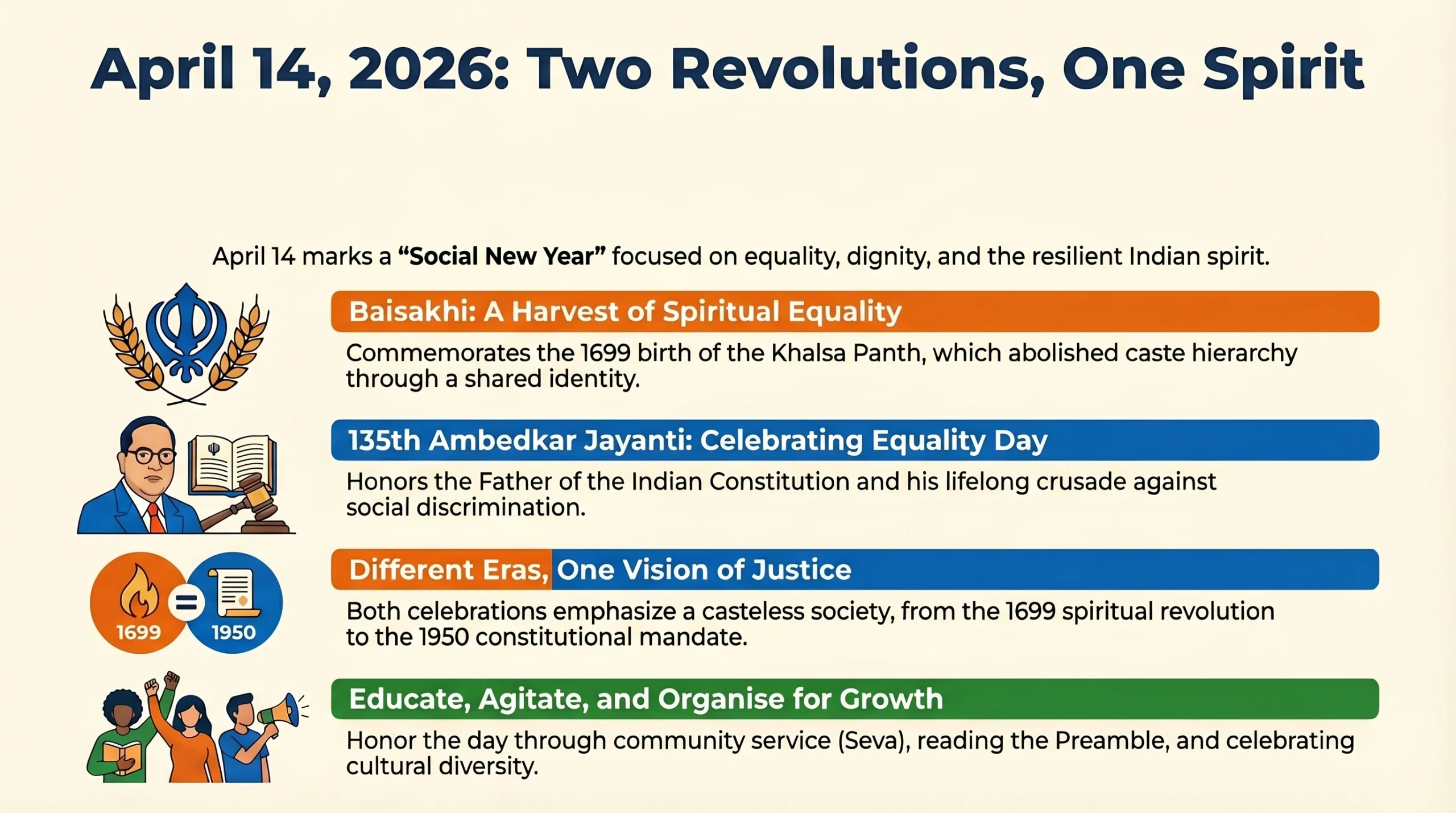
As the golden hue of the spring sun stretches across the Indian landscape this April, there is a palpable sense of renewal in the air. For many, the month of April is a transition—a bridge between the cooling whispers of spring and the approaching intensity of summer. But in 2026, the calendar offers something far more profound than a seasonal shift. On Tuesday, April 14, 2026, India finds itself at a unique cultural and historical crossroads. This single day marks the simultaneous celebration of Baisakhi 2026 and the 135th Ambedkar Jayanti.
It is a rare alignment that brings together the rhythmic beats of the Punjabi dhol and the solemn, powerful echoes of constitutional justice. At first glance, a rustic harvest festival and a national tribute to a visionary scholar might seem like distinct entities. Yet, delve deeper into the heart of these observances, and you’ll find they are two sides of the same golden coin: a celebration of liberation, equality, and the resilient Indian spirit.
The Golden Fields of Baisakhi
For the people of Punjab and the global Sikh community, Baisakhi (Vaisakhi) is the heartbeat of the year. It is a time of immense gratitude as farmers witness the fruition of their hard work with the Rabi crop harvest. The sight of wheat fields swaying in the wind is more than just an agricultural milestone; it’s a symbol of prosperity. Beyond the harvest, Baisakhi holds a monumental spiritual weight, marking the birth of the Khalsa Panth in 1699. It was on this day that Guru Gobind Singh Ji established a brotherhood dedicated to protecting the innocent and, most importantly, shattering the shackles of caste hierarchy.
The Architect of Equality: Ambedkar Jayanti
While the fields of Punjab dance in celebration, the rest of the nation pauses to honor Dr. B.R. Ambedkar, the Father of the Indian Constitution. Observed as Equality Day, April 14 is a reminder of Babasaheb’s relentless crusade against social discrimination. In 2026, as we mark his 135th birth anniversary, his message of Educate, Agitate, Organise feels more relevant than ever. His legacy isn’t just etched in the pages of our Constitution; it is alive in every stride India takes toward social justice and inclusivity.
A Unified Vision for 2026
The convergence of Baisakhi and Ambedkar Jayanti on April 14 creates a beautiful synergy. While the Khalsa was founded on the principle of a casteless society, Dr Ambedkar spent his life building the legal and moral architecture to make that vision a reality for modern India. Whether you are participating in a vibrant Nagar Kirtan, enjoying traditional Baisakhi food, or paying tribute at Chaitya Bhoomi, this day is a collective Happy New Year for the soul of the nation.
Baisakhi 2026: The Golden Harvest and Spiritual Rebirth
In the heart of Punjab, Baisakhi is not just a date on the calendar; it is a feeling. As we approach April 14, 2026, the landscape of Northern India transforms into a shimmering sea of gold. This is the time of the Rabi crop harvest, where the literal fruits of labor are ready to be gathered. But for the millions who celebrate, the Golden Harvest refers to both the wheat in the fields and the spiritual seeds sown centuries ago.
The Rhythms of the Soil: A Celebration of Abundance
For the farming community, Baisakhi is the ultimate Thanksgiving. After months of nurturing the winter wheat, the sight of ripe, golden stalks signifies prosperity and food security for the year ahead.
In the villages, the celebration begins with the ritual of Awat Pauni. Traditional drummers (Dholis) stand at the edge of the fields, their rhythmic beats echoing across the plains. As the dhol resonates, farmers join together to harvest the crops, their voices rising in folk songs that have been passed down through generations. This is the essence of Punjabi harvest festival culture—hard work met with boundless joy.
1699: The Day the Khalsa Was Born
While its agricultural roots are ancient, Baisakhi took on a revolutionary spiritual dimension in 1699. On this day, at Anandpur Sahib, the tenth Sikh Guru, Guru Gobind Singh Ji, created a defining moment in world history.
Imagine the scene: thousands gathered under the spring sun, tension thick in the air. The Guru stepped forward with a shimmering sword and asked a question that chilled the crowd: Who among you is ready to give their head for the sake of Dharma?
One by one, five brave souls stepped forward. These men, coming from different castes and corners of India, became the Panj Pyare (The Five Beloved Ones). When they emerged from the Guru’s tent—not dead, but transformed into Saint-Soldiers—the Khalsa Panth was born.
The Legacy of Equality: The birth of the Khalsa was the ultimate revolution. By giving all men the surname Singh (Lion) and all women the surname Kaur (Princess), Guru Gobind Singh Ji effectively abolished the caste system within the Khalsa. In 2026, this message of a casteless society remains the bedrock of the Baisakhi spirit.
How to Experience Baisakhi 2026 Traditions and Rituals
- Nagar Kirtan: These are grand religious processions led by five initiated Sikhs (representing the Panj Pyare). In 2026, expect these parades to be more tech-savvy, with live-streamed Kirtans (hymns) reaching millions globally.
- The Raising of the Nishan Sahib: At every Gurdwara, the saffron-colored flag is taken down, washed in milk and water, and replaced with a fresh one—a symbol of purity and a New Year for the faith.
- Karwa (Seva): From cleaning the paths of the procession to the massive Langar (community kitchen), Baisakhi is powered by Seva (selfless service).
- Bhangra and Gidda: No Baisakhi is complete without the high-energy Bhangra (performed by men) and the graceful Gidda (performed by women). These aren’t just dances; they are a physical manifestation of a successful harvest.
The Baisakhi 2026 Palette Food and Attire
- The Food: The air will be thick with the aroma of Kada Prasad (sweet flour halwa), Sarson da Saag paired with Makki di Roti, and tall glasses of creamy Lassi.
- The Dress: Expect to see vibrant Basanti (yellow/saffron) and orange outfits. Men will sport elegantly tied turbans with Phulas (fans), while women adorn themselves in Phulkari dupattas and traditional jewellery like the Maangtikka.
Ambedkar Jayanti 2026: The Architect of Modern India
While Baisakhi celebrates the harvest of the land, Ambedkar Jayanti 2026 celebrates the harvest of human rights. Observed on Tuesday, April 14, this day marks the 135th birth anniversary of Dr Bhimrao Ramji Ambedkar. To millions, he is not just a historical figure; he is Babasaheb—the father, the teacher, and the ultimate symbol of resilience.
In 2026, Ambedkar Jayanti (also known as Bhim Jayanti or Equality Day) has transcended national borders, recognised by the United Nations and celebrated globally as a testament to the power of education over oppression.
From Mhow to the World: A Journey of Defiance
Born on April 14, 1891, in the military cantonment of Mhow (now Dr. Ambedkar Nagar), Babasaheb’s early life was a constant battle against the crushing weight of untouchability. He was a boy who was forced to sit on a gunny sack outside his classroom and was denied even a drink of water from the common tap.
Yet, he turned these humiliations into fuel. His academic journey is nothing short of legendary:
- Columbia University (New York): Where he mastered Economics and Sociology.
- London School of Economics: Where he earned his D.Sc. and was called to the Bar at Gray’s Inn.
- A Global Scholar: Proficient in 11 languages and a master of 64 subjects, he proved that education is the milk of a lioness, and whoever drinks it will roar.
The Blueprint of a Nation: The Indian Constitution
As the Chairman of the Drafting Committee, Dr. Ambedkar didn’t just write laws; he wrote a new destiny for 1/6th. He ensured that the Indian Constitution was not merely a legal document but a social charter.
- Article 17: The historic constitutional abolition of untouchability.
- Fundamental Rights: Guaranteeing equality before the law for every citizen, regardless of gender, caste, or religion.
- Women’s Empowerment: Long before modern feminist movements, Babasaheb fought for the Hindu Code Bill, advocating for women’s rights to property, marriage reform, and education.
The Spiritual Revolution: Navayana Buddhism
In the final chapter of his life, Dr. Ambedkar realised that legal rights were only half the battle; the soul also needed liberation. On October 14, 1956, at Deekshabhoomi in Nagpur, he embraced Buddhism along with 500,000 followers. This was the birth of Navayana Buddhism, a path rooted in Pragya (wisdom), Karuna (compassion), and Samata (equality).
On April 14, 2026, millions of followers will gather at Chaitya Bhoomi in Mumbai and Deekshabhoomi to pay their respects, turning these sites into epicentres of blue-clad celebration and intellectual discourse.
How to Observe Ambedkar Jayanti 2026
To truly honour Babasaheb in the modern era, the celebration has shifted from mere rituals to meaningful action:
- Reading the Preamble: Communities gather to read the Preamble of the Constitution aloud, reaffirming the values of Liberty, Equality, and Fraternity.
- Digital Tributes: Use the hashtags #Ambedkar135 and #JaiBhim to share his most powerful quotes on social media.
- Educational Donations: Many corporate offices and NGOs use this day to launch scholarship programs for marginalised students, keeping the Educate, Agitate, Organise” motto alive.
- Processions (Bhim Jayanti): Vibrant rallies featuring blue flags, music, and floral tributes to his statues are a hallmark of the day in cities like Pune, Nagpur, and Delhi.
Key Quote for 2026: I measure the progress of a community by the degree of progress which women have achieved. — Dr. B.R. Ambedkar
The Intersection: Where the Harvest Meets the Heart of Justice
At first glance, a rustic harvest festival from the fields of Punjab and the birth anniversary of a constitutional visionary might seem like a mere coincidence of the calendar. However, look deeper into the soul of April 14, 2026, and you will find a profound synchronisation.
Baisakhi and Ambedkar Jayanti are two different languages speaking the same truth: That no human is born to be a slave to another.
The Abolition of Hierarchy: From 1699 to 1950
In 1699, when Guru Gobind Singh Ji created the Khalsa on Baisakhi, his first act was a radical strike against the caste system. By giving every man the name Singh (Lion) and every woman the name Kaur (Princess), he deleted the surnames that acted as markers of social status. He invited the lowest in society to drink from the same bowl—an act of defiance that was unheard of at the time.
Fast forward to the 20th century, and you find Dr. B.R. Ambedkar fighting the exact same battle, but with the pen instead of the sword. His drafting of the Indian Constitution was the legal culmination of the spiritual revolution started by the Gurus. Both the Khalsa and the Constitution aim for a Begampura—a land without sorrow or discrimination.
The Power of the Common Kitchen (Langar vs. Public Taps)
Food and water have historically been the battlegrounds of dignity in India.
- The Baisakhi Spirit: The tradition of Langar (community kitchen) is central to Baisakhi. It demands that the King and the Peasant sit on the same floor and eat the same food.
- The Ambedkar Legacy: One of Babasaheb’s most famous protests was the Mahad Satyagraha, where he led thousands to drink water from a public tank that was forbidden to Dalits.
Both movements used the simple, human act of consuming food and water to assert that equality is a fundamental right, not a privilege.
Liberation and New Beginnings
April 14 is the National Day of Liberation in many senses:
- For the Farmer: It is liberation from the anxiety of the growing season; the harvest is finally home.
- For the Seeker: It is the Sikh New Year, a chance for spiritual rebirth within the Khalsa.
- For the Citizen: It is a celebration of the Social New Year, a reminder that we live in a democracy where every voice (and every vote) has equal value.
Education and Enlightenment
Baisakhi marks the Enlightenment of a community into a disciplined, fearless Panth. Similarly, Ambedkar Jayanti is celebrated as Knowledge Day (Gyan Diwas). Both emphasize that a community cannot progress without a sharp mind and a brave heart. In 2026, as we embrace a digital-first world, the intersection of Baisakhi’s Chardi Kala (Eternal Optimism) and Ambedkar’s Educate, Agitate, Organise provides the perfect mental framework for the modern Indian.
Wishes, Quotes, and Greetings for 2026
In an age of digital connection, the right words can bridge distances and inspire communities. Whether you are looking for a vibrant greeting for the harvest or a powerful quote on equality, here is your definitive collection for April 14, 2026.
Top Baisakhi 2026 Wishes & WhatsApp Status
- May the golden fields of Punjab bring a harvest of happiness to your home. Sending you warm wishes for a prosperous Baisakhi 2026
- Let’s dance to the rhythm of the dhol and welcome the New Year with an open heart. Lakh Lakh Vadhaiyan Baisakhi Diyan
- May Waheguru bless you with growth, health, and peace. May your hard work bear the sweetest fruits this season. Happy Vaisakhi
- Bhangra, Lassi, and the scent of fresh harvest—it’s time to celebrate the spirit of Punjab! Have a vibrant and blessed Baisakhi.
Inspiring Ambedkar Jayanti 2026 Quotes & Messages
- Celebrating the 135th birth anniversary of the man who gave us the power to dream. Happy Ambedkar Jayanti 2026! #JaiBhim
- Education is the milk of a lioness, and whoever drinks it will roar. Let’s honor Babasaheb by choosing the path of knowledge.
- A society that values equality and justice will always progress. Wishing you a powerful and reflective Equality Day.
- Saluting the Architect of Modern India. May his vision of liberty, equality, and fraternity continue to guide our nation.
The April 14 Unity Special: Fusion Greetings
- From the fields of gold to the halls of justice, today we celebrate the spirit of human dignity. Happy Baisakhi and Ambedkar Jayanti
- One day, two revolutions—one for the soil, one for the soul. Wishing everyone a meaningful April 14
- May the bravery of the Khalsa and the wisdom of Babasaheb inspire you to live a life of courage and equality. Best wishes for the day
Frequently Asked Questions: Baisakhi & Ambedkar Jayanti 2026
1. Is Baisakhi and Ambedkar Jayanti on the same day in 2026?
Yes! In 2026, both Baisakhi and Ambedkar Jayanti fall on Tuesday, April 14. This rare alignment makes it a massive day of national celebration, combining the vibrant harvest traditions of North India with the solemn remembrance of the Architect of the Indian Constitution.
2. Which birth anniversary of Dr. B.R. Ambedkar is being celebrated in 2026?
April 14, 2026, marks the 135th Birth Anniversary of Dr. Bhimrao Ramji Ambedkar. This milestone year is expected to see large-scale international tributes, including seminars on Constitutional Morality in the Digital Age and global Equality Day marches.
3. Why is Baisakhi specifically celebrated in Punjab?
While celebrated elsewhere, Baisakhi is the heartbeat of Punjab because it marks the Rabi crop harvest. Historically, it is the day Guru Gobind Singh Ji established the Khalsa Panth in 1699, giving the Sikh community a unique identity based on courage and equality. For Punjabi farmers, it’s a Thanksgiving for the golden wheat harvest.
4. Is April 14, 2026, a public holiday in India?
Yes, April 14 is a Gazetted National Holiday in India. All government offices, schools, and most private institutions will be closed to observe Ambedkar Jayanti. In states like Punjab and Haryana, it is also a major public holiday for Baisakhi.
5. What is the significance of Knowledge Day (Gyan Diwas) on April 14?
In Maharashtra and several other regions, Ambedkar Jayanti is celebrated as Knowledge Day. This honors Babasaheb’s immense academic achievements—holding multiple doctorates from Columbia University and the LSE—and his belief that education is the most powerful tool for social transformation.
6. What are the traditional foods eaten on Baisakhi?
Food is central to the harvest spirit. Key dishes include Kada Prasad (sanctified wheat halwa), Meethe Chawal (sweet saffron rice), and the classic duo of Sarson da Saag and Makki di Roti. In the spirit of Langar, these meals are shared with everyone regardless of background.
7. How do people celebrate Ambedkar Jayanti at Chaitya Bhoomi?
Chaitya Bhoomi in Mumbai is the memorial site of Dr. Ambedkar. On April 14, hundreds of thousands of followers gather to offer floral tributes, light candles, and sing Bhim Geete (devotional songs). It becomes a sea of white and blue, symbolising peace and the Dalit Buddhist movement.
8. Why do people wear yellow (Basanti) on Baisakhi?
Yellow and Saffron are the colors of Baisakhi. Yellow represents the ripening wheat fields and the onset of spring, while Saffron holds deep spiritual significance in Sikhism, representing sacrifice, courage, and the spirit of the Khalsa.
9. What is the Nagar Kirtan performed during Baisakhi?
A Nagar Kirtan is a religious procession where the Guru Granth Sahib (the holy scripture) is carried through the streets on a decorated float. It is led by the Panj Pyare (Five Beloved Ones) and features Gatka (Sikh martial arts) performances and hymn singing.
10. How can I celebrate Ambedkar Jayanti 2026 at my workplace?
Modern celebrations focus on Inclusion and Awareness. Many companies organise DEI (Diversity, Equity, and Inclusion) workshops, distribute books by Dr. Ambedkar, or launch scholarship funds for underprivileged students to honour his legacy of social justice.




Leave a Reply