
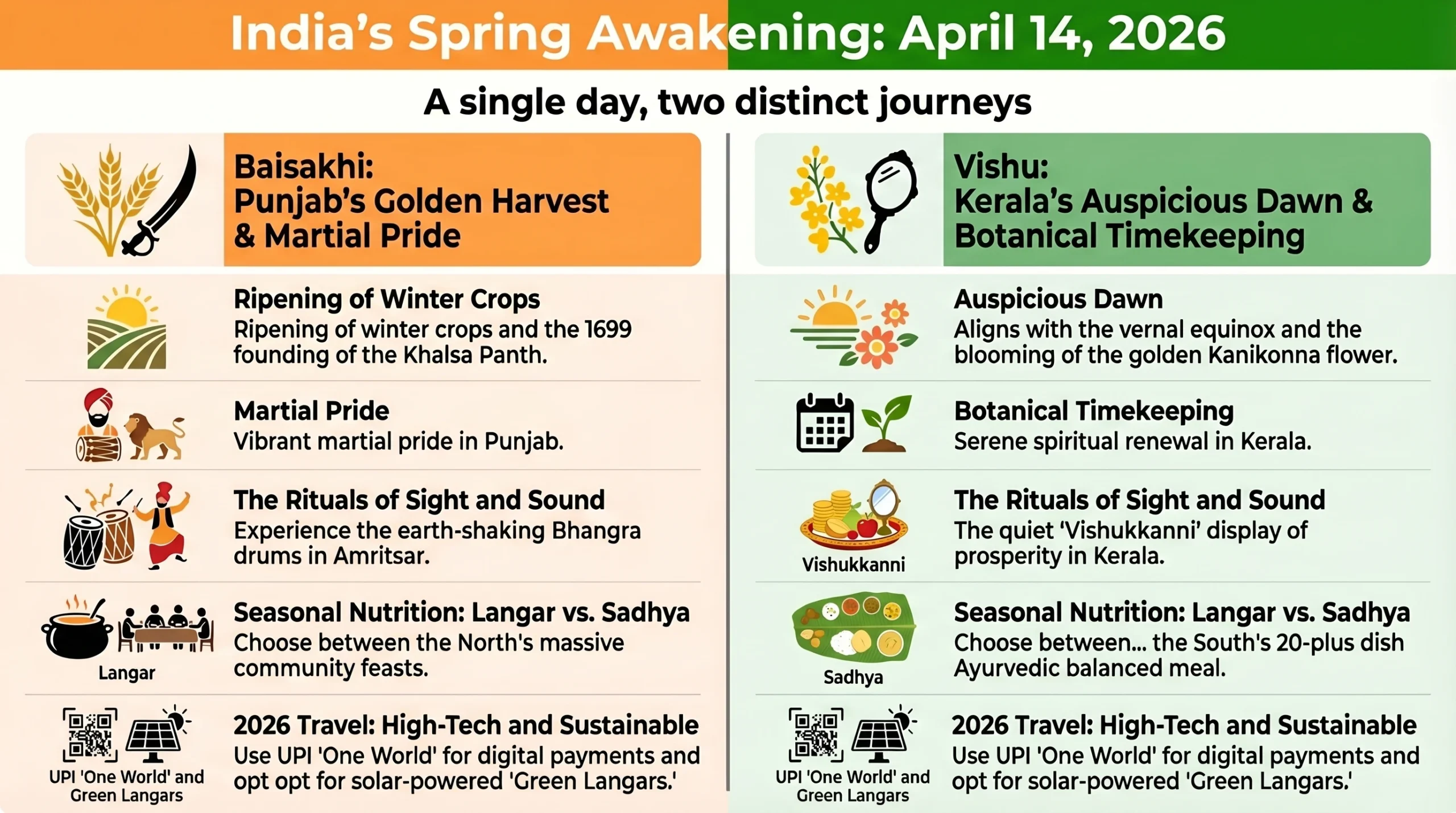
The Spirit of India’s Spring Awakening
The transition from winter to spring in India isn’t just a seasonal shift in weather; it is a profound cultural and environmental awakening. For travellers looking to experience the true, beating pulse of the subcontinent, the India spring festivals 2026 offer an unmatched, immersive journey. As the golden wheat fields of the North sway heavily under the sun and the lush, tropical canopy of the South prepares for a fresh dawn, two distinct yet spiritually connected celebrations emerge. Whether you are seeking the vibrant, high-energy drumbeats of Punjab or the serene, auspicious rituals of Kerala, this comprehensive Colcasac.com travel guide is your passport to witnessing the magic of these April harvest festivals.
At the heart of these twin celebrations is a deep-rooted environmental history tied directly to the agrarian soul of India. Baisakhi, primarily celebrated across the fertile northern plains, marks the joyous culmination of the Rabi harvest. Farmers express their gratitude for the winter crops, practising a seasonal lifestyle tradition that dates back millennia. Meanwhile, in the tranquil backwaters and temple towns of the south, Vishu closely aligns with the vernal equinox. The festival marks the sun’s transit into the Medam zodiac, signalling the dawn of the Malayalam New Year. This precise astronomical and ecological alignment highlights how ancient Indian communities harmonised their lives with the Earth’s natural rhythms—a sustainable, living legacy that continues to draw mindful global travellers today.
For those actively mapping out their Baisakhi 2026 travel itinerary to India, the primary date is firmly set: Tuesday, April 14, 2026. However, Baisakhi is far more than just an agricultural milestone; it is a monumental chapter in regional heritage. In 1699, the tenth Sikh Guru, Guru Gobind Singh, altered the course of history by founding the Khalsa Panth at Anandpur Sahib on this very day. This historical biography infuses the spring festival with martial pride, unwavering devotion, and a fierce spirit of community equality. Travellers visiting Amritsar or Anandpur Sahib will witness breathtaking Nagar Kirtan processions, sweeping community feasts (Langar) that emphasise seasonal nutrition, and the vibrant, earth-shaking echoes of Bhangra that turn the state into a living museum of cultural resilience.
Down south, Kerala’s New Year travel offers a strikingly different, yet equally mesmerising, sensory experience. Celebrated right around mid-April (falling on April 14 or 15 in 2026), Vishu is characterised by introspective peace, spiritual renewal, and quiet optimism. The visual cornerstone of this regional heritage is the Vishukkanni—an elaborate, eye-catching arrangement of seasonal fruits, golden cucumber, bright yellow konna flowers, and mirrors, strictly designed to be the very first sight upon waking. It is a brilliant psychological tradition aimed at manifesting prosperity for the year ahead. Followed by the Vishu Sadhya, a meticulously balanced 20-plus dish feast highlighting seasonal lifestyle and Ayurveda-backed nutrition, this festival offers a profoundly tranquil retreat for the traveller’s soul.
Experiencing these historic festivals requires more than just booking a flight; it demands an understanding of their deep cultural roots and practical travel logistics. As you dive further into this cultural travel guide to India, we will break down the ultimate daily itineraries, crowd-management tips for peak days, and hidden local gems to ensure your April 2026 adventure is nothing short of extraordinary.
The Historical & Environmental Roots of the Twin Festivals
To truly appreciate the harvest festivals of India, travelers must look beyond the vibrant modern-day celebrations and dig into the soil from which they sprang. Both Baisakhi and Vishu are profoundly anchored in India’s environmental history, acting as ecological timekeepers that have guided agrarian societies for millennia. While they are geographically separated by thousands of miles, their roots share a unified celebration of the earth’s natural rhythms, seasonal shifts, and the profound historical milestones that shaped their respective regional identities.
The Earth’s Rhythm: Environmental History of the Spring Harvest
Long before the advent of modern meteorological tracking, ancient Indian communities relied on a sophisticated understanding of solar movements and agricultural cycles. April is a pivotal environmental threshold across the subcontinent.
In the fertile northern plains of Punjab and Haryana, this period marks the critical ripening of the Rabi (winter) crops. After months of tending to fields sown in the crisp winter air, the sudden spike in spring temperatures turns the endless stretches of wheat a brilliant, ready-to-harvest gold. Baisakhi was born out of this pure, elemental gratitude—a seasonal lifestyle tradition where farmers gave thanks for the earth’s bounty before the grueling summer heat set in.
Conversely, the Vishu significance is deeply tied to the precise astronomical science of ancient India. Vishu signifies the sun’s transit into the Medam (Aries) zodiac sign, aligning closely with the vernal equinox where day and night are of equal length. For Kerala’s agrarian ancestors, this perfect celestial balance signaled the beginning of the agricultural cycle. It was the designated time to begin plowing the earth and sowing seeds for the upcoming monsoons, making Vishu a festival focused not just on past harvest gratitude, but on future ecological prosperity.
Baisakhi: A Confluence of Agrarian Joy and Martial History
While Baisakhi began as an ancient celebration of the wheat harvest, its identity was forever transformed by one of the most compelling historical biographies in Indian history. To understand the History of Baisakhi today, one must travel back to April 13, 1699.
On this day, against the backdrop of political oppression under the Mughal Empire, the tenth Sikh Guru, Guru Gobind Singh, gathered thousands of followers at Anandpur Sahib. In a profound test of faith and courage, he established the Khalsa Panth (the community of initiated Sikhs). He baptized the Panj Pyare (the Five Beloved Ones), effectively abolishing caste barriers and forging a unified community bound by equality, martial valor, and unwavering devotion.
Because of this monumental historical event, Baisakhi evolved. It is no longer just a farmer’s festival; it is the birth anniversary of the Khalsa. Today, when you experience Baisakhi Mela celebrations, the rhythmic beating of the dhol (drum) and the energetic leaps of Bhangra are as much a tribute to this fierce martial heritage as they are an expression of agricultural joy.
Vishu: Botanical Timekeeping and Cultural Prosperity
In Kerala, the environmental roots of the festival are beautifully illustrated by a single, striking element of nature: the blooming of the Kanikonna (Golden Shower Tree). This vibrant yellow flower acts as an indigenous, botanical clock. It reliably bursts into full bloom across the state exactly during the weeks surrounding Vishu.
The Kanikonna is the star of the Vishukkanni—the auspicious display viewed first thing in the morning. Historically, this arrangement of golden flowers, newly harvested rice, fresh fruits, and traditional coins was a direct reflection of a family’s wealth and the earth’s yield. The psychological intent was clear: by filling your eyes with the peak of nature’s prosperity at the exact moment of the new solar cycle, you aligned your personal destiny with the abundant, giving nature of the earth itself.
Understanding these deep historical and ecological roots transforms a simple sightseeing trip into a deeply enriching cultural immersion. When travelers step into a Gurdwara in Punjab or a traditional tharavadu (ancestral home) in Kerala this April 2026, they are not just witnessing a festival; they are stepping into a living, breathing timeline of India’s relationship with nature and human resilience.
Baisakhi 2026 Travel Guide: Experiencing Punjab’s Vibrancy
If you want to witness Punjab at its most kinetic and soulful, there is no window more rewarding than the Baisakhi 2026 season. On Tuesday, April 14, 2026, the entire state transforms into a landscape of golden fields, thundering dhol beats, and a collective spirit of Chardi Kala (eternal optimism). For the international traveler or the domestic explorer, navigating this festival requires a blend of spiritual reverence and crowd-smart logistics.
The Heart of the Celebration: Amritsar & The Golden Temple
Amritsar is the epicenter of Baisakhi travel India. While the city is a year-round pilgrimage site, Baisakhi at the Harmandir Sahib (Golden Temple) is an electrifying sensory experience.
- The Amrit Vela Experience (3:00 AM – 5:30 AM): To beat the massive Baisakhi 2026 crowds, arrive before dawn. Witnessing the Palki Sahib ceremony—where the Guru Granth Sahib is carried in a golden palanquin—under the soft glow of the pre-dawn lights is the most spiritual darshan you can have.
- The Nagar Kirtan Procession: By 9:00 AM, the walled city erupts. Led by the Panj Pyare, this religious procession features traditional hymns and awe-inspiring displays of Gatka (Sikh martial arts). Pro Tip: Secure a spot on a rooftop cafe near Hall Bazaar to photograph the sea of saffron and blue turbans from above.
- Beyond the Temple: Spend your afternoon at the nearby Jallianwala Bagh or the Partition Museum. Since Baisakhi also marks a somber anniversary of the 1919 massacre, these sites provide essential context to the resilient Punjabi spirit.
The Birthplace of Khalsa: Anandpur Sahib
For those seeking a deep dive into regional heritage, a trip to Anandpur Sahib is non-negotiable. This is where Guru Gobind Singh Ji formally established the Khalsa in 1699.
- Virasat-e-Khalsa: This world-class museum is a marvel of historical conservation engineering. Its narrative-led architecture tells the story of Sikhism through immersive multimedia—perfect for the content your readers crave.
- Takht Sri Keshgarh Sahib: Join thousands of devotees in the massive communal prayers. The energy here is distinct from Amritsar; it feels like a homecoming of warriors.
Seasonal Lifestyle & Nutrition: The Flavors of Baisakhi
No cultural travel guide is complete without a culinary roadmap. The Baisakhi spread is a masterclass in seasonal nutrition, celebrating the fresh wheat and mustard harvests.
- Guru Ka Langar: Eating at the world’s largest community kitchen is a lesson in equality. On Baisakhi, expect special additions like Kheer (rice pudding) or Kada Prasad.
- The Harvest Feast: Look for local eateries serving Makki di Roti (cornmeal flatbread) and Sarson da Saag (mustard greens). For a sweet finish, try Meethe Peele Chawal (saffron-tinted sweet rice), which mirrors the yellow hues of the blooming mustard fields.
Crowd-Smart Travel Tips for April 2026
- Book Early: Flight prices to Amritsar (ATQ) spike significantly in mid-April. Aim to book your 2026 travel by late 2025.
- Stay Local: Choose a farm stay or a boutique hotel within walking distance of the Golden Temple. On festival day, rickshaws and cars will struggle to navigate the closed streets.
- Dress the Part: Wear bright yellows or oranges to blend into the sea of harvest colours. It’s a small gesture that opens doors to local conversations and connections.
To provide a truly comprehensive comparison, this section shifts the tempo from the vibrant energy of the North to the soul-stirring, serene traditions of the South. This Vishu 2026 travel guide is designed to capture high-intent traffic looking for spiritual retreats and cultural immersion in Kerala.
Vishu 2026 Travel Guide: Kerala’s Auspicious Dawn
As the sun crosses into the sidereal First House of Aries, the God’s Own Country wakes up to Vishu 2026. While Baisakhi is defined by its exuberant sound and motion, Vishu is a festival of sight and silence. For travellers, a Kerala New Year travel itinerary offers a masterclass in mindfulness, regional heritage, and the profound beauty of botanical timekeeping. Scheduled for April 14, 2026, Vishu is the ultimate time to witness the quiet dignity of Malayali traditions.
The Spiritual Heart: Guruvayur & Sree Padmanabhaswamy
For the most authentic experience of the Auspicious Dawn, your travel map must include Kerala’s historic temple towns.
- The Guruvayur Sree Krishna Temple: This is the spiritual epicentre of Vishu significance. Thousands of devotees gather here for the Vishu Kani Kazhcha. To see the deity adorned with golden finery and the yellow Kani Konna flowers, travellers often stay awake through the night. Traveller Tip: The queue for the Kani starts as early as 2:00 AM; booking a hotel within “Temple Town” is essential for 2026 logistics.
- Thiruvananthapuram’s Royal Heritage: Visit the Sree Padmanabhaswamy Temple to see how the erstwhile royal family of Travancore observes the festival. The architectural alignment of the temple with the equinox is a marvel of historical conservation engineering that photographers will find breathtaking.
The Ritual of Sight: Understanding the Vishukkanni
The cornerstone of regional heritage in Kerala is the Vishukkanni—the first thing one sees upon waking.
- The Arrangement: It is a carefully curated urn of prosperity containing Kanikkonna (Golden Shower petals), a metal mirror (Valkannadi), golden cucumbers (Vishu Kani Vellarikka), coins, and silk.
- Connection: In a traditional Kerala home, the eldest member blindfolds the younger ones and leads them to the display. This ensures that their first visual input for the New Year is one of abundance. For travellers, many eco-tourism Kerala homestays offer guests the chance to participate in this ritual, providing a deeply personal connection to the local culture.
Seasonal Lifestyle & Nutrition: The Vishu Sadhya
The Vishu Sadhya is a vegetarian feast that serves as a culinary roadmap of Kerala’s seasonal nutrition. Unlike the heavy, butter-rich harvest meals of the North, the Sadhya focuses on a scientific balance of flavours meant to prep the body for the humid tropical summer.
- The Flavour Palette: A true Vishu feast must include the Veppampoo Rasam (bitter neem flowers) and Mampazha Pulissery (sour/sweet mango curry). This combination of bitter, sour, and sweet reminds the eater that the coming year will bring a variety of life experiences.
- The Star Dish: Don’t miss the Vishu Kanji (a salty rice porridge with coconut milk) and Vishu Katta (sweet rice cake), which are specific to this festival and rarely found during the rest of the year.
Top Heritage Destinations for April 2026
- Fort Kochi: For a blend of history and modernity. Watch the Chinese Fishing Nets silhouetted against the April sunset after a traditional Kathakali performance.
- Munnar’s Tea Estates: If the coastal humidity is too much, head to the hills. April is a beautiful time for trekking through the Western Ghats, an environmental history hotspot.
- Waynad Homestays: For those looking for offbeat spring travel India, the tribal heritage and spice plantations of Waynad offer a quiet alternative to the crowded temple cities.
Pro-Traveler Logistics for Kerala 2026
- The Weather Factor: April in Kerala is Mango Showers season. Expect high humidity and occasional late-afternoon thunderstorms. Pack breathable linens.
- Vishu Kaineettam: If you are staying with a local family or at a boutique heritage villa, don’t be surprised if the elders give you a small gift of money. This is Vishu Kaineettam, a gesture of sharing wealth to ensure it keeps flowing.
Beyond the Traditions: Modern & Sustainable Spring Travel
As we move through 2026, the way we experience heritage is undergoing a profound transformation. Travel is no longer just about witnessing a festival; it’s about regenerative tourism—leaving a place better than we found it. This spring, as the golden fields of Punjab and the lush groves of Kerala prepare for Baisakhi and Vishu, a new wave of conscious travel is taking center stage. Modern explorers are seeking a balance between ancient rituals and futuristic sustainability, turning the spring break into a meaningful journey of cultural preservation.
The New Face of Baisakhi: Green Langars and Digital Heritage
In Punjab, the 2026 Baisakhi celebrations are proving that deep-rooted traditions can seamlessly integrate with modern environmental ethics. The Golden Temple in Amritsar, a centerpiece of the festival, has become a global model for sustainable pilgrimage.
- Eco-Friendly Langars: The community kitchens have shifted toward zero-waste operations. By utilizing biogas plants to process organic waste and transitioning to solar-powered cooking, the sewa (service) now honors the Earth as much as the community.
- Heritage Restoration: Beyond the main shrines, the restoration of Mohran di Haveli and other historic structures offers boutique, low-impact tourism experiences. These sites allow visitors to engage with Punjabi history without the carbon footprint of massive commercial hotels.
- Farm-to-Table Immersion: The Punjab Farm Tourism Scheme has expanded to over 70 registered units. For the modern traveler, this means swapping crowded city centers for an authentic farm stay. You can participate in the harvest, learn traditional wheat-cutting techniques, and enjoy meals sourced entirely from the land you’re standing on.
Kerala’s Vision 2026: The STREET to Sustainability
While Punjab celebrates the harvest, Kerala’s Vishu marks a commitment to Net Zero tourism. The Kerala Responsible Tourism Mission has launched several initiatives that redefine the God’s Own Country experience for the 2026 season.
- The STREET Project: This innovative participatory project develops thematic streets—Agri Streets, Water Streets, and Art Streets—that disperse tourist traffic and support local micro-economies. Visiting an Agri Street during Vishu allows you to see the Vishu Kani (auspicious sight) ingredients growing in their natural habitat.
- Blue-Green Integrated Circuits: The newly launched circuit in Dharmadam, Kannur, features walking museums and mangrove information centers. It’s a masterclass in community-led tourism, where the guides are local residents sharing their environmental history.
- Carbon-Neutral Festivals: Many local temples are now adopting Green Protocols,discouraging single-use plastics during Vishu feasts and encouraging the use of traditional, biodegradable materials for decorations.
Tips for the Conscious Spring Traveller
| Feature | Modern/Sustainable Approach |
| Accommodation | Opt for Certified Farm Stays or Green-Rated Homestays that support local families. |
| Transport | Utilise the growing network of Electric Vehicle (EV) rentals now available in major hubs like Kochi and Amritsar. |
| Participation | Engage in Experiential Tourism—take a workshop in Phulkari embroidery or Mural painting rather than just buying a souvenir. |
| Waste | Follow the “Leave No Trace” principle, especially during crowded temple processions and rural fairs. |
The Future of Spring Travel
The 2026 spring season is a reminder that our heritage is a living, breathing entity. By choosing sustainable spring travel, we aren’t just observing the traditions of Punjab and Kerala; we are actively participating in their survival for the next generation. Whether it’s the solar-powered lights reflecting off the Sarovar or the plastic-free Sadhya served on a banana leaf, the modern traveler is finding that the most authentic experience is often the most responsible one.
Practical Travel Tips for April 2026
Navigating India during a major festival month requires more than just a plane ticket; it requires a strategy. As you prepare for Baisakhi and Vishu 2026, both falling on Tuesday, April 14, keep these practical, updated-for-2026 insights in your pocket to ensure a smooth, culturally immersive journey.
The 2026 Digital Frontier: Visas & Payments
The landscape of Indian travel has shifted significantly heading into 2026.
- Updated e-Visa Rules: The Indian government has expanded e-Visa entry to 51 gateways, including smaller regional airports and seaports. Notably, 2026 has introduced reciprocal pricing—your visa fee may now vary based on your home country’s charges for Indian citizens.
- AI Verification: Be meticulous with your application photo; the Bureau of Immigration now uses AI-driven verification tools that are much less forgiving of shadows or low-resolution uploads.
- The Rise of UPI for Tourists: By April 2026, the Unified Payments Interface (UPI) is the primary way to pay for everything from street-side Amritsari Kulchas to luxury heritage stays. International travellers can now easily link their accounts through “UPI One World” at major airports upon arrival.
Weather & Packing: The April Heat Factor
April marks the definitive start of the Indian summer.
- Punjab (Amritsar/Anandpur Sahib): Expect daytime highs of 33°C to 35°C (91°F – 95°F). While the mornings are crisp and perfect for temple visits, the afternoons can be harsh. Pack lightweight, light-colored cotton or linen. A headscarf is mandatory for entering Gurdwaras—saffron or bright yellow is the festive choice for Baisakhi.
- Kerala (Kochi/Guruvayur): Temperatures hover around 33°C (91°F), but the humidity is exceptionally high (often reaching 85%+). The Mango Showers (pre-monsoon rains) are common in mid-April, so a compact, sturdy umbrella is a must-pack item.
Logistics: Timing Your 2026 Bookings
Because April 14, 2026, is a major holiday across both the North and South, last-minute is not an option.
- Flights: Domestic airfares to Amritsar (ATQ) and Kochi (COK) typically spike 300% in the week leading up to the festivals. Aim to lock in your flights by late 2025.
- Accommodation: In Amritsar, stay within the Walled City or near Hall Bazaar. On Baisakhi day, the 2-mile radius around the Golden Temple becomes a pedestrian-only zone. If your hotel is further out, you will spend hours in traffic.
- Temple Queues: For the Vishu Kani at Guruvayur, the queue begins as early as 2:00 AM. If you aren’t a fan of long waits, consider visiting smaller, equally historic temples like the Sree Subrahmanya Swami Temple in Pathanamthitta for a more intimate experience.
Health & Conscious Travel
- Hydration Strategy: Avoid single-use plastic bottles. Most 2026-standard hotels and Green Gurdwaras now offer high-tech UV filtration stations for refilling reusable bottles.
- The Langar Etiquette: When eating at a community kitchen, always sit on the floor (unless physically unable), keep your head covered, and take only what you can finish. In 2026, many Langars have moved to zero-waste organic sourcing, so honoring the food is honoring the environment.
Quick Check: April 2026 Key Dates
| Date | Event | Region | Travel Impact |
| April 13, 2026 | Baisakhi Eve / Pre-Harvest Fairs | Punjab | High traffic near markets/fairs |
| April 14, 2026 | Baisakhi & Vishu Day | Pan-India | Public holiday; temples at peak capacity |
| April 15, 2026 | Bengali New Year (Poila Baisakh) | West Bengal | Major crowds in Kolkata |
Frequently Asked Questions about Baisakhi & Vishu 2026
1. When exactly are Baisakhi and Vishu in 2026?
Both Baisakhi and Vishu will be celebrated on Tuesday, April 14, 2026. While Baisakhi follows the solar Bikrami calendar, Vishu marks the first day of the Malayalam month of Medam. For travellers, this is a super-Tuesday of cultural immersion, as several other regional New Year’s (like Puthandu in Tamil Nadu) also fall on or around this date.
2. Is there a difference between Baisakhi and Vaisakhi?
There is no functional difference; Baisakhi and Vaisakhi are simply phonetic variations of the same name. Vaisakhi is more common in formal Sikh scriptures and Western academic contexts, while Baisakhi is the colloquial term used across Punjab and in most cultural travel guides. Both refer to the same joyous harvest and historical celebration.
3. What is the Vishu Kani, and why is it the first thing people see?
The Vishu Kani is an auspicious arrangement of fruits, flowers (specifically the golden Konna), grains, gold, and a mirror. According to regional heritage beliefs, the first object you see on New Year’s morning sets the tone for your year. By viewing this display of abundance first, devotees manifest a year of prosperity and psychological well-being.
4. Where are the best places in Punjab to witness Baisakhi 2026?
For the most vibrant experience, head to Amritsar (The Golden Temple) for spiritual depth or Anandpur Sahib for martial history. If you prefer a more local vibe, the rural fairs (melas) in Damdama Sahib (Talwandi Sabo) offer incredible displays of traditional wrestling, folk music, and the raw energy of the Punjab harvest.
5. What is the historical significance of Baisakhi for Sikhs?
Beyond the harvest, Baisakhi marks the birth of the Khalsa Panth. In 1699, Guru Gobind Singh Ji chose this day to transform the Sikh community into a saint-soldier order committed to equality and justice. This historical biography is why you will see martial arts demonstrations (Gatka) and saffron-clad Nagar Kirtan processions during the festival.
6. What should I include in a traditional Vishu Sadhya?
A true Vishu 2026 feast must balance six flavours: sweet, sour, salty, bitter, pungent, and astringent. Key dishes to look for include Vishu Kanji (rice and coconut milk porridge), Vishu Katta (sweet rice cake), and Veppampoo Rasam (neem flower soup). This seasonal nutrition philosophy ensures your body is balanced for the tropical summer ahead.
7. Is there a specific dress code for these festivals?
Yes, and it adds to the experience! In Punjab, wear bright yellow or saffron to mirror the mustard fields. When entering a Gurdwara, you must cover your head. In Kerala, the tradition is Kasavu Saree (white with gold border) for women and Mundu (white sarong) for men. Opting for traditional attire is a sign of respect that locals deeply appreciate.
8. How can I travel sustainably during the 2026 festival season?
Look for Green Langars in Punjab that use solar cooking and zero-plastic policies. In Kerala, choose homestays as part of the Responsible Tourism Mission. Use the UPI (Unified Payments Interface) for all transactions to support small local vendors directly, and utilise the expanded electric vehicle (EV) rental networks now available in Kochi and Amritsar.
9. Can international tourists use digital payments for festival shopping?
Absolutely. By 2026, the UPI One World app will allow international travellers from most countries to link their cards and pay like a local. This is particularly useful for buying regional heritage crafts like Phulkari dupattas in Punjab or Valkannadi mirrors in Kerala without needing to carry large amounts of cash.
10. Can I experience both Baisakhi and Vishu in a single trip?
Yes, but it requires a flight-hop strategy. Since both peak on April 14, we recommend spending April 12-13 in Amritsar to see the pre-festival fervour and Nagar Kirtans, then taking an evening flight on the 13th to Kochi. This allows you to wake up in Kerala on the 14th for the serene Vishu Kani dawn rituals.





Leave a Reply