
The Magic of Maru Mahotsav: Why 2026 is Different
Imagine a landscape where the horizon isn’t just a line, but a shimmering golden haze of dust, music, and legacy. That is the Maru Mahotsav, or the Jaisalmer Desert Festival. In 2026, this three-day cultural powerhouse (January 30th to February 1st) has transcended its traditional roots to become a global bucket-list phenomenon, blending ancient Rajasthani soul with modern “Gram-worthy” spectacle.
The “magic” begins at the cracks of dawn near the Jaisalmer Fort. As the sun hits the yellow sandstone—turning the “Golden City” into a living honeycomb—the Grand Shobha Yatra kicks off. This isn’t just a parade; it’s a sensory overload. You’ll see hundreds of camels adorned in intricate Gorbandh (necklaces), their riders sporting gravity-defying turbans and moustaches that have taken decades to groom. The air is thick with the scent of woodsmoke and the haunting melodies of the Manganiyar musicians, whose voices have echoed through the Thar for generations.
What makes the 2026 edition truly standout is the “Humanised Adventure” aspect. It’s no longer just about watching from the sidelines; it’s about immersion. Whether it’s participating in a turban-tying contest against locals or cheering during the Camel Tattoo Show performed by the BSF, you feel the heartbeat of the desert. This year, the festival has introduced a drone light show featuring 200 drones that tell the story of the Rajputana era against the midnight sky—a stunning bridge between the 12th and 21st centuries.
As the sun dips low, the energy shifts 45km away to the Sam Sand Dunes. Here, the festival reaches its fever pitch. Under the vast, unpolluted desert sky, the Kalbelia dancers mimic the fluid movements of serpents, their black skirts swirling amidst the dunes. The climax occurs on the Full Moon Night (Magh Purnima), where a grand fireworks display illuminates the dunes, and the sound of the Dhol creates a rhythmic trance that stays with you long after the sand has been shaken from your boots.
In 2026, Maru Mahotsav isn’t just a festival you visit; it’s a story you become a part of. It’s the ultimate convergence of luxury glamping, off-road adventure, and ancestral pride—making it the definitive winter experience in India.
Essential Dates & “Need to Know” for 2026
Mark your calendars: the Jaisalmer Desert Festival 2026 is officially set for January 30th to February 1st, 2026. This three-day extravaganza, traditionally known as Maru Mahotsav, is timed to coincide with the auspicious full moon of the Hindu month of Magh, ensuring the grand finale at the Sam Sand Dunes is bathed in natural lunar light.
📅 The 2026 Festival Schedule at a Glance
-
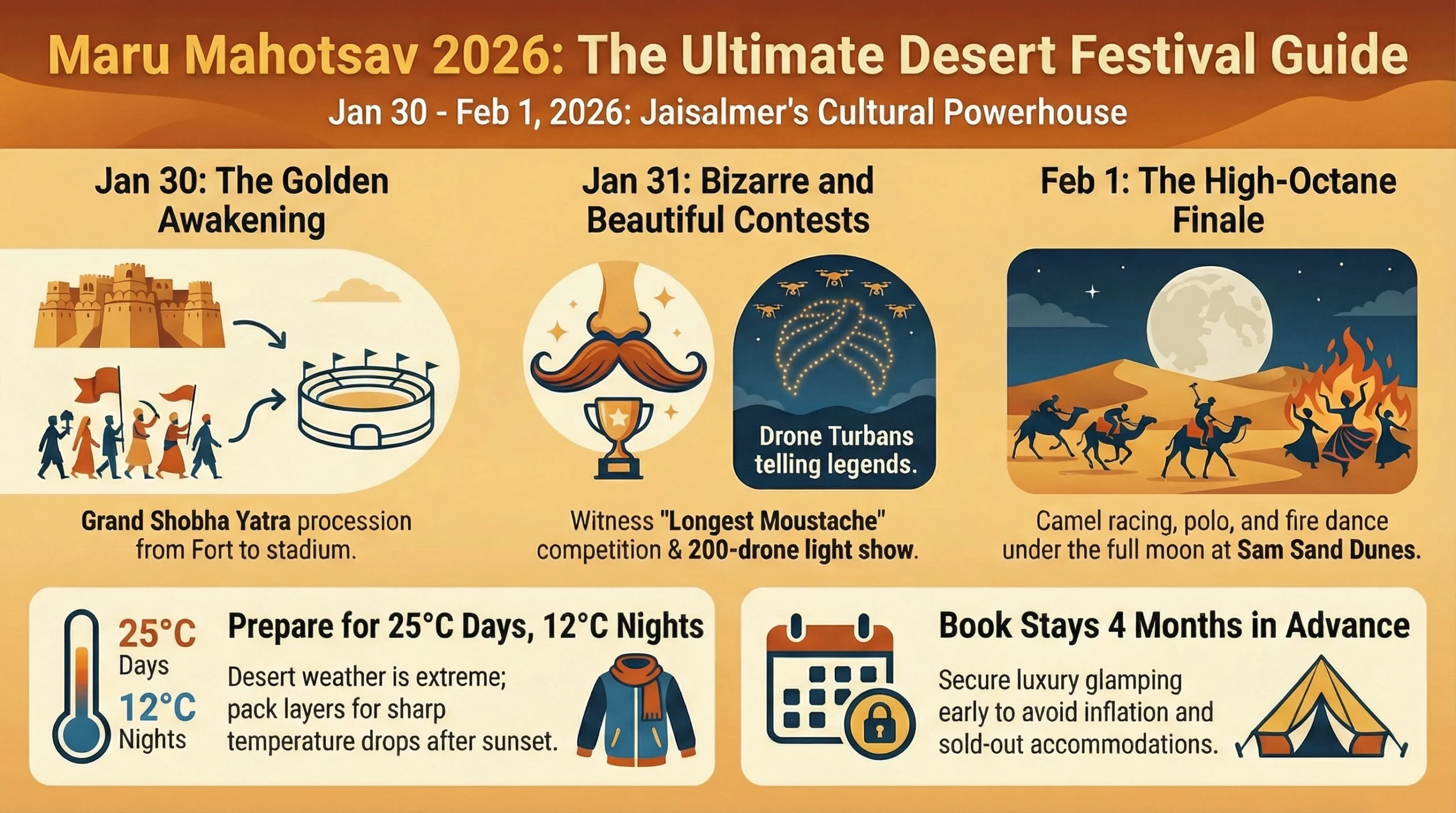
Day 1 (Jan 30): The Grand Shobha Yatra procession from Jaisalmer Fort to Shahid Poonam Singh Stadium. Expect a sea of colors, folk dancers, and decorated camel contingents.
-
Day 2 (Jan 31): Traditional competitions at Dedansar Stadium, including the world-famous Mr. Desert (Maru-Shri) contest and the quirky Longest Moustache competition.
-
Day 3 (Feb 1): The action shifts 42 km away to the Sam Sand Dunes for the high-octane Camel Races, Polo matches, and a breathtaking closing ceremony with fireworks under the full moon.
🌡️ Desert Weather Reality Check
The Thar Desert in February is a land of extremes. While the days are delightfully sunny with temperatures hovering around 25°C, the mercury drops sharply once the sun sets. Nighttime temperatures can plummet to 12°C or lower, so “layering” is your best friend.
💡 Expert “Need to Know” Tips
-
Booking Window: 2026 is seeing a surge in “slow travel” trends. Book your luxury tents at Sam Sand Dunes at least 3-4 months in advance to avoid “festival inflation” prices.
-
Connectivity: While Jaisalmer has a seasonal airport, many travelers prefer the scenic overnight train from Delhi or a 5-hour drive from Jodhpur.
-
Cash is King: While luxury camps accept digital payments, the local craft bazaars and street food vendors in the dunes often deal exclusively in INR cash.
-
Sun Protection: The desert sun reflects intensely off the sand. Pack high-SPF sunscreen, polarized sunglasses, and a traditional Rajasthani Safa (scarf) to protect against both UV rays and occasional dust swirls.
The 3-Day Daily Breakdown: Your 2026 Itinerary
To truly conquer the Maru Mahotsav, you need a plan that balances the high-energy stadium events with the soulful, serene moments in the dunes. Here is your definitive day-by-day roadmap for the Jaisalmer Desert Festival 2026.
Day 1: The Golden Awakening (January 30, 2026)
The festival kicks off with a burst of color that transforms the “Silent Desert” into a living canvas.
-
Morning (9:00 AM – 12:00 PM): The Grand Shobha Yatra. This is the ultimate photo-op. The procession starts at the historic Jaisalmer Fort and winds through the narrow, golden lanes of the city. Look out for the Gair dancers and the beautifully caparisoned camels.
-
Afternoon: The action moves to the Shahid Poonam Singh Stadium. Witness the Inaugural Ceremony, followed by the Camel Decoration Contest. This is where you’ll see camels wearing more jewelry than most people—mirrors, tassels, and intricate embroidery.
-
Evening: As dusk falls, enjoy a Cultural Symphony. Local folk artists perform Ghoomar and Kalbelia dances.
-
Pro-Tip: Stay in the city on Day 1 to be close to the morning procession, but book a late-night transfer to your desert camp to wake up in the dunes for Day 2.
Day 2: The Spirit of the Thar (January 31, 2026)
Day two is all about the “bizarre and beautiful” competitions that have made this festival a global sensation.
-
Morning: Head back to the stadium for the legendary Mr. Desert (Maru Shri) and Miss Moomal pageants. It’s not just about looks; it’s about traditional attire, turban-tying speed, and—for the men—the most magnificent moustache.
-
Afternoon: Participate in the Tug-of-War. It’s usually “Indians vs. Foreigners” or “Locals vs. Tourists,” and the energy is infectious. Afterward, browse the Craft Bazaar for authentic leather goods and silver jewelry.
-
Evening: The “Desert Festival Night” begins. This is often a Music Fusion Concert featuring national folk-fusion artists.
Day 3: The Grand Finale at Sam Sand Dunes (February 1, 2026)
The final day is the emotional and visual peak of the festival, coinciding with the Full Moon (Magh Purnima).
-
Morning: Enjoy a slow Camel Safari through the Sam Sand Dunes. Experience the desert at its most peaceful before the crowds arrive.
-
Afternoon: The Camel Polo and Camel Races. These aren’t just for show; they are high-stakes, fast-paced sports that showcase the incredible bond between the desert people and their animals. Keep an eye out for the BSF Camel Tattoo Show—a display of precision and acrobatics.
-
The Finale (Sunset & Beyond): As the sun sets behind the dunes, the Grand Closing Ceremony begins. Under the light of the full moon, witness a massive Fire Dance performance where artists dance with flaming torches to the beat of huge Dhols.
-
Midnight: The festival concludes with a spectacular Fireworks Display that lights up the entire Thar horizon.
The Ultimate Guide to Camel Races & Polo: The “Ships” in High Gear
If the Maru Mahotsav is the soul of Jaisalmer, the Camel Events are its thumping heartbeat. In 2026, the tradition of the “Ship of the Desert” has taken on a competitive edge that draws thousands of spectators to the Dedansar Stadium and the Sam Sand Dunes. This isn’t just a display of animals; it’s a masterclass in the ancient bond between the desert nomads and their most trusted companions.
1. The High-Stakes Camel Races
Usually held on the final day at the Sam Sand Dunes, the Camel Races are a sight of pure adrenaline. Forget the slow, rhythmic gait you see during a sunset safari; these camels are bred for speed.
-
The Spectacle: Watch as riders in vibrant turbans lean low, urging their mounts across the expansive golden plains. The sheer power and speed of these animals—reaching up to 40 km/h on shifting sands—is a feat of nature.
-
Photography Tip: Position yourself at the “Turn” or near the finish line for those iconic shots of sand flying against the backdrop of the dunes.
2. Camel Polo: Royal Sport on Desert Giants
Camel Polo is where the ruggedness of the desert meets the sophistication of a royal sport. Played primarily by the experts of the Border Security Force (BSF) and local veterans, it is a game of incredible coordination.
-
The Skill: Navigating a camel while swinging a mallet to hit a ball is exponentially harder than its equestrian counterpart. The camels are surprisingly agile, and the matches are intense, often involving “friendly” rivalries between locals and visiting teams.
-
Where to Watch: Look for the final matches usually scheduled for the afternoon of Day 3 (February 1, 2026).
3. The BSF Camel Tattoo Show (A Must-Watch)
Often the “crowning jewel” of the festival, the Border Security Force (BSF) Camel Tattoo Show is a display of precision acrobatics that feels more like a desert ballet.
-
The Highlights: You’ll see camels standing on two legs, formation dancing, and even performing gymnastic stunts with their BSF riders.
-
The Camel Band: Keep your ears open for the BSF Camel Mounted Band—the only one of its kind in the world—playing martial tunes while atop perfectly synchronized camels.
4. Camel Decoration: The Desert Beauty Pageant
Before they race, they “glam.” The Camel Decoration Contest showcases the artistic side of the Thar.
-
The Detail: Owners spend months hand-crafting the Gorbandh (necklaces) and saddles. Every inch of the camel is adorned with mirrors, silver bells, embroidery, and colorful tassels.
-
What to Look For: Judges look for the most intricate “shearing” patterns carved into the camel’s fur—a traditional art form that turns the animal’s coat into a living tapestry.
Sam Sand Dunes Camping: Luxury vs. Authentic
Choosing where to rest your head during the Jaisalmer Desert Festival 2026 is more than just a logistical decision—it defines your entire desert story. The Sam Sand Dunes (42km from the city) offer a spectrum of stays ranging from five-star “glamping” that feels like a royal caravan to raw, authentic experiences that bring you closer to the nomadic soul of the Thar.
The Luxury Experience: Royal Glamping
In 2026, luxury camping has evolved into a full-scale boutique resort experience in the sand. If you want the “Arabian Nights” vibe without sacrificing city comforts, this is for you.
-
The Vibe: Plush interiors, hand-block printed fabrics, and Rajput-style wooden furniture.
-
Amenities: Think attached marble bathrooms, 24/7 running hot water, air-conditioning (for the sunny afternoons), and even private infinity pools overlooking the dunes (featured in top-tier camps like Karwaan Jaisalmer or The Kafila).
-
The Perk: These camps often have dedicated caretakers and curated dining where you can enjoy a candlelight dinner under the stars with gourmet Rajasthani thalis.
The Authentic Experience: Rustic & Real
For travellers who find beauty in simplicity and want to avoid the “tourist bubble,” an authentic stay focuses on the natural elements of the desert.
-
The Vibe: Traditional Swiss Tents or even open-air bedding. You’ll swap air-conditioning for the cool desert breeze and white-tablecloth service for a seat on a Charpai (jute bed) near a woodfire.
-
Amenities: Standard but clean. You’ll have a comfortable bed and essential toilet facilities, but the focus is on the communal bonfire, local folk musicians playing the Sarangi, and the unpolluted view of the Milky Way.
-
The Perk: This is where you get the best stories. You’re more likely to interact with the camel herders and enjoy home-style Ker Sangri cooked by local staff who treat you like family.
Comparative Quick-Look: Which One is For You?
| Feature | Luxury Glamping | Authentic/Budget Camp |
| Comfort | 5-Star (AC, Private Bath) | 3-Star (Essential amenities) |
| Dining | Gourmet Buffet & Barbecue | Traditional Home-cooked Thali |
| Average Price | ₹8,500 – ₹15,000+ per night | ₹1,500 – ₹4,000 per night |
| Ideal For | Couples, Luxury Seekers | Backpackers, Culture Junkies |
| Key Player | Exotic Luxury Camps, Winds Desert Camp | Wild Heritage, Rathore Desert Camp |
A Note on Khuri Dunes
If the bustle of the Sam Sand Dunes feels too commercial for your 2026 visit, consider a camp in Khuri Village. It’s quieter, less crowded, and offers a more “untouched” desert feel while still providing access to the festival highlights.
Adventure Beyond the Festival: Adrenaline in the Thar
While the Maru Mahotsav showcases the cultural soul of Rajasthan, the area surrounding the Sam Sand Dunes serves as a massive, natural playground for thrill-seekers. In 2026, the adventure infrastructure in Jaisalmer has matured, offering everything from high-speed desert chases to bird’s-eye views of the golden expanse.
If you’re looking to break away from the crowds of the Jaisalmer Desert Festival for a few hours, here are the top-tier adventure activities you cannot miss.
1. Dune Bashing: The 4×4 Jeep Safari
This is the quintessential Jaisalmer adventure. Forget a slow ride; dune bashing involves a powerful 4×4 Mahindra Thar or Jeep navigating the steep, shifting crests and troughs of the Sam dunes at high speed.
-
The Experience: Professional drivers take you on a heart-pounding “rollercoaster” across the sand. The best time is just before sunset when the sand is cool and the light is perfect for GoPro footage.
-
Pro-Tip: Ask for a “Full Dune” circuit. It’s a 45-minute ride that goes deeper into the desert where the dunes are taller and untouched.
-
Estimated Price (2026): ₹500 – ₹1,250 per person (or roughly ₹3,500 – ₹4,500 for a private Jeep).
2. Parasailing: A Bird’s Eye View
Imagine floating 300 feet above the Thar Desert, tethered to a moving Jeep. Parasailing in Jaisalmer offers a unique perspective on the “Golden City” landscape that no ground safari can match.
-
The Experience: The flight typically lasts 5–10 minutes. As you soar, you’ll see the vast ripple patterns of the dunes and the distant horizon of the Indo-Pak border region.
-
Safety Check: Ensure your operator is certified and check the wind conditions—mornings are usually the safest and smoothest for flying.
-
Estimated Price (2026): ₹1,000 – ₹2,500 depending on the duration and “flight” height.
3. Quad Biking: Be Your Own Captain
For those who want to be in the driver’s seat, Quad Biking (ATV) is the ultimate way to conquer the desert. These four-wheeled monster bikes are surprisingly easy to handle and offer a gritty, immersive experience.
-
The Experience: You’ll follow a guide through a dedicated “ATV track” in the dunes. It’s dusty, it’s loud, and it’s incredibly fun.
-
Pro-Tip: Wear a face buff or a Rajasthani scarf (Safa) to keep the sand out of your mouth while you’re racing!
-
Estimated Price (2026): ₹800 – ₹2,000 for a 15–20 minute session.
4. Paramotoring: The Ultimate Aerial Safari
If parasailing is a “teaser,” Paramotoring is the full feature. It’s essentially a paraglider with a motorized engine, allowing the pilot to take you on a guided tour over the dunes.
-
The Experience: Because it’s motorized, you can stay in the air longer (up to 20 minutes) and travel further into the Desert National Park area. It’s widely considered the most “luxurious” adventure activity in Jaisalmer.
-
Estimated Price (2026): ₹3,500 – ₹5,000 per flight.
Adventure Table: Quick Comparison
| Activity | Thrill Level | Best Time | Best For |
| Dune Bashing | High | Sunset | Families & Groups |
| Parasailing | Medium | Early Morning | Photographers |
| Quad Biking | High | Mid-Day | Solo Travelers |
| Paramotoring | Extreme | Sunrise | Luxury Seekers |
The Foodie’s Desert Map: A Culinary Caravan
In Jaisalmer, the food is as much a testament to survival as it is to royalty. The cuisine of the Thar is defined by “resourceful royalty”—dishes crafted from ingredients that can withstand the arid heat, transformed into feasts fit for a Maharaja. For the Jaisalmer Desert Festival 2026, the local food scene is buzzing with a mix of traditional open-fire cooking and trendy rooftop dining.
1. The “Big Three” of the Thar
You cannot claim to have experienced Jaisalmer without tasting these three staples:
-
Ker Sangri: The ultimate desert delicacy. Made from dried berries (Ker) and desert beans (Sangri), this tangy, spicy dish is sautéed with local spices and oil. It’s the soul of Rajasthani vegetarianism.
-
Laal Maas: For the meat lovers, this is the “fiery red” goat curry. Its signature color and heat come from the legendary Mathania chillies. Traditionally, it was a hunter’s dish, slow-cooked in a heavy bottom pot over woodfire.
-
Dal Baati Churma: The gold standard of Rajasthani comfort food. Hard wheat rolls (Baati) are baked over cow-dung cakes (for that smoky flavor), dipped in pure ghee, and served with spicy lentil soup (Dal) and sweet, crumbled Churma.
2. Street Food Secrets at Hanuman Chauraha
While the festival grounds at Sam will have plenty of stalls, the real “foodie heart” of the city beats at Hanuman Chauraha and the lanes leading to the Fort.
-
Pyaaz Kachori: Start your morning like a local with these oversized, deep-fried pastries stuffed with a spicy onion filling. Pair it with a steaming cup of Masala Chai from Prabhu Tea Stall.
-
Makhaniya Lassi: This isn’t just a drink; it’s a meal. A thick, creamy saffron-infused yogurt topped with a dollop of butter and dry fruits. Kanchan Shree near the Fort is the undisputed legend here.
-
Ghevar & Malpua: If you have a sweet tooth, look for these honeycomb-shaped desserts soaked in saffron syrup, especially popular during the winter festival months.
3. Trending Dining Spots for 2026
-
For the Views: Desert Cow Restaurant and Cafe The Kaku offer breathtaking rooftop views of the “Sonar Quila” (Golden Fort). They specialize in “Fusion”—traditional Rajasthani flavors served with a modern, artistic flair.
-
For the Fine-Dine: Suryagarh Restaurant remains the pinnacle of luxury, offering a “Nomadic Hunt Menu” that recreates the royal dining experience of the Rajputana era.
-
For the Dunes: Trotters Jaisalmer offers a “Dinner on the Dunes” experience where you can enjoy a candlelight vegetarian meal under the Milky Way, away from the festival’s loud speakers.
4. The “Human” Element: Desert Ingredients
What makes the food special in 2026 is the focus on Zero-Waste Cooking. Because water is a luxury, many traditional dishes use buttermilk, milk, or ghee as a cooking base instead of water. When you eat here, you aren’t just tasting spices; you’re tasting the resilience of the desert people.
Cultural Etiquette & Pro-Tips: Travelling with Respect
The Jaisalmer Desert Festival is a celebration of a living, breathing culture. While the locals—warmly guided by the philosophy of “Atithi Devo Bhava” (The Guest is God)—will welcome you with open arms, understanding the nuances of desert etiquette will transform you from a mere tourist into a respected guest.
Here is how to navigate the social and environmental landscape of Jaisalmer in 2026.
1. The Desert Dress Code: Modesty Meets Fashion
Rajasthan is culturally conservative. While you’ll want those flowing “desert-chic” photos, it’s important to balance style with respect.
-
For Everyone: Shoulders and knees should generally be covered, especially when visiting the Jaisalmer Fort or the ornate Jain Temples.
-
The Power of the Scarf: Carry a lightweight cotton Safa or scarf. It’s perfect for covering your head in temples, protecting your face during a sudden dust swirl in the dunes, and adding a pop of color to your photos.
-
Footwear: Wear sturdy, closed-toe shoes for the city (the fort’s cobblestones are uneven) and easy-to-slip-off sandals for the temples and sand.
2. Photography Ethics: Ask Before You Click
The people of the Thar are incredibly photogenic, but they are not exhibits.
-
The Golden Rule: Always ask for permission (“Photo le loon?”) before taking a portrait. Most locals are happy to oblige, and it often leads to a much more authentic interaction.
-
Sensitive Areas: Photography is strictly prohibited inside certain sanctum sanctorums of temples. Look for signs or ask your guide.
-
Drones: In 2026, drone regulations in India are strictly enforced. Ensure you have the necessary permits and avoid flying near the Indo-Pak border or over crowded festival processions without official clearance.
3. Environmental Guardianship: Leave No Trace
The Thar Desert is a fragile ecosystem. With the 2026 festival focusing on Sustainable Tourism, your role as a traveler is crucial.
-
Plastic is the Enemy: Jaisalmer faces significant waste management challenges. Carry a reusable water bottle (many luxury camps now offer filtered refill stations) and avoid single-use plastics.
-
Water is Gold: In the desert, water is a luxury, not a right. Keep your showers short and reuse your towels.
-
Support Local: Buy directly from artisans in the Handicraft Bazaar. In 2026, look for the “Local Artisans Collective” tags to ensure your money supports the actual creators rather than mass-produced middleman goods.
4. Social Graces: Small Gestures, Big Impact
-
The Right Hand: Use your right hand for eating, shaking hands, or giving/receiving money. In traditional Indian culture, the left hand is considered “unclean.”
-
PDA: Public displays of affection are generally frowned upon in rural Rajasthan. Keep it discreet to avoid making locals feel uncomfortable.
-
Bargaining: It’s part of the culture! Bargain with a smile. It should be a friendly negotiation, not a confrontation. If a price feels fair to you, it’s a good deal.
Strategic “How to Reach” Guide: Your 2026 Transit Blueprint
Navigating your way to the “Golden City” for the Jaisalmer Desert Festival 2026 requires a bit of tactical planning. Since Jaisalmer is a frontier town near the Indo-Pak border, its connectivity is a unique mix of seasonal flights, iconic train routes, and vast desert highways.
Here is the most efficient way to reach the festival from major hubs.
1. By Air: The Seasonal Shortcut
In 2026, the Jaisalmer Airport (JSA) operates primarily during the peak winter months (October to March).
-
Direct Flights: Look for direct connections from Delhi, Mumbai, and Jaipur. These are often operated by SpiceJet or IndiGo.
-
The “Jodhpur Pivot”: If direct flights are sold out or over budget, fly into Jodhpur Airport (JDH). From Jodhpur, it’s a scenic 4.5 to 5-hour drive (approx. 280 km) to Jaisalmer.
-
Pro-Tip: Book your flights at least 3 months in advance. During the festival week, prices can triple.
2. By Rail: The Romantic Route
Travelling to Jaisalmer by train is a rite of passage for every traveller. The city is well-connected to major Indian metros via broad-gauge lines.
-
From Delhi: The Runicha Express (#14087) and the Ranikhet Express (#15014) are the most popular overnight options. They offer a comfortable 15–18 hour journey that lets you wake up to the sight of the rising sun over the desert scrub.
-
From Jaipur/Jodhpur: Multiple daily trains like the Jodhpur-Jaisalmer Express make the short hop in about 5–6 hours.
-
Luxury Option: For those wanting the “Maharaja” experience, the Palace on Wheels luxury train includes a curated stop in Jaisalmer during the festival season.
3. By Road: The Desert Highway Experience
If you love a good road trip, the highways leading to Jaisalmer are some of the best-maintained in India.
-
The Jodhpur-Jaisalmer Stretch (NH11/NH125): A smooth, 280 km drive that takes about 5 hours. You’ll pass through iconic stops like Pokhran (great for a quick fort visit and snacks) and Osian.
-
Bikaner to Jaisalmer: A roughly 330 km drive through the heart of the Thar. It’s a bit more isolated but offers incredible vistas of the arid landscape.
-
Bus Services: Both Rajasthan State Road Transport (RSRTC) and private operators run “Gold Line” AC sleepers from Delhi, Jaipur, and Ahmedabad.
4. Getting Around: Jaisalmer City to Sam Sand Dunes
The festival events are split between the Jaisalmer City (Stadiums) and the Sam Sand Dunes (42 km away).
-
Taxis: A round-trip taxi from the city to Sam Sand Dunes during the festival usually costs between ₹2,000 – ₹2,500.
-
Shared Shuttles: During the three days of Maru Mahotsav, local jeeps run shared services from the “Hanuman Chauraha” for approximately ₹150 – ₹200 per seat.
-
Eco-Trend for 2026: In line with new eco-tourism initiatives, look for the Camel Cart Safaris within the Desert National Park—a slower, more sustainable way to navigate the protected wildlife zones.
Travel Summary Table
| Mode | Route | Duration | Best For |
| Flight | Delhi/Mumbai to Jaisalmer | 1.5 – 2 Hours | Time-savers |
| Train | Delhi to Jaisalmer | 15 – 18 Hours | Budget/Experience |
| Road | Jodhpur to Jaisalmer | 5 Hours | Adventure/Groups |
| Local | City to Sam Dunes | 1 Hour | Festival Events |
Comparison Table – Sam vs. Khuri Dunes
Choosing between Sam and Khuri is the most debated topic for any Jaisalmer traveller in 2026. While both offer the iconic golden sands of the Thar, they cater to entirely different “desert personalities.”
Use the table below to decide where you should pitch your tent for the 2026 festival.
| Feature | Sam Sand Dunes | Khuri Sand Dunes |
| Vibe | Lively & Festive. The “Las Vegas” of the desert. High energy with constant music. | Serene & Soulful. A quiet, untouched retreat focusing on the “silence of the sands.” |
| Crowd Levels | High. Especially during the 2026 festival dates (Jan 30 – Feb 1). | Low. Perfect for travellers wanting to avoid the “tourist trap” feel. |
| Accommodation | Luxury Glamping Focus. Massive resorts with AC, infinity pools, and plush suites. | Authentic Homestays. Traditional mud huts and family-run boutique camps. |
| Activities | Adrenaline-Packed. Jeep bashing, ATVs, parasailing, and grand cultural shows. | Cultural Immersion. Slow camel treks, village walks, and stargazing. |
| Food Style | Buffet Variety. Large multi-cuisine spreads (Indian, Chinese, Continental). | Home-Cooked Thalis. Authentic Rajasthani flavours (Ker Sangri, Bajra Roti) made by locals. |
| Best For | Families with kids, first-timers, and adventure junkies. | Photographers, solo travellers, and “slow travel” enthusiasts. |
| Distance | 42 km from Jaisalmer (approx. 45-min drive). | 50 km from Jaisalmer (approx. 1-hour drive). |
| Access | Excellent roads; constant taxi and shuttle availability. | Good roads but fewer public transport options; private taxi recommended. |
The 2026 Insider Verdict
-
Go to Sam if: You want to be at the centre of the Jaisalmer Desert Festival action. The biggest camel races and BSF performances happen right here. It’s loud, it’s dusty, and it’s undeniably exciting.
-
Go to Khuri if: You want to experience the desert as it was decades ago. It’s the best spot in 2026 for astrophotography and experiencing true Rajasthani hospitality without the commercial “noise.”
Frequently Asked Questions about Jaisalmer Desert Festival 2026
1. What are the exact dates for the Jaisalmer Desert Festival 2026?
The festival is scheduled from January 30th to February 1st, 2026. It traditionally concludes on the full moon night (Magh Purnima). Many travellers arrive on January 29th to settle in before the Grand Shobha Yatra kicks off on the morning of the 30th.
2. Is there an entry fee for the festival events?
Most of the main festival events held at the Shahid Poonam Singh Stadium and Sam Sand Dunes are free and open to the public. However, you will need to pay standard entry fees for city monuments like Jaisalmer Fort (₹50 for Indians, ₹250 for foreigners) and Patwon Ki Haveli. Adventure activities like Jeep safaris and parasailing are also paid separately.
3. Where is the best place to watch the Camel Race?
The high-octane Camel Races take place on the final day (February 1st) at the Sam Sand Dunes. To get the best view, arrive at the dunes by 2:00 PM. Position yourself near the finish line or on a high dune ridge to capture the panoramic action without the crowds blocking your lens.
4. Do I need to book my desert camp in advance for 2026?
Yes, absolutely. For the festival dates, luxury camps at Sam Sand Dunes often sell out 4–5 months in advance. Booking early not only guarantees your spot but also protects you from the 40–50% price hikes that typically happen as the festival nears.
5. Is Jaisalmer safe for solo female travellers during the festival?
Jaisalmer is widely considered one of the safest cities in Rajasthan. During the festival, there is a heavy presence of Tourist Police and BSF personnel. However, standard precautions apply: stick to verified luxury camps, avoid wandering deep into isolated dunes alone after dark, and use reputable transport services like those arranged by your hotel.
6. What should I pack for Jaisalmer in February?
The desert is a land of “layers.”
-
Daytime: Light cotton clothes, linens, and comfortable walking shoes.
-
Nighttime: The temperature can drop to 10°C. Pack a warm fleece, a light down jacket, or a woollen shawl.
-
Essentials: A high-SPF sunscreen, polarised sunglasses, a power bank, and a basic first-aid kit for “Delhi Belly” or minor dehydration.
7. Can I visit the festival as a day trip from Jaisalmer city?
While you can drive to the Sam Sand Dunes for the evening events and return to the city, we don’t recommend it. The true magic of the Maru Mahotsav is waking up to a desert sunrise and the sound of folk music. A one or two-night stay in a desert camp is essential for the full experience.
8. How do I get from Jaisalmer City to the Sam Sand Dunes?
The dunes are about 42 km from the city. During the festival, you can hire a private taxi (₹2,500 round trip) or take a shared Jeep from Hanuman Chauraha (₹150–200 per person). Many luxury camps also offer complimentary pick-up and drop-off services for their guests.
9. Is there mobile connectivity and Wi-Fi in the desert camps?
Major networks like Jio and Airtel work reasonably well at the Sam Sand Dunes, though data speeds can be “desert-slow” due to the high volume of tourists. Most luxury glamping sites provide Wi-Fi in their common dining areas, but don’t expect high-speed streaming in your tent.
10. What are the “must-see” competitions besides the Camel Race?
Don’t miss the Mr. Desert (Maru Shri) and Longest Moustache competitions on Day 2. These are the cultural highlights where local pride is on full display. Another crowd favourite is the Matka Race, where local women race while balancing multiple water pots on their heads—it’s a masterclass in poise and agility.



Leave a Reply