
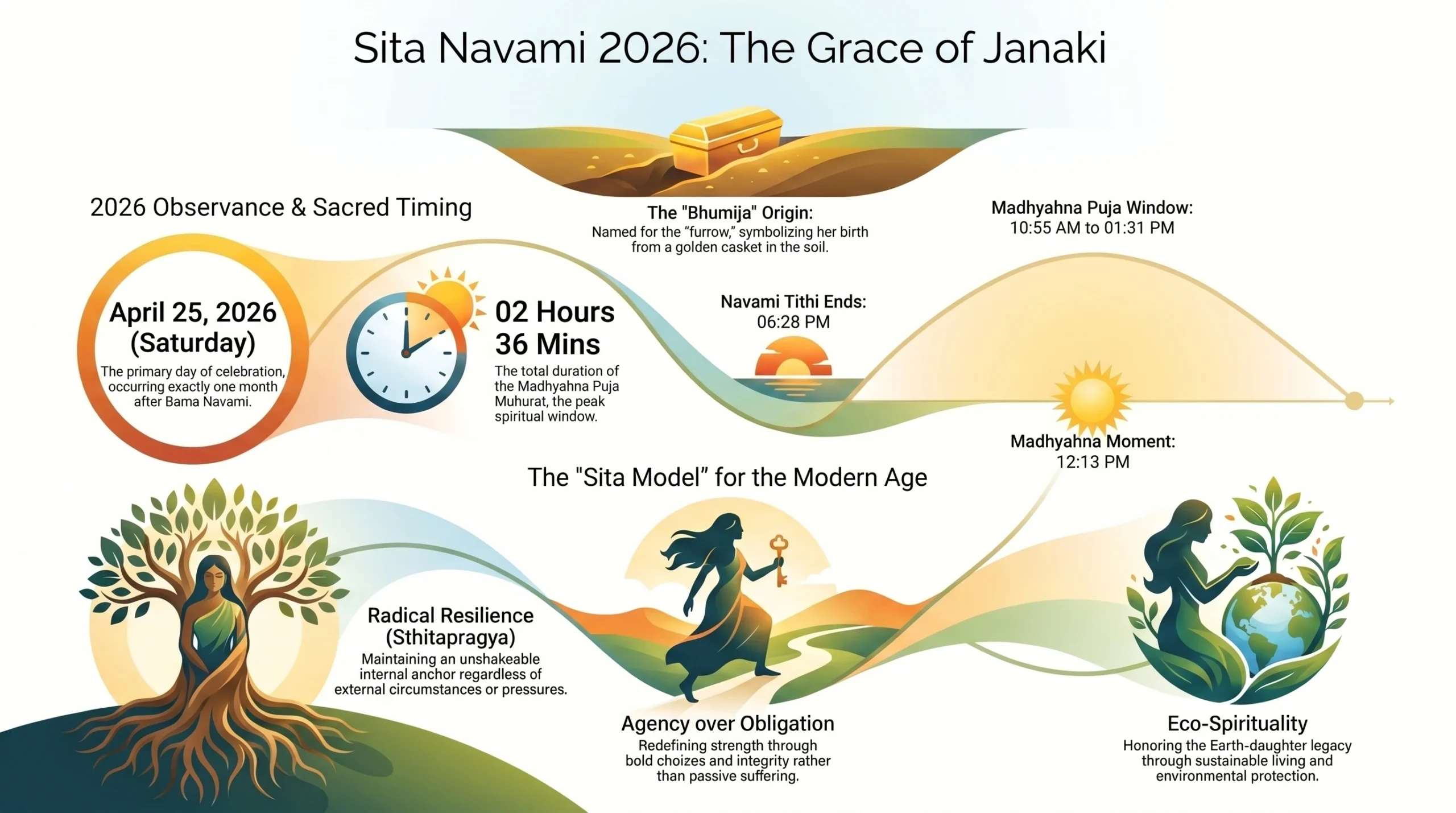
The Grace of Janki
Every year, as the golden rays of the spring sun illuminate the landscape, the Hindu calendar arrives at a moment of profound spiritual significance. Sita Navami 2026 is not merely a date on a calendar; it is a celebration of the ultimate feminine archetype—Mata Sita. Often referred to as Janaki Navami, this day commemorates the miraculous appearance of Goddess Sita, a figure who remains the beating heart of Indian ethos, representing an unparalleled blend of gentleness and granite-strong resolve.
To understand the significance of Janaki Navami, one must look beyond the traditional rituals. While the world often focuses on the grandeur of Rama Navami, celebrated exactly one month prior, Sita Navami invites us into a deeper, more introspective space. It is a day dedicated to the Bhumija—the one born of the earth. When King Janak of Mithila touched his plow to the soil, he didn’t just find a child in a golden casket; he unearthed a legacy of feminine strength and resilience that would guide civilizations for millennia.
In today’s fast-paced digital age, the Grace of Janaki feels more relevant than ever. We often mistake silence for weakness and patience for passivity. However, Mata Sita’s life story redefines these concepts. Her journey—from the opulence of the Mithila palaces to the rugged trails of the Dandakaranya forest—serves as a timeless masterclass in emotional intelligence. This is why Sita Navami 2026 is trending among the youth and spiritual seekers alike; it offers a blueprint for maintaining one’s integrity and values in the face of overwhelming external pressure.
The grace of Janaki is also deeply environmental and grounded. As the daughter of Mother Earth, her birth anniversary reminds us of our own connection to the soil and the natural world. In a modern context, celebrating Janaki Jayanti is an act of reclaiming our roots and honoring the nurturing power of the feminine spirit (Shakti). Whether you are a devotee seeking spiritual growth or someone looking for an icon of moral fortitude, the story of Janaki offers a wellspring of inspiration.
As we prepare to welcome this auspicious day, we delve into the rituals, the history, and the hidden lessons of her life. definitive companion for Sita Navami, bridging the gap between ancient Vedic wisdom and the contemporary search for meaning. We aren’t just looking back at a historical event; we are inviting the grace, the patience, and the quiet power of Mata Sita into our modern homes and hearts.
Sita Navami 2026:Date, Tithi, Subh Muhurat
For any devotee or spiritual seeker, the most critical part of planning is knowing exactly when the cosmic energies align. In 2026, Sita Navami (also celebrated as Sita Jayanti) falls during the vibrant month of April, offering a perfect window for spiritual renewal.
Sita Navami 2026: Quick Reference Table
| Event | Details |
| Sita Navami Date | April 25, 2026 (Saturday) |
| Navami Tithi Begins | 07:22 PM on April 24, 2026 |
| Navami Tithi Ends | 06:28 PM on April 25, 2026 |
| Madhyahna Puja Muhurat | 10:55 AM to 01:31 PM |
| Total Duration | 02 Hours 36 Mins |
| Madhyahna Moment | 12:13 PM |
Understanding the Tithi: Why April 25?
While the Navami Tithi actually begins on the evening of April 24th, the festival is observed on April 25th. In Vedic tradition, the Udaya Tithi (the Tithi present at sunrise) and the Madhyahna (mid-day) period are paramount for Sita Jayanti. Since Mata Sita was born during the Madhyahna period under the Pushya Nakshatra, the afternoon of the 25th is when the spiritual vibe is at its peak.
The Significance of Madhyahna Muhurat
You might wonder why there is a specific 2.5-hour window for the Puja. In the Hindu calendar, Madhyahna is the most auspicious time for Sita Navami rituals because it marks the exact time of her appearance on Earth. Performing your Sankalp (intention setting) and Aarti during this window is believed to amplify the blessings of peace, health, and marital harmony.
Trending Search Insight: Sita Navami vs. Rama Navami 2026
A common query for 2026 is the gap between the two major Navamis. Rama Navami 2026 will be celebrated on March 27, 2026. True to tradition, Sita Navami arrives exactly one month later. This 30-day interval represents the perfect balance of the solar and lunar energies—Lord Rama representing the Sun (Suryavanshi) and Mata Sita representing the nurturing Earth and Moon-like grace.
Pro-Tip for Your Calendar
If you are planning a fast (Vrat), it should ideally begin at sunrise on April 25th and conclude after the Madhyahna Puja or on the following morning (Dashami), depending on your family tradition.
The Divine Origin: The Miraculous Birth Of Sita
The story of Mata Sita’s arrival is perhaps one of the most poetic and symbolic narratives in the entire history of ancient India. Unlike other divine incarnations, Sita’s birth is not a biological event but a Bhumi-Prakatya—a manifestation of the Earth itself. This is why she is affectionately called Bhumija (the one born of the earth) and Dharitri (the daughter of the soil).
The Golden Casket and the Sacred Furrow
The setting for this divine origin is the ancient kingdom of Mithila, ruled by the philosopher-king, Rajarishi Janak. The kingdom was suffering from a severe, soul-crushing drought. Following the advice of sages, King Janak took it upon himself to perform a ritual plowing of the fields to appease the gods and invite the rains.
As the King’s silver plow hit a hard object beneath the soil, he unearthed a magnificent golden casket. Inside, resting on the soft earth, was a radiant baby girl with eyes like lotus petals. The moment the King lifted her, the dry skies cracked open with torrential rain, signaling that the Earth had sent its greatest treasure to save the land. This sacred spot, known today as Sitamarhi (in present-day Bihar), remains a site of immense pilgrimage and spiritual energy.
Why the Name Sita?
In Sanskrit, the word Sita literally translates to the furrow. It represents the line made by a plow in the soil. By naming her Sita, King Janak honored her origin and her connection to the fundamental element of life—the Earth. This name serves as a constant reminder of her grounded nature and her role as a bridge between the divine and the terrestrial.
Historical Engineering: The Symbolism of the Plow
From a historical and cultural perspective, this story highlights the deep-rooted Vedic respect for agriculture. Even a King was expected to labor in the fields to ensure the prosperity of his people. The miraculous birth of Sita emphasizes that true wealth (represented by the golden casket) comes from a harmonious relationship with nature. For modern readers, this is a beautiful lesson in sustainable living and recognizing the divinity in the environment around us.
The Janakpur Connection
While she was found in the fields, she was raised in the grand palace of Janakpur (now in Nepal). Her upbringing was unique; she was the daughter of a king known for his detachment and wisdom. Growing up in the halls of Mithila, she didn’t just learn the arts of royalty—she became a scholar of the Vedas and a master of spiritual discourse. This combination of Earth-born humility and Palace-bred wisdom is what makes the Grace of Janaki so compelling in 2026.
The Hidden Meaning for Today
When we celebrate the birth anniversary of Mata Sita, we are celebrating the idea that extraordinary things can emerge from the most humble places. Just as a seed must endure the darkness of the soil to become a flower, Sita’s origin story teaches us that our struggles and grounded moments are often the birthplace of our greatest strengths.
Spiritual Significance: Beyond the Rituals
While the Sita Navami 2026 rituals bring families together in prayer, the true essence of this day lies in its deep, transformative philosophy. To understand the spiritual significance of Janaki Navami, we have to look past the incense and oil lamps and dive into the life that Mata Sita offers to a modern, often chaotic world.
The Embodiment of Shakti and Sthitapragya
In spiritual discourses, Mata Sita is often described as the perfect Sthitapragya—someone who remains unmoved by the polarities of life. Whether she was the beloved Princess of Mithila or a captive in the Ashoka Vatika, her internal state of grace remained unshakeable.
Celebrating Sita Navami is a spiritual reminder to cultivate this inner anchor. In an era of hustle culture and burnout, the Grace of Janaki teaches us that our worth isn’t defined by our external circumstances, but by our character and mental fortitude.
The Balance of Nature (Prakriti) and Consciousness (Purusha)
If Rama Navami represents the Purusha (the divine consciousness), Sita Navami represents Prakriti (the creative energy of nature). One cannot exist without the other. This day marks the celebration of the feminine force that sustains life.
- Trending Insight: This is why many spiritual leaders today link Sita Navami to Eco-Spirituality. As the daughter of the Earth, her day is a call to protect our environment—the very soil she emerged from.
Resilience: The Power of Choice
A common misconception is that Sita was a figure of silent suffering. On the contrary, her life was defined by bold choices.
- She chose to leave the palace for the forest (Vanvas) to stand by her principles.
- She chose to maintain her dignity during her trials.
By celebrating this day, we honor the power of the human spirit to choose integrity over ease. This resonates deeply with modern empowerment as it shifts the narrative from victimhood to agency.
Forgiveness and Compassion (Kshama)
The spiritual core of Sita Navami is the quality of Kshama (forgiveness). Even toward those who caused her immense pain, Sita’s heart remained a reservoir of compassion. In a digital world often fueled by cancel culture and conflict, invoking the spirit of Janaki is a meditative practice in letting go of bitterness. It is a day to cleanse the heart and start fresh with a perspective of empathy.
The Union of Soul and Super-Soul
On a mystical level, the path of Sita is the path of the Jiva (the individual soul) seeking its way back to the Paramatma (the Supreme Soul, Rama). Her longing and eventual union represent the ultimate goal of all spiritual seekers. For those practising mindfulness or bhakti yoga, Sita Navami 2026 is an auspicious time to deepen one’s personal connection with the divine.
Summary of Spiritual Benefits
By observing this day with a heart, devotees believe they can achieve:
1. Marital Harmony: Balancing the energies within a relationship.
2. Mental Peace: Drawing from Sita’s example of patience (Dhairya).
3. Purity of Intent: Aligning one’s actions with a higher moral compass
The Sita Model: Lesson For the Modern Woman and Man
In the modern era, where we are constantly bombarded with hustle culture and the pressure to project a perfect life on social media, the Sita Model offers a refreshing and grounded alternative. Far from the outdated stereotype of a passive figure, Mata Sita is a masterclass in emotional intelligence, boundaries, and sovereign strength.
The Power of Choice Over Obligation
One of the most trending conversations around Mata Sita is her decision to go to the forest (Vanvas). She wasn’t exiled; she chose to go. This represents a powerful lesson in agency.
- Modern Take: In our professional and personal lives, we often feel trapped by circumstances. The Sita Model teaches us that true power lies in choosing our path based on our core values, even if that path is the more difficult one. It’s about integrity over convenience.
Radical Resilience (The Ashoka Vatika Mindset)
While held in the Ashoka Vatika, Sita faced immense psychological pressure. Yet, she refused to let her environment dictate her internal state. She didn’t just survive; she maintained her dignity and focus.
- For the Modern Professional: We all face Ashoka Vatikas—toxic work environments, personal setbacks, or mental health struggles. Sita’s resilience is a blueprint for mental toughness. It’s the ability to say, You may control my surroundings, but you do not own my mind.
Dignity in Silence vs. Strength in Speech
There is a profound difference between being silenced and choosing silence as a strategic power. Sita knew when to speak (challenging Ravana’s morality) and when to let her character speak for itself.
- Communication Skills: In an age of shouting matches on digital platforms, the Sita Model highlights the strength of graceful confrontation. It teaches us to respond with substance rather than react with noise.
Empathy as a Leadership Trait
Despite her own suffering, Sita showed compassion to the Trijatas (her guards) and others. She understood that everyone is fighting their own battle.
- Leadership: For modern managers and partners, empathy is the soft skill that drives hard results. Leading with a Sita-like heart means building bridges of understanding rather than walls of ego.
The Balance of Independence and Partnership
The relationship between Rama and Sita is often cited as the ideal, but it’s the mutual respect that stands out. Sita was a scholar, a princess of a highly intellectual kingdom (Mithila), and a woman of independent thought.
- Modern Relationships: The Sita Model encourages a partnership of equals where both individuals support each other’s Dharma (duty). It’s about being a Power Couple grounded in shared values rather than just shared aesthetics.
Environmental Consciousness (The Earth-Daughter Legacy)
As the Bhumija, Sita’s identity is tied to the Earth.
- Sustainability: For the modern man and woman, this is a call to Eco-conscious living. Honouring Sita in 2026 means honouring the planet. Whether it’s reducing plastic or supporting sustainable brands, we are protecting the Mother that Sita represents.
The Takeaway
The Sita Model isn’t about being a martyr; it’s about being invincible. It’s a reminder that grace is a form of grit, and kindness is a form of courage. On this Janaki Navami, let’s strive to be as grounded as the earth she came from and as vast as the spirit she embodies.
Celebrating Sita Navami 2026 at home doesn’t require a grand temple setup; it requires a heart full of devotion and a mindful approach. Since this day falls on Saturday, April 25, 2026, many families will have the time to perform these rituals with care.
Whether you are a seasoned practitioner or a modern professional looking to connect with your roots, this Sita Navami Puja Vidhi is designed to be accessible, spiritually rewarding, and grounded in Vedic tradition.
Preparation Setting the Sacred Space
- Cleanse the Area: Begin by cleaning your Puja altar or a quiet corner of your home.
- The Altar Setup: Place a clean yellow or red cloth on a wooden plank (Chowki). Yellow is the favourite colour of Mata Sita, symbolising prosperity and the spring season.
- The Deity: Place an idol or a framed picture of Rama-Sita together. In Vedic tradition, Sita is rarely worshipped alone; she is the Hladini Shakti (pleasure-giving energy) of Lord Rama.
Essential Puja Samagri
Before the Madhyahna Muhurat begins (between 10:55 AM and 01:31 PM),
- Ganges Water (Ganga Jal): For purification.
- Fresh Flowers: Preferably yellow marigolds or red hibiscuses.
- Sandalwood Paste (Chandan) & Kumkum: For tilak.
- Incense Sticks (Agarbatti) & a Ghee Lamp (Diya).
- Seasonal Fruits: Especially those available in April like mangoes or bananas.
- Special Offering (Bhog): Barley (Jau), sweets made of milk, or Makhana Kheer.
The Step-by-Step Ritual (Shodashopachara)
Atma-Pujan & Sankalp
Sprinkle a few drops of Ganga Jal on yourself and say a simple prayer: O Mata Sita, I perform this puja to invite your grace, patience, and peace into my life and my home.
Invocation (Avahana)
Light the Ghee lamp. Meditate on the form of Mata Sita—her calm countenance and golden aura. Invoke her presence into the idol or picture.
The Five Offerings (Panchopachara)
- Gandham: Apply Chandan and Kumkum to the forehead of the deities.
- Pushpam: Offer fresh flowers at their feet.
- Dhoopam: Light the incense to purify the air.
- Deepam: Show the lighted lamp to the deities.
- Naivedyam: Offer the fruits and sweets. Pro-tip: Include a Tulsi leaf in the offering for Lord Rama.
Recitations & Chanting
This is the most powerful part of the Sita Navami rituals. You can chant the following for mental peace:
- Om Shri Sitaye Namah (108 times)
- Recite the Sita Chalisa or verses from the Ramcharitmanas (specifically the Bal Kand which describes her birth).
The Arati: The Final Glow
Perform the Sita-Rama Arati with a circular motion of the lamp. Use a bell or clap softly to create a rhythmic, meditative environment. After the Arati, bow down to the earth—honouring Mata Sita’s origin—and seek blessings for your family’s well-being.
Distribution of Prasad
Share the offered sweets and fruits with your family members and neighbours. In the spirit of Janaki Navami, consider donating a portion of food or a small sum to a local charity or someone in need, as Sita is the ultimate provider (Annapurna).
Modern Tips for 2026
- Digital Fasting: Along with any food fast, try a Digital Fast during the Puja hours. Turn off notifications to truly connect with the silence within.
- Eco-Friendly Puja: Use clay diyas and biodegradable leaf plates for Prasad. Since Sita is the daughter of the Earth, avoiding plastic is a beautiful way to honour her legacy.
- Involve the Family: If you have children, tell them the story of the Golden Casket while they help you arrange the flowers. It makes the tradition a living memory for the next generation.
Religious Celebrations: From Ayodhya to Janakpur
To truly understand the heartbeat of Sita Navami 2026, one must look beyond individual homes and toward the grand, centuries-old landscapes of the Ramayana Circuit. From the rolling plains of Bihar to the majestic temples of Nepal, the celebration of Janaki Navami is a vibrant tapestry of music, emotion, and deep-rooted history.
Janakpur, Nepal: The Home of the Daughter-in-Law
Janakpur (historically the capital of Mithila) is the epicentre of Sita Jayanti celebrations. For the people here, Sita is not just a goddess; she is their daughter (Kishori Ji).
- The Janaki Mandir: This Nau Lakha Mandir (built for nine lakh rupees) becomes a sight to behold. In 2026, expect the temple to be illuminated with thousands of oil lamps, reflecting its stunning Mughal-Hindu architecture.
- The Shobha Yatra: A grand procession featuring decorated elephants, horses, and chariots carrying the idols of Rama and Sita winds through the city.
Sitamarhi, Bihar: Where the Earth Parted
Located in the Mithila region of India, Sitamarhi is revered as the exact spot where King Janak’s plough struck the golden casket.
- Punaura Dham: This is the sacred site of her manifestation. On Sita Navami, devotees from across the border (India and Nepal) congregate here for a holy dip in the Janaki Kund.
- The Mela (Fair): A massive local fair takes place, showcasing traditional Mithila art (Madhubani painting) and local handicrafts. It’s a beautiful intersection of spirituality and rural economy, proving how ancient traditions still sustain modern livelihoods.
Ayodhya, Uttar Pradesh: The Welcome of the Queen
While Ayodhya is the city of Rama, Sita Navami is celebrated with equal fervor as the birth of the city’s beloved Queen (Kanak Bhawan’s deity).
- Kanak Bhawan Festivities: This temple, believed to be a gift to Sita from Kaikeyi, holds special discourses and Bhajans. The Sita-Ram chants echo through the Sarayu ghats.
- Trending Ritual: Many devotees perform a special Abhishek (ceremonial bath) of the idols with milk and honey, followed by a distribution of Panchamrit as Prasad.
Bhadrachalam, Telangana: The Southern Grace
In South India, particularly at the Bhadrachalam Temple, Sita Navami is observed with Vedic precision.
- Kalyanam Vibes: While the grand wedding (Sita Rama Kalyanam) happens on Rama Navami, the following month sees special Unjal Seva (swing rituals) where the divine couple is serenaded with classical Carnatic music.
- Cultural Focus:, The emphasis is on the philosophical union of the soul and the divine, often attracting scholars and classical dancers who perform Kuchipudi recitals based on the Ramayana.
The Mithila Kitchen Traditions
No regional celebration is complete without food. Across Bihar and Nepal, families prepare:
- Makhana Kheer: Using fox nuts (the superfood of Mithila).
- Pirukiya: A traditional sweet dumpling similar to Gujiya.
- Badi-Bhaat: A signature Mithila meal offered to the goddess.
Why Regional Diversity Matters in 2026
In a world that is becoming increasingly homogenised, these regional celebrations remind us of the beauty of local identity. Whether it’s the Maithili songs of Nepal or the Carnatic hymns of the South, the Grace of Janaki acts as a bridge, uniting different languages and cultures under one umbrella of devotion.
The Sita Navami Vrat: Rules & Benefits
Fasting in the Vedic tradition is rarely just about abstaining from food; it is a profound exercise in building willpower, detoxifying the body, and tuning into higher spiritual frequencies. The Sita Navami Vrat (fast) is one of the most revered observances in the Hindu calendar, particularly for those seeking peace, family harmony, and an anchor of inner strength.
Whether you are a traditionalist observing a strict fast or a modern seeker looking to integrate mindfulness into your busy schedule, understanding the rules and benefits of this Vrat is essential for a complete Sita Jayanti experience.
Types of Fasting: Choosing Your Path
The beauty of Hindu fasting rules is their flexibility. The scriptures recognise that devotion is not a one-size-fits-all practice. For Sita Navami 2026, you can choose the type of fast that best suits your health and lifestyle:
- Nirjala Vrat (The Strict Fast): The devotee abstains from both food and water from sunrise on Navami until the sunrise of the following day (Dashami). This requires immense physical and mental discipline.
- Phalahar Vrat (The Fruit-Based Fast): The most common and highly recommended approach. Devotees consume only water, milk, and seasonal fruits.
- Ek-Bhukta Vrat (One Meal a Day): For those with medical conditions or demanding work schedules, you can consume one simple, Sattvic (pure, without onion or garlic) meal after the evening Aarti.
Essential Vrat Rules (Niyam)
- The Sankalp (Vow): Begin your day at Brahma Muhurat (predawn). After bathing, hold a little water in your right hand and make a silent pledge to Mata Sita, stating your intention to complete the fast with a pure heart.
- Sattvic Living: Fasting extends beyond the plate. It involves Brahmacharya (celibacy), avoiding harsh words, and steering clear of negative thoughts or digital drama.
- Breaking the Fast (Parana): The fast should be broken the following morning gracefully. It is customary to offer food to a cow, a priest, or someone in need before taking your first bite.
The Spiritual Benefits: Why Keep the Fast?
Devotees who observe the Janaki Navami Vrat with unwavering faith believe it unlocks profound blessings:
- Marital Harmony: Mata Sita is the ultimate symbol of a devoted partner. Fasting on this day is widely believed to resolve marital discord and bring the blessings of a suitable life partner to unmarried individuals.
- Cultivating Dhairya (Patience): Just as Sita endured the trials of the forest and Ashoka Vatika without losing her grace, this fast helps cultivate deep emotional resilience and patience.
- Cleansing of Karma: According to the Puranas, observing this Vrat with pure devotion absolves the seeker of past negative karmas, paving the way for material and spiritual prosperity.
Seasonal Wellness: The Health Benefit
Falling in late April, Sita Navami 2026 arrives right at the transition from spring to the peak of the Indian summer. This timing is no coincidence.
From the perspective of seasonal wellness, the body’s digestive fire (Agni) fluctuates during this shift. A mindful Phalahar fast—focusing on hydrating seasonal nutrition like melons, cucumbers, milk, and Makhana (fox nuts)—gives the digestive system much-needed rest. It acts as a natural, seasonal detox. By stepping away from heavy, processed foods, you are not just honouring the Earth-born Goddess; you are honouring the ecological rhythms of your own body.
Modern Fasting Tips for the Busy Professional
Hydration is Key: If you are working, opt for the Phalahar fast. Drink plenty of coconut water and buttermilk to maintain your energy levels during office hours.
Mindful Consumption: Instead of focusing on what you can‘t eat, focus on what you can consume—good literature, positive conversations, and moments of silence.
The Intent matters most: If a medical condition prevents you from fasting, simply eating a clean, vegetarian diet and meditating on the virtues of Mata Sita is equally accepted. The Divine Mother values the purity of your intent over physical austerity.
Comparative Analysis Sita Navami vs Ram Navami
To truly grasp the magnitude of Sita Navami, it is essential to view it in tandem with its counterpart, Rama Navami. In the Hindu calendar, these two powerful observances are separated by exactly one lunar month. While they celebrate the two halves of the ultimate divine couple, the energies, rituals, and philosophical takeaways of each day are distinct and beautifully complementary.
For spiritual seekers and cultural enthusiasts in 2026, understanding the Sita Navami vs. Rama Navami dynamic is like understanding the balance of the universe itself—the perfect harmony of the Sun and the Earth.
The Cosmic Balance Purusha and Prakriti
In Vedic philosophy, Lord Rama represents the Purusha (the supreme consciousness, the unmoving center, and the upholder of Dharma). Mata Sita, on the other hand, embodies Prakriti (nature, the dynamic creative energy, and the nurturing force of the Earth).
You cannot have creation without both. Rama is the ideal of righteous action, while Sita is the ideal of profound patience and emotional endurance. When we look at Sita Navami vs. Rama Navami, we are looking at the celebration of action balanced by empathy.
Quick Comparison Sita Navami vs. Rama Navami
| Feature | Rama Navami | Sita Navami (Janaki Navami) |
| Hindu Month | Chaitra (Ninth day of Shukla Paksha) | Vaishakha (Ninth day of Shukla Paksha) |
| 2026 Date | March 27, 2026 | April 25, 2026 |
| Incarnation Of | Lord Vishnu (The Preserver) | Goddess Lakshmi / Earth (The Sustainer) |
| Element & Origin | Solar (Suryavanshi) – Born in a Royal Palace | Earth (Bhumija) – Found in a Ploughed Field |
| Core Virtues Celebrated | Duty, Righteousness, Leadership (Dharma) | Patience, Resilience, Devotion (Dhairya) |
| Key Ritual Focus | Chaitra Navratri conclusion, reading Ramayana | Worshipping the Earth, seeking marital & family harmony |
The One-Month Gap: A Lesson in Timing
Why does Janaki Navami arrive exactly one month after Rama Navami?
Astrologically and symbolically, the one-month gap allows the intense, fiery energy of the Sun (Rama) celebrated in Chaitra to settle, paving the way for the grounded, soothing, and fertile energy of the Earth (Sita) in Vaishakha. It is a natural progression. After establishing the rules of society (Dharma), the universe requires a motherly force to nurture it.
The Comparison for Modern Life
In today’s terminology, this comparison perfectly mirrors the concept of Yin and Yang. We live in a society that heavily rewards Rama qualities—assertiveness, leadership, and taking action. However, we often neglect Sita qualities—active listening, holding space, emotional intelligence, and graceful endurance.
- The Modern Takeaway: If Rama Navami teaches us how to fight for what is right, Sita Navami teaches us how to heal and sustain ourselves after the battle.
By observing both days, devotees acknowledge that a successful life requires both boundaries and boundless love. You need the structured discipline of Rama to achieve your goals, but you need the grounded resilience of Sita to survive the setbacks along the way.
By understanding the differences and the unbreakable bond between these two avatars, our celebration of Sita Navami 2026 becomes much more than a ritual—it becomes a holistic embrace of life’s dualities.
Traditional Culinary Traditional of Mithila
Food is the ultimate storyteller of any culture. To truly experience the essence of Sita Navami, we must look toward the ancient kitchens of Mithila—the birthplace of Mata Sita. The culinary traditions of this region are deeply intertwined with its agricultural heritage, offering a menu that is not only spiritually significant but also perfectly aligned with seasonal wellness.
As Janaki Navami falls during the transition from the mild spring to the sweltering heat of late April, the traditional foods offered as Bhog (divine offering) and consumed by devotees reflect a profound understanding of seasonal shifts and holistic nutrition. The Mithila diet naturally prioritises cooling, hydrating, and easily digestible ingredients, honouring the Earth-born Goddess by utilising the very best of what the local soil provides.
The Superfood of Mithila: Makhana (Fox Nuts)
No conversation about Mithila culture is complete without mentioning Makhana. Cultivated extensively in the ponds of Bihar and Nepal, this aquatic seed is an ancient nutritional powerhouse.
- Makhana Kheer (The Ultimate Bhog): For Sita Navami, locals prepare a rich, sweetened pudding using roasted Makhana, milk, cardamom, and dry fruits. It is considered the most auspicious offering to Goddess Sita.
- Health Benefit: Rich in protein and antioxidants, Makhana provides sustained energy, making it an ideal ingredient for those observing a Phalahar fast.
Traditional Sita Navami Recipes and Staples
Beyond Makhana, the kitchens of Janakpur and Sitamarhi come alive with an array of traditional recipes that have been passed down through generations.
- Badi-Bhaat: A comforting, staple meal featuring sun-dried lentil dumplings (Badi) simmered in a spiced yogurt-based curry, served alongside indigenous varieties of rice. The use of yogurt provides a cooling effect necessary for the late April weather.
- Pirukiya: The Maithili cousin of the popular North Indian Gujiya. These crisp, deep-fried pastries are stuffed with a sweetened mixture of grated coconut, khoya (reduced milk), and cardamom. They are a staple celebratory sweet distributed as Prasad during the temple processions.
- Dahi-Chura with Jaggery: Flattened rice (Chura) mixed with fresh, thick curd (Dahi) and unrefined cane sugar. This requires zero cooking, preserves the digestive fire (Agni), and is heavily consumed during the warmer months as a natural coolant.
- Kachari: Savory, crispy fritters made from soaked lentils and mild spices, offering a textural contrast to the softer, sweeter festive foods.
The Aspect of Maithili Food Culture
What makes the traditional culinary habits of Mithila so special is the communal aspect of their preparation. Making Pirukiya or roasting Makhana is rarely a solitary task. Women of the household gather in the courtyards, singing Sohars (traditional birth songs dedicated to Sita), transforming the act of cooking into a shared expression of joy and devotion.
For the modern reader looking to celebrate Sita Navami 2026 authentically, incorporating these traditional recipes is a beautiful way to honor the legacy of the Bhumija. By preparing a simple bowl of Makhana Kheer, you are not just making a sweet dish; you are participating in a timeless culinary tradition that celebrates the earth’s bounty, seasonal health, and the nurturing grace of Janaki.
Sita in Literature and Arts
The figure of Mata Sita has not only shaped the spiritual landscape of India but has served as the ultimate muse for poets, painters, sculptors, and filmmakers for over two millennia. To explore Sita in Literature and Arts is to witness the evolution of the feminine archetype—from the stoic princess of ancient epics to the resilient, vocal icon of modern feminist retellings.
The Literary Evolution: From Valmiki to Tulsidas
The narrative of Sita is not a monolith; it has been colored by the perspectives of the eras in which it was written.
- Valmiki’s Ramayana (The Sanskrit Adi-Kavya): Here, Sita is portrayed with raw, She is a woman of profound intellect who argues her case to follow Rama into exile. Valmiki emphasizes her Ojas (spiritual splendor) and her unwavering courage.
- Tulsidas’s Ramcharitmanas (The Awadhi Devotional): By the medieval period, the focus shifted to Bhakti (devotion). Tulsidas introduces the Chhaya Sita (Shadow Sita), where the real Sita remains protected by Agni (fire) while a shadow undergoes the trials. This version solidified her image as the Ideal Mother and Divine Consort in the hearts of millions.
- Regional Masterpieces: From the Kamba Ramayanam in Tamil to the Krittivasi Ramayan in Bengali, each region added its own local flavors, folk songs, and nuances to her character, making her a daughter of every soil
Modern Literature: The Sita Reimagined
In the last few decades, a surge of literature has explored Sita’s internal world.
- Chitra Banerjee Divakaruni’s The Forest of Enchantments gives Sita a powerful first-person voice, exploring her choices, her pain, and her ultimate sovereignty. These modern retellings have made Janaki Navami a point of discussion for a new generation of readers who see her as a symbol of agency and self-respect.
Visual Arts: The Iconic Imagery
From ancient stone carvings to modern digital art, Sita’s visual representation is a study in grace.
- Mithila (Madhubani) Art: In her birthplace of Mithila, Sita is the central figure of folk painting. These vibrant, geometric works often depict her wedding or her birth from the earth. To this day, Madhubani art remains a living tradition that celebrates the Grace of Janaki.
- Raja Ravi Varma: The legendary painter’s oleographs in the 19th century gave a face to Sita that persists in Indian households today. His use of light and realistic drapery the Goddess, making her feel accessible yet divine.
Performing Arts and Cinema
The Sita archetype is a staple of Indian classical dance. Whether it’s a Bharatnatyam dancer depicting her longing in the Ashoka Vatika or a Kathak performance showing her graceful gait, the performing arts keep her essence kinetic and alive.
- On Screen: From the classic 1980s Ramayan television series to modern cinematic adaptations, the portrayal of Sita continues to trend. Each adaptation reflects the era’s societal values—moving from traditional piety to complex, layered strength.
Why It Matters Today
The Sita of literature and art is a mirror. When we look at her, we see what we value most in ourselves: our capacity for love, our strength in silence, and our courage to stand alone when necessary. By engaging with these artistic expressions on Sita Navami, we move beyond the rituals and connect with the soul of a woman who remains the eternal heartbeat of a civilization.
Soulful Quotes on Mata Sita’s Legacy
- Grace is not the absence of struggle; it is the presence of dignity within it. This Sita Navami, may we find the strength of the Earth within ourselves.
- Mata Sita reminds us that the loudest strength often speaks in the quietest whispers of resilience.
- To be Bhumija is to be grounded yet reaching for the heavens. May the spirit of Janaki guide your growth.
- “Integrity is choosing what is right over what is easy. That is the eternal lesson of the Princess of Mithila.”
Sita Navami 2026: Heartfelt Wishes for Family & Friends
- Wishing you a blessed Sita Navami 2026. May your home be filled with the same peace, patience, and prosperity that Mata Sita brought to Ayodhya and Mithila.
- On this auspicious day of Janaki Jayanti, I pray that you find the courage to face every forest in your life with a smile and an unshakeable spirit. Happy Sita Navami!
- May the divine blessings of Mata Sita and Lord Rama bring harmony to your relationships and clarity to your path. Have a beautiful and spiritual day
- Celebrating the birth of the Earth’s daughter today. May we all learn to nurture our world and our loved ones with the same selfless love as Janaki.
Short & Trendy Social Media Captions (Instagram/X)
- Grounded like the Earth, resilient like the spirit. Happy SitaNavami
- Embracing the Grace of Janaki this 2026. SitaNavami JanakiJayanti
- Lessons in resilience from the original Queen of Mithila. SitaNavami2026 DivineFeminine
- Finding my inner Sit—unshakeable, dignified, and divine. Spirituality SitaJayanti
Professional & Mindful Greetings
- Wishing you a contemplative and peaceful Sita Navami. May the virtues of integrity and emotional intelligence lead you to success in all your endeavours.
- Happy Janaki Navami! Let us celebrate the power of resilience and the beauty of a grounded character in both our personal and professional lives.
A Special Mithila Style Blessing
May your life be as sweet as the Makhana Kheer of Mithila and as enduring as the bond of Sita-Ram. Happy Sita Navami to you and yours
Pro-Tip for Content Creators
When sharing these wishes on Sita Navami 2026, pair them with a high-quality image of a lotus, a traditional Madhubani painting, or a serene sunset. Using the approach means adding your own personal reflection to these quotes—tell your audience what resilience means to you this year.
Meaningful Sita Navami Quotes and wishes
Sharing a message on Sita Navami 2026 is about more than just tradition; it’s about sparking a conversation centered on values that resonate in our modern world. Whether you are looking for a soulful caption for Instagram, a heartfelt WhatsApp status, or a formal greeting for LinkedIn, these Sita Navami quotes and wishes are designed to be —moving away from robotic templates toward authentic, resonant words.
Soulful Quotes on Mata Sita’s Legacy
- Grace is not the absence of struggle; it is the presence of dignity within it. This Sita Navami, may we find the strength of the Earth within ourselves.
- Mata Sita reminds us that the loudest strength often speaks in the quietest whispers of resilience.
- To be Bhumija is to be grounded yet reaching for the heavens. May the spirit of Janaki guide your growth.
- Integrity is choosing what is right over what is easy. That is the eternal lesson of the Princess of Mithila.
Sita Navami 2026: Heartfelt Wishes for Family & Friends
- For Prosperity: Wishing you a blessed Sita Navami 2026. May your home be filled with the same peace, patience, and prosperity that Mata Sita brought to Ayodhya and Mithila.
- For Courage: On this auspicious day of Janaki Jayanti, I pray that you find the courage to face every ‘orest’ in your life with a smile and an unshakeable spirit. Happy Sita Navami!
- For Harmony: May the divine blessings of Mata Sita and Lord Rama bring harmony to your relationships and clarity to your path. Have a beautiful and spiritual day
- For Nature: Celebrating the birth of the Earth’s daughter today. May we all learn to nurture our world and our loved ones with the same selfless love as Janaki.
Short & Trendy Social Media Captions (Instagram/X)
- Grounded like the Earth, resilient like the spirit. Happy SitaNavami
- Embracing the #GraceOfJanaki this 2026.SitaNavami JanakiJayanti
- Lessons in resilience from the original Queen of Mithila. SitaNavami2026 DivineFeminine
- Finding my inner ‘Sita—unshakeable, dignified, and divine. Spirituality SitaJayanti
Professional & Mindful Greetings
- Wishing you a contemplative and peaceful Sita Navami. May the virtues of integrity and emotional intelligence lead you to success in all your endeavors.
- Happy Janaki Navami! Let us celebrate the power of resilience and the beauty of a grounded character in both our personal and professional lives.
A Special Mithila Style Blessing
In the land of her birth, blessings are often poetic.
May your life be as sweet as the Makhana Kheer of Mithila and as enduring as the bond of Sita-Ram. Happy Sita Navami to you and yours
Frequently Asked Questions about Sita Navami 2026
1. When is Sita Navami 2026? (Date & Time)
Sita Navami 2026 will be observed on Saturday, April 25, 2026. The most auspicious time for Puja, known as the Madhyahna Muhurat, is from 10:55 AM to 01:31 PM. Since Mata Sita was born during the afternoon, this window is considered the most spiritually potent for rituals and prayers.
2. Why is Sita Navami celebrated exactly one month after Rama Navami?
The 30-day gap is symbolic of the cosmic balance between the Sun and the Earth. Rama Navami (the Solar energy) falls in the month of Chaitra, while Sita Navami (the Earthly energy) falls in Vaishakha. This timing allows the intense spiritual energy of Lord Rama’s birth to transition into the nurturing, grounded grace of Mata Sita.
3. Is Sita Navami different from Sita Jayanti or Janaki Navami?
No, they are all names for the same auspicious day. Sita Jayanti refers to her birth anniversary, Janaki Navami honors her as the daughter of King Janak, and Sita Navami is the technical name based on the Hindu Tithi (the 9th day of the waxing moon). All three terms celebrate the miraculous appearance of the Goddess from the earth.
4. What are the specific fasting rules for Sita Navami?
The most common practice is a Phalahar Vrat, where you consume only fruits, milk, and water. Some devotees observe a Nirjala Vrat (no water) until the Puja is completed. For a 2026 approach, focus on staying hydrated with coconut water or buttermilk, avoiding grains, salt, and non-vegetarian food to detoxify the body and mind.
5. Can unmarried women keep the Sita Navami Vrat?
Absolutely. While the fast is traditionally kept by married women for the longevity and success of their husbands, unmarried women often observe it to seek a life partner who embodies the virtues of Lord Rama—integrity, loyalty, and strength. It is a day to pray for a harmonious future relationship.
6. Why is Goddess Sita called ‘Bhumija’?
The word Bhumija literally means born of the earth. According to the Ramayana, King Janak found her in a golden casket while ploughing a field during a ritual. This unique origin story highlights her role as the daughter of Mother Earth and the ultimate symbol of fertility and grounded resilience.
7. What are the benefits of reciting the Sita Chalisa on this day?
Reciting the Sita Chalisa or the Sita Ashtottara Shatanamavali (108 names) is believed to bring mental peace and resolve domestic conflicts. Spiritually, it aligns your frequency with Mata Sita’s attributes of patience (Dhairya) and sacrifice (Tyaga), helping you navigate modern stress with a calm heart.
8. What is the traditional Bhog (offering) for Sita Navami?
The most authentic offering is Makhana Kheer (fox nut pudding). Other traditional items include seasonal fruits like mangoes, yellow sweets, and Pirukiya (sweet dumplings). In the Mithila region, barley and soaked grams are also offered to honour her connection to agriculture and the soil.
9. How should I perform Sita Navami Puja if I live in a small apartment?
You don’t need a grand temple. Simply clean a small corner, place a photo of Rama-Sita, and light a Ghee lamp. Offer a single flower and a fruit with pure intention. The Grace of Janaki resides in the sincerity of your heart, not the size of your altar.
10. What is the significance of the Pushya Nakshatra on this day?
Scriptures state that Mata Sita manifested on a Tuesday under the Pushya Nakshatra. Pushya is considered the King of Constellations, symbolising nourishment and growth. When Sita Navami aligns with this Nakshatra, the day is considered exceptionally powerful for starting new spiritual practices or seeking blessings for family expansion.





Leave a Reply