
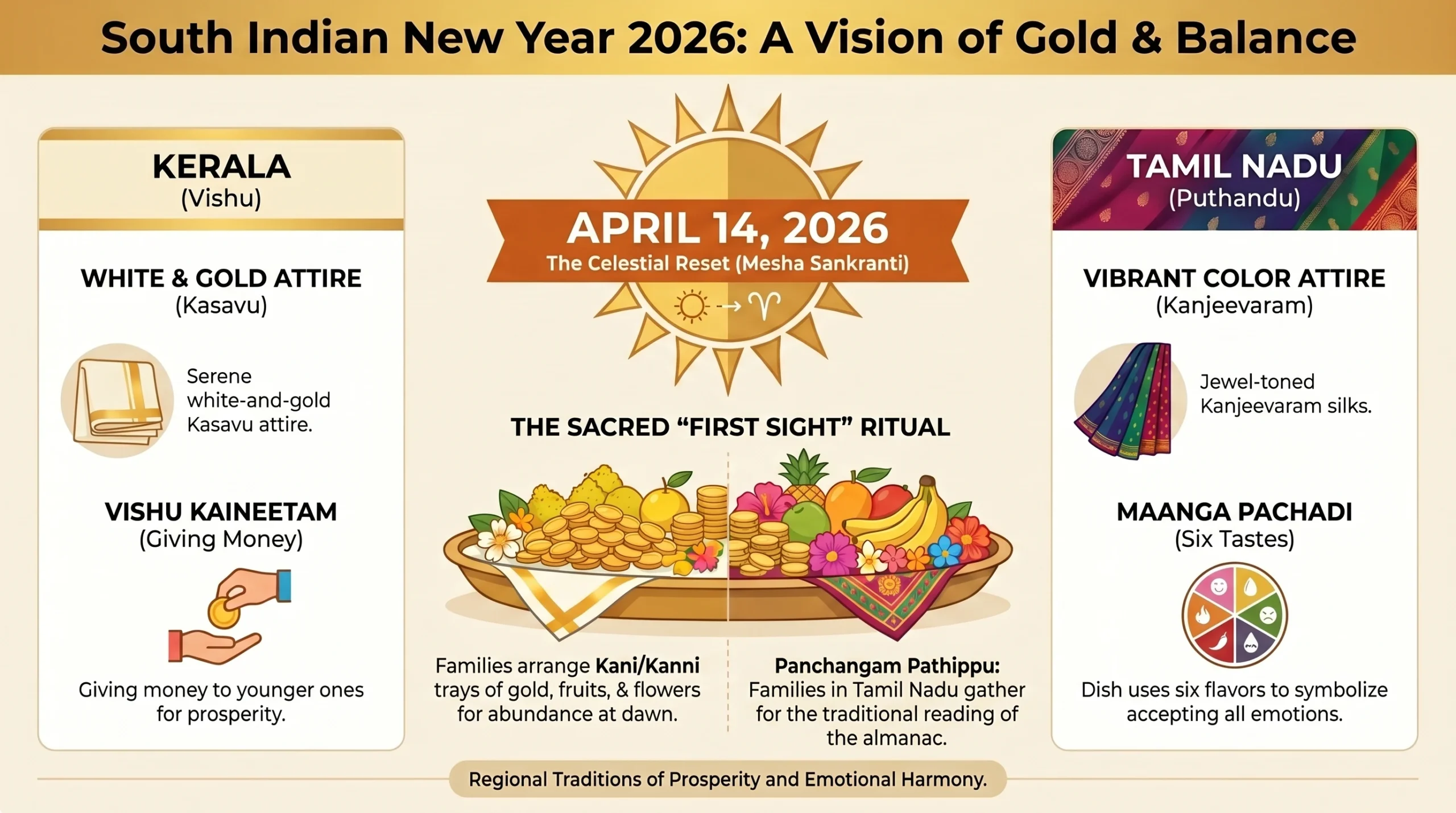
Welcome to the Season of New Beginnings: Vishu and Puthandu 2026
Close your eyes and imagine the perfect mid-April morning in South India. The air is thick with the sweet, intoxicating scent of jasmine, fresh raw mangoes, and ripening jackfruit. In the distance, the rhythmic ringing of temple bells blends seamlessly with the gentle rustle of coconut palms. But the true star of the season is the burst of brilliant yellow everywhere you look—the spectacular Kanikkonna (Golden Shower) flowers are in full bloom, draping the landscape in liquid gold. This isn’t just the arrival of spring; it is the breathtaking dawn of the South Indian New Year.
Every year, as the sun transits into the zodiac sign of Aries (a celestial event known as Mesha Sankranti), two of India’s most culturally rich and visually stunning festivals come alive: Vishu in Kerala and Puthandu in Tamil Nadu. Typically falling on April 14th or 15th, with both Vishu 2026 and Puthandu 2026 eagerly anticipated on these auspicious dates, these celebrations mark a time of profound spiritual renewal, deep agricultural gratitude, and joyous family reunions.
While much of the world pops champagne at midnight on January 1st, the Kerala New Year and the Tamil New Year are celebrated with an entirely different kind of magic. Here, the new year is welcomed not with loud countdowns in the dark, but with quiet, dawn-lit rituals meant to ensure that your very first sight of the year is one of absolute prosperity, devotion, and peace. It’s a time when elders pass down life lessons and blessings through gleaming coins, when homes are adorned with intricate, welcoming rice-flour patterns at their thresholds, and when kitchens become the heart of the house, churning out legendary feasts that beautifully balance every single flavor of life.
For the global diaspora, from the bustling streets of New York to the high-rises of Dubai, Vishu and Puthandu are more than just dates on a calendar—they are an emotional anchor. They represent that nostalgic WhatsApp video call back home, the frantic weekend search for imported mango leaves at the local Indian grocery store, and the fierce pride of wearing a pristine gold-bordered Kasavu sari or a vibrant Kanjeevaram silk thousands of miles away from the homeland. Whether you are celebrating in a traditional courtyard in Madurai, a serene backwater home in Kochi, or a snowy suburb in Canada, the essence of these South Indian harvest festivals remains untouched: a universal hope that the coming year will be as bright and abundant as the spring sun.
If you have ever wondered about the cultural difference between Vishu and Puthandu, or how these twin festivals weave ancient astronomy, agriculture, and mythology into modern-day celebrations, you are exactly in the right place. Perhaps you are a Malayali or Tamilian looking to recreate the authentic magic of your childhood for your own children, or maybe you are a culture enthusiast eager to understand the profound philosophy behind Tamil Nadu’s iconic six-taste Maanga Pachadi and Kerala’s sacred Vishu Kani arrangement.
The Roots of Renewal: Astronomy, Agriculture, and Mythology
To truly understand why Vishu in Kerala and Puthandu in Tamil Nadu hold such a sacred place in the hearts of millions, we have to look beyond the festive lights and the new clothes. The foundation of these celebrations is a brilliant tapestry woven from three distinct threads: the precision of ancient Indian astronomy, the rhythmic heartbeat of agriculture, and the timeless magic of Hindu mythology.
The Celestial Clock: Mesha Sankranti and the Solar Calendar
While the Gregorian calendar marks the New Year on a fixed winter date, the South Indian New Year is dictated by the stars. Both Vishu and Puthandu follow the Sidereal Solar Calendar. The festival marks Mesha Sankranti, the precise moment when the Sun enters the first sign of the zodiac, Mesha (Aries).
In the celestial cycle, this is often considered the Vernal Equinox—a time when day and night are nearly equal in length. For the people of Kerala, this marks the beginning of the month of Medam, while for Tamilians, it heralds the first day of Chithirai. This isn’t just a date on a page; it is a cosmic reset. It’s the universe signalling that the old cycle has closed and a vibrant, sun-drenched chapter is beginning.
The Earth’s Bounty: A Harvest of Gratitude
At its heart, the South Indian New Year is a harvest festival. In ancient times, the life of a community revolved around the paddy fields and the orchards. By mid-April, the summer heat is at its peak, and the land offers up its most prized treasures.
For a farmer in Kerala or Tamil Nadu, this period represents the culmination of hard work and the hope for future abundance. It is the season of the Golden Shower Tree (Laburnum cassia), known as Kanikkonna in Malayalam, which erupts in yellow blossoms specifically for this time of year. It is also the season of the King of Fruits. The sight of raw mangoes hanging heavy from trees and the aroma of ripening jackfruit are the true heralds of the New Year. By celebrating Vishu and Puthandu, families are essentially saying thank you to Mother Earth for the food on their plates and praying for fertile soil in the coming monsoon.
The Mythological Echo Tales of Gods and Creators
Beyond the stars and the soil lie the stories that give these festivals their soul. Each region carries its own divine narrative that explains why this day is so significant.
- Vishu and the Triumph of Light: One popular legend in Kerala links Vishu to the death of the demon king Narakasura at the hands of Lord Krishna. It is said that the sun had not risen from the East for a long time due to the demon’s tyranny; after his defeat, the sun finally graced the world again on the day of Vishu. Another beautiful lore suggests that this was the day Surya (the Sun God) returned to his full glory after the demon King Ravana was defeated, as Ravana had previously forbidden the sun from shining directly on his palace.
- Puthandu and the Dawn of Creation: In Tamil tradition, Puthandu is believed to be the day Lord Brahma, the Creator in the Hindu Trinity, began his divine work of creating the universe. It is a day of primordial energy—a Birthday of the Universe if you will. Additionally, it is said that on this day, Goddess Meenakshi of Madurai married Lord Sundareswarar, which is why the month of Chithirai is celebrated with such immense grandeur in the temple city of Madurai.
Whether it’s the alignment of the planets, the ripening of the mangoes, or the victory of a deity, the roots of Vishu and Puthandu remind us of a singular truth: life is a cycle of ending and beginning. By honouring these roots, we stay grounded in our heritage while reaching toward the golden light of the future.
Puthandu – The Joyous Dawn of the Tamil New Year
As the sun enters the first house of the zodiac, the state of Tamil Nadu transforms into a kaleidoscope of colours, aromas, and spiritual fervor. Puthandu, also affectionately known as Puthuvarusham, is the grand celebration of the Tamil New Year. Falling on the first day of the month of Chithirai, it is a day that vibrates with the promise of fresh starts and the comforting embrace of age-old customs. From the bustling streets of Chennai to the towering temple gopurams of Madurai, the air is thick with the greeting, Iniya Puthandu Vazthukal!
The Kanni Ritual: A Vision of Prosperity
Much like their neighbours in Kerala, Tamilians begin their New Year with a sacred first sight. On the eve of Puthandu, the elders of the house carefully arrange a tray known as the Kanni. This tray is a microcosm of abundance, featuring gold and silver coins, jewellery, betel leaves, areca nuts, seasonal fruits like mango, banana, and jackfruit, and a mirror.
The most vital element, however, is the Neem flowers (Veppam Poo) and gold-hued laburnum. Waking up to this sight is believed to set the tone for the entire year—a visual prayer that ensures the eyes see only beauty and bounty in the months to come.
The Philosophy of Maanga Pachadi: The Six Tastes of Life
If there is one dish that defines Puthandu, it is the iconic Maanga Pachadi. This isn’t just a side dish; it is a profound culinary lesson in stoicism and emotional intelligence. The recipe mandatorily includes six distinct flavours (Arusuvai), each representing a human emotion:
- Sweet (Jaggery): Symbolising joy and happiness.
- Sour (Raw Mango): Representing the setbacks and sour moments we all face.
- Bitter (Neem Flowers): A reminder that grief and pain are inevitable parts of growth.
- Pungent/Spicy (Chili/Pepper): Signifying anger or the fiery challenges of life.
- Salty (Salt): Representing the taste or interest in life and daily experiences.
- Astringent (Turmeric/Unripe Banana): Symbolizing the surprises and shocks that keep us alert.
By consuming this dish first, Tamilians acknowledge that the coming year will be a mix of all these experiences. It is a beautiful way of saying, I am ready for whatever life brings, with grace and balance.
The Art of the Threshold: Kolams and Thoranams
Walking through a Tamil neighbourhood on Puthandu morning is a visual treat. Every doorstep is adorned with a fresh Kolam—intricate geometric patterns drawn with rice flour. Unlike the everyday white Kolams, Puthandu calls for Padi Kolams adorned with red oxide (Kavi) borders, symbolizing auspiciousness.
Above the doors, you’ll see Thoranams—stringed garlands of fresh mango leaves. These aren’t just decorative; in traditional science, mango leaves are known to purify the air, welcoming guests into a home that is physically and spiritually cleansed.
Panchangam Pathippu: Consulting the Stars
A unique highlight of the Tamil New Year 2026 will be the Panchangam Pathippu. Families gather at local temples or in their living rooms to listen to the reading of the new year’s almanack (Panchangam). A priest or the eldest family member reads the predictions for the year, detailing how the planetary shifts will affect harvest, rainfall, and individual zodiac signs. It’s a moment of community bonding, where ancient astrology meets modern-day hopes.
Chithirai Thiruvizha: The Grand Spectacle
In the temple city of Madurai, Puthandu kicks off the world-famous Chithirai Thiruvizha. This month-long festival re-enacts the wedding of Goddess Meenakshi to Lord Sundareswarar. The energy is electric, with massive chariots pulled through the streets and millions of devotees gathering in a sea of faith. While Puthandu is a family affair at home, the Chithirai festival reminds us of the grand, communal scale of Tamil heritage.
From the bitter-sweet bite of the Pachadi to the vibrant swirls of the Kolam, Puthandu is a sensory reminder to live life fully, embracing every flavor with a smile. It is a day where the past is honored, the present is celebrated, and the future is welcomed with open arms.
Vishu vs. Puthandu: A Tapestry of Similarities and Differences
While they are celebrated by two different linguistic cultures, Vishu in Kerala and Puthandu in Tamil Nadu are like two branches of the same ancient tree. They share a celestial birthday, yet each has decorated its branches with unique local flavors, folklore, and flair. If you’ve ever wondered how to distinguish these two South Indian New Year celebrations, this comparison highlights the beautiful harmony between them.
The Shared Soul: Points of Convergence
At their core, both festivals are built on the foundation of gratitude and foresight. Both cultures believe that how you start your year determines its trajectory. This is why the first sight ritual—looking at auspicious items at the crack of dawn—is the most vital part of both festivals.
Whether it is a Malayali looking at the Vishu Kani or a Tamilian looking at the Puthandu Kanni, the goal is the same: to fill the subconscious mind with images of abundance (gold, fruits, grains, and light) before the distractions of the world take over. Furthermore, both festivals are deeply agricultural, celebrating the transition of the sun and the arrival of the spring harvest.
The Unique Flair: Key Differences
| Feature | Vishu (Kerala) | Puthandu (Tamil Nadu) |
| Primary Greeting | Vishu Ashamsakal | Puthandu Vazthukal |
| Floral Symbol | Kanikkonna (Golden Shower Tree) | Veppam Poo (Neem Flowers) |
| The “First Sight” | Focused on Lord Krishna and the Uruli | Focused on the Kanni tray and the Mirror |
| Signature Dish | Vishu Sadya (A massive vegetarian feast) | Maanga Pachadi (The symbolic 6-taste dish) |
| Key Tradition | Vishu Kaineetam (Giving money to younger ones) | Panchangam Pathippu (Reading the almanac) |
| Artistic Expression | Floral decorations and lamps | Kolams (Rice flour patterns) and Thoranams |
A Contrast in Flavours: Sadya vs. Pachadi
One of the most striking differences is found on the dining table. In Kerala, the focus is on the Vishu Sadya, a sprawling feast served on a banana leaf that emphasises the creamy sweetness of Payasam and the comfort of Vishu Katta (rice cakes cooked in coconut milk). It is a celebration of Sathvik richness.
In Tamil Nadu, while a grand lunch is certainly prepared, the philosophical heart of the meal is the Maanga Pachadi. While Kerala celebrates the Golden Dawn, Tamil Nadu celebrates the Balanced Dawn. The inclusion of bitter neem flowers in the Tamil feast is a unique cultural marker, emphasising the acceptance of sorrow alongside joy—a stark contrast to the purely celebratory palette of the Vishu feast.
The Sound of the Season
Vishu in Kerala is often punctuated by the sound of Vishu Padakkam (firecrackers). It is a loud, exuberant greeting to the new year. In contrast, Puthandu in Tamil Nadu, while joyous, tends to be more focused on the rhythmic sounds of temple bells and the scholarly chanting of the Panchangam (almanac) readings.
Why the Connection Matters
Despite these differences, the Tapestry of the South is woven tight. In border towns like Palakkad or Coimbatore, you will see families celebrating both, blending the traditions of the Kerala New Year and the Tamil New Year seamlessly. This overlap is a testament to the shared Dravidian heritage and the universal human desire to celebrate life’s cycles with beauty, food, and family.
Whether you are seeking the Golden Vision of Kerala or the Balanced Wisdom of Tamil Nadu, both festivals offer a profound way to hit the refresh button on your life.
Traditional Attire and Decor: The Visual Soul of the New Year
The beauty of Vishu and Puthandu 2026 isn’t just in the rituals or the recipes; it is written in the very fabric people wear and the way they transform their homes. In South India, dressing up for the New Year is an act of mindfulness—a way of signalling to the universe that you are ready to receive its blessings in your finest form. Whether you are stepping into a temple in Madurai or preparing the Kani in a quiet Kerala village, the aesthetic is one of Old World Elegance meeting Fresh Beginnings.
The Golden Thread: Kerala’s Iconic Kasavu
In Kerala, the color palette for Vishu is unmistakably white and gold. The traditional Kasavu Saree is the undisputed queen of the day. This handwoven cream-colored fabric with its shimmering gold zari border perfectly mirrors the golden Kanikkonna flowers of the season.
- For Women: Modern trends have seen a rise in Mural Art Kasavu sarees, where hand-painted depictions of Lord Krishna are featured on the pallu. Paired with traditional temple jewelry (Manga Mala or Palakka Mala), it creates a look that is both regal and rooted.
- For Men: The Mundu (dhoti) with a matching gold border is the standard. In 2026, the trend of pairing the traditional Mundu with a linen or silk shirt in soft pastels or festive maroons is a popular way to the heritage look for the younger generation.
Vibrant Silks: The Colourful Spirit of Puthandu
While Kerala leans toward the serene white and gold, Tamil Nadu celebrates Puthandu with a magnificent explosion of color. The streets are a sea of jewel tones—mustard yellows, parrot greens, deep magentas, and peacock blues.
- The Kanjeevaram Legacy: For a Tamilian woman, Puthandu is often an occasion to bring out a cherished Kanjeevaram silk saree. These sarees, known for their heavy gold borders and traditional motifs like peacocks (Mayil) or temple towers (Gopuram), represent the strength and richness of Tamil culture.
- Pattu Pavadai: For young girls, the Pattu Pavadai (silk lehenga) remains the quintessential New Year outfit, often accessorized with fresh jasmine flowers (Malli poo) in the hair.
- The Veshti: Tamil men typically wear the Veshti, often paired with a Sattai (shirt) or an Angavastram (shoulder cloth) to maintain the sanctity of the New Year prayers.
Decor: Bringing the Festival into the Modern Home
Decorating for Vishu and Puthandu is about more than just aesthetics; it’s about creating a high-vibration environment. Even if you live in a compact city apartment, these traditional elements can bridge the gap between house and home.
-
The Threshold (The Welcome):
-
-
- Kolams: For Puthandu, the entrance is marked by a fresh Padi Kolam. Using rice flour is a traditional nformation Gain secret—it serves as a symbolic offering to feed tiny insects, representing the interconnectedness of all life.
- Thoranams: Stringing fresh Mango Leaves and marigolds above the main door is a shared tradition. It is believed to ward off negative energy and keep the indoor air fresh during the peak summer heat.
-
- The Illumination (The Light):
-
- Nilavilakku: In Kerala, the tall brass oil lamp (Nilavilakku) is polished until it glows like gold. Lighting this lamp at dawn during the Vishu Kani is the most emotional moment of the day.
- Kuthuvilakku: Similarly, in Tamil homes, the Kuthuvilakku is lit to signify the removal of ignorance and the dawning of wisdom for the new year.
- The Floral Touch:
The use of fresh flowers is non-negotiable. While the Kanikkonna is the star of the Vishu setup, Puthandu decor relies heavily on the earthy scent of Neem flowers and the vibrant orange of Marigolds. These natural elements remind us that the most beautiful decor is provided by Mother Nature herself.
By choosing these traditional attires and decorating your space with intention, you aren’t just following a trend—you are participating in a living history that has endured for centuries. Whether you’re posing for a New Year selfie or sitting down for the family meal, these visual cues are what make the memories of Vishu and Puthandu truly unforgettable.
Celebrating Away from Home: The Global Diaspora and the Digital Dawn
For the millions of Malayalis and Tamilians living in the shimmering hubs of Dubai, the tech corridors of San Francisco, or the cosy suburbs of London, Vishu and Puthandu 2026 aren’t just festivals—they are powerful bridges to their roots. While the physical distance from the backwaters of Kerala or the temples of Tamil Nadu can be vast, the diaspora has mastered the art of keeping the South Indian Soul alive, proving that heritage is something you carry within you, no matter your GPS coordinates.
The Kani in a Global Living Room
In 2026, the tradition of the Vishu Kani or Puthandu Kanni has taken on a fascinating modern life. Diaspora families often spend weeks sourcing the essentials from local Indian grocers. Finding the elusive Kanikkonna (Golden Shower flower) in a chilly London spring or a Sydney autumn is a feat of community networking!
- The Digital Wake-Up: It’s now common for parents in India to wake up their children abroad via a WhatsApp video call. As the phone screen flickers to life, the first thing the Pravasi (expatriate) sees is the beautifully arranged Kani in their childhood home. It’s a tear-jerking, high-tech version of the ancient Kanikanal ritual that erases thousands of miles in a single second.
- Artificial but Authentic: Many in the diaspora have turned to high-quality silk or handcrafted artificial Kanikkonna flowers, which are reused every year—a sustainable and practical way to maintain the aesthetic of the Kerala New Year in climates where the real blossoms don’t grow.
Community Celebrations: From Church Halls to Cultural Centres
One of the most heartwarming trends for Vishu 2026 and Puthandu 2026 is the massive scale of community celebrations. Organisations like the World Tamil Diaspora or various Malayali Associations across the USA, UK, and Australia host grand weekend events.
These gatherings are more than just parties; they are Cultural Classrooms. Second and third-generation children perform Bharatanatyam or Mohiniyattam, and huge community Sadyas are served on parchment paper leaves that mimic the traditional banana leaf experience. For many young Tamilians and Malayalis born abroad, these community feasts are their primary connection to their ancestral flavours, like the sharp tang of Maanga Pachadi or the sweetness of Palada Pradhaman.
The Rise of the Global Sadya
Food is the ultimate universal language. In global culinary hubs like New Jersey or Toronto, specialised South Indian restaurants now offer Sadya in a Box or Puthandu Special Takeaway. These kits come complete with every single element—from the salt to the sharkara varatti—allowing busy professionals to enjoy an authentic 26-dish meal without spending three days in the kitchen.
A New Era of Heritage
The global diaspora is also leading the charge in making these festivals more inclusive and Social media is flooded with How-To guides for inter-cultural couples, explaining the significance of the South Indian harvest festivals to non-Indian partners. We see Vishu-themed brunch parties and Puthandu Kolam workshops that invite neighbors of all backgrounds to participate.
Ultimately, celebrating Puthandu and Vishu away from home is an act of love. It’s about the effort of wearing a Kasavu saree in a skyscraper, the scent of incense in a studio apartment, and the unwavering belief that no matter where you are in the world, the New Year is a chance to start again with a vision of gold and a heart full of hope.
Frequently Asked Questions about South Indian New Year
1. When are Vishu and Puthandu in 2026?
Both Vishu 2026 and Puthandu 2026 will be celebrated on Tuesday, April 14, 2026. This date marks the first day of the Medam month in the Malayalam calendar and the Chithirai month in the Tamil calendar, aligning with the Solar New Year.
2. What is the significance of the Vishu Kani?
The Vishu Kani (meaning the first thing seen) is a curated arrangement of auspicious items viewed at dawn. It is believed that the first object your eyes rest upon on New Year’s Day sets the tone for the rest of the year. Seeing symbols of abundance like gold, fruits, and flowers ensures a year filled with prosperity.
3. What are the essential items for a traditional Vishu Kani?
A traditional setup includes an Uruli (brass vessel) containing raw rice, golden cucumber, betel leaves, areca nut, a mirror (Valkannadi), gold coins, and yellow Kanikkonna flowers, all illuminated by a Nilavilakku (brass lamp) placed before an idol of Lord Krishna.
4. Why is Maanga Pachadi made on Puthandu?
Maanga Pachadi is a symbolic dish made of six tastes—sweet, sour, bitter, salty, pungent, and astringent. It represents the philosophy that life is a blend of different emotions (joy, sorrow, anger, etc.), and one must face the coming year with equanimity and balance.
5. What is the difference between Vishu and Puthandu?
While both celebrate the Solar New Year, Vishu is the New Year of Kerala and focuses on the Vishu Kani and Vishu Kaineetam (giving money). Puthandu is the Tamil New Year, characterised by the drawing of Kolams, the preparation of Maanga Pachadi, and the reading of the Panchangam (almanac).
6. What is Vishu Kaineetam?
Vishu Kaineetam is a heartwarming tradition where elders give a small amount of money to children and younger family members. This gesture symbolizes the sharing of wealth and the passing of blessings from one generation to the next.
7. Why are Kanikkonna flowers important for Vishu?
The Kanikkonna (Golden Shower tree) blossoms specifically during the Vishu season. Its vibrant yellow colour is associated with the sun and Lord Krishna’s glory. It is considered the most vital element of the Vishu Kani; without these golden petals, the Kani is considered incomplete.
8. What are the 6 tastes in Puthandu Pachadi?
The six tastes (Arusuvai) are:
- Sweet (Jaggery)
- Sour (Raw Mango)
- Bitter (Neem Flowers)
- Pungent (Green Chilli)
- Salty (Salt)
- Astringent (Turmeric/Raw Banana).
9. Do people fast on Vishu or Puthandu?
Generally, these are festivals of feasting rather than fasting. Families prepare elaborate vegetarian meals—the Vishu Sadya in Kerala and a festive lunch in Tamil Nadu. However, some devotees may observe a partial fast or consume only Sathvik (pure) food until the morning prayers are completed.
10. How do you wish someone on Vishu and Puthandu?
To wish someone a Happy Kerala New Year, say Vishu Ashamsakal. For the Tamil New Year, the traditional greeting is Iniya Puthandu Vazthukal. Both phrases translate to wishing someone a prosperous and happy new year.
Embracing the Light: A New Chapter with Vishu and Puthandu 2026
As the golden petals of the Kanikkonna settle and the lingering taste of Maanga Pachadi reminds us of life’s beautiful complexity, it becomes clear that Vishu and Puthandu are far more than just dates on a lunar-solar calendar. They are soulful reminders of our resilience, our deep-rooted connection to the earth, and the enduring power of family traditions. Whether you are performing the Kani in a traditional Kerala tharavadu or drawing a kolam on a sun-drenched porch in Tamil Nadu, these festivals invite us to pause, reflect, and reset our intentions for the year ahead.
In 2026, as we navigate a world that moves faster than ever, the slow, intentional rituals of the South Indian New Year offer a much-needed anchor. They teach us that while life will invariably bring a mix of sweetness and bitterness, approaching each moment with gratitude and a vision of gold makes the journey worthwhile. From the clinking of Kaineetam coins to the communal joy of a 26-dish Vishu Sadya, these celebrations weave a tapestry of belonging that transcends borders and generations.
As you step into this new season, may your home be filled with the glow of the Nilavilakku, your heart with the wisdom of the Panchangam, and your life with the abundance of a spring harvest. Whether you are celebrating locally or with the global diaspora, let the spirit of Vishu and Puthandu inspire a year of prosperity, peace, and purposeful beginnings.





Leave a Reply