
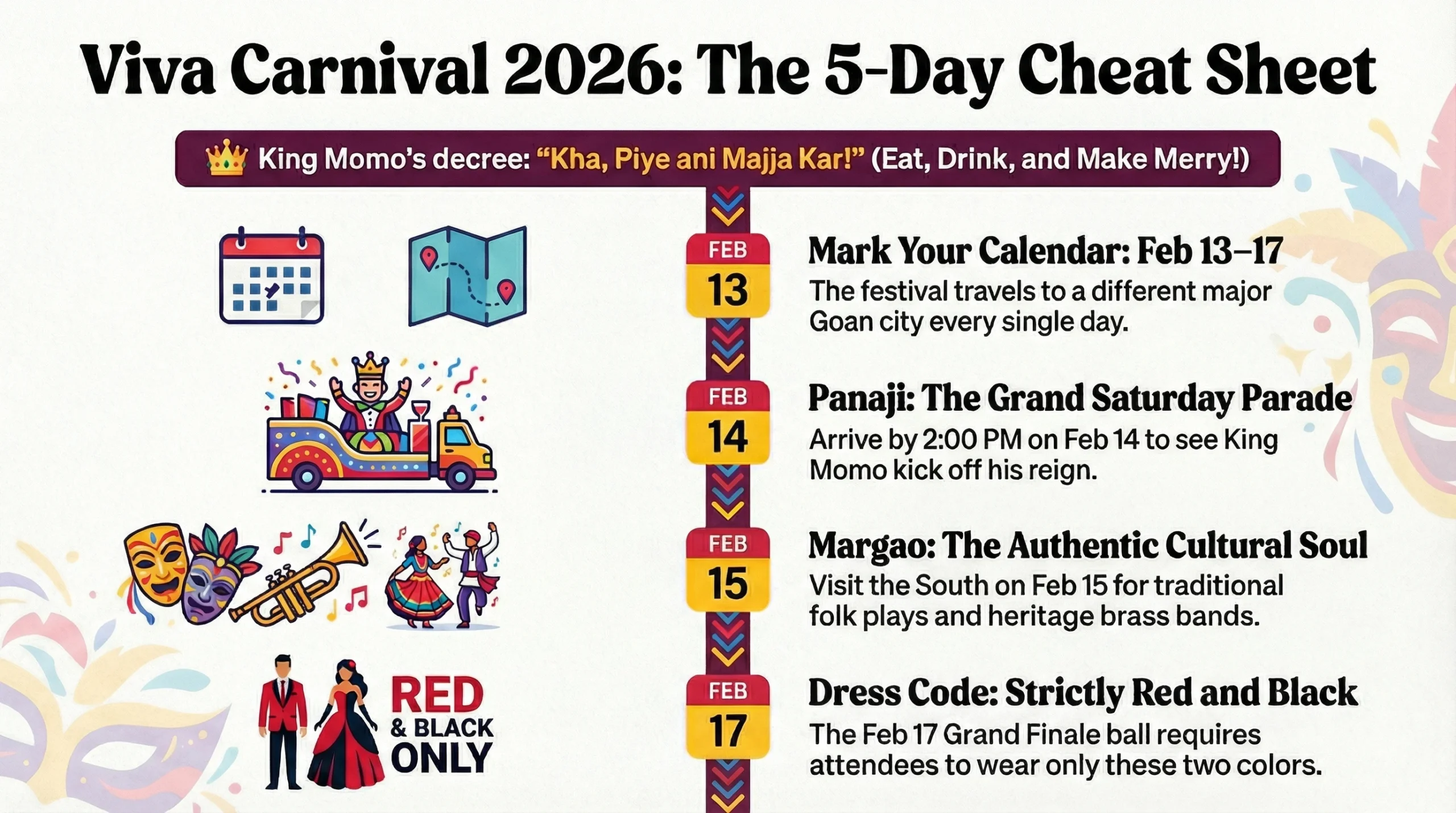
The Proclamation: Welcome to Viva Carnival 2026
If you feel a sudden surge of adrenaline and the rhythmic thumping of the Ghumot (Goa’s traditional clay drum) echoing in your chest, you aren’t imagining things. Goa Carnival 2026 has officially arrived, and it’s unlike any other street party on the planet. For five glorious days—from February 13th to February 17th—the “Susegad” state hits the pause button on reality to host a kaleidoscopic explosion of color, culture, and pure, unadulterated joy.
What is Viva Carnival?
At its heart, the Carnival is Goa’s final hurrah before the somber 40-day season of Lent begins. But don’t let the religious roots fool you; this is a high-octane celebration of Goan identity. Introduced by the Portuguese in the 18th century, it has evolved into a massive multicultural fiesta. Today, whether you are a digital nomad from London or a local fisherman from Colva, the slogan is the same: “Viva Carnival!”
The Arrival of King Momo
The magic officially begins when King Momo, the legendary “King of Chaos” and the symbolic ruler of the festivities, takes the stage. Every year, a local Goan personality is chosen to don the crown and flowing robes. His first order of business? Reading the Grand Proclamation.
As he stands atop his massive, glitter-drenched float in Panjim, King Momo bellows the decree that sets the state on fire:
“Kha, Piye ani Majja Kar!” (Eat, Drink, and Make Merry!)
With those five words, the streets of Panaji transform. The 2026 proclamation carries a special weight—it’s a call to celebrate Goa’s return to its eco-friendly roots, with many of this year’s floats focusing on sustainable “Junk Art” and local Konkani folklore.
Why 2026 is Trending
If you’ve been scrolling through Instagram or TikTok lately, you’ve likely seen the #GoaCarnival2026 hashtag blowing up. Travelers are no longer just looking for beer and beaches; they are seeking authentic experiences. 2026 is trending because of the “Travel” movement—people want to meet the artisans behind the masks and the dancers in the Khell Tiatr (traditional folk plays).
The atmosphere in Panaji on Saturday, February 14th, will be electric. Imagine thousands of revelers in feathered headpieces, brass bands playing Latin-infused jazz, and the smell of fresh Bebinca and Pork Vindaloo wafting from street stalls. It’s a sensory overload that makes your standard music festival look like a library session.
The Viva Carnival Vibe
This isn’t just a parade you watch from the sidelines; it’s a living, breathing entity. The Viva Carnival 2026 vibe is about inclusivity. You’ll see grandmas dancing next to Gen-Z influencers, and colorful floats that range from satirical political commentary to giant sea monsters made of recycled plastic.
As the King’s decree echoes from the Mandovi riverfront to the southern shores of Palolem, one thing is certain: for these four days, the only rule in Goa is to be happy. So, grab your mask, leave your worries at the Mandovi bridge, and prepare to lose yourself in the most vibrant street party in Asia.
Goa Carnival 2026 Official Dates & City Schedule
Mark your calendars and clear your PTO—the Goa Carnival 2026 is set to take over the coastal state from February 13th to February 17th, 2026.
Because this is a travelling festival, the main parade moves to a different major city each day. If you plan your stay right, you can experience the unique flavor of both the North and South Goa celebrations without missing a single beat.
Goa Carnival 2026: Master Schedule
| Date (2026) | Day | City (Venue) | Event Type |
| Feb 13 | Friday | Porvorim | Curtain Raiser & Festive Warm-up |
| Feb 14 | Saturday | Panaji (Panjim) | The Grand Carnival Parade (King Momo’s Decree) |
| Feb 15 | Sunday | Margao | South Goa’s Cultural Extravaganza |
| Feb 16 | Monday | Vasco da Gama | Street Feasts & Family Float Parade |
| Feb 17 | Tuesday | Mapusa & Morjim | Grand Finale & Traditional Red and Black Dance |
Daily Breakdown: What to Expect in Each City
Feb 13: Porvorim (The Teaser)
The festivities kick off just outside the capital in Porvorim. This “Curtain Raiser” is perfect for those who want to see the floats up close before the massive crowds descend on Panjim the next day. It’s a local favorite, featuring school troupes and traditional dancers.
Feb 14: Panaji (The Main Event)
This is the day everyone waits for. Panaji hosts the Main Float Parade, where King Momo officially kicks off his four-day reign. The energy here is unmatched—expect the biggest crowds, the most elaborate corporate and traditional floats, and a riverfront glowing with neon lights and streamers.
Feb 15: Margao (The Cultural Soul)
If you find Panaji too hectic, Margao offers a more “authentic” experience. The South Goa parade is known for its deep focus on Goan heritage, featuring more Khell Tiatr (folk plays) and local brass bands that have been playing for generations.
Feb 16: Vasco da Gama (The Port City Party)
Vasco brings a gritty, industrial charm to the Carnival. The parade here runs through the heart of the city near the railway station. It’s famous for its street food pop-ups—this is where you go to try the best Choris Pão (spicy Goan sausage bread) while watching the floats pass by.
Feb 17: Mapusa & Morjim (The Grand Finale)
The Carnival ends with a bang in the North. Mapusa hosts a vibrant community parade, while Morjim has recently become a trending spot for a “beach-vibe” finale. The night concludes with the legendary Red and Black Dance—a formal ball where everyone dresses in these two colors to celebrate the end of the indulgence.
Pro-Traveler Timing Tip
While the parades officially start around 3:30 PM or 4:00 PM, the “vibe” begins much earlier. To snag a front-row spot along the barricades for those perfect Reels and TikToks, you’ll want to arrive at the city center by 2:00 PM.
The King Momo Parade: Route Maps & Prime Viewing Spots
To truly conquer the Goa Carnival 2026, you need to know exactly where the rubber meets the road—or rather, where the glitter meets the pavement. While the parades are sprawling, the “sweet spots” for that perfect aerial drone-style photo or a front-row seat to King Momo’s decree are highly specific.
Here is your tactical map for the main parade routes and the local-approved spots to dodge the heaviest “human walls.”
1. The Panaji Grand Parade (Feb 14, 2026)
This is the “Super Bowl” of the Goa Carnival. The route is linear, stretching along the Mandovi River, offering a stunning backdrop of cruise boats and the Atal Setu bridge.
-
Official Route: New Patto Bridge → D.B. Bandodkar Road → Campal Ground.
-
The Starting Line: The energy is highest at the New Patto Bridge (near the KTC Bus Stand). This is where King Momo’s float first appears.
-
The Mid-Point: The stretch near the Old Secretariat and Panjim Church offers a classic heritage vibe, but it is notoriously crowded.
-
Prime Viewing Spot (The Pro Choice): Head toward the Campal Ground entry stretch. The roads are wider here, the floats move slower as they prepare to exit, and you have a much better chance of catching a high-five from a performer without being squashed.
2. The Margao Parade: South Goa’s Pride (Feb 15, 2026)
Margao is the cultural heart of the South. The parade here feels more intimate and community-driven.
-
Official Route: Holy Spirit Church → Margao Municipal Council (MMC) Square.
-
The Starting Point: The Holy Spirit Church area provides an incredible architectural backdrop for photography. The elevated sidewalks here give you a natural “grandstand” view.
-
Prime Viewing Spot: The Municipal Council Square. This is the designated “performance zone” where floats often pause for 2–3 minutes to perform their skits or dance routines for the judges.
3. Vasco & Mapusa: The Local Favourites (Feb 16 & 17, 2026)
-
Vasco (Feb 16): The parade runs along Swatantra Path (near St. Andrew’s Junction). The best spot is near Joshi Chowk or the Railway Station area, where the street is broad and the food stalls are plentiful.
-
Mapusa (Feb 17): The final hurrah happens from Milagres Church to the Comunidade Ground. The area behind the church is usually less congested, allowing families to enjoy the floats without the Panjim-level frenzy.
How to “Hack” the Parade View
-
The “60-Minute Rule”: If the parade starts at 3:30 PM, the barricades will be three-deep by 2:45 PM. Reach your chosen spot by 2:15 PM to claim your territory.
-
Elevation is King: If you can book a balcony seat at a café along D.B. Bandodkar Road (like those near the Panjim ferry wharf), do it. You’ll be above the heat and the crowds.
-
Avoid the “S-Bends”: Don’t stand at sharp turns. Floats tend to cluster there, and the crowd pressure becomes intense as everyone tries to lean in for a photo.
-
Follow the Light: For the best photos, stand with the Mandovi River at your back during the Panjim parade. This ensures the afternoon sun hits the faces of the performers directly, giving you that vibrant, high-contrast “trending” look.
Traffic Restrictions & Survival Guide: Your Goa Carnival 2026 Tactical Blueprint
Let’s be real: during Carnival, Goa’s traffic transitions from “relaxed tropical pace” to “absolute gridlock” in a matter of minutes. As a traveler, your biggest enemy isn’t the February sun—it’s the road closure you didn’t see coming.
To help you outrank the chaos (and your competitors), here is the utility guide for navigating Goa Carnival 2026 like a seasoned local.
1. Major Road Closures & Timing
Expect the “Iron Curtain” to fall on major city routes starting at 2:00 PM daily from Feb 13–17.
-
Panaji (Feb 14): The D.B. Bandodkar Road (the main riverfront stretch) will be closed to all vehicular traffic from the Patto Bridge to the Campal Ground. This effectively cuts off the main artery of the city.
-
Margao (Feb 15): Traffic diversions will be in place around the Holy Spirit Church and the Old District Court area.
-
Vasco (Feb 16): Swatantra Path will be off-limits to cars. If you are catching a train from the Vasco station, give yourself an extra 60 minutes.
2. The Parking Hacks (Where to Leave Your Wheels)
Parking near the parade is a myth. If you try to park on the street, you risk a heavy fine or a long walk to a towing pound.
-
Panaji: Use the Multi-level Parking at Patto or the open grounds near the KTC Bus Stand. From there, it’s a 10-minute walk to the start of the parade.
-
Margao: Look for designated parking near the KTC Bus Stand (Fatorda) or the SGPDA Market Ground. Avoid the narrow lanes of the main market.
-
The “Secret” Strategy: Park at least 2 kilometers away from the city center and use a Pilot (Goa’s famous motorcycle taxi) or a rented scooter to get closer. They can navigate the “Gallis” (lanes) that cars cannot.
3. Local Transport Survival Tips
-
GoaMiles is your Best Friend: Download the GoaMiles app before you land. It’s the only reliable way to get a government-regulated taxi rate.
-
Pilot Bikes: For solo travelers, the “Pilots” in their yellow vests are the fastest way to bypass traffic snarls.
-
Avoid the Bridges during Peak Hours: If you are staying in Candolim but want to go to the Margao parade, cross the Mandovi Bridge before 1:00 PM. By 4:00 PM, the bridge becomes a bottleneck.
4. The “Carnival Survival Kit”
If you’re planning to be on your feet for 4+ hours, you need more than just a mask.
-
Hydration: The February temperature in Goa averages 20°C to 32°C. Carry a reusable water bottle; single-use plastic is heavily discouraged (and often banned) at float sites.
-
Cash is King: While UPI is everywhere, network congestion in massive crowds can make digital payments fail. Keep ₹500–₹1000 in small change for street snacks and masks.
-
Power Bank: Between 4K reels of the floats and using GPS to find your way out of the crowd, your battery will drain by 6:00 PM.
-
The Exit Plan: Don’t wait for the very last float to leave. Start moving toward your transport 30 minutes before the finale to beat the mass exodus.
Beyond the Parade: Red and Black Dance & Street Parties
When the last float pulls into the Campal Ground and the sun dips below the Mandovi River, the real spirit of Goa Carnival 2026 shifts from the spectators to the dancers. If you think the parade is the peak, you haven’t seen Goa under the moonlight. This is when the formal tradition of the Portuguese era meets the high-energy pulse of modern nightlife.
1. The Iconic Red and Black Dance (The Finale)
The Red and Black Dance is the crown jewel of the Carnival’s social calendar. Traditionally held on the final night—Tuesday, February 17, 2026—this isn’t just another club night; it’s a high-society masquerade ball that has spilled onto the streets.
-
The Venue: Traditionally hosted at Samba Square (Garcia de Orta Garden) in Panaji, the square transforms into a massive open-air ballroom.
-
The Dress Code (Non-Negotiable): You must wear red and black. Whether it’s a sharp tuxedo with a crimson bow tie or a flowing black gown with red lace, the visual of thousands of people moving in unison in these two colors is a viral moment waiting to happen.
-
The Vibe: Expect a live brass band playing a mix of Portuguese Corridinho, legendary Goan Mando, and modern retro hits. It’s an elegant yet wild farewell to the festivities before the quiet of Lent begins at midnight.
2. Samba Square: The Heartbeat of Panaji
Throughout the Carnival (Feb 14–17), Samba Square acts as the central hub for street parties. Unlike the transient parades, the party here is permanent.
-
Daytime: Great for families with “Junk Art” workshops and local storytelling.
-
Nighttime: Becomes an open-air dance floor. Look out for live performances from famous Goan bands like Lorna or The Cascades.
3. Street Food Pop-ups: A Culinary Carnival
You haven’t truly “lived” the Carnival until you’ve eaten your way through it. The streets are lined with stalls that only appear this time of year.
-
Must-Try: Look for Choris Pão (spicy Goan sausage tucked into fresh local bread) and Pork Sorpotel.
-
The Feni Experience: Seek out community bars in Fontainhas or the SGPA Grounds in Margao. This year, “Carnival-style Feni Cocktails”—blended with Limca, salt, and green chili—are the trending drink of choice.
-
Sweet Finish: Grab a slice of Bebinca or some hot Ros Omelette from a roadside cart to fuel your late-night dancing.
4. Beachside After-Parties (The North Goa Trend)
While the cultural soul stays in the cities, the high-energy “afters” move to the coast.
-
Morjim & Vagator: With the Morjim parade happening on the finale day (Feb 17), the beach shacks here host “Carnival Sunsets” featuring Afro-house and Techno beats.
-
Casa Bacardi at W Goa: Keep an eye on venues like W Goa and HillTop, which often host themed events during the Carnival week for those who want a more “festival” music experience.
5. Margao’s Cultural After-Party (Feb 15)
In South Goa, the party at the SGPA Grounds is where the locals go. It’s more grounded, featuring traditional folk dances like Fugdi and Dekhni before transitioning into a massive community jam session.
A Local’s Itinerary: How to Experience Carnival Like a Goan
If you want to move beyond the tourist traps and experience Goa Carnival 2026 the way a true “Goenkar” (local) does, you need to ditch the main roads and follow the sound of the brass bands into the neighborhoods. Locals don’t just “watch” the Carnival; they live it through community feasts, secret courtyard dances, and morning traditions that most tourists sleep through.
Here is your curated, 3-day “Local’s Itinerary” to ensure your 2026 trip is authentic and SEO-trending.
Day 1: The Panjim Deep Dive (Saturday, Feb 14)
-
10:00 AM – Breakfast in Fontainhas: Start your day in the Latin Quarter. Skip the hotel buffet and head to Confeitaria 31 de Janeiro. Order a Pastel de Nata and watch the locals decorate their colorful balconies with streamers.
-
2:00 PM – The “High View” Strategy: Instead of standing on the street for the main parade, find a local friend with a balcony on D.B. Bandodkar Road or book a window seat at a riverside cafe. Watching the King Momo parade from a height allows you to see the intricate choreography of the dancers that you miss from the ground.
-
7:00 PM – The Fontainhas After-Party: Once the parade ends, don’t leave Panjim. Walk back into the narrow lanes of Fontainhas. Small bars like Joseph Bar or Miski Bar become the epicenter of local gossip and impromptu singing sessions.
Day 2: South Goa’s Cultural Heart (Sunday, Feb 15)
-
11:00 AM – Khell Tiatr in the Villages: Before heading to the Margao parade, drive through the villages of Raia or Loutolim. Look for colorful posters announcing Khell Tiatr—traditional street plays. These are the soul of the Carnival, featuring satirical comedy and local music performed in open fields.
-
4:00 PM – The Margao Experience: The South Goa parade is where the “real” heritage floats are. It’s less commercial and more community-focused.
-
8:00 PM – Dinner at a “Taverna”: Seek out a traditional Goan tavern in the South for a glass of Urrack (the first distillate of cashew, which is in season in February). Pair it with Chonak (Giant Sea Perch) fry.
Day 3: The “Susegad” Finale (Tuesday, Feb 17)
-
12:00 PM – Mapusa Market Run: Head to the Mapusa market to see the final preparations. This is where you buy your authentic masks and traditional Goan sweets like Dodol and Pinaca to take home.
-
4:00 PM – The Morjim Sunset: For a modern twist, watch the parade in Morjim. It’s smaller, sunnier, and ends right on the beach.
-
9:00 PM – The Red and Black Dance: This is non-negotiable. Put on your best red and black attire and head to the Garcia de Orta garden. Dance until the clock strikes midnight, signalling the end of the indulgence and the start of Ash Wednesday.
Local Secrets for 2026
-
The “Mask” Rule: Don’t buy the cheap plastic masks from the roadside stalls. Look for local artisans selling hand-painted papier-mâché masks—they make for better photos and better souvenirs.
-
Avoid the Noon Sun: Locals stay indoors between 12:00 PM and 2:30 PM. Use this time for a heavy Goan fish thali lunch and a siesta so you have the energy to dance until 2:00 AM.
-
Stay in a Heritage Home: To truly feel the vibe, stay in a Heritage Homestay in São Tomé or Campal. Being able to walk to the festivities means you don’t have to worry about the traffic restrictions we discussed earlier.
Photography & Social Media Tips: Capturing the 2026 Viral Moments
In 2026, a static photo isn’t enough to outrank the competition. With the “Travel” trend peaking, your audience wants to feel the bass of the drums and the spray of the color. To make your Colcasac.com content go viral, you need to master the art of capturing motion without losing the “vibe.”
1. The Creator’s Shot List: Trending Perspectives
-
The “King’s Eye” View: If you can get to a balcony in Fontainhas or a riverside café on D.B. Bandodkar Road, use a wide-angle lens (16mm–24mm) to capture the “sea of red and black” flowing through the narrow streets.
-
The Motion Blur (Energy): Don’t just freeze the action. Use a slower shutter speed (1/15s to 1/30s) while “panning” with a dancer. This creates a sharp subject with a blurred, energetic background—perfect for high-engagement Instagram covers.
-
Macro Details: Zoom in on the textures—the hand-painted papier-mâché masks, the steam rising from a Ros Omelette stall, or the sweat on a drummer’s brow. These “sensory” shots perform better on Pinterest and in Google Image searches.
2. Camera Settings for the Golden Hour Parade
The Panjim parade hits its peak right during the Golden Hour (5:30 PM – 6:30 PM).
-
Aperture: Keep it wide (f/2.8 or f/4) to separate the colorful performers from the messy crowds.
-
Auto ISO: Since you’ll be moving between shadows and bright riverfront sun, set your ISO to Auto (with a cap at 3200) so you don’t miss a sudden King Momo appearance while fiddling with dials.
-
Focus Mode: Switch to AF-C (Continuous AF) with face tracking. 2026 camera tech is brilliant at locking onto masked faces—let the AI do the heavy lifting.
3. Social Media Strategy & Trending Hashtags
To outrank competitors, you need to tap into the 2026 “Tropical Edition” energy.
-
Short-Form Video (Reels/TikTok): Use the first 3 seconds to show a high-energy transition—like a “snap” from a quiet heritage street to the middle of the Samba Square dance floor.
4. The “Anti-Influencer” Tip (For Authenticity)
The biggest trend in 2026 is unfiltered authenticity. Post a “Behind the Scenes” of the traffic chaos or a candid shot of a local family sharing a meal. Humanizing the “struggle” of navigating the carnival makes your guide more trustworthy than a polished, corporate travel brochure.
Accommodation Guide: Where to Stay to Beat the Rush
Choosing where to drop your bags for Goa Carnival 2026 is the difference between a seamless cultural immersion and a logistical nightmare. With traffic diversions cutting off major city arteries, your “home base” determines how much of the parade you’ll actually see—and how much time you’ll spend stuck in a taxi.
In 2026, the trend has shifted toward “Hyper-Local Stays.” Travelers are ditching the isolated mega-resorts for heritage homes and boutique stays that offer walking access to the festivities. Here is the breakdown of the best zones to stay in to beat the Carnival rush.
1. Panaji (Panjim): The “Front Row” Experience
If you want to be in the thick of the action, Panaji is the place to be. However, you must stay inside the city limits to avoid the bridge traffic.
-
The Vibe: High energy, walkable, and historic.
-
Best For: Photography enthusiasts and those who want to attend the Red and Black Dance without worrying about a 2 AM commute.
-
Where to Look: * Fontainhas (The Latin Quarter): Look for heritage villas like WelcomHeritage Panjim Inn or boutique guesthouses. You’ll wake up to the sound of brass bands practicing in the lanes.
-
Campal: A quieter, upscale residential area that sits right at the end of the parade route. It’s perfect for a quick escape back to your room once the floats pass.
-
2. Porvorim: The Strategic Middle Ground
Located just across the Mandovi Bridge from Panaji, Porvorim is the tactical choice for the “curtain raiser” on Feb 13th.
-
The Vibe: Suburban, convenient, and slightly more affordable than the capital.
-
Best For: Digital nomads and travelers who want easy access to both the North Goa beaches and the Panjim parades.
-
The “Hack”: Stay here if you have a scooter. You can zip across the bridge before the 2 PM closures and park at the Patto multi-level parking lot.
3. Margao & Raia: The Southern Soul
To experience the Carnival’s cultural roots (and the Feb 15th parade), head South.
-
The Vibe: Authentic, lush, and community-driven.
-
Best For: Families and travelers who prefer Khell Tiatr (folk plays) over loud EDM parties.
-
Where to Look: Search for homestays in Raia or Loutolim. These villages are just 15 minutes from Margao and offer a “Susegad” lifestyle that feels worlds away from the North’s chaos.
4. Morjim & Ashwem: The “Beach Finale” Stay
With the Grand Finale moving toward the North Goa coast on Feb 17th, the “New Goa” crowd is gravitating toward the turtle beaches.
-
The Vibe: Bohemian, upscale, and sunset-focused.
-
Best For: Those who want to pair the Carnival with North Goa’s famous nightlife and beach shack culture.
-
Pro Tip: Look for “Eco-Resorts” along the Morjim riverfront to stay close to the Tuesday parade route.
Booking Tips for 2026
-
The “Carnival Premium”: Expect prices to hike by 30-40% during these five days. Book your stay at least 45 days in advance to secure a spot.
-
Verify Walkability: Use Google Maps to check the walking distance from your hotel to the D.B. Bandodkar Road. If it’s more than 2km, you’ll be dependent on local transport, which becomes scarce during parade hours.
-
Check for “Carnival Packages”: Many heritage hotels in Panjim offer “Carnival Passes” or rooftop viewing access as part of their room rate—always ask before you finalise.
Frequently Asked Questions about the Goa Carnival 2026 Guide
To outrank the competition, your pillar page must answer the specific, long-tail queries travelers are typing into Google right now. Here are the top 10 most-searched FAQs for Goa Carnival 2026, answered with a human touch and local precision.
1. What are the official Goa Carnival 2026 dates?
The Goa Carnival 2026 runs for five days, from February 13th to February 17th, 2026. The festivities move across the state, starting with the Curtain Raiser in Porvorim and culminating in the grand finale dances in Mapusa and Morjim on Shrove Tuesday.
2. Do I need to buy tickets for the Goa Carnival parades?
No, the main street parades in Panaji, Margao, Vasco, and Mapusa are completely free to attend for the public. However, exclusive events like the Red and Black Dance at Samba Square or private cruise parties along the Mandovi River do require paid tickets, which should be booked in advance.
3. What time do the parades usually start?
While the “vibe” builds up by noon, the official float parades typically begin between 3:30 PM and 4:00 PM and continue until sunset (around 6:30 PM or 7:00 PM). For the best viewing spots, especially in Panaji, we recommend arriving by 2:00 PM.
4. Is there a dress code for the Goa Carnival?
For the street parades, there is no official dress code—bright, breathable cotton clothes are best. However, if you attend the Red and Black Dance on the final night, the dress code is strictly Red and Black. Many locals also wear masks, feathered hats, and vibrant wigs to join the fun.
5. Which city has the “best” Carnival parade?
The Panaji (Panjim) parade on Saturday, February 14th, is the largest and most famous, featuring the arrival of King Momo. If you prefer a more cultural, “local” experience with fewer tourists, the Margao parade on Sunday is highly recommended.
6. Are there traffic restrictions in Panaji during the Carnival?
Yes. Major roads, specifically the D.B. Bandodkar Road (riverfront), are closed to all vehicles from 2:00 PM onwards on the day of the parade. Parking is redirected to the outskirts, so plan to walk at least 1–2 kilometers to reach the viewing areas.
7. Is the Goa Carnival safe for solo female travelers?
Absolutely. The Carnival is a family-friendly event with a heavy police presence. However, like any massive street festival, it gets very crowded. We suggest staying on the outer edges of the parade route for an easy exit and keeping your valuables in a front-facing crossbody bag.
8. Can I join the parade and dance with the floats?
The main floats are restricted to registered participants and troupes. However, there are often “Fun Junk” categories and community groups where spectators are encouraged to dance along the sidelines. Just be respectful of the performers’ space!
9. What is the weather like in Goa in February?
Expect perfect tropical weather. Temperatures range from a pleasant 20°C at night to a warm 32°C during the day. It is peak sunshine season, so sunscreen, a hat, and plenty of water are essentials for your survival kit.
10. Where is the best place to stay for Carnival 2026?
To beat the traffic, stay in Panaji or Fontainhas. If you prefer a more relaxed schedule, Margao is excellent for the South Goa leg. If you’re coming for the beach and the finale, look at Morjim or Vagator.



Leave a Reply