
The Sweet Spot of Indian Travel
Let’s be honest: planning a getaway in India can often feel like playing a high-stakes game of weather roulette. Travel too early in the year, and the northern mountain passes are completely inaccessible, buried under feet of snow. Wait just a few weeks too long, and you are suddenly battling the relentless, scorching Indian summer, practically forced to spend your entire vacation indoors hugging the air conditioner.
But right in the middle of these extremes lies the ultimate travel hack. Welcome to March—the undisputed sweet spot of Indian travel.
If you are currently searching for the best places to visit in India in March, you are already one step ahead of the crowd. In the travel community, this month is widely celebrated as the perfect “shoulder season.” It is that fleeting, magical window when the subcontinent officially sheds its heavy winter coat but hasn’t yet surrendered to the intense tropical heatwaves of May and June. The skies are a brilliant, cloudless blue, the humidity levels are remarkably low, and the diverse landscapes across the country are bursting into vibrant spring life.
It is the one time of year when the entire map is your playground. Picture yourself traversing the country from Tawang to Coorg without having to worry about extreme weather ruining your itinerary. Up in the Northeast, the harsh winter frost melts away to reveal stunning valleys carpeted in blooming rhododendrons and orchids, making high-altitude monasteries accessible and welcoming. Down in the southern peninsula, the hill stations are waking up. The sprawling coffee estates and spice plantations are a lush, vibrant emerald green, offering a misty, aromatic refuge that feels worlds away from the bustling cities.
And, of course, we cannot talk about spring travel in India without mentioning the cultural heartbeat of the season. March brings with it a palpable, infectious energy, culminating in the chaotic, colorful, and utterly unforgettable nationwide celebrations of Holi. The wildlife reserves are also hitting their peak visibility; as the dense winter foliage thins out and the days grow warmer, the chances of spotting a Royal Bengal Tiger lounging by a waterhole skyrocket.
However, with a subcontinent this massive and geographically diverse, narrowing down your dream itinerary can feel incredibly overwhelming. Where do you even begin when nearly every single state is experiencing its absolute best weather of the year?
That is exactly why we created this comprehensive pillar guide right here at Colcasac. We know you aren’t just looking for a generic, scraped-together listicle. You are looking for an immersive, expertly curated roadmap for your next adventure. Whether you are a solo backpacker chasing the adrenaline rush of white-water rafting, a couple seeking a romantic retreat among the tea gardens, or a family hoping for a cultural deep-dive into Rajasthan’s royal forts, we have mapped it all out. Grab a cup of coffee, settle in, and let’s explore the ultimate, definitive guide to India’s golden month of travel.
Why March is the Golden Month for Exploring India
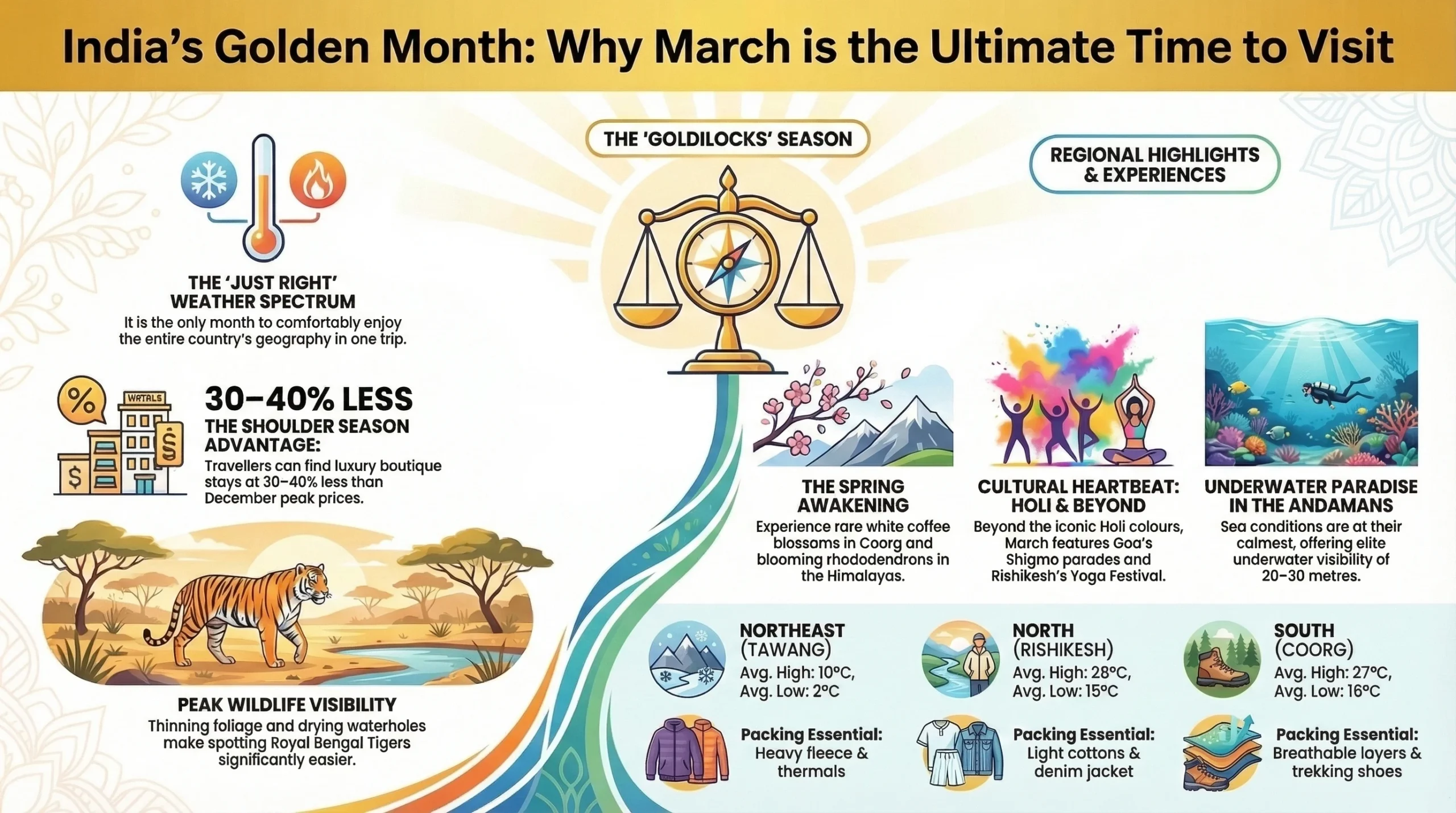
If India had a “Goldilocks” season, March would be it. It is the precise moment when the climate, culture, and nature align to create a travel window that is neither too harsh nor too unpredictable. For anyone looking to maximize their PTO, here is exactly why the best places to visit in India in March offer such a high return on adventure.
1. The “Just Right” Weather Spectrum
Weather is the single biggest factor in Indian travel, and March is the only month where you can realistically enjoy the entire country’s geography in one trip.
- The North: The bone-chilling Himalayan winter begins to retreat. While you’ll still find snow in places like Tawang or Gulmarg, the roads are finally clear, and the “sun-on-your-face” warmth makes outdoor exploration a joy rather than a survival test.
- The South & Coasts: In regions like Coorg and Goa, the humidity hasn’t yet hit its peak. You get those iconic tropical vibes—balmy breezes and golden sunsets—without the oppressive, energy-draining heat that arrives in April.
2. Wildlife Sightings are at an All-Time High
For nature enthusiasts, March is arguably the best time for a safari. As the landscape dries out after the winter, the thick jungle undergrowth thins significantly. This “opening up” of the forest makes it much easier to spot elusive predators like leopards and tigers. Furthermore, as natural water holes inside the parks begin to dry up, animals are forced to frequent the main watering holes more often, leading to spectacular, high-probability wildlife encounters in parks like Ranthambore, Kanha, and Kaziranga.
3. A Symphony of Spring Blooms
While the rest of the world waits for April showers, India is already in full bloom by March. This is the month of the “Spring Awakening.”
- In the Northeast, valleys transform into a riot of color with wild rhododendrons and rare orchids.
- In the Western Ghats, the coffee plantations are often covered in white blossoms that look like a dusting of snow and carry a scent similar to jasmine. It’s a sensory experience that you simply cannot capture during the monsoon or winter.
4. The Cultural High: Holi and Beyond
March is synonymous with Holi, the festival of colors. Experiencing Holi in India is a bucket-list item for global travelers, but the month offers more than just one festival. From the Shigmo parade in Goa to the International Yoga Festival in Rishikesh, the country is buzzing with a unique “spring energy.” It’s a time of renewal and celebration, where the local hospitality is at its most vibrant.
5. The “Shoulder Season” Advantage
By mid-March, the massive influx of “winter sun” tourists begins to taper off. This results in a sweet spot for your budget:
- Better Rates: You can often find luxury boutique stays at a fraction of their December prices.
- Photographer’s Dream: Iconic monuments like the Taj Mahal or the forts of Rajasthan are slightly less crowded, allowing you to capture those perfect, “human-free” shots for your feed.
The Northern Escapes & The Northeast Frontier
When the plains of India begin to simmer, the high-altitude regions of the North and the mist-laden hills of the Northeast offer a literal breath of fresh air. March is a transformative month here; it’s the season where “winter wonderland” meets “spring awakening.”
Tawang, Arunachal Pradesh: The Land of Dawn-Lit Mountains
Tawang in March is nothing short of cinematic. As one of the most sought-after best places to visit in Northeast India, it offers a rare glimpse of snow-capped peaks softening under the spring sun.
- The Experience: The iconic Tawang Monastery—the second largest in the world—glows against the backdrop of the Himalayas. By mid-March, the frozen Sela Pass begins to thaw, creating a dramatic landscape of half-frozen lakes and shifting mist.
- The Highlight: Keep your camera ready for the blooming rhododendrons. The valleys start to flush with pinks and reds, providing a stunning contrast to the rugged, high-altitude terrain.
Shillong, Meghalaya: The Scotland of the East
If you’re looking for a vibe that’s more “refreshing drizzle and rolling hills” than “rugged peaks,” Shillong is your March destination.
- The Experience: The weather is arguably the best of the year—cool enough for a light jacket but warm enough for all-day trekking. Explore the living root bridges nearby or take a boat ride on the crystal-clear waters of Umiam Lake.
- The Highlight: The cafe culture in Shillong is unmatched. Spend your March evenings listening to local indie bands in a cozy room while the spring breeze flows through the pine trees.
Rishikesh, Uttarakhand: The Yoga Capital & Adrenaline Hub
March is widely considered the “Peak Season” for Rishikesh for two very different reasons: spiritual zen and heart-pounding thrills.
- The Experience: This is the month of the world-renowned International Yoga Festival. Thousands of seekers gather on the banks of the Ganges to practice under master yogis.
- The Highlight: For the thrill-seekers, the river rafting season is in its prime. The water is crisp, the rapids are challenging, and the midday sun is warm enough to make the splash feel incredible rather than freezing.
Gulmarg, Kashmir: The Last Call for Powder
For those who aren’t quite ready to say goodbye to winter, Gulmarg in March is a dream.
- The Experience: While the rest of India is reaching for cotton shirts, Gulmarg is still a paradise for skiers and snowboarders. The famous Gondola—one of the highest in the world—takes you up to Apharwat Peak, where the views of the Nanga Parbat are crystal clear in the spring air.
- The Highlight: By late March, the lower valleys of Kashmir begin to hint at the upcoming Tulip Festival. You get the best of both worlds: skiing on the heights and the first green shoots of spring in the meadows
The Royal West & Wild Central India
If you’re looking to capture the “Main Character” energy of your trip, the heart of India in March is where you need to be. This region is a masterclass in contrast—one day you’re navigating the neon-colored chaos of ancient streets, and the next, you’re holding your breath in a silent forest, waiting for a tiger to emerge from the golden grass.
Mathura & Vrindavan: The Epicenter of Holi 2026
In March 2026, all eyes are on the Braj region. While the rest of the world celebrates Holi for a day, Mathura and Vrindavan turn it into a 10-day spiritual odyssey.
- The Experience: The main event, Rangwali Holi, falls on March 4, 2026. However, the real “humanized” travel tip is to arrive early for the Lathmar Holi in Barsana (Feb 25) or the ethereal Phoolon Wali Holi (Holi with flowers) at Banke Bihari Temple on Feb 28.
- The Highlight: Don’t just stay for the colors. The Widow Holi in Vrindavan (March 1) is a powerful, moving celebration of social reform and inclusivity that will change how you view Indian traditions forever.
Jaipur & Udaipur, Rajasthan: The Last Call for Royalty
March is the definitive “last call” for Rajasthan. By April, the desert sun becomes a deterrent, but in March, the weather is a pleasant 18°C to 32°C, perfect for exploring the sprawling Amber Fort or taking a sunset boat ride on Lake Pichola.
- The Experience: Jaipur is trending for “heritage on a budget” in 2026. You can explore the iconic Hawa Mahal and the vibrant Johari Bazaar without the oppressive heat. In Udaipur, keep an eye out for the Mewar Festival (typically late March), which welcomes spring with traditional processions and lakefront firework displays.
- The Highlight: For the best photography, head to Nahargarh Fort at sunset. The view of the Pink City bathing in golden hour light is the ultimate “slow travel” moment.
Ranthambore & Bandhavgarh: The Peak Tiger Season
For wildlife enthusiasts, Central and Western India become a high-stakes playground in March.
- The Experience: As the winter greenery thins out, visibility in Ranthambore National Park becomes elite. Recent sighting reports for early March 2026 show heavy activity in Zones 4 and 6. Tigers like Riddhi and Siddhi are often spotted near drying waterholes, making it a photographer’s dream.
- The Highlight: March is “tiger season” because the cats are forced to travel to permanent water sources as the smaller ones dry up. Booking a morning safari during the first two weeks of March gives you the best odds of seeing a Royal Bengal Tiger in its natural, rugged element.
Goa: The Shigmo Street Carnival
Think Goa is just about beaches? In March, it transforms into a cultural powerhouse thanks to the Shigmo Festival (March 5–18, 2026).
- The Experience: This is Goa’s version of Holi, but with a massive upgrade. Expect grand street parades in Panaji and Margao featuring elaborate floats, folk dancers, and “Romtamel” groups.
- The Highlight: Because it’s the “shoulder season,” you’ll find 30–40% lower prices on beach huts and luxury villas compared to the December rush. It’s the perfect time for a “glow-cation”—focusing on wellness and relaxation before the monsoon sets in.
The Serene South & Island Getaways
While the North is shaking off the frost, the South is leaning into its most evocative season. March in South India is all about that “sweet spot” before the monsoon clouds gather and before the April humidity becomes a constant companion. If your idea of a perfect spring involves misty mornings, the scent of fresh cardamom, or diving into turquoise waters, this is your map.
Coorg, Karnataka: The Aromatic Coffee Bowl
If there is one place that defines the best places to visit in South India in March, it is Coorg (Kodagu). This is a destination that engages every sense, especially during the spring awakening.
- The Experience: March is a very specific time in Coorg—it’s the season of the “Coffee Blossoms.” For a few weeks, the sprawling estates are covered in delicate white flowers that smell remarkably like jasmine. It is a sight (and scent) that most winter tourists miss entirely.
- The Highlight: Take a guided plantation walk in the early morning mist. The weather is a comfortable 16°C to 26°C, making it the perfect climate for trekking up to Tadiandamol Peak or exploring the cascading Abbey Falls without the monsoon slip-and-slide.
Munnar, Kerala: Emerald Greens and Eravikulam Trails
Munnar in March is a masterpiece of landscape design by nature. The tea gardens look like manicured velvet under the clear, bright spring sun.
- The Experience: With the winter mist clearing up, the visibility for panoramic views at Top Station is at its annual peak. It is also the ideal time for wildlife spotting in Eravikulam National Park, where the endangered Nilgiri Tahr can be seen basking on the rocky slopes in the gentle warmth.
- The Highlight: March is the best time for “slow travel” in Kerala. Book a boutique homestay nestled within a tea estate. The cool evening breeze is perfect for a traditional Sadhya meal on a banana leaf followed by a quiet walk through the silver oak trees.
Havelock & Neil Islands, Andamans: The Underwater Paradise
If you are looking for an island getaway that rivals the Maldives but with a more rugged, authentic soul, the Andaman Islands in March are unbeatable.
- The Experience: This is the “Golden Window” for divers and snorkelers. The sea is at its calmest, and the underwater visibility is often 20–30 meters. Whether you are a pro or a first-timer at Radhanagar Beach, the water temperature is like a warm bath.
- The Highlight: March is the best time to witness the bioluminescence at Havelock Island. On a new moon night, a night-kayaking tour will reveal glowing plankton that lights up like stars in the water with every stroke of your paddle.
Wayanad, Kerala: The Hidden Wilderness
For the traveler who wants to avoid the “Instagram-famous” crowds, Wayanad is the trending alternative in 2026.
The Experience: March is the time when the spice gardens are being prepped for the new season. The air is thick with the scent of pepper, ginger, and
cinnamon. The Banasura Sagar Dam offers stunning boat rides against the backdrop of the misty Western Ghats.
The Highlight: Visit the Edakkal Caves. In the clear March light, the prehistoric stone carvings are easier to appreciate, and the trek up to the caves is much more manageable in the dry, spring air compared to the humid summer.
Destination Matchmaker & Quick Reference Guide
To outrank competitors, your pillar page needs to provide immediate, actionable value. Travelers in 2026 aren’t just looking for a list; they’re looking for a filter. Use this section to help your readers skip the scrolling and find their perfect March match based on their specific vibe, budget, and 2026 calendar.
1. The March 2026 Festival Tracker
March 2026 is a heavy hitter for cultural events. If your readers are planning around specific dates, this is their cheat sheet.
| Festival | Location | 2026 Dates | Why You Should Go |
| Holika Dahan | National (Best in Mathura) | March 3, 2026 | The “burning of evil” bonfires before the main event. |
| Holi (Main) | National (Best in Vrindavan) | March 4, 2026 | The iconic festival of colors. Pro Tip: Arrive 2 days early for Lathmar Holi. |
| Shigmo Festival | Goa (Panaji/Margao) | March 5–18, 2026 | Goa’s massive street carnival with mythological floats. |
| Intl. Yoga Festival | Rishikesh | March 9–15, 2026 | 7 days of spiritual immersion on the banks of the Ganga. |
| Mewar Festival | Udaipur | March 21–23, 2026 | Royal processions and folk music to welcome spring. |
2. Matchmaker: What’s Your Travel DNA?
- The Adrenaline Junkie: Head to Rishikesh. March is the “sweet spot” where the Ganga water is clear and the rapids (Level III and IV) are in prime condition before the snowmelt makes the water too cold.
- The Romantic Soul: Choose Udaipur. The evening temperatures in March (around 20°C) are perfect for candlelit dinners on Lake Pichola rooftops without the humidity of the coast.
- The Wildlife Photographer: Target Kaziranga or Ranthambore. With the tall elephant grass thinning out in March, your chances of a “Full Frame” tiger or one-horned rhino sighting increase by nearly 40%.
- The Slow Traveler: Go to Coorg. March is “Blossom Season.” You’ll experience the rare scent of coffee flowers—a sensory detail 90% of travel guides miss.
3. Weather at a Glance: Regional Averages (March 2026)
Use this table to manage expectations. India is a continent disguised as a country; the weather in the North is a world away from the South.
| Region | Destination | Avg. High | Avg. Low | Packing Essential |
| Northeast | Tawang | 10°C | 2°C | Heavy fleece & thermal socks |
| North | Rishikesh | 28°C | 15°C | Light cottons & a denim jacket |
| West | Jaipur | 32°C | 18°C | Linen shirts & wide-brim hat |
| South | Coorg | 27°C | 16°C | Breathable layers & trekking shoes |
| Islands | Havelock | 31°C | 24°C | Reef-safe sunscreen & swimwear |
4. The “Hidden Gem” Callout: Hampi, Karnataka
While everyone flocks to the Taj Mahal or Goa, Hampi in March is the 2026 “insider” pick.
- The March Draw: Hampi’s boulder-strewn landscape can be brutal in the summer heat. In March, you can still climb Matanga Hill for sunrise comfortably.
- The 2026 Vibe: Holi at the Virupaksha Temple is becoming a bucket-list alternative for those who want a spiritual, community-focused celebration without the intense crowds of Mathura.
The Colcasac March Travel Survival Guide
Navigating India in March is an art form. You are caught between the tail end of winter and the aggressive arrival of summer, all while the country is in the middle of its most chaotic (and beautiful) festival season. To help you transition from a tourist to a seasoned traveler, we’ve put together the ultimate survival guide for March 2026.
1. The “Dual-Climate” Packing Strategy
In March, your suitcase needs to work overtime. You might wake up in Tawang needing a heavy parka and end your week in Coorg wanting linen shorts.
- The Golden Rule of Layers: Don’t pack one heavy coat; pack three light layers. A moisture-wicking base, a fleece mid-layer, and a windbreaker will serve you better across both the Himalayas and the Western Ghats.
- The “Holi Sacrifice” Outfit: If you are attending Holi on March 4, 2026, pack an outfit you are prepared to leave behind. In places like Mathura or Jaipur, the dyes are intense. Pro Tip: Apply a generous layer of coconut oil to your skin and hair before heading out; it creates a barrier that makes cleaning up much easier.
- Sustainable Sun Care: The March sun is sneaky. Because the air is cool, you won’t feel the burn until it’s too late. Use reef-safe sunscreen if you’re heading to the Andamans to protect the delicate coral ecosystems.
2. Navigating the 2026 Festival Surge
March 2026 is a “double-peak” month. We have Holi (March 4) and the International Yoga Festival (March 9–15) happening back-to-back.
- Book Your Transit Now: Flights to Dehradun (for Rishikesh) and trains to Mathura/Agra will sell out months in advance. If you haven’t booked your intercity travel by January, expect to pay a “last-minute” premium of 50–70%.
- Cash is Still King for Festivals: While India’s digital payment system (UPI) is world-class, during high-density festivals like Holi or Shigmo, network towers often get congested. Always keep small denominations of cash for local rickshaws and street food vendors.
3. Health, Hydration, and “Spring Fever”
The transition into spring brings changes in both temperature and air quality.
- Hydration Strategy: Don’t wait until you’re thirsty. The dry heat in Rajasthan and Central India can lead to dehydration before you realize it. Carry a reusable filtered water bottle—it’s better for the environment and ensures you always have safe water on hand.
- Allergy Awareness: With everything in bloom (from the coffee blossoms in Coorg to the wild flowers in the North), pollen counts are at an all-year high. If you are prone to hay fever, ensure your medical kit includes a trusted antihistamine.
- The “Slow Food” Transition: As temperatures rise, your digestion might slow down. Stick to “cooked” street food (like fresh Samosas or Dosa) rather than raw salads or cut fruits from street vendors to avoid the dreaded “Delhi Belly.”
4. Digital Connectivity & Planning Apps
To stay ahead of the crowds in 2026, your phone needs the right toolkit.
- Weather Alerts: Use apps like Skymet for localized Indian weather updates, as global apps often miss the micro-climates of hill stations like Munnar.
- Transport: Download IndiGo and Air India apps for real-time flight changes, and ConfirmTkt for tracking your train’s PNR status during the busy Holi week.
Colcasac Insider Tip: If you find yourself in a city during Holi and aren’t feeling the “chaotic color” vibe, most high-end hotels and cafes host “Holi Brunches.” These are controlled, eco-friendly celebrations that allow you to enjoy the music and food without the intensity of the street crowds.
Conclusion: Your Spring Adventure Awaits
India in March is a country in transition, and there is something incredibly poetic about being there to witness it. From the high-altitude silence of the Northeast to the aromatic hills of the South, you aren’t just visiting a destination; you’re experiencing a season of renewal.
Whether you’re chasing the thrill of a tiger sighting in Ranthambore or the calm of a Kerala backwater, March is the month that delivers it all. It is the perfect window to see India at its most vibrant, before the summer heat resets the clock.
Frequently Asked Questions about India Travel in March 2026
1. Is March a good time to visit India?
March is widely considered the “sweet spot” for Indian travel. It is the transition month where the biting cold of the northern winter has faded, but the sweltering, triple-digit heat of the summer hasn’t yet arrived. You get clear blue skies, manageable humidity in the south, and accessible mountain passes in the north, making it the most versatile month for a cross-country itinerary.
2. What is the weather like in India in March?
India is a subcontinent, so the weather varies by latitude. In the North and Rajasthan, expect pleasant days (25 degrees to 30 degrees) and cool nights. In South India, it begins to get tropical (28 degrees to 33 degrees) but remains comfortable in the hill stations like Coorg. In the Himalayas, it is still “spring-winter,” with temperatures ranging from 2 degrees to 15 degrees.
3. When is Holi 2026 and where should I celebrate it?
Holi falls on March 4, 2026. For the most authentic experience, head to Mathura and Vrindavan (the birthplace of Krishna) for a high-energy, traditional celebration. If you prefer something more curated and less chaotic, the heritage hotels in Jaipur or the community celebrations in Hampi are excellent alternatives for international travelers.
4. Can I still see snow in India during March?
Yes! If you are chasing the last of the winter snow, head to Gulmarg in Kashmir or Tawang in Arunachal Pradesh. While the lower valleys begin to bloom, high-altitude passes like Sela Pass (near Tawang) or Apharwat Peak (Gulmarg) usually remain blanketed in white well through the end of the month.
5. Is March a good time for a tiger safari in India?
March is arguably the best month for wildlife enthusiasts. As the winter vegetation thins out and natural water sources dry up, tigers and other predators frequent the main watering holes more regularly. Parks like Ranthambore, Bandhavgarh, and Kanha report some of their highest sighting frequencies during this window.
6. Which are the best hill stations to visit in March?
For a “misty and green” vibe, Coorg and Munnar in the South are spectacular as the coffee and tea estates come into bloom. If you prefer rugged mountain scenery, Shillong and Gangtok in the Northeast offer crisp air and stunning views of the Kanchenjunga range before the monsoon clouds arrive.
7. Is South India too hot to visit in March?
Coastal areas like Chennai or Kerala’s backwaters will feel humid, but it’s not yet the “oppressive” heat of April or May. However, the South Indian hill stations (the Western Ghats) are at their absolute prime. Places like Wayanad, Ooty, and Coorg offer a refreshing escape with daytime temperatures rarely crossing 28 degrees C.
8. What should I pack for India in March?
Think “versatile layers.” You’ll need breathable cottons or linens for daytime sightseeing in the plains. However, if you’re heading to the North or the hill stations, a light down jacket or a pashmina is essential for the chilly mornings and evenings. Don’t forget a pair of “sacrifice” clothes if you plan on participating in Holi!
9. Are the Andaman Islands worth visiting in March?
Absolutely. March is considered the peak “diving window” for the Andamans. The sea is at its calmest, providing 20-30 meters of underwater visibility. It’s the perfect time for scuba diving or snorkelling at Havelock Island before the pre-monsoon winds pick up in late April.
10. Is travel in India expensive during March?
March is technically the end of the “High Season,” so while it’s not as cheap as the monsoon (June-August), it is significantly more affordable than the December-January peak. Many luxury boutique properties begin offering “Spring Specials” or shoulder-season discounts, allowing you to experience high-end heritage stays for a fraction of the winter price.




Leave a Reply