
The Spirit of Kala Ghoda 2026: Ahead of the Curve
Every year, as the February breeze rolls in from the Arabian Sea, Mumbai’s historic precinct undergoes a chrysalis-like transformation. The Kala Ghoda Arts Festival (KGAF) 2026 isn’t just an event; it’s a living, breathing pulse point of India’s creative soul. Walking down Rampart Row during these nine days feels like stepping into a kaleidoscope where Victorian neo-Gothic architecture meets the cutting edge of modern expression.
The 2026 Theme: ‘Ahead of the Curve’
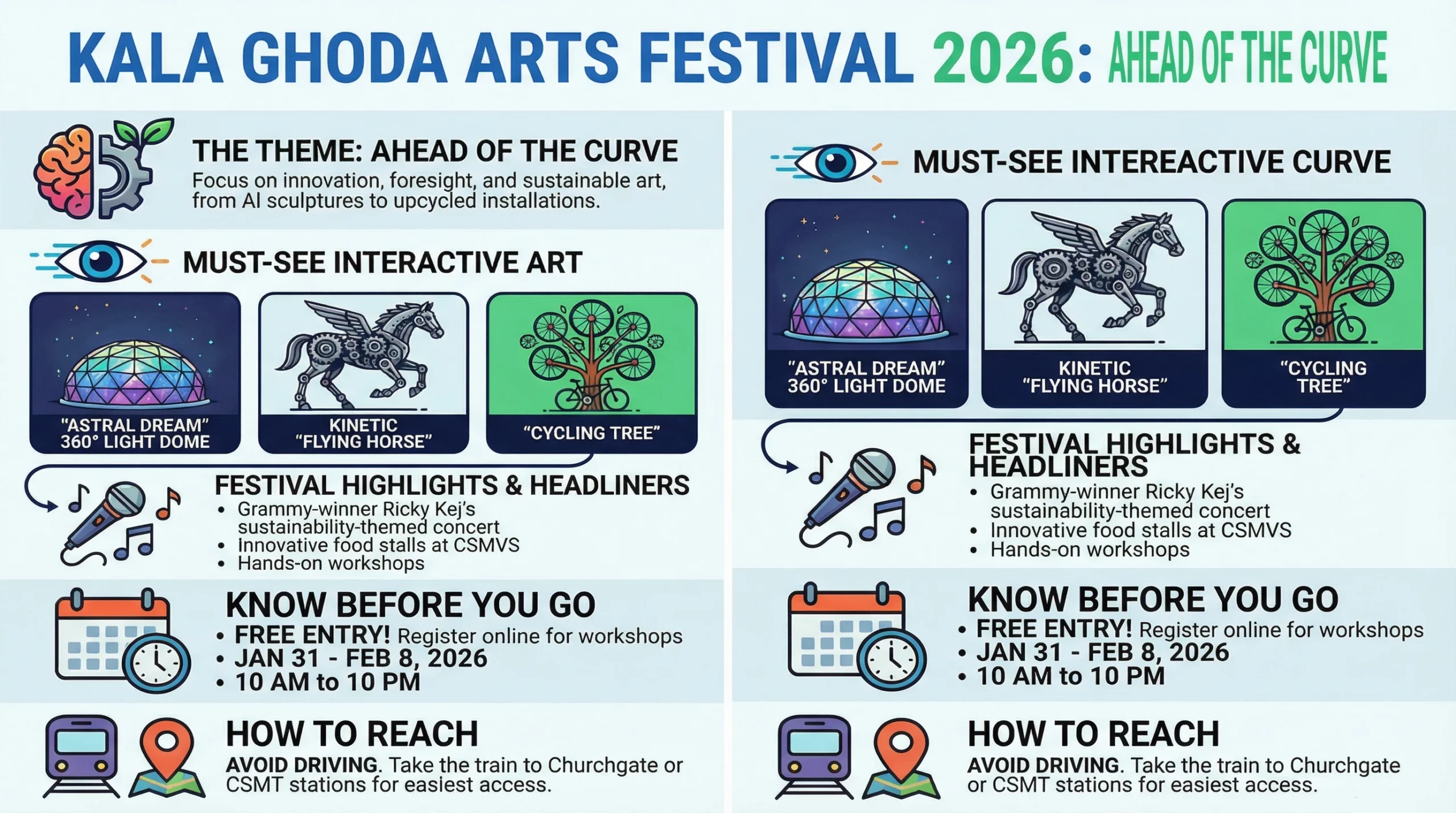
This year, the festival celebrates its 26th edition with a theme that perfectly mirrors Mumbai’s relentless pace: “Ahead of the Curve.” It’s a nod to innovation, foresight, and the city’s knack for staying one step ahead of global trends. Whether it’s through AI-integrated sculptures or immersive AR (Augmented Reality) heritage walks, KGAF 2026 is less about looking back and more about drafting the blueprint for our cultural future.
The spirit of 2026 is decidedly sustainable and tech-forward. You’ll notice a shift from traditional massive structures to “living art”—installations that use upcycled marine waste or kinetic energy to light up the South Mumbai nights. It’s art with a conscience, proving that being “ahead” means being responsible.
A Melting Pot of ‘Maximum City’ Energy
What makes the spirit of Kala Ghoda truly human is its radical inclusivity. On one corner, you might find a high-profile Bollywood director debating cinema at the Yashwantrao Chavan Centre; on the other, a group of college students from across the country sitting on the pavement, sketching the iconic black stone horse.
The energy is infectious. It’s the sound of ‘Sound Waves’—the 2026 music vertical—drifting from Cross Maidan, featuring everything from Grammy-winner Ricky Kej’s environmental symphonies to Usha Uthup’s legendary jazz-pop vocals. It’s the smell of “A Movable Feast”—this year’s culinary theme—wafting through the air, blending traditional Koli flavors with futuristic vegan experiments.
More Than Just an Art Fest
For Mumbaikars, KGAF is a homecoming. It’s the one week where the “hustle culture” of India’s financial capital pauses for a literal stroll through the arts. The spirit of the 2026 festival lies in the unexpected intersections:
- A tech CEO attending a poetry slam at the David Sassoon Library.
- A street photographer capturing the “Edible Futures” workshop at the NGMA.
- Children engaging with interactive digital canvases that react to their touch.
This year, the festival isn’t just a gallery without walls; it’s a conversation without borders. It represents a Mumbai that is evolving, inclusive, and undeniably Ahead of the Curve. As you navigate the cobblestone streets, you aren’t just a spectator—you are part of the installation.
Essential Logistics: The “Know Before You Go” Handbook
Navigating Mumbai during the Kala Ghoda Arts Festival (KGAF) 2026 is an art form in itself. With the precinct expected to host over half a million visitors across nine days, showing up without a plan is a recipe for getting lost in the “Maximum City” hustle.
Here is your logistical cheat sheet to ensure your 2026 experience is seamless.
1. The 2026 Calendar & Timings
Mark your calendars: The festival officially runs from Saturday, January 31, to Sunday, February 8, 2026.
- Daily Timings: 10:00 AM to 10:00 PM.
- Pro-Tip: If you’re looking for those “Instagrammable” shots of the installations without the sea of people, aim to arrive by 10:30 AM on a weekday. The crowds usually peak after 5:00 PM when the office crowd from Fort and Nariman Point joins in.
2. Entry & Digital Registration
The most common question: Is Kala Ghoda 2026 free? Yes. Entry to the main precinct, Rampart Row installations, and the big stage at Cross Maidan remains completely free and open to all.
However, for 2026, the festival has leaned into the “Ahead of the Curve” theme with a more robust digital entry system:
- General Entry: No ticket is needed for the street festival.
- Workshops & Indoor Sessions: For high-demand workshops at the David Sassoon Library or theatre at Yashwantrao Chavan Centre, you must register via the official KGAF website or the District.in portal.
- QR Codes: Keep an eye on the @kgafest Instagram bio for direct registration links that typically go live 24–48 hours before a session.
3. Strategic Arrival: How to Reach KGAF 2026
Do not, under any circumstances, try to drive your private car into the Kala Ghoda precinct during the festival. Road closures and a lack of parking make it a nightmare.
| Transport Mode | Best Stop / Route | Walking Distance |
| Western Railway | Churchgate Station | 8–10 Minutes |
| Central Railway | CSMT (Victoria Terminus) | 12–15 Minutes |
| Taxi/Uber | Drop off at ‘Regal Cinema’ or ‘Lion Gate’ | 2 Minutes |
| Bus | Any bus to ‘Ahilyabai Holkar Chowk’ (Churchgate) | 5 Minutes |
Local’s Secret: Take the “Kaali Peeli” taxi from Churchgate station. It will cost you about ₹30–₹50 and drop you right at the entrance of Rampart Row, saving your energy for the walking ahead.
4. Mapping the 2026 Venues
The festival isn’t just one street; it’s a district-wide takeover. The 2026 map includes:
- Rampart Row (K. Dubash Marg): The visual heart with all the street installations.
- Cross Maidan: The massive stage for music, dance, and larger-than-life performances.
- CSMVS (Museum Lawns): The primary hub for Food Stalls and Children’s Workshops.
- Khaki Lab: A new 2026 addition hosting digital heritage exhibitions.
- Horniman Circle Garden: The serene venue for workshops and classical performances.
5. Survival Essentials
- Stay Hydrated: In line with the 2026 sustainability goal, bring a reusable water bottle. There are designated refill stations scattered throughout the precinct.
- Connectivity: Network speeds can drop significantly in high-density areas. Download the PDF schedule to your phone beforehand so you don’t miss your favorite slot.
- Security: Avoid carrying large bags or sharp objects (scissors, metal sticks). Security checks at entry points like Rampart Row and Cross Maidan are stringent.
The Main Event: 2026’s Must-Visit Art Installations
At the heart of the Kala Ghoda Arts Festival 2026, the streets of South Mumbai don’t just host art—they become it. Following this year’s “Ahead of the Curve” theme, the 2026 installations move away from static sculptures and toward immersive, responsive, and eco-conscious experiences.
Whether you’re a seasoned gallery-hopper or a casual weekend explorer, here are the non-negotiable art highlights you need to see on Rampart Row and beyond.
1. The ‘Astral Dream’ 360° Dome
In a massive “first” for KGAF, the Mumbai Light Festival and Full Dome Pro have brought the Astral Dream to the heart of the district. This isn’t your average sculpture; it’s a 360-degree immersive light dome. Step inside, and you’ll find yourself in a celestial world where AI-generated light patterns react to the ambient sounds of the city. It’s an ethereal escape from the Mumbai heat that feels like traveling through a digital nebula.
2. ‘The Flying Horse’ (KGAF 2026 Edition)
The iconic black horse gets a futuristic reimagining every year, but 2026’s version—The Flying Horse—is a masterclass in kinetic art. Designed in collaboration with award-winning animator Chetan Sharma, this installation uses intricate mechanical joints to mimic the galloping motion of a horse. It’s built entirely from upcycled automotive parts, symbolizing Mumbai’s relentless forward momentum.
3. ‘Aqua Line’: Mumbai’s Water Heritage
Located at the Khaki Lab, this digital art installation by Saurabh Chadekar is a visual love letter to Mumbai’s “pyaus” (heritage water fountains). Using Augmented Reality (AR), visitors can scan parts of the installation to see “water” flowing through long-dried historical channels. It’s a hauntingly beautiful commentary on the city’s water crisis and its forgotten architectural gems.
4. ‘The Cycling Tree’ & Sustainable Sculptures
Tucked away near the Army & Navy Building, The Cycling Tree by team TAD Connect is the festival’s sustainability poster child. Constructed from hundreds of discarded bicycle rims and “foliage” made from industrial waste, the tree lights up when visitors pedal connected stationary bikes. It’s interactive, Instagrammable, and drives home the message of carbon-neutral urban living.
5. ‘Curious Curves’ at CSMVS
For the younger crowd (and the young at heart), the Curious Curves installation at the Museum Lawns blends STEM with sculpture. Facilitated by Dr. Avinash Jhangiani, this nature-inspired piece allows children to build “clay-bots” that move through a winding, winding world of clay and light. It’s art that literally grows and changes throughout the nine days of the festival.
Summary Table: 2026 Art Highlights
| Installation | Venue | Best Time to Visit | Vibe |
| Astral Dream Dome | Cross Maidan | Post-Sunset (6 PM onwards) | Immersive/Tech |
| The Flying Horse | Rampart Row | Mid-day (for the shadows) | Kinetic/Iconic |
| The Cycling Tree | Army-Navy Entrance | Evening (when it lights up) | Sustainable/Fun |
| Aqua Line (Digital) | Khaki Lab | Morning (lesser crowd) | Heritage/AR |
Pro-Tip: Keep your smartphone charged. Many of the 2026 installations use QR-activated AR filters that add a layer of hidden digital storytelling to the physical art.
Culinary Canvas: The Best Food Stalls & Pop-ups
If art is the soul of the festival, then the food is undoubtedly its beating heart. For 2026, the culinary vertical has outdone itself with the theme “A Movable Feast,” curated by Romi Purkayastha. Inspired by Hemingway’s Parisian memoirs, this year’s spread is designed to be a “celebration in motion”—blending Mumbai’s gritty street-food heritage with high-concept gourmet innovation.
The primary hub for your food pilgrimage is the CSMVS (Museum) Gardens, but the feast spills over into local institutions like the International YWCA and the Taj Mahal Hotel.
1. The 2026 Must-Try Food Stalls
While there are over 40 vendors, these five are generating the most buzz on social media for 2026:
- The Koli Kitchen (Regional Heritage): Experience the authentic flavors of Mumbai’s original inhabitants. Don’t miss the Prawns Koliwada and their signature Stuffed Pomfret, made with a secret 2026 spice blend that’s already trending among food bloggers.
- Mezcalita Cantina (Global Fusion): Representing the “Ahead of the Curve” spirit, Mezcalita brings bold Mexican design to the plate. Their Jackfruit Barbacoa Tacos are a masterclass in plant-based gourmet.
- The Whole Truth (Health & Transparency): For the conscious eater, this stall offers “clean label” snacks. They are also hosting a 2026-exclusive workshop for kids titled “FBI: Food Board Investigators” to teach them how to read snack labels.
- Urban Platter (Mediterranean Magic): Expect a massive queue for their Mushroom Shawarma and Lahmacun (Turkish Flatbread). They are using the 2026 festival to showcase fermented ingredients and Middle Eastern spices.
- The Parsi Pop-up: No visit to South Mumbai is complete without Parsi food. Look for the stall serving Mutton Berry Pulav and Salli Boti, keeping the culinary legacy of the Fort precinct alive.
2. Immersive Workshops: ‘A Movable Feast’
KGAF 2026 isn’t just about eating; it’s about learning the craft. This year features several high-profile workshops (remember to register on the District.in app):
- Mediterranean Hands-On: Learn the art of rolling the perfect pita and balancing tahini-based sauces.
- Edible Futures: A deep dive into sustainable eating, featuring ingredients like millets and lab-grown greens.
- The Tea & Coffee Trail: Hosted at the Taj Mahal Hotel, this session explores the evolution of Mumbai’s brewing culture from Irani chai to specialty third-wave coffee.
3. Iconic Local Eateries (The “Nearby” Gems)
When the festival crowds at the stalls get a bit too much, step into the historic lanes of Fort for a sit-down meal at these legendary spots:
- Café Military: Established in 1933, it’s the place for Keema Pav and Mawa Custard.
- Bake House Café: Perfect for a mid-afternoon latte and a slice of their famous cheesecake while you people-watch.
- 145 Kala Ghoda: For the younger crowd looking for modern cocktails and “freakshakes” after the sun goes down.
Quick Guide: The 2026 Foodie Cheat Sheet
| Category | Recommended Stall/Venue | Must-Order |
| Street Soul | The Koli Kitchen | Prawns Koliwada |
| Gourmet Veg | Mezcalita | Jackfruit Tacos |
| Guilt-Free | The Whole Truth | Dark Chocolate Protein Bars |
| Classic Fort | Café Military | Mutton Berry Pulav |
| Quick Refuel | Urban Platter | Mushroom Shawarma |
Pro-Tip: Most stalls at KGAF 2026 are cashless. Ensure your UPI (GPay/Paytm) is working and you have a backup power bank, as the network can be spotty when the crowds peak near the Museum lawns.
Vertical Deep-Dives: A Masterclass in Mumbai Culture
To truly outrank competitors, your pillar page must go beyond the “street art” surface. KGAF 2026 is organized into specific “verticals”—curated silos of talent that span across South Mumbai’s most iconic heritage buildings. Here is your deep-dive into the must-experience categories for 2026.
1. Music: The Sound of the Future
The music vertical at KGAF 2026 is themed around “Symphonies of Change,” moving from the historic Asiatic Library Steps to the high-energy Cross Maidan.
- The Headliner: Three-time Grammy winner Ricky Kej makes his much-anticipated festival debut on February 7th. Expect a cutting-edge audiovisual performance focused on sustainability.
- Classical Fusion: The festival kicks off with a soulful Santoor fusion by Rahul Sharma, blending traditional strings with global rhythms.
- Indie & Pop: Don’t miss Sing & Tonic at the Cooperage Bandstand—a five-piece ensemble delivering high-energy 70s and 80s hits that will have the whole crowd singing along.
- Late Night Sukoon: Look for Sukoon Mehfil, where Utkarsh Sharma pays tribute to legends like Jagjit Singh and Gulzar with the soulful tunes of the sarod and sarangi.
2. Literature: Words in the Wild
The David Sassoon Library and its newly restored garden remain the sanctuary for bibliophiles. The 2026 lit-fest vertical focuses on “Fact & Fiction.”
- Mumbai in Fact & Fiction: Join heritage expert Alisha Sadikot for a unique literary walk that explores the city’s history through the lens of famous excerpts.
- The Story Pitch Room: A 2026-exclusive collaboration with Bound India, where aspiring writers can pitch story ideas to industry experts in a fast-paced “Shark Tank” style for books.
- Poetry Slams: Evening sessions under the stars featuring “Hinglish” spoken word artists addressing urban life in 2026.
3. Theatre & Stand-Up Comedy: The Stage is Set
Performances in 2026 have expanded to the Yashwantrao Chavan Centre and Cooperage Bandstand Garden, bringing a mix of high-brow drama and “Maximum City” humor.
- ‘Let’s Laugh’ Series: A blend of Hindi poetry and stand-up comedy that tells the everyday stories of the common Mumbaikar.
- Experimental Theatre: Look for “Street Plays” (Nukkad Natak) that pop up unexpectedly near the Jehangir Art Gallery, focusing on the 2026 theme of being “Ahead of the Curve.”
4. Dance: The Rhythm of the Crescent
The dance vertical celebrates both the classical and the contemporary at Cross Maidan and Horniman Circle Garden.
- Harihara: A breathtaking Bharatanatyam performance exploring the narratives of Hari and Hara through the landscape of Bhakti Sampradaya.
- Konkan Kanya Band: An all-female ensemble performing multilingual, semi-classical sets that bridge the gap between folk heritage and modern girl-power.
At-A-Glance: Vertical Venues 2026
| Vertical | Primary Venue | Vibe |
| Music | Cross Maidan / Asiatic Steps | Electric & High Energy |
| Literature | David Sassoon Library | Intellectual & Serene |
| Comedy | Cooperage Bandstand | Casual & Laugh-out-loud |
| Dance | Cross Maidan / Horniman | Vibrant & Cultural |
| Cinema | Yashwantrao Chavan Centre | Independent & Thoughtful |
Workshops & Heritage Walks: Immersive Experiences
For those who want to do more than just “see” art, the workshops and heritage walks at Kala Ghoda Arts Festival 2026 offer a chance to participate in the city’s living history. This year, the focus is on interactive learning and tactile storytelling, moving away from passive observation to high-engagement experiences.
1. Heritage Walks: Walking Through Time
Curated by experts like Bharat Gothoskar and Kaevan Umrigar, the 2026 walks are designed to uncover the hidden narratives of South Mumbai.
- Mumbai in Fact & Fiction (The Literary Walk): Led by Alisha Sadikot, this is a must for 2026. It traces the city’s evolution from standalone islands to a global metropolis, using the words of literary giants like Salman Rushdie and Arun Kolatkar as your map.
- The Native Quarter Exploration: A fascinating deep dive into the “Native Quarter” of Fort, where wealthy Indian merchants once resided, showcasing a different architectural side to the Victorian Gothic mainstream.
- Victorian Gothic & Art Deco Tours: Explore why Mumbai holds a UNESCO World Heritage status for its unique ensemble of Victorian and Art Deco buildings.
- Networks of the Past: A daily guided tour (11:30 AM & 3:30 PM) at the CSMVS, exploring a landmark international exhibition that connects antiquities from 14 global museums.
Registration Hack: Unlike other events, heritage walks often require physical passes. Head to the Heritage Help Desk near Ador House on Rampart Row. For morning walks, passes are usually distributed at 10:00 AM on the day of the walk.
2. Creative Workshops: Mastering the Craft
The 2026 workshop calendar, overseen by Suditi Shah, is packed with sessions that blend traditional arts with modern-day lifestyle skills.
- The Art of Brewing with Blue Tokai: Learn the science of the perfect pour-over. From grind size to water temperature, this masterclass is a caffeine lover’s dream. (Pre-register at community@bluetokaicoffee.com).
- Mind Your Wine Manners!: Hosted by India’s first Master of Wine, Sonal Holland, this session at the Taj Mahal Hotel teaches the fine art of wine appreciation and etiquette.
- Sun Printing (Cyanotypes): A hit for 2026, where participants use UV light and botanical elements to create blue-toned photographic prints—a perfect blend of science and art.
- Astro-Voyage with NSCM: For the night owls, this celestial navigation workshop (6:00 PM onwards) teaches you how to identify planets and constellations through high-powered telescopes.
3. The Artisan Market: Shop with a Story
The stalls at Rampart Row and Cooperage Bandstand are not just shops—they are windows into the soul of Indian craftsmanship.
- Terra Ghoda (The Potters’ Market): Located at the Museum lawns, this is where you can watch live pottery demonstrations and buy directly from master potters.
- Upcycled Fashion Stalls: Consistent with the 2026 sustainability theme, look for stalls specializing in upcycled denim and hand-painted cloth bags.
- VMSB Mallakhamb: Don’t miss the live demonstrations by students of the Victoria Memorial School for the Blind, blending yoga and gymnastics in a breathtaking display of skill.
Booking & Participation Table
| Activity Type | Venue | Booking Method | Pro-Tip |
| Heritage Walks | Starts near Ador House | Physical Pass (Day-of) | Arrive 30 mins early for passes. |
| Art Workshops | BNHS / Horniman Circle | Online via KGAF App | Bring your own stationery if requested. |
| Culinary Sessions | Taj Mahal Hotel / CSMVS | Email / District.in | Limited seats; book 48h in advance. |
| Kids’ Workshops | Museum Gardens | Walk-in (Limited) | Best for ages 5-12. |
The “Human” Side: A Local’s Survival Guide
If you ask any Mumbai local, they’ll tell you that the Kala Ghoda Arts Festival 2026 is a beautiful, chaotic whirlwind. To outrank the generic travel blogs, we need to talk about the reality of the streets: the heat, the crowds, and the tactical maneuvers required to actually enjoy the art.
Here is your “insider’s playbook” for surviving and thriving at KGAF 2026.
1. Timing is Everything (The Crowds Strategy)
Mumbai doesn’t sleep, and during KGAF, it barely breathes.
- The Golden Hour: Arrive by 10:30 AM on a Tuesday or Wednesday. You’ll have the Rampart Row installations almost to yourself for photography, and the humidity hasn’t peaked yet.
- The “No-Go” Zone: Avoid Saturday and Sunday evenings unless you are specifically there for a big-ticket concert at Cross Maidan. The footfall on weekends can make it difficult to even see the smaller sculptures.
- The “Quiet” Pocket: If you need a sensory break, head to the Horniman Circle Garden. It’s usually 3-4 degrees cooler under the trees and offers a much-needed respite from the Rampart Row megaphone announcements.
2. The 2026 Dress Code: Style Meets Stamina
This isn’t just a fashion show; it’s a marathon.
- Footwear First: You will likely clock 10,000+ steps. Ditch the heels or heavy boots for breathable sneakers or cushioned Kohlapuris.
- Fabric Choice: February in Mumbai is “springy” but humid. Stick to linens, mulmul, or light cottons.
- The Bag Hack: Carry a crossbody bag or a small backpack. You’ll want your hands free for taking photos and holding street snacks.
3. Tech & Connectivity Hacks
In 2026, the festival is more digital than ever, but the infrastructure can struggle with 50,000 people hitting the same cell tower.
- Pre-Load the Map: Network speeds drop to a crawl near the Jehangir Art Gallery. Screenshot the 2026 venue map and the day’s schedule before you leave home.
- The Power Bank Rule: Between high-brightness screen use for photos and scanning QR codes for AR installations, your battery will drain by 3 PM. Don’t leave home without a 10,000mAh backup.
- Digital Payments: While 2026 is largely cashless, carry ₹500 in small change. Some heritage walk registrations or small artisan stalls in the “Native Quarter” might still prefer cash if their UPI is acting up.
4. Pit-Stops & Essentials
- Hydration: KGAF 2026 has introduced “Sustainability Sips” stations—water ATMs where you can refill your bottle for a nominal fee. Look for the blue kiosks near Ador House.
- Restrooms: Clean public toilets are the holy grail of South Mumbai. Your best bets are the CSMVS Museum (if you have an entry ticket), Westside (Fort), or the Lion Gate public convenience.
- The “Secret” Coffee Fix: While everyone crowds the festival stalls, walk two lanes over to Anna Idli for a quick, piping hot filter coffee that costs a fraction of the price and recharges you instantly.
5. Respect the Art (and the Artist)
- The Photo Etiquette: It’s tempting to lean on the sculptures for a selfie, but most are delicate or interactive. Always look for the “Touch” or “No Touch” signs.
- The Human Connection: If you see an artist standing near their work, strike up a conversation! They love sharing the “Ahead of the Curve” inspiration behind their 2026 pieces.
Pillar Page Summary Table: The Local Survival Kit
| Essential Item | Why You Need It | Local Tip |
| Reusable Bottle | Stay hydrated sustainably | Use the refill stations near Cross Maidan. |
| Screenshot of Schedule | Avoid network lag | Data signals die when the crowd peaks. |
| Small Cash (₹10/20/50) | For quick taxi/snacks | UPI can be “pending” in crowded areas. |
| Power Bank | AR scans & Photography | You’ll be taking 200+ photos/day. |
| Sunscreen/Hat | Mumbai’s midday sun | Even in February, the afternoon is harsh. |
Sustainability at KGAF 2026: Art with a Purpose
In 2026, the Kala Ghoda Arts Festival isn’t just celebrating art; it’s championing the planet. Under the flagship theme “Ahead of the Curve,” the festival has pivoted to become a blueprint for sustainable urban events. For a city like Mumbai, which balances on the edge of the sea, this focus on environmental stewardship is more than a trend—it’s a necessity.
Here is how KGAF 2026 is leading the green revolution in India’s cultural landscape.
1. The Upcycled Aesthetic: Installations with a Second Life
Walk down Rampart Row and you’ll notice a distinct shift in materials. This year, “Visual Arts” is synonymous with “Upcycled Arts.”
- Trash to Tunes: In a brilliant collaboration, students from Ryan Global School and local NGOs have created a series of musical instruments entirely from recycled waste. These aren’t just for show; they are used in daily flash mobs to prove that “waste” is just a lack of imagination.
- Eco-Art Adventures: Look for large-scale sculptures crafted from discarded industrial denims and reclaimed ocean plastic. These pieces serve as a haunting reminder of our environmental footprint while showcasing the beauty of circular design.
2. Eco-Friendly Shopping at the Artisan Market
The shopping experience at KGAF 2026 has been curated with a “Zero-Waste” lens.
- Sustainable Stalls: Over 60% of the stalls this year focus on eco-friendly products. From hand-painted cloth bags by Vibgyor High students to sustainable textiles and organic wellness products, the market is a haven for the conscious consumer.
- Artisan Empowerment: By removing plastic packaging and encouraging the use of biodegradable materials, the festival is helping traditional artisans modernize their supply chains to be “Ahead of the Curve.”
3. Green Programming & The ‘Ricky Kej’ Effect
Sustainability has moved from the sidelines to the main stage—literally.
- The Sustainability Concert: Three-time Grammy winner and environmental activist Ricky Kej makes his festival debut on February 7th. His performance at Cross Maidan is more than a concert; it’s an immersive audiovisual journey themed around environmental preservation and Indian culture.
- Educational Workshops: The CSMVS Children’s Museum is hosting “Eco-Art Adventures,” where kids learn the magic of Eco-Printing using real leaves and flowers to create vibrant prints on fabric. It’s about teaching the next generation that art and nature are inseparable.
4. Zero-Waste Logistics: A Local’s Responsibility
The Kala Ghoda Association has implemented several infrastructure changes to minimize the festival’s carbon footprint:
- Water ATMs: To combat the plague of single-use plastic bottles, KGAF 2026 has installed multiple high-capacity water refill stations. Visitors are encouraged to bring their own copper or steel bottles.
- Digital-First Approach: By moving the majority of the schedule and registration to the District.in app, the festival has significantly reduced paper waste from printed brochures.
- Pedestrian-Friendly Design: This year features even more road closures to encourage walking and the use of public transport like the Mumbai Local and BEST buses.
Sustainability Checklist for 2026 Visitors
| Feature | Action to Take | Impact |
| Water ATMs | Carry a reusable bottle. | Saves ~50,000 plastic bottles daily. |
| Digital Schedule | Use the official KGAF App. | Eliminates tons of paper waste. |
| Artisan Market | Bring your own cloth tote. | Reduces single-use plastic bags. |
| Commute | Take the train to CSMT/Churchgate. | Lowers the festival’s carbon footprint. |
Frequently Asked Questions about KGAF 2026
1. What are the official dates and timings for Kala Ghoda 2026?
The Kala Ghoda Arts Festival 2026 runs for nine days, from Saturday, January 31st to Sunday, February 8th, 2026. The festival precinct generally opens at 10:00 AM and concludes by 10:00 PM daily. While street installations are accessible all day, specific workshops and indoor performances have individual time slots usually found in the daily schedule.
2. Is there an entry fee for the Kala Ghoda Arts Festival?
No, entry to the Kala Ghoda Arts Festival is completely free for all attendees. The festival is a community-funded initiative aimed at making art accessible to everyone. However, entry to specific indoor venues (like the David Sassoon Library or NGMA) is on a first-come, first-served basis and may be restricted once the venue reaches capacity.
3. Do I need to register for workshops or heritage walks?
Yes. While the festival is free, most workshops and heritage walks require prior registration due to limited seating. For 2026, you can register via the official KGAF website or the District.in app. Heritage walk passes are typically distributed at a physical help desk near Ador House (Rampart Row) on the morning of the walk.
4. Where are the main venues for KGAF 2026?
The festival is spread across the “Crescent District” of South Mumbai. Key locations include:
- Rampart Row: Street installations and the artisan market.
- Cross Maidan: Large-scale music and dance performances.
- CSMVS (Museum Gardens): Children’s workshops and major food stalls.
- Horniman Circle Garden: Theatre and classical workshops.
- David Sassoon Library: Literature and poetry sessions.
5. Who are the headline performers for the 2026 music lineup?
KGAF 2026 features a high-octane lineup at Cross Maidan. The most anticipated debut is by three-time Grammy winner Ricky Kej. Other notable artists include Jonita Gandhi, Shilpa Rao, and a tribute to Lata Mangeshkar by Mugdha Hasabnis. The Asiatic Library Steps also host soulful evening classical sets.
6. Is parking available near the festival precinct?
No dedicated parking is provided by the Kala Ghoda Association. South Mumbai is notoriously difficult for parking, especially during the festival. It is highly recommended to use public transport (Local trains to Churchgate or CSMT) or ride-sharing apps like Uber/Ola. If you must drive, the nearest pay-and-park lots are near the Bombay Stock Exchange or Regal Cinema, but these fill up by noon.
7. What are the best food options at the 2026 festival?
The 2026 food theme is “A Movable Feast,” curated by Romi Purkayastha. You can find curated food stalls at the CSMVS Museum Lawns and the International YWCA. For a sit-down experience, local icons like Café Military (Parsi food) and 145 Kala Ghoda (modern fusion) are festival favorites located within the district.
8. Is the festival accessible for people with disabilities?
Yes, the festival aims to be inclusive. Most outdoor areas like Rampart Row and Cross Maidan are wheelchair accessible. The association provides ramps at major entry points and has designated spaces for individuals with disabilities at the main performance stages.
9. Can I bring my pets to the festival?
While Mumbai loves its pets, the festival is not recommended for pets due to the high density of crowds, loud music, and security restrictions. Service animals are permitted, but for the comfort and safety of your furry friends, it is best to leave them at home.
10. Are photography and filming allowed at the venues?
Personal photography and mobile filming are allowed and encouraged! However, the use of professional equipment like tripods, drones, or commercial film crews requires prior written permission from the Kala Ghoda Association. Some indoor exhibitions or theatre performances may have strict “no-flash” or “no-photo” policies to respect the artists.

Leave a Reply