
The Spirit of April 2026: A Season of Solar Renewal
As the morning mist lifts over the golden wheat fields of Punjab and the first rays of the sun hit the vibrant yellow Konna flowers in Kerala, a familiar yet fresh energy takes hold. This is the spirit of April 2026—a month that serves as a collective deep breath for millions across India. It isn’t just about a change in the calendar; it’s a profound astronomical and emotional reset.
The Unifying Glow of the Solar New Year
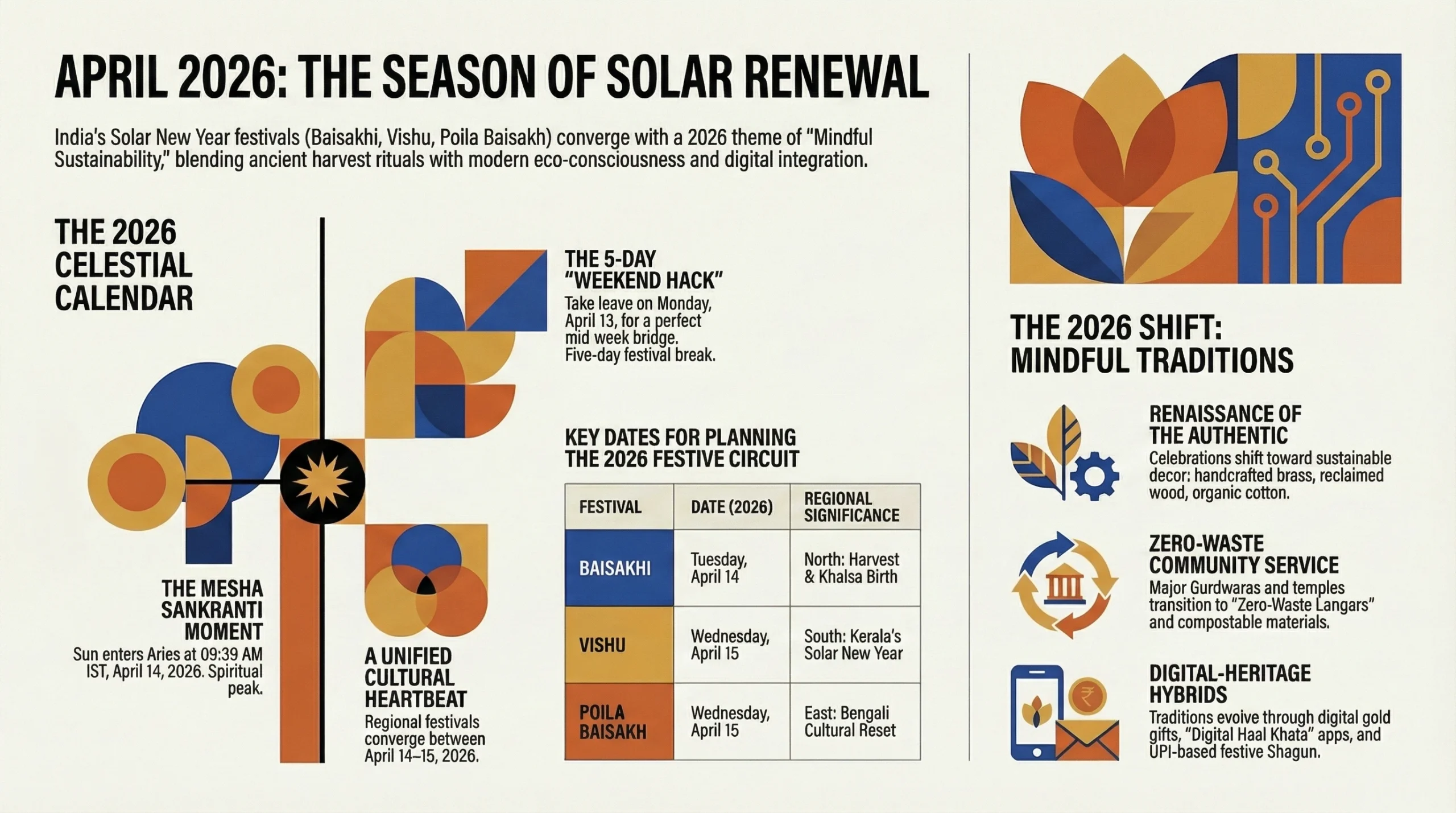
While we often think of January 1st as the “New Year,” the true cultural heartbeat of the subcontinent skips to the rhythm of the sun. Around April 14–15, 2026, the Sun makes its grand entrance into Aries (Mesha Rashi). This celestial event, known as Mesha Sankranti, acts as a unifying thread. Whether you are calling it Baisakhi in the North, Vishu in the South, or Poila Baisakh in the East, you are essentially celebrating the same thing: the Solar New Year.
In 2026, these dates fall conveniently on a Tuesday and Wednesday. For the savvy traveller or professional, this creates a perfect “Mid-Week Mindful Break.” By taking just a single day off on Monday, April 13, many are planning an April 2026 long weekend to reconnect with their roots, proving that even in our high-speed digital age, the pull of heritage remains unshakable.
The 2026 Shift: Mindful and Sustainable Traditions
What makes the spirit of 2026 distinct is a visible shift toward conscious celebrations. We are seeing a “Renaissance of the Authentic.” Instead of mass-produced decor, the trend for sustainable festive decor 2026 is leaning into handcrafted brass lamps, reclaimed wood Vishukkani trays, and organic cotton drapes.
There’s a beautiful element to how we celebrate now. It’s less about the performance and more about the presence. Families are prioritising eco-friendly ethnic fashion, opting for handloom Mulmul or Tussar silk that breathes in the rising summer heat. We’re also seeing a rise in fusion festive fashion, where traditional kurtas are styled with comfortable sneakers for the Nagar Kirtan processions—a nod to the practicality of modern life without losing the soul of the tradition.
A Community Heartbeat
Whether it’s the roar of “Jo Bole So Nihaal” at the Golden Temple or the quiet, meditative sight of the Vishukkani at dawn, the underlying spirit is one of unwavering hope. It’s the time when traders in Bengal open their Haal Khata (new ledgers), symbolizing a clean slate not just in business, but in life.
The spirit of April 2026 is a reminder that we are all part of a larger cycle. As we share a plate of Panta Bhat or a bowl of Kada Prasad, we aren’t just eating; we are participating in a thousand-year-old story of resilience and gratitude. This month invites us to step out of our screens and into the sun, embracing the warmth of a community that celebrates together, regardless of the miles or languages between us.
At a Glance: Key Dates & Timings for April 2026
When planning your festivities, timing is everything—especially when aligning with the 2026 celestial calendar. In April 2026, the transition of the Sun into the Aries zodiac (Mesha Sankranti) creates a powerful window for new beginnings.
The 2026 Festive Calendar Table
| Festival | Date | Day | Significance |
| Baisakhi | April 14, 2026 | Tuesday | Sikh New Year & Khalsa Sirjana Diwas |
| Vishu | April 14, 2026 | Tuesday | Kerala’s Solar New Year |
| Bohag Bihu | April 14, 2026 | Tuesday | Start of the 7-day Assamese New Year |
| Poila Baisakh | April 15, 2026 | Wednesday | Bengali New Year (Naba Barsha) |
| Puthandu | April 14, 2026 | Tuesday | Tamil New Year |
Auspicious Timings & 2026 Muhurats
For those performing rituals at home or visiting temples, these are the trending search queries for 2026 timings you need to know:
- Mesha Sankranti 2026 Moment: The Sun officially enters Aries at 09:39 AM IST on April 14. This is the “spiritual peak” of the day.
- Vishu 2026 Kanikanal: For the most auspicious start, the Vishukkani (first sight) should be viewed at dawn on April 14, 2026.
- Baisakhi Punya Kaal: The most meritorious window for a holy dip (Snan) and charity is between 06:09 AM and 01:03 PM.
- Poila Baisakh Tithi: While the festivities begin on Wednesday, April 15, many businesses will perform the Haal Khata (opening new ledgers) during the morning hours to invite prosperity.
The April 2026 Long Weekend Hack
If you are looking to maximise your celebrations, here is a pro-tip for your 2026 travel planning:
Since the festivals fall on Tuesday (April 14) and Wednesday (April 15), taking a leave on Monday, April 13, gives you a glorious 5-day break (starting from Saturday, April 11).
This is the perfect window for a “pilgrimage and party” trip to Amritsar for Baisakhi or a serene getaway to Kerala for the Vishu Sadya.
Baisakhi 2026: The Golden Harvest of the North
As April 14, 2026, approaches, the air in Punjab begins to hum with a specific kind of electricity. It’s the sound of the dhol echoing across vast, sun-drenched plains and the sight of golden wheat swaying in a final, graceful dance before the harvest. Baisakhi is more than just a date on a calendar; it is the soul of Northern India laid bare—a thunderous celebration of agriculture, history, and spiritual revolution.
The Golden Fields: A Farmer’s Thanksgiving
For the farming community, Baisakhi 2026 marks the culmination of months of gruelling labour. This is the time of the Rabi harvest, specifically the winter wheat that feeds a nation. In 2026, the harvest season is expected to be particularly vibrant, with many local “Mandi” (market) fairs showcasing the year’s bounty.
To experience the human side of this, look beyond the cities. In the villages, you’ll see farmers performing the Awat Pauni—a tradition where people gather to harvest the crops together to the beat of a drum. It’s a rhythmic, communal effort that reminds us that in 2026, despite our digital isolation, some things are still best done hand-in-hand.
1699: The Day the Khalsa Was Born
While the harvest brings the food, the history brings the fire. Baisakhi is the anniversary of the Birth of the Khalsa Panth. In 1699, at Anandpur Sahib, Guru Gobind Singh Ji transformed the Sikh faith into a brotherhood of “Saint-Soldiers.” He called for five volunteers—the Panj Piare—who were willing to give their lives for righteousness.
In 2026, as we commemorate this event, the focus remains on the “Five Ks” and the values of equality and courage. Whether you are a devotee or a curious traveller, witnessing the Nagar Kirtan (holy procession) is essential. In 2026, these processions are evolving; expect to see traditional Gatka (martial arts) displays alongside modern floats that highlight global Sikh contributions.
The 2026 Ritual Guide: How to Celebrate Like a Local
If you are planning to participate in the festivities, here is your 2026 ritual checklist:
- The Holy Dip: Thousands will gather at the sarovars (sacred pools) of the Golden Temple or the banks of the Sutlej. On Tuesday, April 14, the most auspicious window for this purification starts at dawn.
- The Akand Path: Listen to the continuous reading of the Guru Granth Sahib. The atmosphere inside the Gurdwaras on this day is thick with incense and soulful Kirtan.
- The Langar Experience: No Baisakhi is complete without sitting cross-legged on the floor to share a meal. In 2026, many Gurdwaras are emphasising “Zero-Waste Langars,” blending ancient hospitality with modern environmental ethics.
2026 Travel Spotlight: Amritsar vs. Anandpur Sahib
Where should you be on April 14, 2026?
- Amritsar (The Spiritual Hub): The Golden Temple will be illuminated with thousands of lights. Pro-tip for 2026: Arrive for the Amrit Vela (3:00 AM – 6:00 AM) to witness the Palki Sahib ceremony before the massive crowds (upwards of 200,000 people) arrive.
- Anandpur Sahib (The Historical Birthplace): This is where the Khalsa was founded. The energy here is more “martial” and grand, set against the backdrop of the Shivalik hills.
The Culinary Soul of Baisakhi
Your 2026 Baisakhi experience is incomplete without the food. Focus on Kada Prasad (the rich, velvety wheat halwa served in Gurdwaras), Makki di Roti with Sarson da Saag, and a tall glass of creamy Punjabi Lassi. For a 2026 twist, many local cafes in Amritsar are serving “Baisakhi Fusion” platters—think Pindi Chole tacos or Saffron Kheer shooters—allowing the tradition to taste new again.
Vishu 2026: Kerala’s Canvas of Prosperity
While the North roars with the energy of Baisakhi, the South welcomes the New Year with a quiet, golden dawn. Vishu 2026, falling on Wednesday, April 15, is more than just a festival; it is a sensory experience designed to set the tone for the entire year. Rooted in the concept of “Kanikanal”—the first sight—Vishu is a psychological reset that uses beauty, abundance, and light to program the mind for prosperity.
The Science of the First Sight: Vishukkani 2026
In 2026, the Mesha Sankranti moment (the sun’s entry into Aries) occurs on the afternoon of April 14. Because this transition happens after sunset, the official celebration and the viewing of the Vishukkani will take place at sunrise on April 15, 2026.
The ritual is profoundly “human.” Long before the sun rises, the eldest woman of the house prepares the Uruli—a circular brass vessel—filling it with items that represent the five elements of a successful life:
- The Golden Bounty: Ripe yellow mangoes, jackfruit, and the iconic Kani Vellarikka (golden cucumber).
- The Light: The Nilavilakku (traditional oil lamp) flickering against a Valkannadi (metal mirror).
- The Wealth: Gold coins, fresh currency, and grains of rice.
- The Soul: The cascading yellow Kanikkonna flowers (Cassia fistula), which are the unofficial floral ambassadors of Vishu 2026.
Family members are led to the Kani with their eyes covered, ensuring that the very first thing they witness in the New Year is this tableau of perfection. In a world of digital clutter, this 2026 tradition remains a powerful reminder to choose our focus wisely.
The Tradition of Giving: Vishu Kaineettam
If Onam is about grand homecoming, Vishu is about the “Circle of Giving.” The tradition of Vishu Kaineettam involves elders gifting money to the younger members of the family, servants, and even tenants. In 2026, we see this tradition evolving. While crisp currency notes are still the norm, many are shifting toward sustainable gifting, such as digital gold, plantable seed cards, or “experience vouchers” for eco-resorts in the Western Ghats. It’s a beautiful way to ensure the New Year begins with the circulation of wealth and blessings.
The Vishu Sadya: A Balanced Palette (2026 Trends)
No Malayali New Year is complete without the Vishu Sadya, a vegetarian feast served on a banana leaf. Unlike the massive Onam feast, the Vishu meal is often more intimate and features specific seasonal ingredients.
- Vishu Kanji: A nourishing porridge made of rice, coconut milk, and spices—the ultimate comfort food for a 2026 summer morning.
- The Flavour of Life: Traditional dishes like Mambazha Pulissery (sweet mango curry) and Veppampoo Rasam (bitter neem flower soup) are essential. Why? Because the spirit of Vishu teaches us to embrace all flavours—the sweet, the salty, and even the bitter—as part of a complete life.
2026 Travel Tips: Where to Catch the Golden Glow
If you’re travelling to Kerala for the April 2026 long weekend, here are the top experiences:
- Guruvayur Temple: Famous for its massive Vishukkani display. Pro-Tip for 2026: Be prepared for crowds; devotees often queue from the night before to see the deity draped in gold at dawn.
- Kochi (Fort Kochi): To see the blend of tradition and modern “Cafe Culture.” Many boutique hotels in 2026 are offering “Curated Kani Experiences” for tourists.
- Backwater Retreats (Alleppey): For a quiet, sustainable Vishu, many houseboats are hosting “Floating Sadyas,” allowing you to celebrate the New Year amidst the serene emerald waters.
Poila Baisakh 2026: A Cultural Renaissance
While the rest of the country celebrates on Tuesday, the heartbeat of Bengal skips a beat until Wednesday, April 15, 2026. This is Poila Baisakh (or Nobo Borsho), the first day of the Bengali calendar. In 2026, this festival isn’t just a date; it’s a full-throttle cultural renaissance. From the narrow lanes of North Kolkata to the bustling streets of Dhaka, the air is thick with the scent of Gondhoraj lemons, fresh incense, and the crisp, starchy smell of “Notun Jama” (new clothes).
The “Tarikh-e-Elahi”: A Legacy of Prosperity
To truly understand the “spirit” of Poila Baisakh we have to look back at its human origins. Unlike many religious festivals, this one has deep roots in agricultural economics. It traces back to the Mughal Emperor Akbar, who created a new calendar—the Tarikh-e-Elahi—to sync tax collections with the harvest season.
Today, that legacy lives on through the Haal Khata ceremony. If you walk into any traditional Bengali shop on April 15, 2026, you’ll see the “Lal Khata” (red-bound ledger) being sanctified with sandalwood paste and hibiscus flowers. Business owners invite customers for a “Mishti-Mukh” (sweetening of the mouth), turning cold transactions into warm, human connections. In 2026, we see a digital evolution: “Digital Haal Khata” apps are trending among young entrepreneurs, blending ancient luck with modern fintech.
Mangal Shobhajatra: A Canvas of Hope
One of the most visually stunning for 2026 is the Mangal Shobhajatra. Recognised by UNESCO as Intangible Cultural Heritage, this Procession of Well-being is a riot of colour. Massive papier-mâché masks of owls, tigers, and birds are paraded through the streets to ward off evil and welcome the sun.
In 2026, the theme is expected to centre around Amra Shobai Raja (We are all Kings)—a call for equality and collective resilience. For travellers visiting Kolkata or Dhaka during the April 2026 long weekend, participating in this walk isn’t just a photo-op; it’s a communal meditation on hope.
The Nobo Borsho Aesthetic: Slow Fashion 2026
This section means talking about the “look” of the day. The 2026 trend is firmly rooted in Sustainable Bengali Fashion. We are seeing a massive resurgence of:
- Handloom Jamdani & Tant: Light, breathable sarees in “Laal-Paar” (red border) styles.
- Panjabi for Men: Intricate Kantha stitch work on white or tussar silk.
- Eco-Jewellery: Terracotta and Dokra pieces are the “it” accessories for Poila Baisakh 2026, as Gen Z looks to celebrate heritage without the heavy environmental footprint.
A Feast for the Soul: The 2026 Bengali Platter
You cannot write a pillar page without a deep dive into the food. The Poila Baisakh 2026 Menu is a masterclass in seasonal eating. The traditional star remains Panta Ilish (soaked rice with fried Hilsa), though environmental consciousness is pushing many toward “Chitol Muitha” or vegetarian delicacies like “Enchorer Dalna” (raw jackfruit curry—often called the “meat of the vegetarians”).
The 2026 Must-Haves:
- Aam Panna: To beat the rising April heat.
- Luchi & Cholar Dal: The quintessential Bengali breakfast.
- The Mishti Trinity: Rossogolla, Sandesh, and a thick clay pot of Mishti Doi. In 2026, look for “Nolen Gur” fusion desserts that are taking the Kolkata culinary scene by storm.
Why April 15, 2026, is Your Fresh Start
Poila Baisakh is the ultimate reset button. It’s the day to wear your best, forgive old debts (literal and emotional), and greet everyone with a heartfelt “Shubho Noboborsho!” Whether you’re a local or a digital nomad exploring Bengal during this window, the spirit of 2026 invites you to become part of the family.
The Taste of the New Year: A Culinary Journey
If April is the soul of the Indian calendar, then food is undoubtedly its heartbeat. As we step into the festivities of April 2026, the air across the subcontinent transforms into a swirling masterpiece of aromas—the buttery scent of roasting wheat in Punjab, the cooling fragrance of coconut milk in Kerala, and the sharp, inviting tang of mustard oil in Bengal.
To eat your way through the Solar New Year is to understand the geography of India itself. In 2026, the culinary trend is a beautiful “Back to Roots” movement, where ancient recipes are being revived with organic, farm-to-table ingredients and a modern focus on health.
The North: Richness of the Soil
In the North, Baisakhi is a celebration of abundance. The star of the show is the Kada Prasad—a velvety, golden-brown halwa made from whole wheat flour, ghee, and sugar. In 2026, many households are opting for A2 Ghee and unrefined jaggery to keep this spiritual treat wholesome.
No Punjabi harvest is complete without the iconic duo: Sarson da Saag and Makki di Roti. While traditionally a winter dish, the late-harvest greens of April offer a distinct, earthy flavour. Pair this with a tall, frothy glass of creamy Lassi, topped with a dollop of white butter, and you have a meal that isn’t just food—it’s a hug for the soul.
The South: The Balanced Palette of Vishu
Down in Kerala, the Vishu Sadya is a masterclass in culinary balance. Served on a fresh banana leaf, this feast is designed to touch all six tastes (Sadrasa).
- The Highlight: Mampazha Pulissery, a sweet and sour tempered yoghurt curry made with ripe “Chandrakkaran” mangoes—the seasonal gold of 2026.
- The Tradition: Vishu Kanji, a nourishing porridge of rice and coconut milk, often served with a side of spicy Puzhukku (steamed tubers).
The 2026 trend for Vishu is the Mindful Sadya, where families are including more forgotten grains like Proso Millet and Red Rice to increase the nutritional density of their festive meal without losing the authentic “Nadan” (traditional) flavour.
The East: A Celebration of Water and Earth
For Poila Baisakh, the Bengali palate craves the cooling and the celebratory. The traditional breakfast of Luchi and Cholar Dal (puffed bread with coconut-infused lentils) sets a festive tone, but the real star is the Nobo Borsho Thali.
In 2026, we are seeing a resurgence of Panta Ilish—fermented rice served with crispy fried Hilsa. For the health-conscious Bengali, Panta Bhat is trending as a “Superfood” due to its probiotic properties, making it the perfect gut-friendly start to the summer. Of course, no Bengali New Year is complete without the “Mishti Trinity”: a clay pot of Mishti Doi, spongy Rossogollas, and artisanal Sandesh shaped like the Shankha (conch shell).
2026 Food Trend: The Fusion-Tradition Hybrid
What’s exciting about the 2026 festive food scene is how Gen Z is interacting with these traditions. We are seeing Baisakhi Mezze Platters (think Pindi Chole hummus) and Vishu Smoothie Bowls using the flavours of the Sadya. This approach ensures that while the ingredients might evolve, the spirit of the first meal of the year remains sacred.
Global Celebrations: From London to Toronto
The vibrant spirit of Vaisakhi, Vishu, and Poila Baisakh transcends borders, transforming global hubs into extensions of the Indian heartland. In 2026, the diaspora continues to evolve these traditions, blending ancient rituals with modern multicultural flair to create some of the largest South Asian gatherings outside the subcontinent.
United Kingdom: Nagar Kirtans and Melas
London remains a central stage for these festivities. On Saturday, April 18, 2026, the iconic Trafalgar Square will host Vaisakhi on the Square, offering a day of spiritual Kirtan, Gatka (Sikh martial arts) demonstrations, and free Langar for thousands of visitors. Meanwhile, the Midlands will see one of the UK’s largest open-air celebrations at Victoria Park, Smethwick, on May 10, 2026, featuring a massive Nagar Kirtan procession. For the Bengali community, the Boishakhi Mela near Brick Lane remains a cornerstone, filling the streets with the aromas of traditional sweets and the rhythm of folk music.
Canada: The Surrey Khalsa Day Parade
In North America, the Surrey Khalsa Day Vaisakhi Parade in British Columbia stands as a global phenomenon. Scheduled for April 18, 2026, it is expected to draw over 500,000 attendees, making it one of the largest parades of its kind in the world. Similarly, in Toronto and Brampton, community centers and Gurdwaras become hubs of Information Gain for younger generations, passing down agricultural and spiritual history through high-tech cultural exhibitions.
Global Reach: Sydney to Dubai
The celebrations extend across the Southern Hemisphere and the Middle East:
- Sydney, Australia: The Boishakhi Mela at Fairfield Showground on April 26, 2026, will feature live concerts and traditional Borsho Boron ceremonies.
- Dubai, UAE: On April 18, 2026, the Malayalee community will celebrate Vishu with intimate Baithak-style bhajan evenings and elaborate Sadhya feasts, proving that the essence of home travels wherever the community settles.
Sustainable Celebrations: The 2026 Mindset
As we look toward the festivities of April 2026, a new theme has emerged that is as much about the future as it is about the past: Mindful Sustainability. In 2026, the trend has shifted from conspicuous consumption to conscious celebration. Whether it’s the fields of Punjab or the backwaters of Kerala, the 2026 mindset is about honouring the earth that provides the harvest.
Zero-Waste Gurdwaras and Community Feasts
One of the most significant shifts in 2026 is the rise of the Zero-Waste Langar. Major Gurdwaras and community centres are leading the way by eliminating single-use plastics and adopting large-scale composting for organic waste. The Seva (service) of 2026 includes segregating waste and ensuring that every scrap of food is repurposed, mirroring the ancient wisdom that resources are sacred.
Eco-Friendly Decor: The Biophilic Trend
For home celebrations like Vishu and Poila Baisakh, biophilic design is the 2026 aesthetic of choice. Instead of synthetic banners, families are opting for:
- Upcycled Accents: Repurposing vintage brassware and heirlooms.
- Natural Textures: Using jute, terracotta, and locally sourced flowers like the Kanikkonna and marigolds.
- Handcrafted Art: Supporting local artisans for Alpana and Kolam using natural rice paste rather than chemical dyes.
Sustainable Fashion: The 2026 Quiet Luxury
Your festive wardrobe in 2026 is likely to be a long-term investment. The trend for Sustainable Ethnic Fashion highlights breathable, heritage fabrics like Organic Mulmul, Handloom Linen, and Ethical Tussar Silk. In 2026, Slow Fashion means choosing a capsule wardrobe of earthy tones—sage green, terracotta, and muted gold—that can be restyled across seasons, proving that tradition never goes out of style when it’s made to last.
In April 2026, the alignment of Baisakhi, Vishu, and Poila Baisakh creates a unique Festival Circuit.
Since the main festival days fall on Tuesday, April 14, and Wednesday, April 15, 2026, these itineraries are designed around the Human-First experience—balancing spiritual immersion with local hidden gems.
April 2026: The Ultimate Festival Travel Itineraries
1. The Golden Harvest Loop: Punjab (5 Days)
Best for: Photography enthusiasts, spiritual seekers, and foodies.
- April 11–12 (The Weekend Warm-up): Start in Chandigarh. Visit the Rock Garden, but spend your evening at a local “Mandi” (grain market) to see the first heaps of golden wheat arriving.
- April 13 (The Eve of Khalsa): Drive to Anandpur Sahib. This is the most human part of the trip. Witness the Mohalla rehearsals—Sikh martial arts (Gatka) performed with breathtaking skill against the backdrop of the Shivalik Hills.
- April 14 (Baisakhi Day): Arrive in Amritsar by dawn.
- The 2026 Insider Tip: Head to the Golden Temple at 3:00 AM for the Palki Sahib ceremony. After your morning prayers, head to the nearby Jallianwala Bagh for a moment of quiet reflection on the 107th anniversary of the historical event.
- April 15: A slow day exploring the Village Life at Sadda Pind, an interactive Punjabi culture living museum, before heading home.
2. The Emerald & Gold Trail: Kerala (4 Days)
Best for: Slow travellers, wellness advocates, and families.
- April 12–13: Begin in Kochi. Spend your pre-Vishu days exploring the spice markets of Mattancherry. In 2026, many boutique cafes in Fort Kochi host Vishu Workshops where you can learn to arrange a traditional Vishukkani tray.
- April 14 (Vishu Eve): Travel to Guruvayur. The town stays awake in anticipation. The energy here is communal and electric.
- April 15 (Vishu Day): Wake up at 4:00 AM for the Kani Darshanam.
- The 2026 Insider Tip: Skip the heavy restaurant crowds for lunch. Many traditional Tharavadu (ancestral homes) in the outskirts of Thrissur now offer Community Sadya experiences where you sit on the floor and eat with local families.
- April 16: Wind down with a sunset cruise on the Vembanad Lake in Alleppey, reflecting on the New Year as you float past endless greenery.
3. The City of Joy Cultural Deep-Dive: Kolkata (3 Days)
Best for: Art lovers, history buffs, and City-Slicker explorers.
- April 13–14: Dive into Kumartuli, the potters quarters. While famous for Durga Puja, during Poila Baisakh, you’ll find artists creating the massive masks for the Mangal Shobhajatra.
- April 15 (Poila Baisakh): Morning: Join the Mangal Shobhajatra near College Street. It’s a riot of color, music, and street art.
- Afternoon: The Haal Khata walk. Visit the iconic jewelry shops of Bowbazar or the saree houses of Gariahat. You’ll likely be invited in for sweets and a calendar—the traditional Bengali New Year gift.
- Evening: A dinner at Ballygunge Place or Oh! Calcutta for a 2026-themed Nobo Borsho Thali.
2026 Travel Essentials Checklist
- Book Early: Since April 14–15, 2026, are mid-week, flight prices for the preceding weekend (April 10–12) are expected to surge by 30%.
- Dress Code: Pack light linens. April 2026 is predicted to be warmer than average. Opt for Eco-friendly ethnic wear—think handloom cotton kurtas that keep you cool during outdoor processions.
- Stay Connected: Use local festival apps. In 2026, cities like Amritsar and Kochi are launching real-time Crowd Trackers to help tourists navigate the busiest temple zones safely.
Gifting Guide For 2026
To truly capture the essence of April 2026, your gifting strategy needs to move beyond the transactional. In 2026, gifting is about Intentionality—the idea that a gift should either tell a story, support a local artisan, or bridge a digital gap.
As we approach the festive window of April 14–15, 2026, here is your high-authority guide to gifting across the harvest festivals of India.
The 2026 Gifting Guide: From Heritage to High-Tech
1. The Baisakhi Chardikala Collection (North)
Baisakhi is about energy, abundance, and the High Spirits (Chardikala). In 2026, we see a shift from heavy hampers to functional, heritage-rich tokens.
- For Elders: A2 Ghee & Raw Honey Hampers. Specifically, look for Himalayan-sourced wellness kits that include raw forest honey and herbal teas. It’s a gift of health that honours the agricultural roots of the festival.
- For the Youth: Tech-Integrated Punjabi Apparel. Smart-trackers paired with hand-embroidered Phulkari jackets are a major 2026 trend—blending fitness goals with festive flair.
- The Digital Touch: Instant Shagun Transfers. With over 70% of urban Indians now preferring digital cash gifts, sending a festive-themed UPI Shagun with a personalised video message is the standard for 2026.
2. The Vishu Kani Gifts (South)
Vishu is a celebration of the first thing you see in the morning. Gifting here centers around prosperity and the Golden theme.
- The Kani Starter Kit: Instead of just fruit, gift Handcrafted Brass Lamps (Deepam) or traditional Uruli bowls. In 2026, artisanal brassware is seeing a massive revival as people move away from plastic decor.
- Sustainable Silk: Gift Organic Mundum Neriyathum (traditional Kerala attire). The 2026 trend focuses on Peace Silk (Ahimsa Silk) or hand-loomed cotton that supports local weaver cooperatives in Balaramapuram.
- For Kids: Vishu Kaineettam Savings Bonds. Instead of just loose coins, gifting digital gold or small investment top-ups for children is the modern wealth-building take on this ancient tradition.
3. The Poila Baisakh “Nobo Borsho” Tokens (East)
Bengali New Year gifting is deeply rooted in literature, art, and the iconic Haal Khata.
- The Lal Khata Evolution: Gift Sustainable Stationery. Think seed-paper journals or Cork-based Diaries that are biodegradable. These are perfect for the tradition of starting new accounts for the year.
- Artisanal Gourmet: Move over generic chocolates; 2026 is the year of Artisanal Sandesh Boxes. Look for fusions like Jalbhara with dark chocolate centers or Nolen Gur-infused macarons.
- Home Decor: Terracotta & Dokra Wall Art. Supporting the artisans of Bankura, these pieces represent the Cultural Renaissance of 2026 and fit perfectly into the modern biophilic home.
4. The 2026 Green & Tech Crossover (Corporate)
If you are managing gifting for a team in April 2026, the focus is on Employee Well-being and ESG (Environmental, Social, and Governance) goals.
- The 2026 Wellness Box: Includes a smart reusable water bottle (that tracks hydration), a bag of organic Superfood snacks (like foxnuts or millet puffs), and a subscription to a mental wellness app.
- Plantable Memories: Desk organizers made from recycled wood that come with Seed Pencils. Once the pencil is used, you plant the tip to grow a tulsi or tomato plant.
2026 Gifting Pro-Tip: The Packaging is the Gift
In 2026, unboxing isn’t about glittery paper; it’s about Zero-Waste aesthetics.
- Use Furoshiki-style wrapping (using a beautiful cotton scarf or fabric that becomes part of the gift).
- Swap plastic tape for jute twine and fresh flowers.
- Always include a handwritten note or a QR code leading to a personal video message—in a digital world, the human touch is the most valuable luxury.
Frequently Asked Questions about April 2026 Festivals
1. What are the exact dates for Baisakhi, Vishu, and Poila Baisakh in 2026?
In 2026, these festivals fall in mid-week, creating a unique mid-April “festive block.”
- Baisakhi: Tuesday, April 14, 2026.
- Vishu (Vishu Kani): Wednesday, April 15, 2026.
- Poila Baisakh (Bengali New Year): Wednesday, April 15, 2026.
- Puthandu (Tamil New Year): Tuesday, April 14, 2026.
- Bohag Bihu (Assam): Starts Wednesday, April 15, 2026.
2. Why is Baisakhi celebrated on April 14th in 2026?
Baisakhi is determined by the solar calendar, marking the Sun’s entry into Mesha Rashi (Aries). In 2026, this transit—known as Mesha Sankranti—occurs on April 14. Historically, it also marks the day in 1699 when Guru Gobind Singh Ji established the Khalsa Panth, making it a dual celebration of a bountiful harvest and spiritual sovereignty.
3. What is the significance of Vishukkani in the 2026 celebrations?
Kani literally means that which is seen first. The Vishukkani is a ritual arrangement viewed at dawn on April 15, 2026. It is believed that the prosperity of the entire year depends on this first sight. In 2026, there is a trending shift toward Micro-Kani setups—minimalist, elegant arrangements using locally grown yellow Kanikkonna flowers, gold, and mirrors, perfect for modern urban homes.
4. Is Baisakhi 2026 a public holiday in India?
Yes, Baisakhi (April 14, 2026) is a Gazetted Holiday in several northern states, including Punjab, Haryana, and Chandigarh. In other parts of India, it is often a Restricted Holiday. Since it falls on a Tuesday in 2026, many professionals are planning bridge leaves on Monday (April 13) to create a four-day festival weekend.
5. What is the Haal Khata ceremony in Poila Baisakh?
Haal Khata refers to the opening of new accounting ledgers. For Bengali traders and business owners in 2026, this traditional practice is evolving into Digital Haal Khata. While the physical ledger is still sanctified with Sindoor and prayers to Lord Ganesha, many businesses are using April 15, 2026, to migrate to new cloud-based financial software, blending heritage with modern efficiency.
6. Where are the best places to experience the 2026 Baisakhi celebrations?
For the most authentic experience, Amritsar remains the top destination. The Golden Temple will be at its most radiant on April 14, 2026. Anandpur Sahib is another high-value location, where you can witness the Nagar Kirtan and Gatka (martial arts) displays. If you prefer a rural vibe, the village stay circuits in Gurdaspur offer a raw look at the wheat harvest in action.
7. What are the must-eat dishes for the Solar New Year 2026?
- North: Kada Prasad (flour halwa) and Meethe Chawal (sweet saffron rice).
- South: Mampazha Pulissery (mango curry) and the iconic Vishu Sadhya feast.
- East: Panta Ilish (fermented rice with Hilsa) and fresh Nolen Gur Sandesh.
- Modern Twist: In 2026, look for Millet-Based Festive Thalis, which are replacing traditional white rice in many health-conscious households.
8. How can I participate in Vishu Kaineettam in 2026?
Vishu Kaineettam is the tradition of elders giving money to the younger members of the family. In 2026, the tradition is going digital. UPI Shagun with custom Vishu-themed digital skins is the preferred method for the diaspora, ensuring that children in London or New York still receive their “first wealth” of the year from their grandparents in Kerala.
9. What is the Mangal Shobhajatra, and will it happen in 2026?
The Mangal Shobhajatra is a vibrant, colourful morning procession held on Poila Baisakh. In Kolkata and Dhaka, the 2026 processions are expected to centre around the theme of Climate Resilience and Cultural Roots. Massive masks and papier-mâché floats represent the victory of the human spirit over adversity.
10. How can I celebrate these festivals sustainably in 2026?
The 2026 mindset is Zero-Waste.
- Decor: Use fresh flowers (marigolds, jasmine) and terracotta lamps instead of plastic garlands.
- Food: Host Potluck Sadhyas to reduce food waste and use biodegradable banana leaves or areca nut plates.
- Fashion: Opt for Handloom cotton or upcycled heirlooms rather than fast-fashion ethnic wear.
Conclusion: A Year of New Beginnings
As the final echoes of the dhol fade in the North and the golden lamps of the Vishukkani continue to glow in the South, April 2026 stands as a powerful testament to India’s enduring spirit. Across the diverse landscapes of Punjab, Kerala, and Bengal, these festivals—Baisakhi, Vishu, and Poila Baisakh—prove that while our methods of celebration evolve, our core values remain beautifully static.
In 2026, we see a fascinating convergence of the old and the new. We’ve moved toward sustainable festivities, embraced digital Shagun and Haal Khata, and prioritised authentic experiences over mass-produced celebrations. Whether you spent the Solar New Year sharing a Langar meal in Amritsar, tasting the six flavours of a Vishu Sadya, or walking the colourful streets of Kolkata for Mangal Shobhajatra, the takeaway is the same: hope is a seasonal harvest.
This April is your personal invitation to hit the reset button. Just as the farmer clears the field for a new crop and the businessman opens a fresh ledger, April 2026 offers you a clean slate. It is a month to celebrate the abundance we often overlook and to strengthen the communal ties that keep us grounded in an increasingly digital world.
As you step into this New Year, carry the warmth of the April sun and the resilience of the harvest with you. May your 2026 be as vibrant as a Kanikkonna flower and as prosperous as a golden wheat field.
Shubho Noboborsho, Happy Baisakhi, and Vishu Ashamsakal!


Leave a Reply