
What does it actually cost to live in the world’s most elite destinations? Whether you are a digital nomad scouting your next base, an expat eyeing a high-salary relocation, or a traveller planning a luxury escape, understanding the Cost of Living (COL) is the difference between financial freedom and a budget crisis.
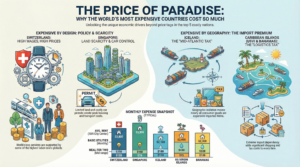 In 2026, the global economic landscape has shifted. While remote work has decentralised the workforce, inflation and supply chain dependencies have pushed the expenses in certain “prestige hubs” to record highs. From the precision-engineered luxury of Switzerland to the land-scarce, high-tech skyline of Singapore, these destinations offer an unparalleled quality of life—at a premium.
This guide moves beyond the surface-level rankings to analyze the Economic Indicators that drive these prices. We look at the Consumer Price Index (CPI), local purchasing power, and the “import traps” that make island nations like the US Virgin Islands and the Bahamas surprisingly expensive.
Living in a high-COL country isn’t just about spending more; it’s about a trade-off for world-class infrastructure, safety, and social services. Explore our deep dive into the five most expensive countries on Earth and learn how to navigate their financial demands without compromising your lifestyle.
2. The Methodology: How Is Cost of Living Calculated?
Understanding the true cost of a destination requires looking beyond the price tag of a single cup of coffee. To rank the world’s most expensive countries, economists and relocation experts utilize a sophisticated blend of quantitative metrics and real-world consumer data. In 2026, these calculations have become even more nuanced, accounting for digital infrastructure and the “remote work tax” in popular expat hubs.
The primary benchmark used is the Cost of Living Index (COLI). This index typically uses a “base city”—often New York City (NYC)—which is assigned a value of 100. If a country like Switzerland has an index of 120, it is 20% more expensive than NYC across several key categories:
- Consumer Price Index (CPI): This tracks the weighted average price of a “basket” of consumer goods and services, such as transportation, food, and medical care.
- Rent & Housing Index: Often the largest expenditure, this measures the cost of renting or buying apartments in major urban centers versus suburban areas.
- Local Purchasing Power: This is a crucial “quality of life” metric. It measures how much the average local salary can actually buy within that country. A high cost of living is often offset by high local wages, as seen in Singapore or Zurich.
- The Groceries & Logistics Factor: For island nations like the Bahamas or Iceland, the cost of living is driven by a heavy reliance on imports. Shipping costs and fuel surcharges are baked into the price of every gallon of milk and liter of petrol.
By analyzing these data points, we can determine whether a country is expensive due to high demand and luxury (like the USVI) or due to high-quality public services and high wages (like Switzerland).
3. Deep-Dive Profiles: The World’s Most Expensive Nations
To truly understand why these nations top the charts, we must look at the unique economic engines driving their prices. In 2026, the distinction between “expensive due to luxury” and “expensive due to necessity” has never been clearer.
Switzerland: The Gold Standard of High-Cost Living
Switzerland remains the perennial leader in global cost rankings. With cities like Zurich and Geneva serving as global financial hubs, the cost of living index here consistently nears the 100-point mark.
- The Driver: High labor costs. Because Swiss workers earn some of the highest minimum wages in the world, services—from haircuts to dining out—carry a significant premium.
- The Trade-off: While a simple lunch might cost $40 USD, citizens benefit from world-class healthcare, a pristine environment, and an education system that is second to none.
Singapore: The Price of Urban Excellence
As a city-state with virtually no natural resources and limited land, Singapore’s high costs are a result of strategic policy and geography.
- The Driver: The Certificate of Entitlement (COE) makes car ownership the most expensive in the world, often exceeding the price of the vehicle itself. Additionally, the red-hot real estate market driven by foreign investment keeps housing costs at a peak.
- The Trade-off: Singapore offers unparalleled safety, a hyper-efficient public transit network, and a tax-friendly environment for high earners and entrepreneurs.
Iceland: The Isolation Premium
Living in the “Land of Fire and Ice” comes with a “Mid-Atlantic tax.”
- The Driver: Geography. Almost all consumer goods, from fresh produce to electronics, must be shipped across the ocean. Furthermore, the 2026 surge in eco-tourism has driven up short-term rental prices, making it harder for locals and long-term expats to find affordable housing.
- The Trade-off: Access to 100% renewable energy, breathtaking landscapes, and a high level of social equality.
4. Comparative Analysis: Side-by-Side Data (2026 Estimates)
US Virgin Islands: The Price of Island Logistics
The US Virgin Islands (USVI) present a unique economic paradox: a tropical paradise under the US flag where everyday expenses can rival Manhattan.
- The Driver: Extreme import dependency. Because the islands lack significant local manufacturing or large-scale agriculture, virtually everything—from construction materials to fresh milk—is shipped in. This adds a “logistics tax” to every item on the shelf. Furthermore, electricity costs are among the highest in the US due to the reliance on imported fuel for power plants.
- The Trade-off: Residents enjoy a tropical lifestyle without needing a foreign visa (for US citizens), alongside access to US federal legal and banking frameworks.
The Bahamas: Luxury Meets Import Reality
The Bahamas is synonymous with high-end tourism and offshore finance, but for residents, the financial reality is driven by its “archipelagic” geography.
- The Driver: The Value Added Tax (VAT) and high import duties. To fund public services in a nation with no personal income tax, the government relies heavily on duties and VAT. This means that while your paycheck stays intact, your purchasing power is hit at the register. In 2026, the demand for luxury real estate in Nassau has further inflated housing costs for locals and expats alike.
- The Trade-off: A tax-neutral environment and some of the world’s most stunning beaches, making it a top choice for high-net-worth individuals and retirees.
To help you visualize the differences, here is how a typical monthly budget compares across these five high-cost destinations.
| Destination | Avg. Rent (1BR City Center) | Basic Utilities (Monthly) | Meal for Two (Mid-range) | Monthly Transit Pass |
| Switzerland | $2,800 | $250 | $120 | $90 |
| Singapore | $3,500 | $160 | $70 | $110 |
| Iceland | $2,100 | $180 | $110 | $75 |
| US Virgin Islands | $2,400 | $450 | $95 | $60* |
| Bahamas | $2,200 | $320 | $100 | $50* |
| *Note: Public transit is limited in USVI and Bahamas; costs often reflect subsidized local options or high fuel costs for private vehicles. |
5. Categorical Breakdowns: Why Your Wallet Feels the Weight
To navigate these high-cost environments, it’s essential to understand exactly where your money goes. In 2026, the cost of living isn’t just a flat fee; it is distributed across three main pillars: Housing, Logistics, and Public Services.
Housing & Real Estate: The Land Scarcity Crisis
In destinations like Singapore and Switzerland, the primary driver of cost is physical space.
- Singapore: With limited land mass, the government tightly controls residential development. The 2026 property market has seen a surge in “green-certified” luxury condos, pushing rents to historic highs.
- Switzerland: Strict zoning laws and a high demand for alpine views mean that even modest apartments in Zurich come with a “prestige tax.”
Logistics & Food: The “Import Tax”
For the Bahamas, Iceland, and the US Virgin Islands, the price of a grocery basket is dictated by the price of oil and global shipping lanes.
- The 2026 Trend: As global fuel prices fluctuate, these nations see immediate “shelf-price” volatility. In Iceland, indoor vertical farming is beginning to offset the cost of leafy greens, but specialty items and proteins remain high-ticket imports.
- The Cost of Freshness: In the Caribbean, “farm-to-table” is often more expensive than “ship-to-table,” a reversal of the typical global trend.
Healthcare & Education: The Quality Premium
While the daily costs are high, some of these nations offer “hidden value” through superior infrastructure.
- Switzerland & Singapore: These nations boast the world’s top-ranked healthcare systems. While insurance premiums are high, the out-of-pocket costs for major procedures are often more predictable than in the United States.
- Social Security: In Northern Europe and Singapore, your high cost of living contributes to incredibly safe streets, punctual high-speed transit, and world-class public parks.
6. Survival Guide: Tips for Living/Travelling – Strategies for High-COL Living
Living in an expensive country doesn’t have to mean financial exhaustion. Smart residents utilize these 2026 “hacks”:
- The “Local” Loophole: In Singapore, eat at Hawker Centers rather than air-conditioned malls. In Switzerland, shop for groceries across the border in Germany or France (the “border run”).
- Digital Nomad Arbitrage: Use a “geo-arbitrage” strategy by earning in a high-value currency (like USD or CHF) while living in a slightly more affordable suburb of these expensive hubs.
- Subscription Living: Leverage 2026’s “as-a-service” economy—renting furniture, using car-sharing apps instead of owning a vehicle, and utilizing co-working spaces to reduce fixed overheads.
7. Global Trends & 2026 Predictions
As we move through 2026, the definition of an “expensive” country is evolving. It is no longer just about the price of goods, but about climate resilience and digital connectivity.
- The Rise of “Green Inflation”: In 2026, we are seeing a trend where countries with the highest environmental standards (like Switzerland and Iceland) are becoming even more expensive. Carbon taxes and the transition to sustainable energy are being reflected in consumer prices, a phenomenon known as “Greenflation.”
- The “Remote Work Premium”: Countries that offer specialized Digital Nomad Visas or high-speed satellite internet in remote areas (like the Bahamas and USVI) are seeing a surge in demand. This “Zoom-town” effect is decoupling local wages from local rent, as high-earning tech workers move in and drive up prices.
- Decentralization: While Singapore and Zurich remain at the top, we are seeing a “spillover effect” where secondary cities in these nations are becoming the new hubs for those seeking a balance between high-tier infrastructure and slightly lower costs.
8. Conclusion: Is the High Cost Worth It?
Ultimately, living in one of the world’s most expensive countries is a strategic choice. For some, the safety, political stability, and efficiency of Singapore or Switzerland justify every cent. For others, the unparalleled natural beauty and lifestyle of Iceland or the Caribbean are worth the “import tax” on daily life.
As global mobility increases, the most successful expats and residents in 2026 are those who practice intentional spending—understanding that while the floor for expenses is high, the ceiling for quality of life is even higher.
Frequently Asked Questions: Navigating High-Cost Nations
Q: Which country currently has the highest overall cost of living in 2026?
A: While rankings fluctuate slightly based on currency strength, Switzerland consistently holds the top spot. This is driven by the “High Wage-High Price” cycle. In 2026, Zurich and Geneva remain the most expensive cities globally due to astronomical housing costs and the premium placed on local services and Swiss-made goods.
Q: Is it possible to live in Singapore on a budget?
A: Yes. By utilizing HDB (government-built) housing areas, eating at hawker centers, and relying on the MRT (train system), you can live significantly cheaper than the “luxury expat” lifestyle often depicted in the media.
Q: How does “Purchasing Power” change the perspective on high costs?
A: Cost of living is only half the story. Purchasing Power measures how much your salary can actually buy. For example, while Singapore is expensive, its low income tax and high professional salaries mean residents often have more “disposable” income than those in lower-cost countries with high tax brackets.
Q: Why are island nations like the Bahamas and USVI consistently more expensive than mainland US or Europe?
A: It comes down to Import Dependency. These islands have limited manufacturing and agriculture. In 2026, global shipping fuel surcharges and “port-to-shelf” logistics add a 20-30% markup on basic goods like milk, electronics, and construction materials compared to mainland prices.
Q: Is it possible to live in Singapore on a modest budget?
A: Absolutely. While Singapore is famous for luxury, it offers a “dual-tier” economy. By utilizing HDB (government) housing, eating at Hawker Centers (where meals are $5–$10), and using the world-class MRT public transit instead of owning a car (which requires a $100k+ permit), a modest lifestyle is highly achievable.
Q: What is “Greenflation,” and how is it affecting costs in Europe and Iceland?
A: “Greenflation” refers to rising prices driven by the transition to a green economy. In countries like Iceland and Switzerland, high carbon taxes and strict environmental regulations on housing and transport have increased the cost of living in the short term, though they offer long-term sustainability and energy independence.
Q: Does the Bahamas really have “zero tax,” and how does that affect daily expenses?
A: The Bahamas has no personal income tax, but the government earns revenue through VAT (Value Added Tax) and high import duties. This means your “take-home pay” is higher, but your “at-the-register” cost for groceries and clothing is significantly higher than in the US or UK.
Q: Why is car ownership so expensive in countries like Singapore and Switzerland?
A: In Singapore, the government uses the Certificate of Entitlement (COE) system to prevent gridlock on a small island, often making the permit more expensive than the car itself. In Switzerland, high insurance mandates, expensive petrol, and steep parking fees make public transit the more economical (and popular) choice.
Q: Is healthcare included in the high cost of living in these countries?
A: It varies. In Switzerland, healthcare is mandatory and private, requiring high monthly premiums but offering elite service. In Singapore, it’s a mix of mandatory savings (Medisave) and subsidies. While expensive, the quality and efficiency in these nations often result in better health outcomes than in lower-cost countries.
Q: How has remote work affected the cost of living in the US Virgin Islands?
A: The “Zoom-town” effect has hit the USVI hard. High-earning remote workers from the US mainland have moved to the islands, driving up the cost of long-term rentals and real estate. This has made it a “luxury hub,” where the cost of housing often outpaces local wage growth.
Q: What is the “Big Mac Index,” and does it still apply in 2026?
A: The Big Mac Index is an informal way to measure Purchasing Power Parity (PPP). By comparing the price of a McDonald’s Big Mac in different countries, economists can tell if a currency is overvalued or undervalued. In 2026, it remains a popular (though simplified) tool to show why $50 USD goes further in some regions than others.





Leave a Reply