
Introduction: The Soul of Telangana
Imagine a forest—deep, ancient, and silent—suddenly erupting into a sea of humanity. Imagine the scent of turmeric and crushed jaggery hanging thick in the air, while the rhythmic, primal beat of the Doli drums vibrates through the very ground beneath your feet. This isn’t just a gathering; it is a spiritual homecoming. This is the Medaram Jatara 2026, a phenomenon that defies modern logic and stands as a roaring testament to the enduring power of tribal faith.
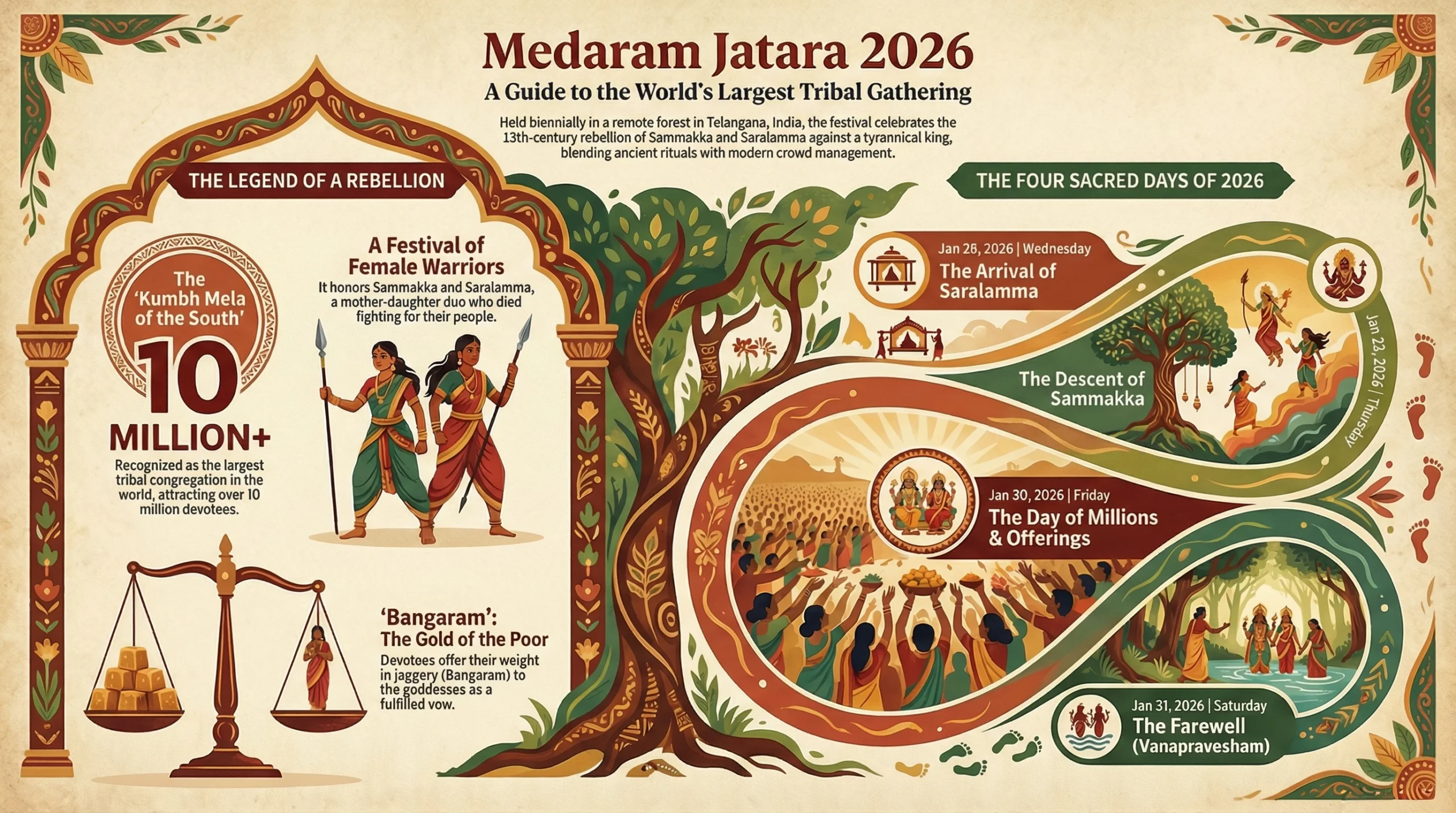
Often hailed as the “Kumbh Mela of the South,” the Sammakka Saralamma Jatara is officially recognized as the largest tribal congregation in the world. But to the people of Telangana and the surrounding states of Andhra Pradesh, Chhattisgarh, Maharashtra, and Odisha, it is far more than a statistic. It is a living, breathing celebration of a 13th-century rebellion—a story of two brave women who chose to die on their feet rather than live on their knees under the tyranny of an empire.
The Phenomenon of 2026
As we approach the 2026 edition (January 28th to January 31st), the energy in the air is palpable. In an era of high-speed internet and rapid urbanization, Medaram remains a sacred sanctuary where time slows down. While the Telangana government has infused the 2026 festival with over ₹150 crore in infrastructure—bringing AI-driven crowd management and drone surveillance to these ancient woods—the core of the festival remains beautifully primitive.
There are no stone temples here. There are no gold-plated idols or Vedic priests chanting Sanskrit verses. Instead, the gods are found in the trees, the earth, and the sacred platforms (Gaddelu). The devotees, numbering over 10 million, don’t just come to watch; they come to merge with the divine.
Why Medaram Captures the Global Imagination
What makes Medaram Jatara 2026 a “must-experience” event on the global cultural calendar?
- The Unfiltered Devotion: Witnessing millions of pilgrims traveling in colorful bullock carts, camping under the stars, and offering their weight in jaggery (Bangaram) is a sight that humbles even the most cynical traveler.
- The Feminist Legacy: At its heart, the festival celebrates female agency. Sammakka and Saralamma are not mythological goddesses descended from the heavens; they were real women, mothers and daughters, who fought for the rights of their people.
- The Great Equalizer: In the heart of the Tadvai forest, social hierarchies dissolve. Whether you arrive in a luxury SUV or on a dusty bicycle, the red soil of Medaram treats everyone the same.
As the moon waxes toward the auspicious Magha Shuddha Pournami (full moon) in January 2026, the tiny village of Medaram prepares to transform into a sprawling metropolis of faith. Whether you are a spiritual seeker, a cultural photographer, or a curious traveler, the 2026 Jatara promises an assault on the senses and a soothing of the soul.
The Legend: The Saga of Sammakka and Saralamma
To understand Medaram, you must first understand the blood that watered its soil. Unlike many Indian festivals rooted in ancient mythology, the Medaram Jatara is grounded in a gritty, historical defiance. This is the story of a 13th-century tribal revolt against the mighty Kakatiya Dynasty, a tale of courage that has been passed down through Koya oral traditions for eight centuries.
The Mystery of Chilakalagutta
The legend begins with a hunting party from the Koya tribe who ventured into the dense Tadvai forest near a hillock called Chilakalagutta. Amidst the undergrowth, they found a young girl surrounded by tigers, playing fearlessly. Amazed by her aura, the tribe adopted her and named her Sammakka.
As she grew, Sammakka became a symbol of wisdom and healing for the forest people. She eventually married Pagididda Raju, a feudatory tribal chief of the Kakatiyas. Together, they had three children: two daughters, Saralamma (Sarakka) and Nagalamma, and a son, Jampanna.
The Great Defiance (13th Century)
The peace of the forest was shattered when the Kakatiya Empire, reeling from a severe drought, demanded a heavy tax from the Koya people. The tribals, who were themselves starving and had no harvest to offer, pleaded for relief. When the Kakatiya King (Pratapa Rudra) refused to relent, the Koya family chose resistance over subjugation.
A fierce battle broke out on the banks of the Sampangi Vagu (now known as Jampanna Vagu). The conflict was devastating:
- Pagididda Raju fell in battle.
- Saralamma and Nagalamma fought valiantly before being martyred.
- Jampanna, the young warrior, realized the battle was lost and, in a final act of protest, jumped into the river. Legend says the river turned red with his blood, leading to its renaming as Jampanna Vagu.
The Divine Transformation
Sammakka, witnessing the loss of her entire family, did not surrender. She took up arms and continued the fight, wounding many of the imperial soldiers. However, realizing the end was near, she retreated toward the Chilakalagutta hill.
When the Koya people went searching for her, they found no trace of her physical body. Instead, they discovered a Kumkuma Bharani (a small casket of vermillion) near a bamboo grove, guarded by a massive tigress. It was then that the tribe realized Sammakka had not died; she had transformed into a guardian deity to watch over them forever.
Why This Story Still Matters in 2026
In the context of the Medaram Jatara 2026, this legend isn’t just “history”—it’s a living identity.
- Social Justice: The festival remains a powerful symbol of the common man’s fight against bureaucratic overreach.
- Tribal Sovereignty: It marks the first recorded instance of tribal resistance in the Deccan plateau.
- Matriarchal Power: In a world where heroes are often male, the Koya people worship a mother and daughter as their supreme protectors.
When you stand at the Gaddelu (sacred platforms) in 2026, you aren’t just looking at a shrine; you are standing on the very spot where a mother stood her ground for her people.
Medaram Jatara 2026: The 4-Day Ritual Schedule
For those planning to attend, timing is everything. The festival follows a precise, centuries-old sequence where the deities “arrive” from the forest to their altars. In 2026, the festivities are set to reach their peak between January 28th and January 31st.
Here is your day-by-day roadmap to the rituals of Medaram Jatara 2026.
Day 1: Wednesday, Jan 28, 2026 – The Arrival of Saralamma
The festival begins with the ceremonial arrival of Saralamma from the village of Kannepally.
- The Ritual: Koya priests (Vaddes) carry the deity in the form of a casket of vermillion and turmeric.
- The Atmosphere: As the procession moves toward the Gaddelu (sacred platforms) in Medaram, the air is filled with the frantic beats of tribal drums. Thousands of devotees perform “Danda Pranam,” prostrating on the path to seek blessings.
- Other Deities: Simultaneously, Pagididda Raju (Sammakka’s husband) is brought from Poonugondla, and Govinda Raju is brought from Kondai.
Day 2: Thursday, Jan 29, 2026 – The Descent of Sammakka
This is the most electric and emotionally charged day of the Jatara. This is when the main deity, Sammakka, is brought from the Chilakalagutta hill.
- The “Gadde Pravesham”: Around sunset, the chief priest brings the deity (represented by a vermillion casket) down the hill.
- The Gun Salute: In a unique tradition, the Telangana State Police offers a formal gun salute as Sammakka reaches the platform, acknowledging her status as a warrior queen.
- The Trance: It is during this time that many devotees enter a state of spiritual trance (Sivasattulu), dancing to the rhythms of the forest.
Day 3: Friday, Jan 30, 2026 – The Day of Millions
Friday is the “Grand Finale” for devotees. Both Mother and Daughter are now seated on their respective Gaddelu, and this is the day for the mass pilgrimage.
- The Offering of “Bangaram”: This is the peak day for offerings. Devotees offer jaggery (Bangaram) equal to their body weight to the goddesses.
- The Holy Dip: Expect massive crowds at Jampanna Vagu, where pilgrims take a ritual bath before approaching the altars.
- The Crowd: Current estimates for 2026 suggest over 4 to 5 million people will visit the site on this single day alone.
Day 4: Saturday, Jan 31, 2026 – Vanapravesham (The Return)
The festival concludes with a poignant ceremony known as Vanapravesham.
- The Farewell: The deities are ceremoniously taken back into the forest, signifying their return to their spiritual abode.
- The Aftermath: While the “official” rituals end, many families stay back to cook traditional meals in the forest clearings before beginning their long journey home in their bullock carts or buses.
2026 Ritual Timings Table
| Date | Day | Primary Ritual | Key Location |
| Jan 28 | Wednesday | Arrival of Saralamma | Kannepally to Medaram |
| Jan 29 | Thursday | Sammakka’s Descent | Chilakalagutta Hill |
| Jan 30 | Friday | Mass Offerings (Bangaram) | Main Gaddelu (Medaram) |
| Jan 31 | Saturday | Vanapravesham (Farewell) | Medaram Forest |
Rituals & Traditions: The Heartbeat of the Jungle
What makes Medaram Jatara 2026 truly “human” is not the scale of the crowds, but the deeply personal rituals that have remained unchanged for centuries. Unlike the structured ceremonies of urban temples, the traditions here are raw, earthy, and profoundly symbolic.
If you are visiting for the first time, these are the three experiences that define the essence of the festival.
The Offering of “Bangaram” (Gold of the Poor)
In any other context, Bangaram means gold. But in Medaram, gold takes the form of Jaggery.
- The Symbolism: For the Koya tribes, jaggery was a precious commodity, a symbol of life’s sweetness and the harvest’s bounty.
- The Vow: Devotees make a vow to the goddesses and, upon fulfillment, offer an amount of jaggery equal to their own body weight (known as Tulabharam).
- The Sight: Walking through the festival grounds in 2026, you will see literal mountains of jaggery piled high near the Gaddelu. The air is sweet, sticky, and heavy with the scent of unrefined sugar—a sensory memory that stays with you long after you leave.
The Sacred Dip in Jampanna Vagu
Before any devotee touches the sacred platforms, they must seek purification in the Jampanna Vagu.
- The Healing Waters: Despite the red-tinted silt (historically linked to Jampanna’s blood), the water is believed to have medicinal and spiritual healing properties.
- The Human Connection: Seeing thousands of families—grandparents and toddlers alike—splashing in the knee-deep water at dawn is a powerful reminder of the communal nature of Indian faith. In 2026, the government has installed special showers and safety railings, but most pilgrims still prefer the traditional river dip.
The Dance of the Sivasattulu
As the drums reach a crescendo, you will witness the Sivasattulu. These are devotees—often women—who are believed to be temporarily possessed by the spirit of the goddesses.
- The Experience: Dressed in vibrant sarees, smeared with turmeric and vermillion, and carrying copper pots, they dance with a rhythmic intensity that seems to defy physical exhaustion.
- The Guidance: Locals often approach them during this state to seek blessings or answers to life’s problems, believing that Sammakka is speaking directly through them.
Pro-Tip for 2026 Travelers: If you plan to offer Bangaram, buy your jaggery in nearby towns like Warangal or Mulugu. While it is available at the festival site, the prices can triple during the peak days of Jan 29-30!
Travel & Logistics: Your 2026 Survival Guide
Getting to a forest village with 10 million other people requires more than just a GPS. It requires a strategy. For the 2026 Jatara, logistics have been modernized, but the old-school challenges remain.
How to Reach Medaram
- By Air: The nearest major airport is Hyderabad (RGIA), roughly 260 km away. From there, you can hire a private taxi or take a state bus.
- By Rail: The closest railway station is Warangal (WL) or Kazipet (KZJ). These hubs are about 100 km from Medaram.
- By Road (The TSRTC Lifeline): The Telangana State Road Transport Corporation (TSRTC) is the hero of this festival. In 2026, they are operating 6,000+ special buses from various points in the state. These buses have dedicated lanes, making them much faster than private cars.
The 2026 Helicopter Service
For those who want to avoid the 12-hour traffic snarls, private aviation companies, in coordination with the Telangana government, offer Helicopter Shuttles from Hanamkonda (Warangal) to Medaram. The 20-minute flight provides a breathtaking aerial view of the “Sea of Humanity” in the Tadvai forest.
Accommodation: Where do you sleep?
- The Forest Experience: Most devotees camp in the open forest clearings under their bullock carts or in makeshift tents.
- Haritha Medaram: The Telangana Tourism department has a limited number of permanent rooms and high-end tents, but these are usually booked out 6 months in advance.
- Base Camp Warangal: The most practical option for “comfort” travelers is to stay in a hotel in Warangal and start your journey toward Medaram at 3:00 AM to beat the morning rush.
2026 Special Infrastructure: Where Tradition Meets AI
The Medaram Jatara 2026 isn’t just a tribal gathering anymore; it’s a showcase of how the Telangana government is using cutting-edge technology to manage one of the world’s largest human congregations. For the first time, the “Kumbh Mela of the South” is going high-tech to ensure the safety of over 30 million expected visitors.
AI-Powered Security & Crowd Control
- Real-time Monitoring: The Telangana Police have deployed AI-based security systems and over 500 CCTV cameras equipped with Automatic Number Plate Recognition (ANPR). These are linked directly to the Command and Control Centre in Hyderabad for 24/7 surveillance.
- Smart Tracking for Families: To tackle the common issue of lost children in such massive crowds, the police have introduced QR-code wristbands and a “Smart System” to trace missing persons instantly.
- Drone Surveillance: A fleet of drones will continuously monitor crowd density at the Gaddelu (altars) and Jampanna Vagu to prevent stampedes and manage traffic flow in real-time.
The “Green Medaram” Initiative
In 2026, there is a massive push to protect the Tadvai forest ecosystem.
- Plastic-Free Zone: The government has launched a “Plastic-Free Medaram” campaign, urging devotees to use cloth or jute bags.
Waste to Bio-Plants: For the first time, all meat waste and ritual offerings (like discarded sarees and coconuts) are being segregated and sent to specialized bio-plants for recycling, ensuring the sacred forest remains pristine after the festival.
Essential Do’s and Don’ts for 2026 Pilgrims
To ensure your visit to the Sammakka Saralamma Jatara is spiritual and stress-free, follow this vetted survival guide:
✅ The Do’s
- Download the ‘My Medaram’ App: Use the official ‘My Medaram’ WhatsApp Chatbot or mobile app launched by the Mulugu District administration. It provides real-time traffic updates, parking locations, and emergency contacts.
- Use Public Transport: With over 5 lakh private vehicles expected, the TSRTC special buses (6,000+ operating in 2026) are your best bet. They have dedicated lanes and will drop you significantly closer to the altars than private cars.
- Identify Medical Camps: Over 3,000 medical staff and 72 medical camps have been deployed. If you feel unwell, look for the Sri Sammakka Saralamma Vaidya Shala (the 50-bed main hospital) at the TTD Kalyana Mandapam.
- Carry Cash: While digital payments are growing, network congestion in the forest can make UPI unreliable. Carry enough physical cash for Bangaram (jaggery) and local meals.
❌ The Don’ts
- Avoid Single-Use Plastic: Strict checks are in place at entry points. Don’t carry plastic bags; the forest animals often ingest them, leading to fatal consequences.
- Don’t Drive at Night: The roads leading to Medaram pass through dense wildlife sanctuaries. For the safety of the animals and to avoid forest-road accidents, plan your travel during daylight.
- Don’t Rush the Altar: The peak days (Jan 29-30) are incredibly crowded. If you have elderly family members, consider visiting during the “Pre-Jatara” week to avoid the 30-million-person crush.
2026 Emergency Helpline Numbers
| Service | Number |
| General Helpline I | 08715-223257 |
| General Helpline II | 08717-281247 |
| Police/Emergency | 100 / 108 |
| WhatsApp Chatbot | Check the official Mulugu District portal |
Beyond the Forest: Nearby Attractions
If you’ve travelled from afar to reach Medaram, don’t miss the chance to explore the “Temple Circuit” of Telangana. The region surrounding Mulugu is home to some of India’s most stunning architectural and natural wonders.
- Ramappa Temple (UNESCO World Heritage Site): Located just 70km from Medaram, this 13th-century Kakatiya marvel is famous for its “floating bricks” and intricate sand-box foundation technology.
- Laknavaram Lake: A mere 35km away, this sprawling lake features a famous hanging bridge and island resorts—perfect for a peaceful cooldown after the intensity of the Jatara.
- Bogatha Waterfall: Often called the “Niagara of Telangana,” these falls are at their best right after the monsoon, but still offer a scenic retreat for nature lovers.
To truly outrank the competition, your FAQ section shouldn’t just be a list of answers—it should be a helpful concierge for the millions of people searching for clarity right now.
Here are the top 10 most-searched FAQs for Medaram Jatara 2026, written with a human touch and optimized for Google’s featured snippets.
Top 10 Frequently Asked Questions: Medaram 2026
1. What are the official dates for Medaram Jatara 2026?
The biennial Sammakka Saralamma Jatara will be held over four days: January 28, 29, 30, and 31, 2026. The festival peaks on January 30th, which is considered the most auspicious day for mass offerings.
2. Why is jaggery offered as “Bangaram” (Gold) at Medaram?
In Koya tribal tradition, jaggery is a symbol of life’s sweetness and the harvest’s purity. Since the tribal goddesses Sammakka and Saralamma fought for the people’s welfare, devotees offer jaggery equal to their body weight as a substitute for gold. This “Gold of the Poor” represents a heart-to-heart promise fulfilled between the devotee and the divine.
3. How can I reach Medaram from Hyderabad in 2026?
The most efficient way is via the TSRTC special buses (over 6,000 are in operation for 2026). If you prefer driving, follow the Warangal-Mulugu-Pasara route. For a premium experience, look into the 2026 Helicopter services departing from Hanamkonda, which bypass the massive road traffic.
4. Are there any COVID-19 or health protocols for the 2026 Jatara?
While the pandemic era has passed, the 2026 administration maintains strict public health surveillance. Over 70 medical camps are stationed around the Tadvai forest. Visitors are encouraged to stay hydrated (carry ORS) and avoid communal eating in unhygienic areas to prevent water-borne illnesses.
5. Can I visit Medaram on non-Jatara days?
Absolutely. In fact, many prefer visiting a few weeks before or after the main event to avoid the 20-million-person crowd. While the high-octane rituals only happen during the four days in January, the spiritual energy of the Gaddelu (sacred platforms) remains year-round.
6. What is the significance of the “Jampanna Vagu” dip?
Jampanna was Sammakka’s son who sacrificed his life in this stream during the battle against the Kakatiyas. Taking a dip in the red-tinted waters of Jampanna Vagu is believed to cleanse sins and provide the physical strength needed to complete the pilgrimage.
7. Is there a dress code for the festival?
There is no formal “Vedic” dress code, but out of respect for tribal customs, most men wear traditional dhotis or trousers, and women wear sarees or churidars. Comfortable footwear is a must, as you will likely be walking 3–5 km from the parking zones to the altars.
8. How do I book accommodation in Medaram for 2026?
Permanent accommodation is extremely limited. The Telangana Tourism (Haritha) guest houses book up months in advance. Most pilgrims stay in Warangal (100km away) or camp in the forest. For 2026, many locals in Mulugu are offering “Verified Homestays” via digital portals.
9. How is the 2026 Jatara using technology for safety?
The 2026 edition features AI-driven crowd density sensors that alert police before a zone becomes overcrowded. Additionally, look for QR-code kiosks where parents can register children to get “safety bands,” ensuring they can be found instantly if separated in the crowd.
10. Is Medaram Jatara open to people of all religions?
Yes. The soul of Telangana is inclusivity. Though it is a Koya tribal festival, it is attended by people of all castes, creeds, and religions. The goddesses are seen as universal protectors of justice, making it a true “People’s Festival.”
If you are looking for any kind of Corporate Event Photographer / Exhibition Photographer in Hyderabad, then connect with us.



Leave a Reply