
The “Revenge” of Love (Nandgaon Lathmar Holi 2026)
Imagine the air so thick with Gulal that the sun itself turns a hazy shade of crimson. The rhythmic thumping of nagadas vibrates in your chest, and the narrow lanes of Nandgaon—the legendary childhood home of Krishna—are transformed into a living, breathing canvas of pink and orange. This is February 26, 2026, the day of the iconic Nandgaon Lathmar Holi, and you are standing at the epicenter of a centuries-old “battle” that is as much about devotion as it is about high-octane drama.
The Tables Turn: From Barsana to Nandgaon
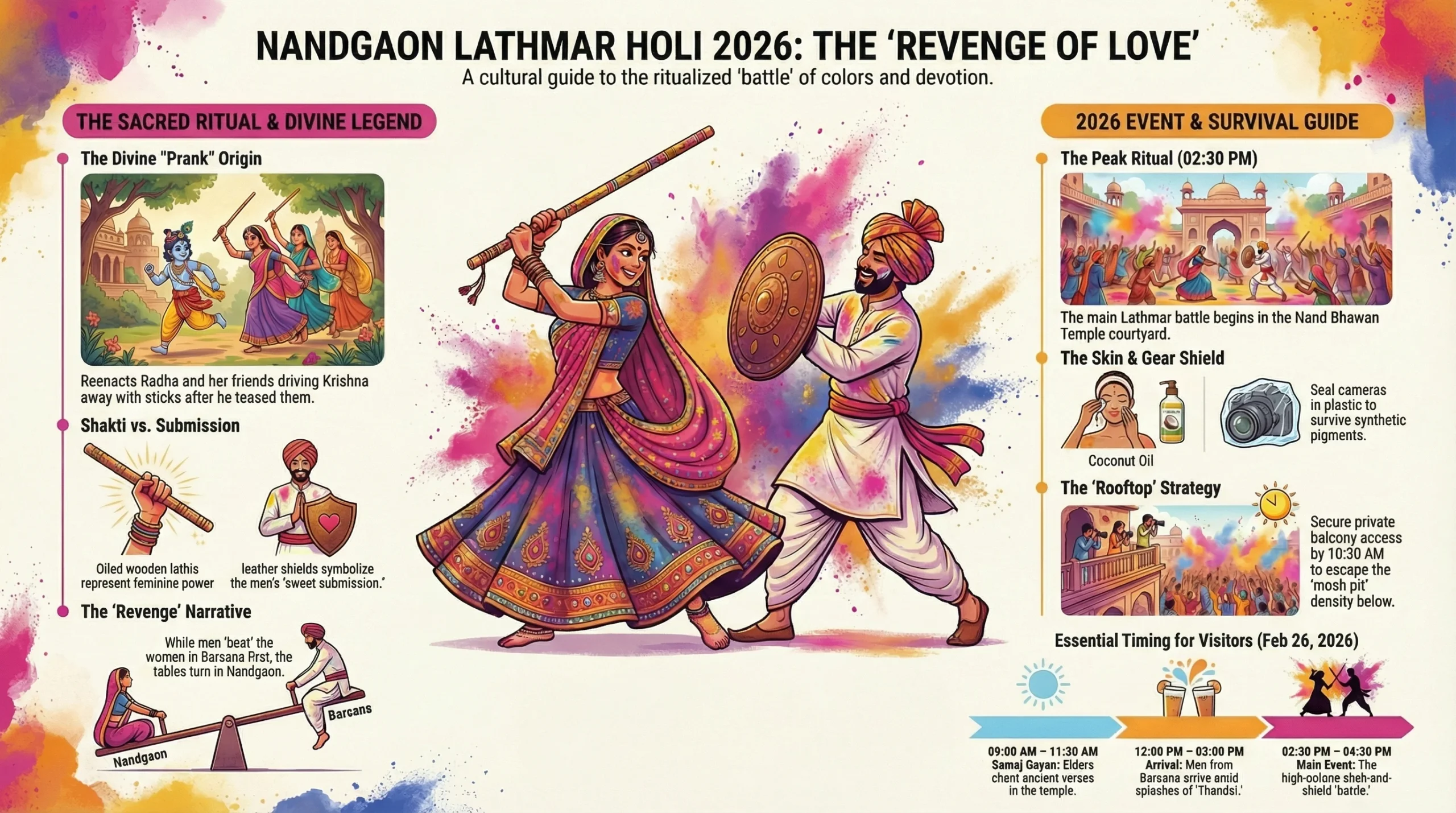
If you were in Barsana just 24 hours ago, you witnessed the men of Nandgaon getting “beaten” by the women of Radha’s village. But today, the narrative shifts. In a beautiful, theatrical display of cultural gender-role reversal, the men of Barsana—the Huriyare—cross the 8km stretch to Nandgaon to seek their “revenge.”
But make no mistake: this isn’t a revenge of anger; it is the Revenge of Love. According to the Radha-Krishna Leela, after being chased away from Barsana, Krishna’s friends (the Gopas) invited the women of Barsana to their turf to continue the play. Today, the men of Barsana arrive at the Nand Bhawan Temple dressed in traditional turbans and carrying heavy leather shields, ready to be “welcomed” by the fierce women of Nandgaon wielding long wooden sticks (lathis).
Why Feb 26, 2026, is the Date to Watch
This year, the Braj Ki Holi 2026 calendar has placed the Nandgaon festivities on a Thursday, creating a perfect mid-week peak for the Rangotsav celebrations. For travelers and photographers, this is the “Goldilocks” day of the festival. While Barsana is famously chaotic, Nandgaon offers a raw, more intimate energy.
The highlight occurs in the courtyard of the Nand Baba Temple, perched atop the Nandisvara Hill. As the men from Barsana enter, singing provocative Hori folk songs to tease the local women, the “attack” begins. The sound of wood hitting leather shields creates a thunderous clap that echoes through the valley, signaling a victory for the spirit of the Gopis.
The Survival Vibe
Participating in Lathmar Holi 2026 is not for the faint of heart. It is a sensory explosion. You’ll see:
- Thandai flowing freely: Infused with traditional herbs to keep the energy levels skyrocketing.
- Samaj Gayan: Elders sitting in circles, chanting ancient verses that have remained unchanged for 500 years.
- A Photographer’s Dream: The “Color Fountains” inside the temple where the sky literally disappears behind clouds of pigment.
This is the day when the “battle” between the two villages reaches its peak. It’s a riot of colors, a test of endurance, and a profound spiritual experience that proves in the land of Braj, even a beating is a blessing.
The Legend: Why Sticks & Shields? (The Divine Origins of Lathmar Holi)
To the uninitiated observer, the sight of women vigorously raining down wooden staffs on men crouched behind leather shields might look like a medieval skirmish. But in the heart of the Braj region, this isn’t a riot—it’s a ritual. To understand why Lathmar Holi 2026 remains the most anticipated event on the Indian cultural calendar, you have to peel back the layers of time and dive into the Radha-Krishna Leela.
The Mischief that Sparked a Tradition
The legend begins in the Dwapara Yuga, with a young, mischievous Lord Krishna. Krishna, who grew up in the pastoral village of Nandgaon, was famously enamored with Radha, the spirited daughter of the chief of Barsana.
The story goes that Krishna, accompanied by his band of cowherd friends (Gopas), would travel the 8km path to Barsana just to tease Radha and her friends (Gopis). On one particular spring day, Krishna’s teasing went a step too far. Legend has it he applied color to Radha’s face to match his own dark complexion. In a playful fit of “enough is enough,” Radha and the women of Barsana took up long wooden sticks (lathis) and drove the boys out of their village.
Krishna and his friends, having no weapons against the ladies’ wrath, used whatever they could find—mostly large leather shields—to protect themselves as they made a hasty retreat back to Nandgaon.
From Divine Play to Living History
Fast forward to 2026, and this “divine prank” is reenacted with breathtaking precision. The sticks and shields are no longer just tools of a legend; they are symbols of a deep-rooted cultural heritage.
- The Lathis (Sticks): Wielded by the women (the Huryarin), these aren’t flimsy branches. They are heavy, oiled, and polished wooden staffs. In the context of the festival, the stick represents the power of the feminine—Shakti. It is the only day of the year where the traditional hierarchy shifts, and the women of Braj playfully “punish” the men for their mischief.
- The Dhals (Shields): Carried by the men of Barsana (the Huriyare), these shields are heavy-duty, often made of reinforced leather. The men must crouch low, holding the shield with both hands, absorbing the rhythmic thud of the sticks. It is a test of endurance and a symbolic act of “sweet submission” to the beloved.
The Spiritual Significance: More Than Just a Game
While the visual of the Lathmar “battle” is what trends on Instagram, the soul of the event lies in the Samaj Gayan. Before the sticks come out, the men sit in the temple courtyard, singing traditional Braj Holi songs that describe the beauty of Radha and the antics of Krishna.
The sticks and shields represent the “tug-of-war” of human emotions—love, ego, teasing, and devotion. When a woman strikes a shield in Nandgaon on Feb 26, she isn’t hitting a stranger; she is participating in a centuries-old dialogue between two villages that consider themselves one large, divine family.
Why the Legend Matters for Your 2026 Visit
Understanding this history changes how you experience the festival. When you see a Huriyare smiling despite the heavy blows, or a woman laughing as she strikes the shield, you’re seeing the Braj spirit in action. It’s a reminder that in the land of Krishna, even a “beating” is an act of grace, and every strike is a celebration of a love story that has refused to fade for thousands of years.
2026 Schedule: The Minute-by-Minute Itinerary (Feb 26)
Timing is everything when you’re navigating the narrow, color-drenched arteries of Nandgaon. On February 26, 2026, the village doesn’t just wake up; it explodes into a rhythmic devotion that follows a very specific, traditional clock. To help your readers capture the best shots and avoid the “choke points,” here is the definitive Nandgaon Lathmar Holi itinerary.
06:00 AM – 08:30 AM: The “Calm” Before the Color
- The Goal: Reach Nandgaon and secure your “Base.”
- The Action: Arrive early to beat the heavy barricading. Head straight to the Nand Bhawan Temple (Nand Rai Ji Temple) perched on the hill.
- Pro Tip: This is the best time for peaceful Darshan. Witness the Mangala Aarti and see the temple priests preparing the Tesu flowers (natural orange dye) and heaps of Gulal.
09:00 AM – 11:30 AM: The Soul of Braj (Samaj Gayan)
- The Goal: Witness the spiritual core.
- The Action: In the temple courtyard, groups of elders from Nandgaon sit in a circle for Samaj Gayan. They sing ancient Dhrupad-style Holi songs in the local Brajbhasha dialect.
- Photographer’s Note: The light is soft now—perfect for capturing the weathered, joyful faces of the singers draped in white and orange.
12:00 PM – 02:00 PM: The Arrival of the “Grooms” (Barsana Huriyare)
- The Goal: See the procession.
- The Action: The men from Barsana begin to arrive in groups. They are greeted with heavy splashes of color and refreshing Thandai. They wind their way up the narrow incline toward the temple, singing and chanting “Radhe Radhe!”
- Watch Out: The “Rang Gali” (the lane leading to the temple) becomes a mosh pit of color here. If you are sensitive to crowds, stay on a rooftop.
02:30 PM – 04:30 PM: The Main Event (Lathmar Ritual)
- The Goal: The “Battle” of Sticks and Shields.
- The Action: This is the peak. The women of Nandgaon (the Huryarin) line up with their heavy wooden sticks. The men from Barsana crouch under their leather shields. The sound of the first strike—a sharp, wooden crack—signals the start.
- Vantage Point: If you haven’t secured a rooftop spot by 1:30 PM, you likely won’t see the action. The temple courtyard becomes extremely dense.
05:00 PM – 06:30 PM: The Golden Hour & Exit Strategy
- The Goal: Post-ritual glow and beating the traffic.
- The Action: As the sun sets, the intensity drops. The temple steps are now a carpet of thick, damp color. This is the “Golden Hour” for cinematic wide shots of the village.
- Travel Advice: Start your descent toward the parking area before the final temple Aarti to avoid the 10,000-person bottleneck at the village exit.
How to Reach Nandgaon from Barsana (The Core Logistics)
Navigating the 10-kilometer stretch between Barsana and Nandgaon on February 26, 2026, is less about a GPS and more about a strategy. While the physical distance is short—roughly 10.6 km—the “festival time dilation” means a 20-minute drive can easily morph into a two-hour ordeal if you don’t play your cards right.
Here is the breakdown of how to bridge the gap between Radha’s home and Krishna’s village like a local pro.
Option 1: The Shared Auto/E-Rickshaw (The “Local” Pulse)
On the day of Lathmar Holi, hundreds of shared autos and e-rickshaws ply the MDR143W (the main Barsana-Nandgaon road).
- The Experience: It’s loud, crowded, and incredibly festive. You’ll be squeezed in with locals carrying bundles of gulal.
- Cost: Expect to pay anywhere between ₹50 to ₹150 per seat. Prices spike during the festival, so keep small change ready.
- Drop-off: They won’t take you to the temple gates. They will drop you at the Nandgaon Barrier, approximately 1.5 to 2 km from the temple. From there, your feet do the rest.
Option 2: Private Taxi or Personal Car (The Comfort Bet)
If you have a pre-booked cab or your own vehicle, the road is straightforward, but the parking is a puzzle.
- The Route: Follow the Barsana-Nandgaon road. It’s a well-maintained stretch lined with mustard fields.
- Parking Reality 2026: For the 2026 festival, authorities have designated 56 parking sites and 94 barricading points. Most private cars will be stopped at the outer periphery of Nandgaon.
- Insider Tip: Do not try to push your car into the village. Park at the first authorized lot you see and switch to a walking pace. Leaving your car 2km away is faster than getting stuck in a 4-hour lane-lock later in the evening.
Option 3: The Pilgrim’s Path (Walking the Fields)
For the adventurous (and the spiritually inclined), walking from Barsana to Nandgaon is a rite of passage.
- The Duration: Roughly 2 to 3 hours at a steady pace.
- The Vibe: Instead of the dusty main road, take the dirt paths through the wheat and mustard fields. You’ll see peacocks, local shrines, and groups of devotees chanting “Radhe Radhe.”
- The Benefit: You bypass the vehicle gridlock entirely and arrive at the base of Nandisvara Hill with a much deeper connection to the landscape.
Crucial 2026 Traffic Alert: The “9 AM Rule”
Based on the 2026 Rangotsav security plan, traffic movement between the two towns is expected to be strictly regulated after 9:00 AM.
- The Barrier: If you aren’t across the Nandgaon village border by 9:30 AM, you may find the main road closed to private four-wheelers.
- The “Secret” Entry: If the main Barsana road is choked, some travelers approach from the Kosi Kalan side (northern entry), which often remains slightly more fluid until midday.
Where to Stay: Strategic Locations for Lathmar Holi 2026
Finding a place to stay during the Braj Holi 2026 circuit is a lot like playing a high-stakes game of musical chairs. With millions of devotees and travelers descending upon a handful of small villages, your choice of accommodation can make or break your experience.
Do you want to wake up to the sound of temple bells in the heart of the village, or do you prefer a hot shower and a plush bed two hours away from the chaos? Here is your strategic breakdown of the best places to stay for Nandgaon Lathmar Holi on Feb 26.
1. Nandgaon: For the “Hardcore” Cultural Immersion
If you want to be the first person inside the Nand Bhawan Temple at dawn, staying in Nandgaon itself is your only option.
- The Reality Check: Forget “hotels.” In Nandgaon, you are looking at local Ashrams and Dharamshalas. Expect basic amenities: a mattress on the floor, shared bucket-wash bathrooms, and simple satvik meals.
- The Perk: You bypass the 5:00 AM traffic gridlock entirely. You get to witness the private, quiet moments of the villagers preparing their lathis and thandai.
- Booking Tip: These places don’t usually have websites. You’ll need to arrive a few days early or have a local contact to secure a spot.
2. Kosi Kalan: The Most Practical Hub (15-20 Mins Away)
Located just 10-12 km from Nandgaon, Kosi Kalan is the nearest town with “standard” hotel facilities.
- Why Stay Here? It sits on the main Delhi-Agra highway and has a major railway station. You’ll find air-conditioned rooms, attached bathrooms, and actual room service.
- Transport Advantage: It’s much easier to find a private auto or taxi from Kosi Kalan to the Nandgaon barricades than from anywhere else.
- Best For: Solo travelers and small groups who want a “middle ground” between comfort and proximity.
3. Barsana: The “Back-to-Back” Strategy
Since Lathmar Holi in Barsana happens on Feb 25 (the day before Nandgaon), many travelers choose to keep their base in Barsana for both days.
- The Logistics: Stay in Barsana on the night of the 25th, then take a morning auto/e-rickshaw to Nandgaon on the 26th.
- Options: Barsana has slightly “upgraded” guest houses compared to Nandgaon, such as the Wingston Hotel or various upscale Ashrams near the Rangeeli Mahal.
4. Vrindavan & Mathura: The Comfort & Luxury Zone
This is where the majority of international tourists and “luxury” travelers stay.
- The Experience: You have access to 4-star properties like Nidhivan Sarovar Portico or Hare Krishna Orchid. After a day of being drenched in color and dust, a clean pool and a multi-cuisine buffet feel like heaven.
- The Catch: The Commute. On Feb 26, the 50km drive from Vrindavan to Nandgaon can take 3 to 4 hours due to massive diversions.
- The Strategy: If you stay here, you must leave Vrindavan by 4:30 AM to reach Nandgaon before the roads are sealed off.
5. Govardhan: The Spiritual Alternative
Located roughly halfway between Vrindavan and the Lathmar villages, Govardhan offers a spiritual vibe with decent boutique hotels (like The Shri Radha Brij Vasundhara Resort).
- Why Govardhan? It’s less crowded than Vrindavan but more developed than Nandgaon. It serves as a great “Base Camp” for the entire 10-day Holi period.
The “Golden Rule” for 2026 Bookings
Listen closely: The “Holi Premium” is real. By January 2026, 90% of the quality inventory in the Braj region will be sold out. If you see a room available today for February 26, book it immediately. Most hotels implement a “no-refund” policy for the Holi week, so double-check your dates and travel insurance.
Pro Tip: Look for “Homestays” on Airbnb in the periphery of Mathura. They often offer a more authentic experience and better safety for foreign travelers than the crowded city hotels.
Survival Guide: Safety & Etiquette for Lathmar Holi 2026
Let’s be real: Lathmar Holi in Nandgaon is a beautiful, chaotic, high-intensity mosh pit of devotion and dust. If you walk into the narrow lanes of Nandgaon on February 26, 2026, without a plan, you aren’t just a spectator—you’re a target for a literal ton of gulal.
To ensure your memories are of the vibrant culture and not a trip to the local clinic, follow this 2026 Survival Guide. This is the “no-nonsense” advice every traveler needs to navigate the madness of the Braj region.
1. The “Skin & Hair” Defense Protocol
By the time the sun sets on Feb 26, you will be dyed a shade of magenta that doesn’t exist in nature. While the colors are traditionally natural (Tesu flowers), modern celebrations often involve synthetic pigments.
- The Oil Shield: Before you leave your room, slather yourself in coconut oil or mustard oil from head to toe. This creates a barrier, making it easier to wash the color off later.
- Hair Care: Don’t leave your hair open. Tie it in a bun or wear a bandana/cap. If you have light-colored hair, double-oil it unless you want pink highlights for the next three months.
- Eye Protection: This is non-negotiable. Wear cheap, wraparound sunglasses. They protect your eyes from direct hits of dry powder and liquid “pichkaris.”
2. The “Dress Code” for 2026
- Material Matters: Wear thick, breathable cotton. White is the traditional choice (it looks great in photos!), but ensure your clothes aren’t transparent when wet.
- Footwear: Do not wear expensive sneakers or flip-flops. Flip-flops get stuck in the mud/slush, and expensive shoes will likely be ruined or “rehomed” by the crowd. Wear old, sturdy sneakers with a good grip—the temple steps get incredibly slippery with wet color and flower petals.
- Modesty: While it’s a festival of “play,” Nandgaon is deeply traditional. Avoid shorts or sleeveless tops. Respect the local culture to ensure a respectful experience.
3. Women’s Safety: Navigating the Crowd
Lathmar Holi is physically intense. For women travelers (especially solo travelers), the experience can be overwhelming.
- Strength in Numbers: Always travel in a group. If you are solo, try to “attach” yourself to a family or a group of photographers.
- The “Rooftop” Strategy: The ground-level “pit” at the Nand Bhawan temple can get aggressive. Most local families open their rooftops to tourists (sometimes for a small fee or just a friendly “Radhe Radhe”). Watching from a rooftop provides 100% safety and the best bird’s-eye view of the sticks hitting the shields.
- Avoid the “Mosh Pit”: If you see a massive surge of people jumping and dancing in a tight circle, keep your distance. Things can get pushy very quickly.
4. The “Bhang” Caution
Thandai is the soul of Holi, and in Nandgaon, it is often laced with Bhang (cannabis paste).
- Know Your Limit: If you’ve never tried it, Feb 26 is not the day to experiment. The heat, the crowd, and the potency of local Bhang can lead to extreme dehydration or panic attacks.
- Stay Hydrated: Carry your own water bottle. Avoid drinking water from open sources or unverified stalls.
5. Cultural Etiquette: The “Radhe Radhe” Key
In Nandgaon, “Radhe Radhe” isn’t just a greeting; it’s a password, a “thank you,” and an “excuse me” rolled into one.
- Temple Decorum: Despite the colors, the Nand Bhawan is a sacred space. Remove your shoes where designated. Do not carry leather items (belts/wallets) into the inner sanctum if possible.
- Permission for Photos: Most locals love being photographed, but always give a nod or ask “Photo?” before shoving a lens in someone’s face. If someone says no, respect it.
- Don’t Block the Battle: When the Lathmar starts, do not stand between the woman hitting the stick and the man holding the shield. You will get hit, and it will hurt.
6. Your “Essential” 2026 Gear Bag
- Dry Bag/Ziplocs: For your phone, cash, and car keys.
- Power Bank: Your phone battery will drain quickly as you search for a signal in the dense crowd.
- Wet Wipes: Essential for a quick “face-save” before you head back to your car or hotel.
The “Golden Rule” of Lathmar Holi
The most important survival tip? Keep a smile on your face. The energy of Braj is infectious. If someone pours a bucket of colored water on you, don’t get angry—it’s considered a blessing from Krishna himself. Laugh it off, say “Bura na mano, Holi hai!” (Don’t be offended, it’s Holi!), and move on.
Photographer’s Corner: Capturing the Chaos
For a photographer, Nandgaon Lathmar Holi 2026 is the ultimate “Final Boss” level. You are dealing with high-velocity projectile powder, moisture-heavy air, intense crowds, and lighting that shifts from harsh midday sun to deep temple shadows in seconds. To get those viral-worthy shots without “bricking” your expensive gear, you need a battle plan.
1. The Gear Shield: “Holi-Proofing” Your Kit
In 2026, the trend has shifted toward high-end Mirrorless systems (like the Sony A7R V or Nikon Z9) for their superior AI-subject tracking—essential when trying to focus on a face amidst a cloud of pink dust.
- The “One Lens” Rule: Never, under any circumstances, change your lens in Nandgaon. Pick a versatile zoom (24-70mm or 24-105mm f/2.8) and seal the mount with gaffer tape.
- The DIY “Space Suit”: Professional rain covers are great, but many pros still swear by the cling-wrap method. Wrap your camera body tightly in multiple layers of plastic wrap, leaving only the lens element and the viewfinder clear.
- UV Filter (The Sacrificial Lamb): Screw on a high-quality UV filter. It will get scratched and stained. At the end of the day, you’ll throw the filter away, but your lens glass will be pristine.
2. Mastering the Light & Motion
- Shutter Speed is King: To freeze the “exploding” powder into individual grains, you need a shutter speed of 1/1000s or higher.
- Backlighting for Drama: Position yourself so the sun is behind the color clouds. This creates a “glow” effect, making the powder look like shimmering gold or neon smoke.
- Burst Mode: The “perfect” strike—the exact moment the lathi hits the shield—lasts for a fraction of a second. Use your highest burst rate (fps) to ensure you capture the impact.
3. Top Vantage Points in Nandgaon
- The Nand Bhawan Balconies: These are the “front-row seats” of history. You’ll need to arrive by 10:30 AM to negotiate a spot. Look for the upper-level galleries overlooking the main courtyard.
- The Temple Steps: Position yourself halfway down the hill. This allows you to capture the “Sea of Turbans” as the Barsana men ascend.
- The “Secret” Rooftops: Many local houses around the temple periphery offer rooftop access for a small fee (usually ₹500–₹1000). These are safer and offer a cleaner “wide-angle” perspective of the village.
4. The “Human” Element: Ethics & Composition
Don’t just chase the “color explosion.” Some of the most powerful shots from Rangotsav 2026 will be the quiet ones:
- The Hands: A close-up of a Huriyarin’s weathered hands gripping the oiled staff.
- The Eyes: Use a wide aperture (f/2.8) to blur the chaos and focus on the intense, joyful eyes of a devotee peeking through a layer of green powder.
- The Respect: In the 2026 social media landscape, ethical photography is trending. Always ask with a smile before taking a close-up portrait. A simple “Radhe Radhe” followed by a gesture toward your camera usually wins a heart and a great shot.
Post-Process: The “After-Care” Clinic
When you return to your room in Kosi Kalan or Vrindavan, do not immediately turn your camera on.
- Use an air blower (not your mouth!) to remove loose dust.
- Use a soft-bristled paintbrush for the crevices and buttons.
- Only then, use a slightly damp microfiber cloth to wipe the body.
While the sky in Nandgaon and Barsana might be a blur of magenta and marigold, the true soul of Braj is found in its kitchens and its quiet, tucked-away corners. When you need a break from the Lathmar chaos, here is how to refuel and where to find a moment of peace.
🍯 The Flavors of Holi: Must-Try Eats
In Braj, food isn’t just sustenance; it’s Prasad (a divine offering). During Holi, the region’s dairy-rich heritage goes into overdrive.
- Thandai (The Festive Fuel): You haven’t truly experienced Holi until you’ve had a clay kulhad of Thandai. It’s a chilled milk drink loaded with almonds, pistachios, saffron, and fennel.
Note: Many local stalls offer a “special” version with Bhang (cannabis). If you’re not a seasoned pro, stick to the plain version—the Holi heat is intense enough! - Bedai & Aloo Sabzi: The champion breakfast of the region. Bedai is a crisp, deep-fried puri stuffed with spiced lentils, served with a watery, fiery potato curry and a dollop of curd.
- Gujiya: These crescent-shaped dumplings are stuffed with khoya (milk solids) and dry fruits. In Barsana, look for the “Chashni” versions—extra syrupy and decadent.
- Mathura Peda: Don’t leave without a box of these caramelized milk sweets. They are brown, grainy, and carry the distinct aroma of cardamom and wood-fired milk.
- Makhan Mishri: A nod to Krishna’s favorite snack—freshly churned white butter mixed with crystallized sugar lumps. It’s surprisingly refreshing in the spring sun.
Hidden Gems: Escaping the Crowd
If the main temples (Shriji in Barsana or Nand Bhavan in Nandgaon) feel too overwhelming, these nearby spots offer deep spiritual history with a fraction of the noise.
1. Kokilavan Shani Dham
Located just about 6 km from Nandgaon, this is a sprawling temple complex dedicated to Shani Dev (Saturn). Legend says Krishna appeared here in the form of a Cuckoo (Kokila) to give darshan to Shani Dev. It’s a forested area where pilgrims perform a 3 km parikrama (circumambulation).
2. Ter Kadamba
Nestled between Nandgaon and Yavat, this is a serene grove where the saint Srila Rupa Goswami stayed. It’s believed Krishna used to climb the Kadamba trees here and play his flute to call the cows. It remains one of the most peaceful, “untouched” spots in the Braj circuit.
3. Pavan Sarovar
At the foot of the Nandishwar hill in Nandgaon lies this sacred lake. It is said that Mother Yashoda used to bathe Krishna here. The reflections of the hill in the still water at sunset are a photographer’s dream, far removed from the flying gulal.
4. Charan Pahadi
A short walk from the center of Nandgaon, this hill supposedly bears the footprints of Krishna, which “melted” into the rock when he played a particularly enchanting tune on his flute. It offers a panoramic view of the surrounding mustard fields.
Pro-Tip for 2026
Most “hidden gems” in this region require a bit of walking through narrow lanes or dusty paths. Skip the heavy sneakers and wear sturdy, washable sandals. Your shoes will get drenched in colored water and mud, so choose function over fashion!
Frequently Asked Questions about Navigating Lathmar Holi 2026
As we wrap up this ultimate guide to the 2026 Braj Rangotsav, here are the most-searched questions from travelers, photographers, and first-timers. Consider this your “cheat sheet” to avoid the most common rookie mistakes.
1. What is the official date for Lathmar Holi 2026 in Nandgaon?
The main Nandgaon Lathmar Holi took place on Thursday, February 26, 2026. This follows the Barsana celebration (Feb 25) and is the midpoint of the 10-day Rangotsav calendar. If you are reading this on March 2, the action has moved to Vrindavan and Mathura for the main Holi on March 4!
2. Is it safe for solo female travelers and foreign tourists?
Yes, but strategy is everything. The tradition itself is female-led, which creates a respectful environment, but the sheer crowd density can be intimidating.
- The candid truth: Avoid the ground-level “mosh pits” in the temple courtyard.
- The fix: Secure a rooftop spot. It offers a 100% safe buffer from the pushing and shoving while giving you the best view.
3. What is the best time to arrive in Nandgaon to see the Lathmar?
If you aren’t in Nandgaon by 8:30 AM, you’re late. While the main stick-and-shield ritual starts around 2:30 PM, the village entry points usually see heavy barricading by 10:00 AM. Arriving early lets you witness the Samaj Gayan (traditional singing) and secure a vantage point before the “human wave” hits.
4. Do I need to buy a ticket to watch the festival?
No. Lathmar Holi is a public, religious, and community event. There are no “official” tickets. However, some local families may charge a small fee (₹500 to ₹2000) for access to their private rooftops. It is often the best money you will spend all day for safety and photography.
5. Can I bring a professional DSLR camera?
Yes, but you must “Holi-proof” it. Most temples in 2026 allow DSLRs, but drones are strictly prohibited by local authorities for security reasons.
- Pro Tip: Do not change lenses once you enter the village. The fine, colored dust is microscopic and will ruin your sensor in seconds.
6. How do I get from Barsana to Nandgaon during the festival?
The 10km stretch is usually a traffic nightmare. Most travelers use shared e-rickshaws (₹100–₹200) or pre-booked local taxis. Note that in 2026, the administration has set up 56 parking sites far from the temple; expect to walk at least 1.5 to 2 km from the final barrier to the Nand Bhawan temple.
7. What should I wear? Is white mandatory?
White is the traditional choice because it shows off the colors best, but it’s not a rule.
- Safety first: Wear thick, old cotton clothes that cover your arms and legs. White can become transparent when wet, so layering is a smart move.
- Footwear: Wear old sneakers you plan to throw away. The temple steps are a slick mix of water, color, and flower petals—flip-flops are a recipe for a fall.
8. Where is the best place to stay for the Lathmar weekend?
Stay in Mathura or Vrindavan for better hotels and medical facilities. Nandgaon has very few guest houses and is usually “locked down” for vehicles during the festival. If you want to be close but comfortable, Kosi Kalan (12km away) is the most practical choice for 2026.
9. Is the color used in 2026 natural or chemical?
While the temples (like Nand Bhawan) use traditional Tesu (Palash) flowers to make orange water, the crowds in the streets often use synthetic Gulal.
- Protection: Apply a heavy layer of coconut oil to your skin and hair before you head out. It makes the “Post-Holi Scrub” significantly less painful.
10. What exactly does “Lathmar” mean?
It literally translates to “hitting with sticks” (Lath = stick, Mar = hit). It’s a playful re-enactment of Lord Krishna visiting Radha’s village and being driven away by the Gopis. It’s not an act of aggression; it’s a choreographed ritual of love, defense, and local pride.
Final Pro-Tip for 2026 Travelers
Always carry a physical ID and keep your phone in a sealed Ziploc bag. Between the flying water and the 50,000-person density, electronics are the first casualty of the day.


Leave a Reply