
The Heartbeat of the Desert: Why Gangaur 2026 is Rajasthan’s Most Soulful Rhythm
As the last echoes of Holi’s boisterous laughter fade into the golden dunes, a different kind of energy begins to pulse through the veins of Rajasthan. It’s a rhythmic, melodic, and deeply intimate vibration that locals call the “Heartbeat of the Desert.” This is Gangaur 2026, an 18-day odyssey that transforms the rugged landscape of northern India into a living, breathing canvas of devotion and heritage.
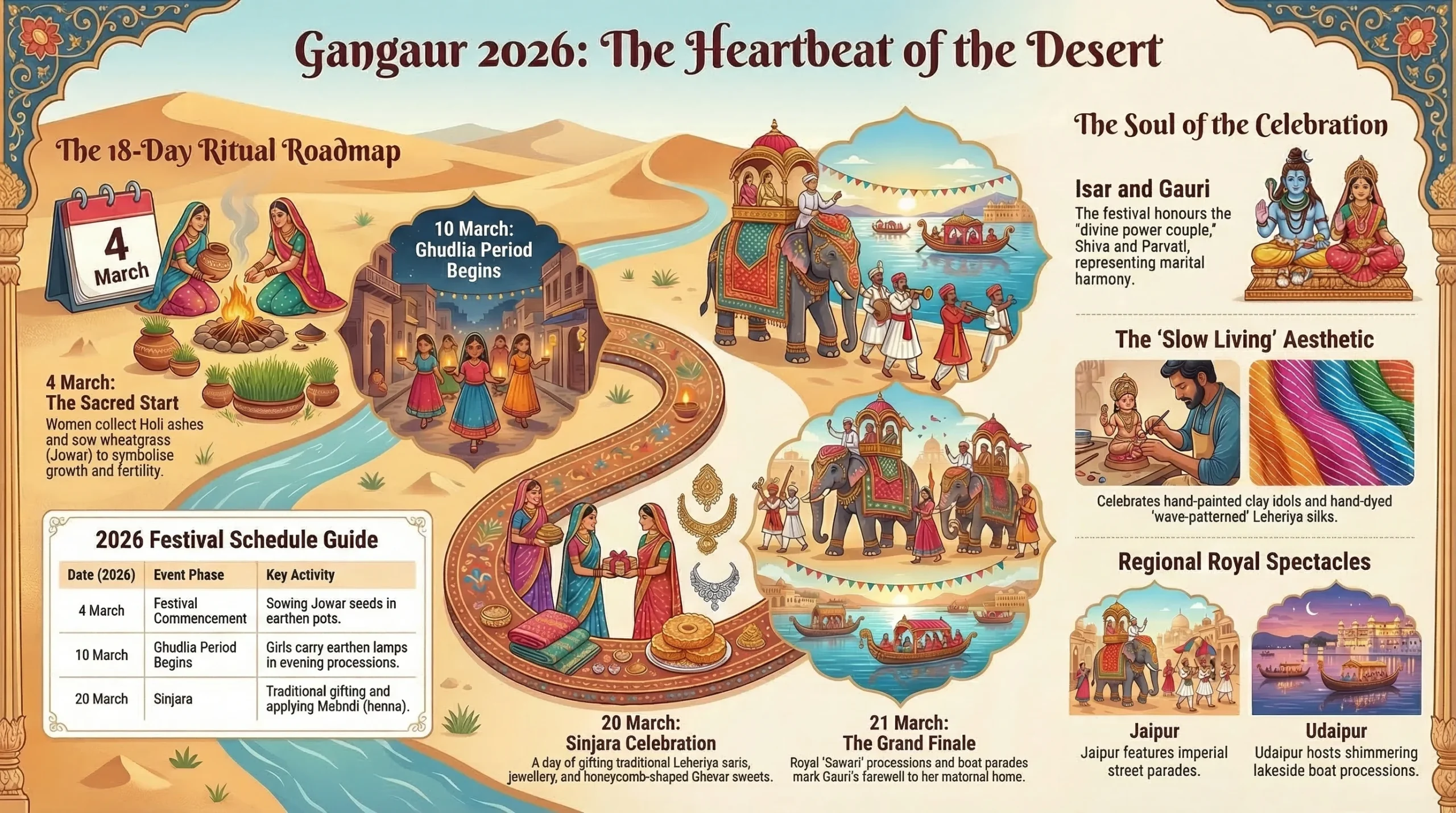
For the uninitiated, Gangaur might look like a series of colorful parades, but for those who live it, the festival is the very soul of the Chaitra month. It is a celebration where the divine meets the domestic, centering on the union of Lord Shiva (Isar) and Goddess Parvati (Gauri). In 2026, the festivities kick off on March 4, immediately following the pyres of Holika Dahan, and reach their royal crescendo on March 21.
A Symphony of Spring and Spirit
In the desert, spring is not just a season; it’s a survival victory. Gangaur marks this transition with a burst of Leheriya saris, the scent of blooming jasmine, and the earthy aroma of fresh clay. This festival is uniquely “human” because it mirrors the cycle of life. It tells the story of Gauri returning to her maternal home to bless her friends with marital bliss, only for her husband, Isar, to arrive later to escort her back to the heavens.
It is this 18-day “stayover” that defines the festival’s pace. While the world outside moves at the speed of a fibre-optic cable, Gangaur demands a slow-living approach. Women spend hours hand-painting clay idols, planting sacred wheatgrass (Jowar), and singing folk songs that have remained unchanged for centuries., we believe in the beauty of things that take time to create, and Gangaur is the ultimate cultural embodiment of that philosophy.
The Royal and the Personal
Whether you are navigating the narrow, spice-scented lanes of the Pink City (Jaipur) or watching the sunset reflect off the oars of a ceremonial boat in Udaipur, the “heartbeat” is unmistakable. In Jaipur, the royal Gangaur ki Sawari procession—featuring caparisoned elephants and antique palanquins—reminds us of a regal past. Yet, the true magic often happens in the quiet courtyards of local homes, where newly married women and young girls alike pray for love that is as enduring as the Aravalli hills.
Why 2026 Feels Different
As we head into Gangaur 2026, there is a renewed global interest in authentic travel experiences. Travellers aren’t just looking for a photo-op; they are seeking a connection to “The Heartbeat.” They want to understand the grit behind the glamour—the artisans who spent months carving wooden idols, the masters of the Ghevar sweet-making craft, and the community bond that makes this festival a pillar of Rajasthan’s cultural heritage.
This is more than a date on a calendar; it is a reminder that even in the harshest deserts, love, tradition, and craftsmanship can bloom.
Gangaur 2026: Mark Your Calendars
If you’re planning to experience the magic of Rajasthan, timing is everything. Unlike festivals that last just a day, Gangaur 2026 is a grand 18-day marathon of culture, devotion, and royal spectacle. To help you navigate this vibrant season, we’ve mapped out the essential dates you need to bookmark.
In 2026, the festival begins while the embers of Holi are still warm and culminates in a royal farewell to the Goddess that you simply cannot miss.
The Gangaur 2026 Schedule at a Glance
| Event / Phase | Date | Significance |
| Festival Commencement | March 4, 2026 | The day after Holi; rituals begin with the collection of Holi ashes. |
| Ghudlia Period Begins | March 10, 2026 | Young girls begin carrying earthen lamps (Ghudlias) in neighborhood processions. |
| Dashamata Vrat | March 13, 2026 | A day of fasting and prayer for family prosperity within the 18-day cycle. |
| Sinjara 2026 | March 20, 2026 | The penultimate day; families send gifts and “Sinjara” sets to daughters. |
| Main Gangaur Puja | March 21, 2026 | The final and most auspicious day (Chaitra Shukla Tritiya). |
| The Grand Procession | March 21, 2026 | The royal “Sawari” in Jaipur and boat processions in Udaipur. |
March 4: The Sacred Start
The festival kicks off on the first day of the Chaitra month. Women collect ashes from the Holika Dahan fire and sow wheat and barley (Jowar) in small earthen pots. Watching these seeds sprout over the next two weeks is a symbolic nod to growth, fertility, and the arrival of spring.
March 20: Sinjara – The Celebration of Gifting
If you are in Rajasthan on March 20, 2026, you will notice a surge in the markets. Sinjara is the day dedicated to pampered traditions. It’s when parents send Koshali (gifts) to their married daughters—think vibrant Leheriya saris, traditional jewelry, and boxes of fresh Ghevar. It’s also the night when the air smells of fresh Mehndi (Henna) as women decorate their hands in anticipation of the big day.
March 21: The Grand Finale (Chaitra Shukla Tritiya)
This is the day of the Main Gangaur Puja. According to the Panchang, the Tritiya Tithi begins in the early hours of March 21, making the morning Muhurat (6:31 AM) the most auspicious time for prayers.
By the afternoon, the streets of Jaipur and Udaipur transform. In Jaipur, the City Palace opens its gates for the royal procession. If you’re a photographer, this is your “golden hour.” The sight of the bejewelled Gauri idol being carried through the Pink City is a memory that stays with you forever.
Pro-Tip for Travellers
- Because Gangaur 2026 culminates on a Saturday (March 21), expect higher-than-usual crowds in major cities. We recommend booking your heritage stay or boutique hotel in Udaipur or Jaipur at least 3 months in advance.
Mythological Roots: The Story of Gauri and Shiva
To understand Gangaur, one must look beyond the vibrant saris and silver jewelry. At its heart, this is a celebration of the ultimate “divine power couple.” The name itself is a portmanteau: ‘Gan’ refers to Lord Shiva (often called Isar Ji in local Rajasthani lore), and ‘Gaur’ represents Gauri, the beloved manifestation of Goddess Parvati. Their story isn’t just a religious myth; it is a narrative of persistence, passion, and the delicate balance of Shiva-Shakti energy.
The Penance that Moved Mountains
The legend begins with Parvati’s unwavering devotion. Born into royalty, she fell deeply in love with Shiva, the ascetic who lived in the cold peaks of the Himalayas, detached from worldly desires. To win his heart, Parvati didn’t just pray—she performed a grueling ‘Tapasya’ (penance) for centuries, enduring the harshest winters and the most scorching summers.
This journey from a princess to a devoted yogini is why Gangaur resonates so deeply with women today. It celebrates the strength of feminine resolve. When Shiva finally opened his eyes and accepted her, their union became the gold standard for marital harmony and companionship. In Rajasthan, every woman who picks up the clay idol of Gauri is, in a way, connecting with that same spirit of dedicated love.
The Village Blessing: Nectar and Devotion
A favorite folklore shared during the 18-day puja tells the story of Shiva, Gauri, and the sage Narada wandering through a small village. As word spread that the gods were among them, the village women rushed to offer hospitality.
The poor women arrived first, offering simple forest fruits and water with hearts full of pure love. Touched by their sincerity, Gauri sprinkled ‘Suhaag Ras’ (divine nectar) upon them, blessing them with eternal marital bliss. Later, the wealthy women of the village arrived with lavish feasts and golden platters. Having already given away the nectar, Gauri did something extraordinary—she cut her own finger and sprinkled her blood as a blessing upon them.
This story is the “human” soul of the festival. it teaches that devotion (Bhakti) is not measured by the weight of your offerings, but by the purity of your intent. It explains why, during Gangaur, a simple prayer at a home altar is just as powerful as the grandest palace procession.
The Homecoming and the Farewell
The reason Gangaur lasts 18 days is rooted in the tradition of a daughter’s visit to her Peehal (maternal home). Legend has it that Gauri returned to her parents’ home for this period to bless her friends and community with prosperity. The festival’s final day marks the moment Isar (Shiva) arrives to take his bride back to Mount Kailash.
The emotional “Vidaai” or farewell songs sung on the final day are incredibly moving. They reflect the real-life emotions of Rajasthani families saying goodbye to their daughters after a visit. This blend of the divine and the domestic is what makes Gangaur one of the most relatable and enduring festivals in Indian culture.
The 18-Day Ritualistic Journey: A Step-by-Step Guide to Gangaur 2026
Gangaur isn’t a “flash-in-the-pan” event; it is a slow-burning devotion that unfolds over 18 days. In a world of instant gratification, this festival stands as a testament to the beauty of patience and the craftsmanship of tradition. From the moment the smoke clears from the Holi bonfire to the final immersion of the idols, every day carries a specific spiritual weight.
If you are following the Gangaur 2026 rituals, here is the chronological roadmap of this sacred marathon.
Phase 1: The Ash and the Seed (Days 1–7)
The journey begins on the first day of the Chaitra month, immediately following Holika Dahan.
- The Sacred Ash: Women collect the ashes from the Holi fire and mix them with soil. This symbolizes rebirth—life springing from the remnants of the old.
- The Sowing of Jowar: In small, decorated earthen pots, wheat and barley seeds (Jowar) are sown. For the next two weeks, these seeds are watered daily with songs and prayers.
- The Symbolism: The height and health of the green sprouts are believed to mirror the future prosperity of the household. It’s a beautiful, “green” ritual that connects the desert people to the fertility of the earth.
Phase 2: The Ghudlia Tradition (Days 8–15)
About a week into the festival, the atmosphere shifts from private prayer to community celebration. This is when the Ghudlia makes its appearance.
- What is a Ghudlia? It is an earthen pot with numerous holes, containing a lit lamp (Deepak).
- The Ritual: Young girls carry these glowing pots on their heads, moving from house to house in their neighborhoods. They sing traditional folk songs and, in return, receive small gifts of sweets, jaggery, or coins.
- The Legend: This tradition commemorates the bravery of Rao Satal of Jodhpur, who rescued 140 girls kidnapped by a Mughal governor named Guddhi Khan. The holes in the pot represent the wounds on the governor’s head. It’s a powerful blend of history and folklore.
Phase 3: The Crafting of Isar and Gauri (Days 10–16)
While many families use ancestral wooden idols (Muter), many still participate in the meditative process of crafting new ones from clay.
- Artisanal Focus: This is where the Rajasthani craftsmanship truly shines. The idols of Isar (Shiva) and Gauri (Parvati) are meticulously painted with natural pigments.
- The Wardrobe: The idols are dressed in miniature versions of traditional Rajputi Poshak—velvet, silk, and gold-thread embroidery. They are adorned with tiny jewelry pieces, including the iconic Borla (head ornament) and Nath (nose ring).
Phase 4: Sinjara and the Main Puja (Days 17–18)
As we approach the climax on March 20 and 21, 2026, the intensity peaks.
- Sinjara (The Day Before): This is a day of indulgence. Parents send lavish gift hampers to their daughters, known as Sinjara. It includes the “Gangaur Shringar” (makeup and jewelry) and the star of the show: Ghevar.
- The Final Puja (Tritiya): On the 18th day, the “Main Gangaur Puja” takes place. Women dress in their finest Leheriya or Bandhani saris, apply intricate Mehndi designs, and gather for the final story-telling session of Gauri’s journey.
Phase 5: The Grand Farewell (The Vidaai)
The festival concludes with the immersion of the idols. After being worshipped with love for 18 days, Gauri must return to her husband’s home.
The idols are carried in a colorful procession to a nearby lake, stepwell (Baori), or temple tank. The air is thick with the sound of drums and the emotional singing of “Vidaai” songs. As the idols are gently placed in the water, it marks the end of the festival—a bittersweet moment of letting go until the cycle begins again next year.
Sinjara: The Gift of Love and Heritage
If the 18-day journey of Gangaur is a marathon of devotion, then Sinjara is the celebratory “eve” where the spirit of pampering takes center stage. Falling on March 20, 2026, Sinjara is perhaps the most anticipated day for the women of Rajasthan. It is a day that bridges the gap between maternal homes and marital households, wrapped in the scent of fresh henna and the sweet crunch of Ghevar.
The word “Sinjara” itself is a local evolution of the Sanskrit word Shringar (ornamentation). In 2026, as the sun sets on March 20th, Rajasthan will transform into a vibrant mosaic of tradition, gifting, and aesthetic preparation.
The “Sinjara Box”: What’s Inside?
For a married woman, the Sinjara gifts come from her Peehal (maternal home), while for an engaged girl, they arrive from her future in-laws. This isn’t just a care package; it’s a symbolic “Sinjara Box” curated with love and heritage.
- The Hero Sweet: Ghevar: No Sinjara is complete without this honeycomb-shaped delicacy. Whether it’s the classic Malai Ghevar or the rich Paneer variant, it is the undisputed king of the festival.
- The Fabric of Spring: Leheriya: You’ll see the streets of Jaipur and Jodhpur awash in Leheriya saris and poshaks. These “wave-patterned” tie-dye fabrics in vibrant pinks, oranges, and greens are the official uniform of the season.
- The Shringar Kit: This includes everything needed to celebrate womanhood—colourful glass bangles, Sindoor (vermilion), Bindi, and often traditional silver jewellery like the Pajeb (anklets).
- Mehndi (Henna): Sinjara is the designated “Mehndi Night.” The air in every household is thick with the cooling scent of eucalyptus and henna.
The Ritual of Pampering
Sinjara serves a beautiful emotional purpose. It is a day of “Slow Living”—a pause in the busy lives of women to focus on self-care and community. Mothers-in-law often take over the kitchen duties on this day so the daughters and daughters-in-law can focus on their Shringar.
Applying Mehndi on Sinjara is more than a beauty ritual; it’s a meditative practice. Legend has it that the darker the henna stain, the deeper the love a woman will receive from her husband and mother-in-law. In 2026, trending Gangaur Mehndi designs often feature motifs of the Sun, Moon, and the divine couple, Isar and Gauri, intricately woven into the patterns.
A Connection to Craftsmanship
At its core, Sinjara is a celebration of local artisans. From the halwai (confectioner) who spends hours perfecting the Ghevar’s texture to the Rangrez (dyer) who creates the perfect Leheriya folds, Sinjara sustains the creative heartbeat of the desert., we value this dedication to craft—the idea that the things we cherish most are those made with patience and intention.
The Aesthetic of Gangaur: A Visual Masterclass
If Rajasthan is India’s “Land of Kings,” then Gangaur is its royal coronation of style. This isn’t just a festival; it’s a high-fashion heritage event that has remained unchanged for centuries. The aesthetic of Gangaur 2026 is a masterclass in color theory, traditional craftsmanship, and the art of slow-made beauty.
For a brand which values the intersection of protection and timeless design, the visual language of Gangaur offers a profound parallel. It is about adorning what is sacred with the finest materials the earth can provide.
1. The Fabric of the Monsoon in Spring: Leheriya
While the desert may be dry, the clothing of Gangaur ripples like water. Leheriya, the iconic Rajasthani tie-dye technique, is the undisputed fabric of the season.
- The Technique: Artisans fold and tie fine muslin or silk diagonally before dipping them into vibrant vats of dye. The result is a “wave” pattern that mimics the flowing rivers of India.
- The Palette: For Gangaur 2026, expect a riot of pinks, oranges, and “Basanti” (bright yellows). These colors aren’t just for show; they represent the blossoming of the Palash flowers and the arrival of the spring harvest.
2. The Royal Rajputi Poshak
For the main puja on March 21, many women opt for the Rajputi Poshak, a four-piece ensemble consisting of the Kanchali (inner wear), Kurti (sleeveless tunic), Ghagra (heavy pleated skirt), and the Odhni (long veil).
- The Detail: Look closely at the embroidery. You’ll see Gota Patti (gold or silver ribbon work), which originated in Rajasthan. Each piece of “leaf” (patti) is hand-cut and stitched onto the fabric, creating a metallic shimmer that catches the desert sun.
3. Jewellery: The Grammar of Grace
A Gangaur look is incomplete without the traditional “Shringar” jewellery, each piece holding a deep symbolic meaning.
- The Borla: Unlike the flat Maang Tikka seen elsewhere in India, the Rajasthani Borla is a bell-shaped or spherical head ornament, often encrusted with kundan or pearls. It sits proudly at the hairline, symbolising the “crown” of the married woman.
- The Nath & Aad: The Nath (nose ring) and the Aad (a rectangular, heavy gold choker) are the hallmarks of Rajasthani royalty. These pieces are often family heirlooms, passed down through generations—the ultimate definition of sustainable, timeless luxury.
4. The Art of the Idol: Muter & Clay
The aesthetic extends to the deities themselves. The wooden idols (Muter) of Isar and Gauri are treated like living royalty.
- Hand-Painted Faces: Artisans in regions like Bassi (near Chittorgarh) spend months painting the large, almond-shaped eyes of the idols, a style known as the Mewar school of art.
- Miniature Fashion: The idols are dressed in miniature versions of the same Leheriya and Gota Patti fabrics worn by the devotees, creating a beautiful visual mirror between the human and the divine.
5. The “Ghudlia” Glow
As evening falls, the aesthetic shifts to light and shadow. The Ghudlia (perforated earthen pots) with flickering lamps inside create a “starry” effect on the dark streets. It’s a primitive yet sophisticated form of street art that turns a simple clay pot into a vessel of light.
The Gangaur aesthetic is a reminder that luxury is in the details. Whether it’s the hand-stitched hem of a Poshak or the protective padding of a sleeve, true quality is felt in the layers of craftsmanship.
The Royal Procession: Where to Witness the Magic in 2026
For 17 days, Gangaur is an intimate, home-bound affair—a whisper of prayers, the quiet molding of clay, and the gentle chiming of bangles. But on the 18th day, the festival spills out onto the streets in an explosion of color, music, and royal pageantry. If you want to witness the true heartbeat of Rajasthan, you must find your way to the grand finales.
As we approach the climax of Gangaur 2026 on March 21, the state is gearing up for its most spectacular showcases. Here is your ultimate guide on where to stand, what to see, and how to experience the royal processions like a true insider.
1. Jaipur: The Imperial “Gangaur Ki Sawari”
When it comes to regal magnitude, nothing rivals the Gangaur procession Jaipur. Originating from the Zenana Mahal (women’s quarters) of the historic City Palace, this procession is a moving museum of Rajputana glory.
- The Route: The royal entourage winds its way through Tripolia Bazaar, Chhoti Chaupar, and Gangauri Bazaar, finally culminating at Talkatora Lake.
- The Spectacle: Imagine vintage palanquins, antique silver chariots, and caparisoned elephants marching to the resonant beats of the Kachhi Ghodi and Kalbelia folk dancers. The idol of Gauri, adorned in priceless royal jewels, is carried with utmost reverence.
- The Insider Tip for 2026: The Tripolia Gate is exclusively opened for the royal family on this day. To get the best photographs, arrive hours early and secure a spot on the rooftop terraces of the shops lining Tripolia Bazaar. The golden-hour light hitting the pink facades makes it a photographer’s absolute dream.
2. Udaipur: The Shimmering Gangaur Boat Ride
If Jaipur is about royal might, Udaipur offers a deeply romantic, poetic finale. Known as the “Venice of the East,” Udaipur replaces chariots with boats, creating a mesmerising spectacle on the waters of Lake Pichola.
- The Gangaur Ghat: Devotees from all over the city gather at the iconic Gangaur Ghat, balancing clay idols on their heads.
- The Udaipur Gangaur Boat Ride: As dusk falls, the royal barge of the Mewar family sets sail. The idols are placed on beautifully illuminated boats that glide across the lake. The reflection of fireworks, the echoing folk songs, and the shimmering lights on the water create an atmosphere of pure magic. It is a slow, elegant farewell that perfectly mirrors the concept of slow living and intentional appreciation.
3. Jaisalmer and Jodhpur: The Desert Echoes
While Jaipur and Udaipur draw the largest crowds, the heart of the desert beats to its own unique rhythm.
- Jaisalmer’s Unique Tradition: In Jaisalmer, you will witness a rare sight—a procession featuring only Gauri. According to local lore, centuries ago, the idol of Isar (Shiva) was stolen by a rival state just before the festival. Since then, the brave women of Jaisalmer celebrate the procession without him, a fascinating quirk of history!
- Jodhpur Festivals: In the Blue City, the focus remains heavily on the Ghudlia tradition. The vibrant street fairs in Jodhpur during this time are the best places to pick up authentic Rajasthani textiles and taste local street food.
Protecting Your Memories
Photographing the Gangaur 2026 processions means navigating shoulder-to-shoulder crowds, sudden bursts of color, and the unpredictable desert elements. Whether you’re balancing on a Jaipur rooftop or leaning over a boat in Udaipur, your gear needs protection that doesn’t compromise on style. Just as the artisans of Rajasthan weave durability into their Leheriya silks, designs protective sleeves that safeguard your cameras and laptops, allowing you to focus purely on capturing the magic of the moment.
The Taste of the Festival: Culinary Traditions
If the visual aesthetic of Gangaur 2026 is a masterclass in color, then its culinary landscape is a symphony of texture, richness, and the undeniable warmth of Rajasthani hospitality. Food during this 18-day celebration isn’t merely sustenance; it is an offering, a gift of love (like the Sinjara), and a reason for communities to gather.
1. The Undisputed King of Spring: Ghevar
You cannot talk about Gangaur without dedicating a significant portion of the conversation to Ghevar. This iconic, disc-shaped sweet is the culinary soul of the Chaitra month and a non-negotiable part of the Sinjara gifting tradition.
- The Craftsmanship of Cooking: Making authentic Ghevar is a slow, meticulous art form. A thin batter of refined flour (maida), ghee, and ice-cold water is poured from a height into a deep pan of bubbling, hot ghee. The temperature difference causes the batter to splatter and form a porous, honeycomb-like structure.
- The Variations: Once fried to a golden crisp, the Ghevar is soaked in sugar syrup. For Gangaur 2026, the trending favorites in the sweet shops of Jaipur and Jodhpur will undoubtedly be the rich Malai Ghevar (topped with thickened sweetened milk) and the luxurious Mawa/Rabdi Ghevar (garnished with silver leaf, saffron, and pistachios).
- The Symbolism: Its circular shape is often said to represent the cycle of life and the completeness of the marital bond celebrated during the festival.
2. The Savory Counterparts: Balancing the Sweetness
Rajasthanis are masters of balancing intense sweetness with robust, spicy flavors. While the fasts (vrats) observed by women during Gangaur dictate certain dietary rules, the feasts that follow are legendary.
- Pyaaz Ki Kachori: A staple of the region, these deep-fried, flaky pastries are stuffed with a spicy, caramelized onion mixture. During the festival, the aroma of frying kachoris wafting from local halwais (sweet shops) is an irresistible invitation.
- Mirchi Bada: Large, mild green chilies stuffed with a spiced potato mixture, coated in gram flour batter, and deep-fried. It’s the perfect, fiery street food to enjoy while waiting for the royal processions to begin.
- Ker Sangri: A traditional desert vegetable dish made from dried berries (Ker) and beans (Sangri) found in the arid regions. Cooked with a generous amount of oil and spices, it has a long shelf life, making it a historic staple that continues to be celebrated during festivals for its unique, tangy flavor.
3. The Offerings to Gauri: Pure and Simple
While the feasts are grand, the daily food offerings (Bhog) made to the clay idols of Gauri and Isar are deeply rooted in simplicity and purity.
- Meethe Gune: These are small, sweet, deep-fried snacks made from wheat flour and jaggery, often shaped into intricate designs or simple discs. They are a staple offering during the daily pujas.
- Churma: A classic Rajasthani dessert made by coarsely grinding deep-fried wheat flour balls (baatis) and mixing them generously with ghee and jaggery or sugar. It is a hearty, energy-rich food that sustains the women during their fasting days.
A Feast for the Senses
The culinary traditions of Gangaur are a testament to the ingenuity of the desert people—creating extraordinary richness from the simplest of ingredients. Just as takes simple, natural materials and crafts them into something protective and beautiful, the food of Gangaur is a slow-crafted labor of love that nourishes both the body and the spirit.
Modern Perspective: Gangaur in the 21st Century
As we move through Gangaur 2026, a fascinating phenomenon is unfolding. While many ancient traditions struggle to find a foothold in the digital age, Gangaur is experiencing a vibrant renaissance. It has evolved from a localized ritual into a global celebration of identity, slow-living, and aesthetic heritage. In the 21st century, the festival isn’t just surviving; it’s thriving by blending the sacred with the contemporary.
The Digital Renaissance: #Gangaur2026
In today’s hyper-connected world, the “Heartbeat of the Desert” is being broadcast to every corner of the globe. Instagram and TikTok have become modern archives for the festival.
- The “Slow-Mo” Tradition: Younger generations are using short-form video to document the meticulous process of applying Sinjara Mehndi or the graceful movement of a Leheriya veil.
- Global Community: For the Rajasthani diaspora living in London, New York, or Dubai, digital platforms allow them to perform the rituals in tandem with their families back home. We are seeing “Virtual Gangaur Pujas” where the story of Gauri and Shiva is narrated over Zoom, proving that devotion isn’t bound by geography.
The Sustainability Movement: Eco-Friendly Gauri
One of the most heartening shifts in the 21st century is the return to Eco-Friendly Gangaur celebrations. As the world becomes more conscious of its environmental footprint, there is a massive push toward:
- Organic Clay Idols: Moving away from chemical paints, modern families and artisans are returning to natural pigments like turmeric, sandalwood, and indigo to decorate their clay idols.
- Symbolic Immersion: Instead of immersing idols in large water bodies, many now perform the Vidaai in garden pots at home, allowing the clay to return to the earth and nourish the very plants (like the Jowar) that were grown during the festival. This “full-circle” sustainability is a core value.
Gangaur as a Travel Trend
The 21st-century traveler is no longer satisfied with being a spectator; they want to be a participant. Gangaur has become a cornerstone of Cultural Tourism.
- Experiential Stays: Boutique heritage hotels in Jaipur and Udaipur now offer “Gangaur Packages,” where guests can learn to tie-dye Leheriya fabrics, take workshops in Rajasthani folk singing, or join local families for the Sinjara feast.
- Women-Centric Travel: Because Gangaur is a celebration of feminine power and sisterhood, it has become a popular time for solo female travelers and “girls-trip” itineraries centered around the festival’s aesthetic and rituals.
The Blend of Old and New
At Colcasac, we often talk about “timeless design”—the idea that something well-made never goes out of style. Gangaur is the cultural equivalent of that philosophy. Whether it’s a Gen-Z girl pairing a traditional Borla with a modern pant-suit or a photographer using a high-tech mirrorless camera (safely tucked in a protective sleeve) to capture a centuries-old procession, the 21st century has proven that heritage is our greatest luxury.
Gangaur 2026 reminds us that even as we rush toward the future, there is immense value in slowing down, honoring our roots, and celebrating the “divine couple” within ourselves.
Travel & Photography Guide for 2026: Capturing the Colors of Gangaur
Traveling to Rajasthan during Gangaur 2026 is like walking into a high-definition dream. Between the vivid Leheriya saris and the dusty gold of the desert sun, the visual opportunities are endless. However, navigating a festival of this magnitude requires more than just a good lens—it requires a strategy.
As we reach the final days of the celebration in late March, the weather in Rajasthan begins to warm up, and the crowds reach their peak. Here is how to navigate the terrain and protect your gear while capturing the “Heartbeat of the Desert.”
1. Top Vantage Points for 2026
To get those “hero shots” of the royal processions, you need to think vertically.
- Jaipur: Don’t try to shoot from the street level in Tripolia Bazar; you’ll likely only see the backs of heads. Instead, negotiate with local shopkeepers a day in advance to access their rooftop terraces. The bird’s-eye view of the elephants and dancers against the “Pink City” architecture is unparalleled.
- Udaipur: For the boat procession, head to Ambrai Ghat or the balconies of the City Palace Museum. If you want a more intimate shot of the “Vidaai” (immersion), find a quiet spot near Hanuman Ghat as the sun begins to set.
2. Mastering the Light
The Rajasthani sun can be harsh. For the best results:
- Golden Hour: The processions usually begin in the late afternoon. Use this “golden hour” light to capture the shimmer of the Gota Patti embroidery and the glowing skin of the devotees.
- Low Light: During the Ghudlia evening walks, use a fast prime lens ($f/1.8$ or $f/1.4$) to capture the flickering candlelight inside the earthen pots without using a distracting flash.
3. Essential Gear Protection
Rajasthan in March is beautiful, but it’s also dusty and crowded. Your equipment is an investment that deserves the same level of care that artisans give to their clay idols.
- Dust Defense: The desert wind can carry fine sand that wreaks havoc on camera sensors. Always keep your camera in a weather-resistant sleeve when not in use.
- The Colcasac Edge: When moving through dense crowds at the Jaipur City Palace, you need protection that isn’t bulky. A Colcasac hemp or corduroy sleeve provides a natural, shock-absorbing layer that fits easily into a backpack while protecting your laptop or tablet from the inevitable bumps of a festival crowd.
4. Cultural Etiquette for Photographers
The most important rule for 2026: Connection before Capture.
- Ask First: While the public processions are fair game, if you want to photograph a woman performing her private puja at a shrine, a simple nod or asking “Photo le sakte hain?” (Can I take a photo?) goes a long way.
- Dress the Part: You don’t need to wear a full Poshak, but dressing modestly (covering shoulders and knees) shows respect for the sacred nature of the rituals. In fact, wearing a touch of Leheriya or a bright scarf often acts as a great icebreaker with the locals!
5. Logistics: Stay and Transport
- Book Ahead: For March 20–21, 2026, hotels in Udaipur and Jaipur will be at 100% capacity. Look for “Heritage Haveli” stays for a more authentic backdrop.
- Early Arrival: On the day of the main procession, most roads in the old cities will be closed to vehicles by 2:00 PM. Plan to arrive in the area by noon and enjoy a local lunch while the streets transform.
- Is Gangaur 2026 open to international tourists? Absolutely! It is one of the most welcoming festivals in India.
- What should I wear? Bright, festive colors are encouraged. Avoid all-black or all-white outfits, as these are not traditionally considered “shubh” (auspicious) for this festival.
- Is the festival safe for solo female travelers? Yes, the festival is a celebration of women, and the atmosphere is generally very respectful and communal.
Timeless Craft for Timeless Traditions
At first glance, a centuries-old Rajasthani festival and a contemporary protective sleeve brand might seem worlds apart. But look closer at the philosophy of Gangaur 2026, and you’ll find the exact same DNA that drives. Both are built on a foundation of intentionality, resilience, and the celebration of the handmade.
In an era of mass-produced, “disposable” tech and fast fashion, Gangaur stands as a vibrant rebellion. It reminds us that the things that truly matter—our heritage, our rituals, and the tools we use to capture our lives—deserve to be treated with a specific kind of reverence.
The Soul of the Material
During Gangaur, the material is the message. Artisans don’t just use any wood for the Isar idols; they seek out specific grains that can withstand the test of time. Women don’t just wear any fabric; they choose Leheriya and Gota Patti, crafts that require hours of manual labor to perfect.
we share this obsession with the “soul” of the material. Whether it’s our heavy-duty Hemp, classic Corduroy, or plush Jersey linings, we select fabrics that offer more than just a surface-level look. We choose materials that have a story, a texture, and an inherent strength—much like the rugged yet beautiful landscape of Rajasthan itself.
Protection as a Ritual
The women of Rajasthan spend 18 days protecting their Jowar sprouts from the wind and meticulously wrapping their Gauri idols in fine silk to keep them pristine. This act of protection is an act of love.
We see our sleeves in the same light. Your MacBook, iPad, or Kindle isn’t just a “device”—it’s your canvas, your library, and your connection to the world. It holds your photos of the Jaipur procession and your notes on the history of the Mewar kings. Just as the Rajasthani Poshak protects the grace of the wearer, a sleeve is designed to safeguard your most valuable tools from the “dust and tumble” of the modern desert.
The Beauty of Ageing Gracefully
One of the most beautiful aspects of Gangaur is the use of ancestral wooden idols. These pieces aren’t replaced when they show signs of wear; they are repainted, cherished, and passed down. They gain character with age.
Our products are designed with this same longevity in mind. A sleeve isn’t meant to be replaced every season. Like a well-worn piece of hand-loomed textile, it softens and gains character the more you travel with it. It is an investment in timeless design over fleeting trends.
Crafting the Future
As we celebrate the “Heartbeat of the Desert” in 2026, we invite you to look at your own belongings through the lens of Gangaur. Are they made with intention? Do they reflect a heritage of craftsmanship?
Whether you are navigating the bustling markets of Jodhpur or the urban jungle of a modern city, carry something that reflects the spirit of the artisan. Because when we choose craft over convenience, we aren’t just buying a product—we are keeping a tradition alive.
Frequently Asked Questions about Gangaur Festival 2026
1. What are the exact dates for Gangaur 2026?
While the daily rituals and prayers begin on March 4, 2026 (the day after Holi), the most significant public celebrations and the main puja occur on March 21, 2026. This 18-day period allows for the gradual sprouting of the sacred wheatgrass and the meticulous preparation of the idols.
2. Why do unmarried girls celebrate Gangaur?
Unmarried girls participate with great fervor to seek the blessings of Goddess Gauri for a worthy and loving life partner. The festival is seen as a time to honor the devotion Parvati showed to win Lord Shiva’s heart, teaching young women the values of patience, strength, and grace in love.
3. Is there an entry fee to watch the Royal Processions?
No, watching the grand processions in the streets of Jaipur (Tripolia Bazaar) or at the Udaipur Ghats is completely free for the public. However, if you wish to sit on a reserved hotel terrace or inside certain areas of the City Palace, it is advisable to book a specific “Gangaur Tour” or heritage ticket in advance.
4. What is the significance of “Sinjara”?
Sinjara falls on the eve of the main festival (March 20, 2026). It is a day of gifting where parents send clothes, jewelry, and sweets (especially Ghevar) to their married daughters. It symbolizes the eternal bond between a woman and her maternal home, ensuring she feels cherished and “adorned” before the final puja.
5. Can tourists participate in the rituals, or is it only for locals?
While the core religious pujas happen in private homes, the festival is incredibly welcoming. Tourists are encouraged to join the street festivities, watch the Ghoomar dances, and even visit local temples like Govind Dev Ji in Jaipur to witness the communal spirit. Many heritage hotels also organize “mock” pujas to help guests understand the traditions.
6. What is the “Ghudlia” pot tradition?
From the seventh night after Holi, young girls carry Ghudlias—earthen pots with numerous holes and a lit lamp inside—on their heads. They go from house to house singing songs and collecting small gifts. This tradition commemorates a historical victory where a local ruler rescued 140 kidnapped girls, symbolizing the triumph of light and protection over darkness.
7. Why is “Ghevar” the official sweet of the festival?
Ghevar is synonymous with Rajasthani festivals that celebrate the feminine. Its honeycomb structure and syrup-soaked layers represent the sweetness and complexity of marital life. Because the festival falls during the transition to spring, the calorie-rich Ghevar is also a traditional way to provide energy to those observing fasts.
8. What should I wear if I want to attend the celebrations?
While there is no strict dress code for spectators, wearing bright, festive colors like red, yellow, or pink is highly recommended to blend in with the celebratory vibe. For women, a Leheriya dupatta or scarf is a beautiful nod to the local culture. Avoid black or white, as these are traditionally not worn during auspicious Hindu festivals.
9. Where is the best place to experience Gangaur in 2026?
- Jaipur: Best for grand, imperial street processions with elephants and chariots.
- Udaipur: Best for a romantic, soulful experience featuring illuminated boat processions on Lake Pichola.
- Jaisalmer: Best for a unique cultural quirk where only the Gauri idol is paraded without Isar (Shiva).
10. Is it safe for solo female travellers during the festival?
Yes, Gangaur is a celebration of womanhood, and the atmosphere is generally very safe and respectful. However, the crowds in Jaipur and Udaipur can become extremely dense during the final processions. We recommend staying in well-lit areas, keeping your belongings (and camera gear!) in a secure Colcasac sleeve, and perhaps hiring a local guide to navigate the busier streets.



Leave a Reply