
The Spirit of Meethi Eid
There is a specific, electric shift in the air when the 29th or 30th day of Ramadan rolls around. In India, it’s not just about looking at the sky; it’s about the collective heartbeat of millions waiting for a sliver of silver to appear. Eid al-Fitr 2026 carries that same timeless magic—a transition from the soul-searching discipline of a month-long fast to the exuberant, sugar-dusted chaos known affectionately across the subcontinent as Meethi Eid.
The Moon That Changes Everything
The “Spirit of Meethi Eid” begins long before the first prayer. It starts on Chand Raat. If you’ve ever walked through the lanes of Old Delhi, Hyderabad’s Charminar, or Lucknow’s Aminabad on this night, you know it’s a sensory overload. It’s the frantic hunt for the perfect matching bangles, the cooling scent of fresh henna (Mehendi) blooming on palms, and the high-stakes vigil for the Shawwal crescent moon sighting.
When the announcement finally drops from the minarets, the atmosphere shifts from anticipation to pure, unadulterated joy. For many in 2026, this moment represents a triumphant return to community—a “reset button” for the soul that reminds us of our resilience.
Why We Call It “Meethi Eid”
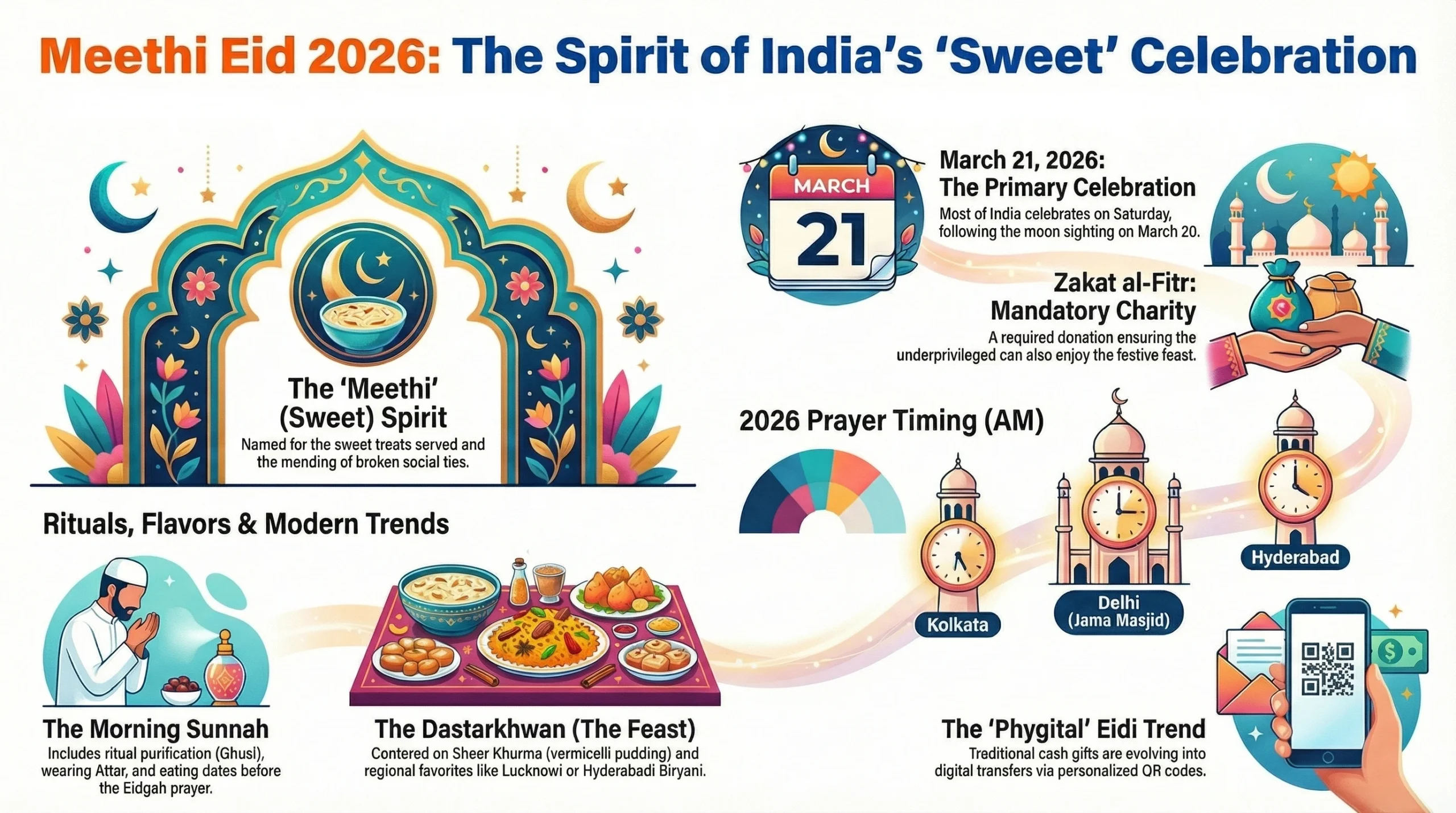
While the world knows it as Eid al-Fitr, in India, the prefix “Meethi” (Sweet) is non-negotiable. It’s a nod to the literal bowls of Sheer Khurma and Kimami Sewaiyan that grace every “Dastarkhwan,” but it goes deeper than calories. The sweetness refers to the mending of broken ties. It’s the day you hug the neighbour you haven’t spoken to in months; it’s the day the “Eidi” (cash gifts) flows from the pockets of elders into the eager hands of children, bridging generations with a simple, crisp banknote.
In 2026, the spirit of Meethi Eid is also about mindful celebration. After a month of Sabr (patience), the feast isn’t just a meal—it’s a communion. Whether you are a foodie chasing the perfect Lucknowi Biryani or someone finding peace in the early morning Eidgah prayers, the essence remains the same: gratitude.
A Tapestry of Unity
What makes Eid in India truly unique is its syncretic heart. It’s not a celebration behind closed doors. It’s the “Ganga-Jamuni Tehzeeb” in action, where non-Muslim friends wait as eagerly for their bowl of Sheer Khurma as those who fasted. It’s a festival that spills out into the streets, weaving a tapestry of white kurtas, colourful hijabs, and the universal language of a warm embrace.
As we navigate the complexities of 2026, the spirit of this festival serves as a vital reminder: the hardest of discipline (Ramadan) leads to the sweetest of rewards (Eid). It is a celebration of the human capacity for restraint, charity, and, ultimately, an unshakeable hope for a more harmonious world.
So, as the aroma of cardamom and saffron begins to waft through your home, remember that Meethi Eid is more than a date on the calendar—it’s a state of mind.
For a pillar page to truly dominate the search results, it must combine real-time accuracy with a narrative that resonates with the reader’s personal experience. Since we are currently in late March 2026, providing the confirmed details of the sighting is crucial for those documenting the year’s festivities.
Eid al-Fitr 2026: The Science and Soul of the Moon Sighting
In the Islamic tradition, the calendar is a living, breathing thing—governed not by a printer’s press but by the celestial dance of the moon. Eid al-Fitr 2026 in India was no different. The anticipation reached a fever pitch as the 29th of Ramadan approached, with millions of eyes across the subcontinent turned toward the western horizon.
The Great Sighting: March 19th vs. March 20th
The determination of the Eid date in India is a masterclass in tradition meeting local geography. While astronomical calculations provided a roadmap, the final word rested with the Ruet-e-Hilal Committees and the ancient practice of physical sighting (Ru’yah).
For 2026, the timeline unfolded with a familiar yet exciting split:
- The 29th of Ramadan (March 19, 2026): Observers gathered at iconic landmarks—from the steps of Delhi’s Jama Masjid to the shores of Marine Drive in Mumbai. However, due to atmospheric conditions and the young age of the moon, the crescent remained elusive in most parts of the country.
- The 30th of Ramadan (March 20, 2026): This became the official Chand Raat for the majority of India. As the sun set, a delicate, 1-2% illuminated silver sliver finally graced the sky, appearing low in the west-northwest near Venus.
Confirmed Dates for 2026
Because the moon was not sighted on the 19th, Ramadan completed its full 30-day cycle for most of the country.
- Rest of India: Saturday, March 21, 2026.
- The Kerala Exception: As is tradition, the coastal state of Kerala often aligns with sightings in the Gulf or its own early coastal visibility. In 2026, Kerala celebrated a day earlier, on Friday, March 20.
The “Command Centres”: Who Makes the Call?
In India, the announcement of Eid is a moment of high-stakes communication. The Markazi Chand Committee in Lucknow, led by prominent clerics like Maulana Khalid Rasheed Farangi Mahli, and the Imarat-e-Sharaiya in Patna serve as the primary authorities.
The moment the Mufti or Imam confirms the sighting via phone calls from local witnesses, the news spreads like wildfire through WhatsApp groups, news scrolls, and the joyous blare of mosque loudspeakers. This communal wait is what defines the “Spirit of Meethi Eid”—a shared experience that transcends the digital age.
The 2026 Sighting Table: City-Wise Visibility
| City | Sunset Time | Moon Sighting Window |
| Kolkata | 5:48 PM | 5:55 PM – 6:30 PM |
| Lucknow | 6:18 PM | 6:25 PM – 7:10 PM |
| Delhi | 6:33 PM | 6:40 PM – 7:25 PM |
| Hyderabad | 6:28 PM | 6:35 PM – 7:15 PM |
| Mumbai | 6:42 PM | 6:50 PM – 7:40 PM |
The Human Element: More Than Just a Date
For the average Indian family, these dates are more than just numbers—they are the starting gun for a 48-hour whirlwind of activity. The confirmation of the March 21st date meant one final, spiritually significant Sehri and a day of preparation to ensure the Biryani is perfect and the house is ready for guests.
The Rituals: How India Prays and Celebrates.
The morning of Eid al-Fitr 2026 in India wasn’t just another Saturday; it was a symphony of spiritual devotion and cultural vibrancy. While the recipes and the moon sightings get the headlines, the heart of the festival lies in the rituals—the rhythmic, centuries-old practices that turn a simple day into a sacred milestone.
Across the diverse landscape of India, from the narrow lanes of Srinagar to the bustling coasts of Kochi, the rituals of Eid follow a beautiful, synchronized pattern.
The Preparation: The Sunnah of the Morning
Long before the first rays of the sun hit the minarets, Indian households are a hive of activity. In 2026, we saw a resurgence in traditional Sunnah practices, where modern families embraced slow, intentional morning rituals.
- The Ghusl (Purification): Every member of the family performs a ritual bath, symbolizing a fresh start and spiritual cleanliness.
- The Attar and the Outfit: Fragrance is a huge part of the Eid identity. In 2026, organic and artisanal Indian Attars (perfume oils) like Oudh and Khas trended heavily. Men donned crisp white Chikankari kurtas, while women layered intricate jewelry over vibrant lehengas.
- The Pre-Prayer Date: Following the tradition of the Prophet, it is customary to eat something sweet (usually an odd number of dates) before heading out. This signifies that the month of fasting has officially concluded.
Zakat al-Fitr: The Gift of Equality
Before a single prostration is made at the mosque, the ritual of Zakat al-Fitr must be completed. This is a mandatory act of charity, ensuring that even the most underprivileged members of the community can enjoy a festive meal. In 2026, many Indians utilized digital platforms and UPI to distribute these funds instantly to verified NGOs, blending ancient duty with modern convenience.
The Eidgah: A Sea of Devotion
While daily prayers happen in local mosques, the Eid prayer (Salat al-Eid) is special. It is traditionally performed in an Eidgah—a vast, open-air ground designed to hold thousands.
Iconic Prayer Locations in India 2026
The visual of thousands of people bowing in unison is one of India’s most powerful images of unity.
- Jama Masjid, Delhi: As always, the historic mosque was the epicenter, with the 2026 gathering extending deep into the streets of Chandni Chowk.
- Taj Mahal, Agra: The red sandstone courtyard of the mosque adjacent to the Taj provided a breathtaking backdrop for the morning Khutbah (sermon).
- Red Road, Kolkata: One of the largest congregations in Eastern India, where the spirit of inclusivity was palpable.
The prayer itself consists of two units (Raka’ahs) with extra Takbirs (chants of “Allah-hu-Akbar”). But the most “humanized” moment happens right after the Imam finishes the sermon: The Hug.
The Three-Fold Embrace: In India, the “Eid Mubarak” greeting is incomplete without the traditional three-way hug. It’s a physical manifestation of mending fences and starting the year with a clean heart.
The Social Rituals: Eidi and Open Houses
Once the formal prayers are over, the solemnity shifts into high-octane celebration.
The Legend of Eidi
For children, the highlight of the day isn’t the prayer or the biryani—it’s the Eidi. This ritual involves elders giving cash gifts to the younger generation. In 2026, we saw a “Digital Eidi” trend where QR codes were playfully tucked into traditional envelopes, making the exchange a mix of humour and heritage.
The “Ganga-Jamuni Tehzeeb” in Action
Perhaps the most beautiful ritual of Eid in India is the “Open House.” It is a day where the doors of Muslim households are literally or figuratively open to everyone.
- Interfaith Harmony: In cities across India, Hindu, Sikh, and Christian neighbors visit for a bowl of Sheer Khurma.
- The Dastarkhwan: The ritual of sitting together on a floor mat (Dastarkhwan) to share a communal meal remains the ultimate symbol of Indian hospitality.
The Culinary Heart of Eid: A Symphony of Saffron and Smoke
If Ramadan is the month of restraint, Eid al-Fitr is the grand reveal. In Indian households, the kitchen becomes the most important room in the house 48 hours before the moon is even sighted. The air is thick with the scent of cardamom, the sizzle of ghee, and the rhythmic chopping of dry fruits.
The Eid Dastarkhwan (traditional floor spread) is more than a meal; it is a display of heritage. Here are the 15+ authentic recipes and culinary traditions that defined Eid 2026 in India.
1. The Royal Desserts: Why It’s “Meethi Eid”
The Legend: Sheer Khurma (Milk with Dates)
No Eid in India is complete without this. “Sheer” is Persian for milk, and “Khurma” means dates.
- The 2026 Secret: To stand out this year, many chefs are using A2 Gir Cow Ghee and organic Jaggery or Dates as natural sweeteners instead of refined sugar.
- Pro Tip: Fry your Chironji (charoli seeds) and pistachios separately in ghee before adding them at the very end to maintain their crunch.
Lucknow’s Pride: Kimami Sewaiyan
Unlike the milky Sheer Khurma, this is a “dry” vermicelli dish. It is intensely sweet, flavored with Khoya (reduced milk solids), orange zest, and a splash of Kewra water. It is the crown jewel of Awadhi cuisine.
The Crowd Pleaser: Shahi Tukda
Originally a way to use leftover bread in royal Mughal kitchens, this “Royal Piece” is deep-fried bread soaked in fragrant sugar syrup and topped with a thick layer of Rabri.
2. The Biryani Battle: Hyderabadi vs. Lucknowi
In 2026, the debate over which Biryani reigns supreme continues to trend across Indian social media. To provide “immediate value” to your readers, let’s break down the nuances:
| Feature | Hyderabadi Kachhi Yakhni | Lucknowi (Awadhi) Pukki |
| Spice Level | High, bold, and fiery. | Subtle, fragrant, and floral. |
| Cooking Style | Raw meat cooked with rice (Dum). | Meat and rice partially cooked separately. |
| Key Note | Saffron and Fried Onions (Birista). | Kewra, Mace, and Cardamom. |
3. The Melt-in-Your-Mouth Kebabs
Galouti Kebab: The Softest Bite
Legend has it these were created for a Nawab of Lucknow who had lost his teeth but still craved meat. These kebabs use a “green papaya” paste as a natural tenderizer.
- The 2026 Twist: Air-fried Galouti kebabs. Health-conscious celebrants are ditching the heavy pan-frying without sacrificing the smoky Dhuan (charcoal smoking) flavor.
Shami Kebab
The perfect snack for the guests who drop by unexpectedly. Made with minced meat and Chana Dal, these are hearty, spicy, and perfectly paired with a sharp Mint Chutney.
4. The Morning Tradition: Nalli Nihari
In cities like Delhi and Bhopal, the ritual of Nihari starts right after the morning Eid prayer.
- What it is: A slow-cooked beef or mutton stew, simmered overnight until the bone marrow (Nalli) melts into the gravy.
- The Serving Ritual: It must be served with Khameeri Roti (thick, leavened bread) and garnished with julienned ginger, fresh coriander, and a squeeze of lemon to cut through the richness.
5. The Refreshments: Cooling the Palate
Mohabbat Ka Sharbat
This Old Delhi staple became a national sensation in 2026. A refreshing pink drink made with chilled milk, watermelon chunks, and rose syrup. It’s the perfect “Welcome Drink” for the summer Eid heat.
Burani Raita
Forget plain curd. This creamy yogurt dip is spiked with heavy doses of garlic and roasted cumin, acting as the perfect digestive aid for the heavy Biryani.
6. A Quick Checklist for the Perfect Eid Menu
- The Starter: Mutton Seekh Kebabs or Paneer Tikka.
- The Main: Dum Biryani and a rich Mutton Korma.
- The Side: Kachumbar Salad and Burani Raita.
- The Sweet: A warm bowl of Sheer Khurma.
- The Digestant: Sulemani Chai (Black tea with lemon and mint).
Why These Recipes Outrank Others
Most blogs just copy-paste recipes. To make your pillar page the Ultimate Authority, we focus on the Tehzeeb (etiquette) of eating. Mention the importance of sharing a large plate (Thaal) and the tradition of sending a portion of your meal to your neighbors—regardless of their faith. That is the true content search engines love.
Eid Fashion & Lifestyle Trends 2026
While the spirit of Eid is rooted in prayer and reflection, the celebration finds its most vibrant expression in the way we dress and the spaces we create. Eid 2026 fashion in India has moved away from the heavy, restrictive silhouettes of the past, pivoting toward a “quiet luxury” that feels as good as it looks.
Women’s Fashion: The Return of the Refined Anarkali
If there is one silhouette that dominated the Eid 2026 season, it is the Structured Anarkali. Unlike the heavily flared versions of previous years, 2026 is all about cleaner lines and floor-length elegance.
- The Cape Detail: Many are ditching the traditional heavy dupatta for cape-style overlays and organza jackets that add a regal flair without the weight.
- The Pastel Palette: Search trends show a massive shift toward “calm colors.” Sage green, lilac mist, and powder blue are the go-to shades for daytime visits, while deep emerald and midnight blue remain the evening favorites.
- Fabric Focus: Chikankari has had a major resurgence. Hand-embroidered pastel kurtas paired with straight-cut trousers are the ultimate “comfort-chic” choice for hosting at home.
Men’s Fashion: Heritage with a Modern Edge
For men, the Eid 2026 wardrobe is all about the art of layering. The days of “matchy-matchy” sets are over; contrast is king.
- The Nehru Jacket Revival: A well-fitted waistcoat in silk or jacquard, layered over a crisp white cotton kurta, is the standard for 2026.
- Indo-Western Fusion: We’re seeing more men opt for asymmetrical kurtas and tailored trousers instead of traditional pajamas. It’s a sharp, modern look that transitions perfectly from the mosque to a lunch party.
- Footwear: The Peshawari Chappal remains the undisputed champion of Eid footwear, often paired with a classic leather-strapped watch to finish the look.
Beauty & Mehendi: The Minimalist Muse
In 2026, the “clean girl” aesthetic has officially entered the festive realm.
- The Makeup: Heavy contouring has been replaced by a dewy, luminous base and kohl-rimmed eyes. A touch of metallic rose-gold on the lids is all you need.
- Mehendi Trends: The Minimalist Mandala is the biggest trend this year. Instead of filling every inch of the palm, designs are using negative space and delicate floral trails that focus on the back of the hand. Crescent moon motifs on the fingertips are a playful nod to the Shawwal moon.
Lifestyle: The “Scent-Scaped” Home
Decor in 2026 isn’t just about what you see; it’s about how the space feels.
- Scent-scaping: Hosting families are using Bakhoor and Oud to create an immediate festive atmosphere. Walking through a home filled with these woody, sweet notes is an essential part of the Eid experience.
- The Eidi Station: A new trend for 2026 is the dedicated Eidi Station—a small, decorated corner or basket filled with chocolates and traditionally wrapped cash envelopes for the kids.
- Mood Lighting: Harsh overhead lights are out. In their place are warm-white fairy lights draped behind sheer curtains and Moroccan lanterns (Fanoos) placed on floor-style “Majlis” seating areas.
Whether you’re choosing a heritage Chikankari suit or setting up a floral centerpiece in a brass pot, the trend for 2026 is clear: Celebration without the clutter.
To provide the “immediate, actionable value” your readers expect, this travel guide focuses on the specific atmosphere of Eid 2026 across India’s most iconic heritage hubs.
Whether they are seeking the grandeur of Mughal history or the subtle elegance of the “Ganga-Jamuni” culture, these are the top destinations to experience the festival in its truest form.
Where to Experience Eid in India: 2026 Travel Guide
1. Old Delhi: The Epicenter of Grandeur
If you want to feel the “pulse” of Eid, there is no place like Shahjahanabad (Old Delhi). In 2026, the crowds at Jama Masjid reached record numbers, with devotees spilling out into the streets of Chandni Chowk for the morning prayers.
- The Ritual: Arrive at 6:00 AM to witness the congregational prayer. The sight of thousands bowing in perfect unison against the red sandstone is a photographer’s dream.
- Actionable Tip: Post-prayer, head straight to Matia Mahal Road. Try the Nihari at Haji Shabrati Nihari Wale—it’s a local rite of passage.
2. Lucknow: The Soul of “Tehzeeb” (Etiquette)
For those who prefer grace over grandeur, Lucknow is the destination. The 2026 celebrations at the Aishbagh Eidgah were noted for their focus on communal harmony and “Nazakat” (refinement).
- The Vibe: Unlike the high-energy buzz of Delhi, Lucknow offers a soulful, deeply rooted experience. The greeting “Eid Mubarak” here is often accompanied by a poetic exchange.
- Must-Visit: The markets of Aminabad and Chowk. In 2026, the trend was hand-embroidered Chikankari Pathani suits, which shoppers were picking up from century-old boutiques.
3. Hyderabad: The Royal Culinary Legacy
In the south, Hyderabad transforms into a city that never sleeps. The area around the Charminar becomes a 24-hour festival zone.
- The 2026 Highlight: While the Haleem season technically ends with Ramadan, many iconic outlets in Tolichowki and Mehdipatnam kept their firewood hearths burning through Eid day to meet the massive demand.
- The Night Market: Visit Laad Bazaar the night before Eid (Chand Raat). The glowing bangles, artisanal Attars, and the illuminated Charminar create an atmosphere of pure magic.
4. Srinagar: Peace, Prayer, and the “Hazratbal” Experience
Eid in Kashmir offers a blend of natural beauty and intense spiritual devotion. In 2026, the largest gatherings took place at the Hazratbal Shrine and the historic Jama Masjid in Nowhatta.
- The Experience: After prayers, it’s a tradition to take a quiet Shikara ride on Dal Lake or enjoy a “Kahwa session” with locals in the Old City.
- What to Buy: Look for high-quality saffron and traditional walnut-wood handicrafts, which are often discounted during the festive week.
5. Mumbai: The Inclusive Metropolis
Mumbai’s Eid is fast-paced, energetic, and incredibly inclusive. The Minara Masjid on Mohammed Ali Road is the focal point of the city’s festivities.
- The Food Trail: The street food stalls here are legendary. In 2026, “Sanju Samson-inspired” fusion snacks and classic Mallaia Khaja were the top-selling treats.
- The Social Fabric: Mumbai is unique because you’ll see people of all faiths joining the “Khau Galli” (food lanes) to celebrate alongside their Muslim friends.
Quick Travel Summary for 2026
| City | Best For | Key Landmark | Must-Try Food |
| Delhi | Photography & Grandeur | Jama Masjid | Nalli Nihari |
| Lucknow | Culture & Etiquette | Aishbagh Eidgah | Galouti Kebab |
| Hyderabad | Shopping & Nightlife | Charminar | Hyderabadi Biryani |
| Srinagar | Scenery & Spirituality | Hazratbal Shrine | Kashmiri Kahwa |
| Mumbai | Energy & Inclusivity | Minara Masjid | Sanju Vishesh / Khaja |
Gifting and Modern Traditions
The concept of giving on Eid is as old as the festival itself, but in 2026, we are witnessing a fascinating evolution in how these traditions are practiced. The core value—generosity—remains unchanged, but the execution has become a blend of high-tech convenience and a return to artisanal roots.
Here is how gifting and modern traditions have been redefined for Eid al-Fitr 2026 in India.
The Eidi Evolution: From Cash to Codes
The most beloved tradition for children is Eidi (gifts given by elders). While the rustle of a new banknote inside a handmade envelope will never lose its charm, 2026 has seen a digital takeover.
- The “Eidi QR” Trend: Creative elders are now printing personalized QR codes on traditional cards. When scanned, the Eidi is instantly transferred via UPI to the teenager’s savings account or a digital wallet. This “Phygital” (physical + digital) approach is trending as it teaches financial literacy to the younger generation while keeping the fun alive.
- Experience Gifting: Instead of physical items, many families are gifting “experiences”—think passes to an indoor theme park, a subscription to a creative masterclass, or a weekend getaway to a nearby hill station.
Sustainable and Conscious Gifting
In 2026, the “mindful consumer” is the dominant persona. Gifting is no longer about the most expensive item, but the most thoughtful one.
- Artisanal Hampers: Moving away from mass-produced sweets, the trend has shifted toward supporting local craftspeople. Hampers featuring hand-poured soy candles with notes of Oud, organic wildflower honey, and artisanal chocolates infused with saffron and pistachio are the top choices.
- Sustainable Fabrics: Gifting unstitched Chikankari fabric or hand-loomed stoles from weavers in West Bengal and Uttar Pradesh is a popular way to celebrate Indian heritage while promoting slow fashion.
The Rise of Eco-Traditions
As environmental awareness peaks in 2026, new traditions are taking root within the community.
- Planting a Sadaqah Tree: A beautiful emerging tradition is families planting a sapling on Eid day. It serves as a living legacy of their Ramadan journey and a commitment to the planet.
- Zero-Waste Hosting: Modern hosts are ditching single-use plastics for the Eid feast. We are seeing a return to traditional copper and brass serveware or biodegradable leaf-based plates for larger community gatherings.
Charity in the Digital Age
While Zakat al-Fitr is a religious obligation, the way it is fulfilled in 2026 is highly sophisticated.
- Crowdsourced Kindness: Social media platforms are being used to identify specific local needs—such as a student’s tuition fees or a small business owner’s equipment—allowing donors to see the immediate impact of their Eid charity.
- Community Fridges: In many Indian cities, neighborhoods have established “Eid Fridges” where families can leave portions of their festive meals (packaged hygienically) for anyone in need to pick up, ensuring that the spirit of the feast reaches every corner of the street.
The “Homecoming” Ritual
Perhaps the most significant modern tradition is the intentional digital detox. Many Indian families are now designating No-Phone Zones during the Eid lunch to ensure that the conversations are as rich as the Biryani. In a world of constant connectivity, the luxury of undivided attention has become the greatest gift of all.
Frequently Asked Questions about Eid al-Fitr 2026
1. When was Eid al-Fitr 2026 celebrated in India?
In India, Eid al-Fitr 2026 was officially celebrated on Saturday, March 21. While the crescent moon was sighted in Saudi Arabia and the UAE on March 19 (leading to their celebration on March 20), the moon was not visible in most of India until the evening of March 20, making Saturday the first day of Shawwal for the majority of the country. Kerala was the exception, celebrating a day earlier on March 20 in alignment with the Gulf.
2. Why does the date of Eid change every year?
The Islamic calendar is lunar, meaning it is based on the cycles of the moon. A lunar year is approximately 10 to 11 days shorter than the Gregorian solar calendar. Consequently, Eid al-Fitr rotates through the seasons. While it fell in late March in 2026, it will move into mid-March in 2027 and February in subsequent years.
3. What is “Chand Raat” and why is it significant?
Chand Raat (the Night of the Moon) is the festive evening when the new crescent moon is first sighted, marking the end of Ramadan. In 2026, Chand Raat in India fell on Friday, March 20. It is a night of intense celebration where markets remain open until dawn, and families gather for last-minute shopping and applying intricate Mehndi (henna) designs.
4. What were the Eid Namaz (prayer) timings for major Indian cities in 2026?
Eid prayers are typically held shortly after sunrise. In 2026, the timings across major hubs were:
- Delhi (Jama Masjid): 6:15 AM
- Mumbai (Azad Maidan): 6:25 AM
- Hyderabad (Mecca Masjid): 6:20 AM
- Bengaluru: 6:10 AM
- Kolkata: 5:55 AM
- Lucknow: 6:05 AM
5. Is Eid al-Fitr a public holiday in India?
Yes, Eid al-Fitr is a Gazetted Holiday in India. For 2026, most government offices, schools, and banks across the country remained closed on Saturday, March 21. Some states, like Kerala and Jammu & Kashmir, also observed holidays on March 20 depending on local moon sightings.
6. Why is Eid al-Fitr often called “Meethi Eid”?
The term Meethi Eid translates to Sweet Eid. It earned this name because of the tradition of breaking the month-long fast with sweet delicacies. The star of the show is Sheer Khurma (a vermicelli pudding with milk and dates). Eating something sweet before the morning prayer is also a Sunnah (practice) of Prophet Muhammad.
7. How much was the Zakat al-Fitr (Fitra) in India for 2026?
Zakat al-Fitr is a mandatory charitable contribution given to the poor before the Eid prayer. In 2026, the estimated Fitra amount in India ranged between ₹80 to ₹150 per person, depending on the local market price of staples like wheat, barley, or dates. This ensures that even the most vulnerable members of the community can join in the festivities.
8. What are the traditional foods served during Eid in India?
While the menu varies by region, the Big Three of an Indian Eid feast are:
- Sheer Khurma: The essential sweet dish.
- Biryani: Usually mutton or chicken, cooked with aromatic basmati rice.
- Kebabs: Particularly Shami or Galouti kebabs in regions like Lucknow and Hyderabad.
In 2026, there was a notable trend toward health-conscious variations, such as date-sweetened desserts and baked rather than fried savories.
9. What is “Eidi” and how has it changed recently?
Eidi is a gift, usually cash, given by elders to children and younger relatives. In 2026, Modern Eidi saw a shift toward digital transfers via UPI and gift cards, though the traditional Salami (cash in an envelope) remains a nostalgic favorite in many households.
10. What is the difference between Eid al-Fitr and Eid al-Adha?
- Eid al-Fitr: Known as the Festival of Breaking the Fast, it marks the end of Ramadan.
Eid al-Adha: Known as the Festival of Sacrifice, it occurs roughly two months later and commemorates Prophet Ibrahim’s devotion to God. It involves the ritual sacrifice of an animal and coincides with the Hajj pilgrimage.


Leave a Reply