
The Night Bangalore Never Sleeps
The clock strikes midnight in the heart of India’s Silicon Valley, but for once, the hum of servers and the glow of startup hubs take a backseat. This is the night of the Bangalore Karaga, a spectacle so ancient and visceral that it feels like the city’s very DNA is vibrating. If you’ve ever wondered what keeps the soul of Bengaluru anchored amidst its rapid modernisation, this is it.
The air in the narrow, winding lanes of Tigalarapet is thick—not with the usual city smog, but with the intoxicating, heavy scent of thousands of kilograms of fresh jasmine (Mallige). There is a palpable electricity in the crowd. People from every corner of the state have gathered, their eyes fixed on the gates of the Dharmaraya Swamy Temple. They are waiting for a miracle of balance, devotion, and heritage.
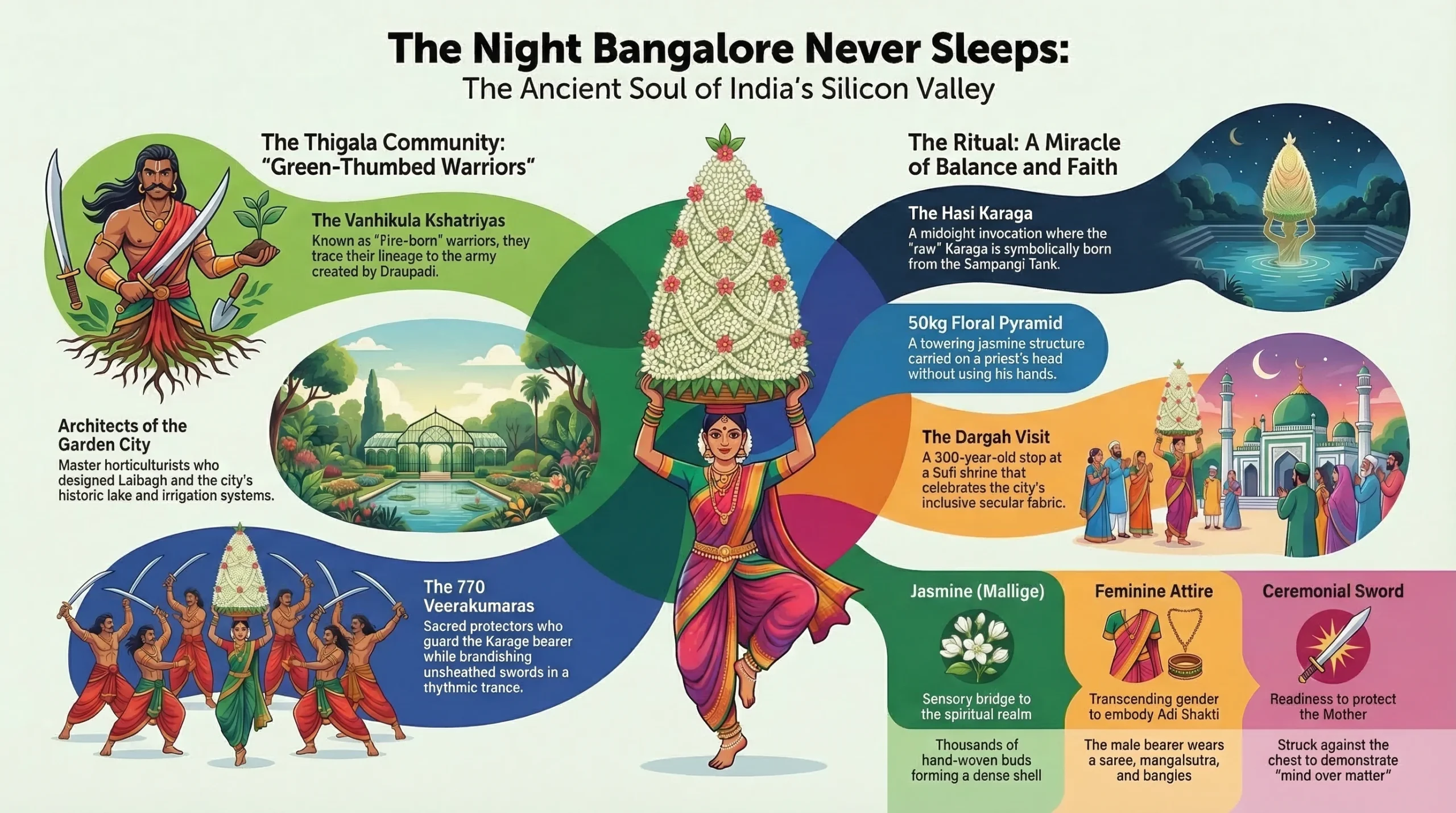
As the moon of Chaitra Purnima hits its peak, the “Mother” emerges. This is the Draupadi Karaga, a towering, floral pyramid carried on the head of a single priest from the Thigala community. But here is the catch that defies physics: the bearer carries this massive weight without using his hands. He dances, swerves, and navigates the surging crowds, protected by the Veerakumaras—a phalanx of sword-wielding warriors who chant “Govinda, Govinda” in a rhythmic trance that feels like a heartbeat.
What makes this “the night Bangalore never sleeps” isn’t just the ritual; it’s the history of a community that has guarded this tradition for over 300 years. The Thigalas, or Vanhikula Kshatriyas, were once the master architects of the city’s famous lakes and gardens. On this night, they reclaim their status as the spiritual guardians of the soil.
One of the most moving moments—and a trending topic for anyone exploring Bangalore’s secular heritage—is the procession’s stop at the Hazrat Tawakkal Mastan Dargah. In an era where “community” is often a buzzword, seeing the Karaga bearer pay respects at a Muslim Sufi shrine is a powerful reminder of the city’s inclusive fabric. It’s a tradition born from a centuries-old pact of brotherhood, proving that the roots of this festival go deeper than religion; they are woven into the very identity of the people.
For the modern traveller or the local resident, witnessing the Karaga is a lesson in resilience. While the city above ground changes with every new tech IPO, the world of the Thigalas remains a steadfast anchor. This night is a sensory overload of turmeric-yellow robes, flickering oil lamps, and the clashing of steel swords—a vivid contrast to the blue-light glare of our daily screens.
As the first light of dawn touches the Vidhana Soudha, the Karaga returns to its temple. The crowd begins to thin, but the energy remains. This isn’t just a festival; it’s a living, breathing testament to Karnataka’s folk traditions. For one night, Bangalore doesn’t sleep because it is too busy remembering who it truly is.
The Thigala community: warriors, gardeners, and guardians
To understand the Bangalore Karaga, you have to first understand the people who have carried its weight—both literally and figuratively—for centuries. The Thigala community is one of Karnataka’s most fascinating social enigmas. Often referred to as the “green-thumbed warriors,” they represent a rare intersection of fierce martial heritage and delicate horticultural mastery.
If Bangalore is known globally as the Garden City, it owes its very soul to the Thigalas.
The Fire-Born Lineage: Vanhikula Kshatriyas
The Thigalas identify themselves as Vanhikula Kshatriyas (also known as the Agnikula or Fire-born race). Their history is steeped in the epic lore of the Mahabharata. According to oral tradition, they are the descendants of the army created by Draupadi to slay the demon Timirasura.
This isn’t just a “cool origin story”—it is the foundation of their identity. The term Vanhikula links them to the element of fire, symbolising purity and strength. When you see the Veerakumaras (the community’s sworn protectors) brandishing unsheathed swords during the festival, you aren’t just looking at a performance; you’re witnessing a centuries-old martial tradition that has been passed down through bloodlines.
From Tamil Soil to Karnataka’s Heartland
While they are now an inseparable part of Karnataka’s cultural heritage, the Thigala community’s journey likely began in the Tamil-speaking regions (historically linked to the Vanniyar community). Historians suggest their migration to the Mysore Kingdom occurred several centuries ago, particularly during the reigns of Hyder Ali and Tipu Sultan.
Why were they brought here? Because of their unmatched skill in wetland farming and horticulture. The rulers of Mysore recognised that to build a kingdom that flourished, they needed master gardeners who understood the language of the soil.
The Architects of the “Garden City”
It is a little-known fact that the iconic Lalbagh Botanical Garden and many of Bangalore’s historic “keres” (tanks/lakes) were nurtured by Thigala hands. They weren’t just labourers; they were the original landscape architects of the city. Their deep connection to water and greenery is why the Karaga festival begins at the Sampangi Tank.
For the Thigalas, nature isn’t just a resource—it’s divine. This is why the Karaga itself is a floral pyramid, a “living” deity crafted from jasmine and other sacred blooms. Their dual identity as Guardians of the Earth and Warriors of the Goddess creates a unique social fabric that resists the flattening effect of modern urbanisation.
The 770 Veerakumaras: A Sacred Brotherhood
Within the community, the role of the Veerakumara is one of immense prestige and discipline. These men undergo rigorous preparation, including fasting and spiritual seclusion, to serve as the bodyguard of the Karaga bearer.
The sight of hundreds of Veerakumaras, chests smeared with vermilion and turmeric, striking their swords against their own bare skin without drawing blood, is a testament to their unwavering faith. It’s a human display of “mind over matter” that continues to trend every year as spectators marvel at their stoic endurance.
The Legends of the Mother drapadi and the veerakumars
At the core of the Bangalore Karaga lies a story of divine strength, an ancient battlefield, and a promise that has survived the test of millennia. While most of the world views Draupadi as the tragic queen of the Mahabharata, the Thigala community sees her through a different lens: she is the Adi Shakti (the Primal Power), a fierce warrior-mother who chose her people over the heavens.
To understand why thousands of men guard a floral pyramid with unsheathed swords today, we have to look back at the moment the Great War ended.
The Birth of the Veerakumaras: An Army from Fire
According to the local legend, as the Pandavas were making their final journey toward the Himalayas (the Mahaprasthana), a formidable demon named Timirasura rose to challenge them. Draupadi, embodying the supreme feminine energy, took a stand. From her divine form, she manifested an army of brave warriors to vanquish the demon.
These warriors were the Veerakumaras (Heroic Sons). They weren’t just soldiers; they were born of her will, tasked with protecting the balance of the world. After the demon was defeated, the Pandavas continued their ascent to heaven, but the Veerakumaras were left behind.
The Eternal Promise: “I Will Return”
Imagine the scene: a group of warriors, having just fought for their Mother, realising she is about to leave the earthly realm. The legend says they fell at her feet, pleading with her not to abandon them.
Moved by their devotion, Draupadi made a sacred pact. She couldn’t stay forever, but she promised to return to Earth once every year during the first full moon of the Hindu New Year (Chaitra Purnima). This “return” is the very essence of the Karaga festival. For the Thigala community, the Karaga isn’t just a parade; it is the physical manifestation of Draupadi keeping her word.
Reimagining Draupadi: From Victim to Victor
One of the reasons this topic is trending in cultural discussions is the modern re-evaluation of Draupadi’s character. In the Thigala tradition, she is far from the “damsel in distress” often portrayed in popular media. Here, she is a symbol of:
- Unfiltered Power: She is the one who creates and protects.
- Resilience: She stands tall after the devastation of war.
- Maternal Authority: She is the “Mother” to whom the community owes its existence.
This connection to a deity is what makes the Draupadi Karaga so unique. When the Karaga bearer walks the streets, he isn’t just carrying a ritual object—he is “becoming” the Mother, fulfilling a 5,000-year-old promise to her sons.
The Ritual Connection: Why the Swords?
You might notice the Veerakumaras during the procession striking their bare chests with the flat of their swords, shouting “Govinda!” This isn’t just for show. It’s a symbolic act of “reminding” the Mother of their presence. It is a display of their readiness to fight for her, just as their ancestors did against Timirasura. It’s a raw, high-energy demonstration of faith and lineage that remains one of the most photographed and searched aspects of Bangalore’s spiritual heritage.
Decoding the Rituals: A9 Day spiritual odyssey
The Bangalore Karaga is not a singular event; it is a spiritual crescendo. To the casual observer, it’s a one-night spectacle, but for the Thigala community, it is a nine-day odyssey of asceticism, discipline, and metaphysical transformation. Understanding these nine days is like peeling back the layers of Bangalore’s oldest living history.
From the moment the flag is hoisted to the final return of the Goddess, every second is steeped in a “Vratha” (sacred vow) that demands absolute purity.
The Flag Hoisting (Dwajarohana): The Call to Arms
The journey begins at the historic Dharmaraya Swamy Temple in Tigalarapet with the Dwajarohana. As the yellow flag with the emblem of a lion is unfurled, a silent pact is made between the community and the divine. For the next nine days, the temple becomes the centre of the universe. The participants, especially the Veerakumaras, renounce worldly comforts—many go barefoot, sleep on the floor, and observe strict dietary restrictions. It is a period of “becoming” rather than just “doing.”
Hasi Karaga: The Midnight Invocation
A few nights before the main procession, the most mysterious and debated ritual takes place: the Hasi Karaga. Under the shroud of midnight, the priest and the elders head to the Sampangi Tank (near the modern-day Kanteerava Stadium).
“Hasi” translates to “raw” or “fresh.” In this ritual, the Karaga is symbolically “born” or invoked from the water. It’s a deeply atmospheric scene—torches flickering against the dark water, the rhythmic chanting of ancient mantras, and a sense of heavy, divine presence. It is here that the Shakti is invited to inhabit the floral vessel. This is a high-ranking “Featured Snippet” topic because many people search for the “secret” of what happens at the tank.
The Alchemy of the Floral Pyramid
While the world sees a towering structure of jasmine, the construction of the Karaga is a closely guarded secret. It is said to contain several sacred objects that represent the “Primal Power.” The floral engineering involved is staggering. Thousands of jasmine buds (Mallige) are woven together with such precision that the pyramid remains stable even as the priest performs his high-energy, trance-like dance. This jasmine isn’t just decoration; its scent is believed to act as a bridge between the physical and spiritual realms.
The Main Event: Karaga Shaktyotsava
The 9th night is the Shaktyotsava, the night Bangalore never sleeps. This is when the Karaga bearer, dressed in feminine attire—complete with a mangalsutra and bangles—emerges from the temple. Why the feminine dress? Because for this one night, the man ceases to be himself; he is the vessel for Mother Draupadi.
As he steps out, he is surrounded by the Veerakumaras, their swords flashing in the lamplight. The procession follows a specific, ancient route through the Old City, stopping at various “Mutt” and temples. Each stop is a human encounter between the Goddess and her devotees, a moment of shared history that has remained unchanged even as skyscrapers rose around them.
The Return: Closing the Circle
The odyssey concludes as the sun begins to rise. The Karaga returns to the temple, the flag is lowered, and the “Shakti” is symbolically released. The participants return to their daily lives, but they do so transformed. For the Thigalas, these nine days are the spiritual fuel that powers their community for the rest of the year.
The Bearer: The Man who becomes a Goddess
In the heart of one of the world’s fastest-growing tech cities, a man stands in a secluded chamber of the Dharmaraya Swamy Temple, undergoing a transformation that defies modern logic. He isn’t just a priest; for the next several hours, he is the living vessel of a Goddess.
The role of the Karaga Bearer is perhaps the most physically demanding and spiritually intense calling in Karnataka’s folk traditions. To the thousands cheering in the streets, he is the Mother. To the man himself, it is the culmination of months of gruelling sacrifice.
The Path of the Ascetic: Months of Preparation
Being chosen as the Karaga bearer is an honour that comes with a heavy price—literally and metaphorically. The preparation doesn’t start on the night of the festival; it begins months in advance.
- Isolation and “Vratha”: The bearer leaves his family and moves into the temple premises. He observes a strict “Vratha” (sacred vow), which includes a rigorous diet, celibacy, and intense meditation.
- Mental Fortitude: He must detach himself from his ego. In the Thigala community, it is believed that if the bearer has even a sliver of doubt or impurity in his heart, he will not be able to balance the Karaga.
- Physical Conditioning: While faith is the driver, the physical toll is immense. The bearer must practice walking and dancing while maintaining a perfectly upright posture to support the floral pyramid.
The Divine Feminine: A Man Dressed as a Goddess
One of the most striking and human aspects of the Bangalore Karaga is the bearer’s attire. To represent Draupadi, the male priest dons traditional feminine symbols:
- The Saree: He is draped in a yellow or red saree, colours associated with Shakti and purity.
- The Mangalsutra and Bangles: He wears the sacred thread of marriage and glass bangles.
- The Ornaments: Every piece of jewellery is symbolic, representing the “Alankara” (adornment) of the Goddess.
This gender-fluid ritual is a profound theological statement. It suggests that the Divine transcends biological labels. On this night, the “male” identity is surrendered to allow the “feminine” power of Draupadi to lead the way. It’s a concept that resonates deeply with modern discussions on the fluidity of identity and spirituality.
The Physics of Faith: Balancing the Unbalanced
The Karaga itself is a floral structure that can weigh anywhere between 30kg to 50kg. It is high, top-heavy, and notoriously unstable. Yet, the bearer carries it on his head through surging crowds, narrow alleys, and uneven pavement—all without touching it with his hands.
How is this possible? Sceptics look for hidden harnesses, but the devotees know better. They call it the “Shakti” taking over. The bearer moves in a trance-like state, his steps synchronised with the clashing of the Veerakumaras’ swords and the frantic beats of the drums. If you watch closely, his movements are not just a walk; they are a rhythmic, zig-zag dance that keeps the centre of gravity perfectly aligned.
The Weight of a Community’s Hopes
The bearer doesn’t just carry a floral pyramid; he carries the collective prayers of the Vanhikula Kshatriya people. He is the bridge between the ancient promise made by Draupadi and the modern reality of the Thigala community. When he finally returns to the temple at dawn, exhausted and drenched in sweat, he has ensured that for another year, the bond between the Mother and her sons remains unbroken.
A Beacon of Secularism: The Dargah Visit
In a world often defined by its divisions, the Bangalore Karaga offers a masterclass in what it truly means to be a “cosmopolitan” city. Long before Bangalore was a tech hub, it was a melting pot of faiths, and nothing illustrates this better than the procession’s midnight stop at the Hazrat Tawakkal Mastan Dargah.
This isn’t just a brief pause for a photo op; it is a 300-year-old testament to communal harmony that remains the emotional high point of the festival.
The Legend of the Healed Saint
The story behind this visit is as beautiful as the ritual itself. According to local lore, Hazrat Tawakkal Mastan, an 18th-century Sufi saint, was once severely injured during a Karaga procession. The Karaga priest of that time stopped to tend to the saint’s wounds, using sacred ash and herbs to heal him.
Deeply moved by this act of compassion, the Saint made a dying request: that the Karaga—the manifestation of Mother Draupadi—should always visit his tomb to bless him. The Thigala community, staying true to their word for centuries, has never missed a year. This narrative is a favourite for those searching for “Bangalore’s hidden secular history” because it proves that the city’s inclusive spirit isn’t a modern invention—it’s a heritage.
The Ritual: A Dance of Two Faiths
When the Karaga bearer reaches the Dargah in the Cottonpeth area, the atmosphere shifts. The loud, rhythmic chanting of “Govinda!” softens into a respectful murmur.
- The Circumambulation: The bearer, carrying the heavy floral Karaga, circles the tomb of the Sufi saint three times.
- The Exchange: The head of the Dargah offers a lemon and flowers to the priest, who, in return, offers the “Prasada” of the Goddess.
- The Symbolic Bond: For those few minutes, the boundaries between Hindu and Muslim, between temple and mosque, simply evaporate.
It is a high-energy, high-emotion moment that frequently goes viral on social media every year, as it perfectly encapsulates the Ganga-Jamuni Tehzeeb (the syncretic culture) of Southern India.
Why It Matters in 2026
In an era where social media often highlights friction, the Dargah visit stands as a beacon of secularism. It reminds us that the Thigala community and the local Muslim community have co-existed as neighbours, friends, and spiritual brothers for generations.
“The Karaga doesn’t belong to one religion; it belongs to the soil of Bangalore. When the Mother visits the Saint, she isn’t just a Hindu deity—she is the guardian of the entire city’s peace.” — A local elder from Tigalarapet.
For anyone writing about or researching Karnataka’s cultural landscape, this section is crucial. it moves the conversation from “folklore” to “humanity,” making the pillar page not just an educational resource, but a deeply moving human story.
The Architecture of Devotion: Dharmaraya swamy Temple
While the skyscrapers of nearby MG Road reach for the clouds, the Dharmaraya Swamy Temple in the heart of Tigalarapet reaches for something far more grounded: the collective memory of a people. If the Karaga is the pulse of Bangalore, this temple is its beating heart.
Constructed over 800 years ago, this isn’t just a place of worship; it is an architectural manifesto of the Thigala community. For a professional content strategist or a history buff, this temple is a goldmine of “firsts” and “onlys.”
A Rarity in Stone: The Pandava Connection
Walk across the length and breadth of India, and you will find thousands of temples dedicated to Shiva, Vishnu, or the Goddess. But a temple dedicated to the five Pandava brothers and Draupadi? That is a rarity.
The Dharmaraya Swamy Temple stands as one of the few places in the world where the protagonists of the Mahabharata are worshipped as primary deities.
- The Sanctum: At the centre stands Dharmaraya (Yudhisthira), the personification of Dharma.
- The Divine Consort: Beside him is Draupadi, not as a submissive queen, but as the powerful Karaga Shakti.
- The Brothers: Shrines for Arjuna, Bhima, Nakula, and Sahadeva flank the main deity, creating a physical map of the epic itself.
The Dravidian Fingerprint
Architecturally, the temple is a stunning example of the Dravidian style, characterised by its towering Gopurams (gateways) and intricate carvings. But look closer, and you’ll see the Thigala craftsmen.
The pillars aren’t just supporting a roof; they are storytelling devices. You’ll find depictions of the Thigala ancestors, scenes from the Great War, and motifs of the very flowers and plants the community has cultivated for centuries. For anyone interested in the temple architecture of Karnataka, this site is a living museum of how a community imprints its professional identity (gardening and warfare) onto its spiritual home.
The “Garbhagriha” and the Secret of the Karaga
During the nine days of the festival, the temple transforms. The inner sanctum—the Garbhagriha—becomes a high-security spiritual lab. It is here that the floral Karaga is meticulously “charged” with energy.
One of the most trending topics for heritage travellers is the temple’s specific layout, which facilitates the secretive rituals of the Thigala elders. The temple isn’t just designed for aesthetics; it’s designed for the flow of the Karaga. The wide courtyards are built to accommodate the thousands of Veerakumaras who gather to protect the deity, their swords clashing in a rhythmic resonance that the stone walls have echoed for eight centuries.
An Urban Anchor in a Changing Bangalore
In 2026, as Bangalore continues to expand into a “mega-city,” the Dharmaraya Swamy Temple remains a steadfast anchor. It serves as a reminder that before the city was a hub of Silicon Valley, it was a cluster of “petes” (markets) and “keres” (tanks).
The temple’s resilience is a testament to the Thigala community’s commitment to their roots. While the world outside its gates speaks in code and algorithms, the language inside remains one of bells, ancient Kannada chants, and the heavy scent of jasmine.
The science and Art of the karaga
While the Bangalore Karaga is undoubtedly a spiritual phenomenon, there is an incredible amount of “floral engineering” and traditional physics that goes into creating the iconic pyramid. To the casual observer, it’s a beautiful tower of jasmine. To the Thigala community, it is a masterpiece of precision, weight distribution, and sensory art that has been perfected over hundreds of years.
If you’ve ever wondered how a five-foot-tall floral structure stays perfectly balanced on a man’s head as he dances through a chaotic crowd, the answer lies in a blend of ancient science and dedicated craftsmanship.
The Engineering of the Jasmine Pyramid
The Karaga is not just “assembled”; it is engineered. The primary material used is Jasmine (Mallige), but not just any jasmine. The buds are carefully selected for their size, fragrance, and “grip.”
- The Weaving Technique: Thousands of jasmine buds are tied together using a secret, centuries-old knotting technique. The flowers are woven so tightly that they form a dense, fabric-like layer. This isn’t just for aesthetics—this “floral skin” acts as a protective shell for the sacred core.
- The Centre of Gravity: The structure is wider at the base and tapers toward the top, creating a low centre of gravity. This is what allows the bearer to perform sharp turns and sudden movements without the structure toppling. It’s a lesson in applied physics disguised as a religious ritual.
- Weight Distribution: While the exterior is light and airy jasmine, the “heart” of the Karaga contains sacred weights—symbolic objects that give the structure the heft it needs to remain stable against the wind and the bearer’s movements.
The Aromatic Science: Why Jasmine?
There is a psychological and physiological reason behind the choice of jasmine. In sensory branding terms, the scent of jasmine is known to reduce anxiety and promote a state of “relaxed alertness.”
For the Karaga bearer, who is in a deep spiritual trance, the overwhelming aroma of tons of fresh jasmine acts as a sensory anchor. It helps maintain his focus and keeps him grounded while his body is under extreme physical stress. This is science at its best—using the power of nature to enhance human performance.
The Pothuraju and the Visual Arts
The Karaga isn’t a solo act; it’s a full-scale artistic production. Surrounding the bearer are the Pothuraju dancers, often seen with their bodies smeared in turmeric and vermilion, whipping themselves in a rhythmic frenzy.
- The Color Palette: The dominance of yellow (turmeric) and red (kumkum) isn’t accidental. These are the colors of the earth and the fire—the two elements central to the Thigala identity as Vanhikula Kshatriyas.
- The Soundscape: The art of the Karaga is incomplete without the “Nadaswaram” and the “Thavil” (traditional drums). The frequency of these instruments is designed to cut through the ambient noise of the city, creating a “sonic barrier” that protects the sanctity of the procession.
Sustainable Heritage in the Modern Age
What’s trending in 2026 is the sustainability of traditions. The Karaga is a zero-waste festival. The flowers, the bamboo frame, the organic dyes—everything returns to the earth. In an era where “green events” are the goal, the Thigala community has been running a carbon-neutral masterclass for three centuries.
By viewing the Karaga through the lens of art and science, we move beyond the “myth” and begin to appreciate the sheer intellectual and creative power of the people who built Bangalore.
Modern challenges and the Digital Age
In 2026, Bangalore is a city that moves at the speed of a fiber-optic cable. But once a year, the “Silicon Valley of India” faces a fascinating collision: the high-tech future meeting its high-touch past. Maintaining a 300-year-old procession in a city defined by metro lines, flyovers, and luxury high-rises isn’t just difficult—it’s a feat of modern logistics and communal willpower.
For the Thigala community, the digital age hasn’t been a threat to their heritage; it’s become their newest tool for preservation.
The Path of the Goddess vs. The Path of the Metro
One of the most significant modern challenges for the Bangalore Karaga is the physical changing of the guard. The traditional route of the Karaga is sacred and non-negotiable, yet the landscape of the “Pete” area has transformed.
- Infrastructure Hurdles: Negotiating the height of the floral Karaga under low-hanging Metro lines and electric cables requires precision planning with city officials.
- The “Street” Problem: Narrow alleys that once held horse-drawn carriages now struggle to hold tens of thousands of people plus digital creators with gimbal stabilizers.
- Crowd Control in the AI Era: The Bangalore Police now use AI-driven crowd management and heat-mapping to ensure the safety of the procession, blending ancient security (the Veerakumaras) with modern tech.
The “Phygital” Karaga: From Temples to TikTok
If you look at the crowds today, you’ll see as many smartphones as you see jasmine petals. The Thigala youth have embraced the “digital guardian” role.
- Viral Heritage: In 2026, the Karaga is a trending topic on global platforms. Short-form videos of the Hasi Karaga or the Dargah visit allow the diaspora and the world to witness the trance-like dance in real-time.
- Live-Streaming the Divine: For those Thigalas living in San Francisco or London, the festival is now a virtual homecoming. Live streams have turned a local community event into a global cultural phenomenon.
- Digital Archives: The community is using digital storytelling to document the oral histories of elders, ensuring that the “why” behind the rituals isn’t lost to time.
Gen Z Thigalas: From Coding to Karaga
Perhaps the most of this story is the duality of the participants. In 2026, it’s not uncommon to see a Veerakumara who spent his morning writing Python code for a global tech firm and his evening sharpening a ceremonial sword.
This generation isn’t choosing between their career and their culture; they are integrating them. They are the ones optimising the festival’s logistics with apps while maintaining the strict “Vratha” (vows) of their ancestors. This hybrid identity is what keeps the Karaga relevant; it’s not a dusty relic, but a living, breathing part of their modern lives.
Climate Change and the Jasmine Crisis
Even the flowers aren’t immune to the modern world. Changing weather patterns have occasionally affected the blooming cycles of the specific jasmine varieties needed for the Karaga. The community has had to adapt, working with local farmers to ensure that the “floral engineering” remains sustainable. This has sparked a “Green Karaga” movement, emphasizing the importance of protecting the local ecosystem that makes the festival possible.
“The city changes its skin every decade, but the Thigala heart remains the same. We use the tools of today to protect the promises of yesterday.” — A young Thigala activist.
Conclusion: Why the Karaga Matters in 2026
As the jasmine petals are swept from the streets of Tigalarapet and the first light of dawn touches the glass facades of the city’s tech parks, a profound silence settles over Bangalore. The Bangalore Karaga has returned to the temple, and with it, Mother Draupadi has fulfilled her annual promise.
But in 2026, as we stand on the cutting edge of global innovation, one question remains: why does this 300-year-old tradition matter more now than ever?
The answer lies in the concept of cultural anchor points. In an age of rapid-fire digital transformation and urban sprawl, the Thigala community provides the city with its “original code.” They remind us that before Bangalore was a hub of Silicon Valley, it was a garden—and before it was a garden, it was a home to a people whose faith was as unshakeable as the swords they carry.
A Blueprint for Identity in a Digital Age
The history of the Thigalas isn’t just a story for the archives; it is a blueprint for how a community can thrive in a modern economy while keeping its soul intact. They have successfully transitioned from being the master horticulturists of the Mysore Kingdom to being entrepreneurs, developers, and global professionals, all while maintaining the strict Vratha (vows) of their ancestors.
This resilience is the true legacy of the Karaga. It proves that heritage isn’t a weight that holds us back, but a foundation that allows us to build higher. For the modern Bangalorean, the festival is a reminder that identity is not found in a LinkedIn bio, but in the shared stories of our streets.
The Soul of the Garden City
The Karaga matters because it is the ultimate act of secular storytelling. It is one of the few places left where:
- A Hindu goddess stops to bless a Muslim saint.
- A man embodies the divine feminine to teach us about the fluidity of power.
- An entire city pauses its relentless grind to witness a miracle of balance.
Final Reflections: Beyond the Jasmine
For the readers of Colcasac, who appreciate the craftsmanship of a well-lived life, the Karaga is the ultimate masterpiece. It is a festival built on the values of discipline, community, and the enduring power of a promise kept. As we look toward the future, the Thigala community stands as a beacon, showing us that even in a city of mirrors and glass, the scent of jasmine can still lead us home.
Summary of the Karaga’s Impact (2026)
| Aspect | Value to Modern Bangalore |
| Social | Promotes communal harmony through the Dargah visit. |
| Environmental | Reclaims the “Garden City” identity through horticultural roots. |
| Spiritual | Offers a space for ancient Shakti worship in a modern landscape. |
| Cultural | Preserves the Vanhikula Kshatriya lineage and folk arts. |
A Note on Authenticity: While the world becomes increasingly automated, the Karaga remains stubbornly, beautifully human. It cannot be replicated by an algorithm; it must be felt, smelled, and lived.
Frequently Asked Questions about Decoding the Bangalore Karaga
1. What is the history of the Bangalore Karaga festival?
The Bangalore Karaga is one of the oldest festivals in Karnataka, with a documented history spanning over 300 years. It is rooted in the Mahabharata, specifically the legend of Draupadi and her army of Veerakumaras. The festival was institutionalised by the Thigala (Vanhikula Kshatriya) community, who migrated to Bangalore and became the city’s master horticulturists. It represents the annual fulfilment of a divine promise made by Draupadi to return to her “sons” on Earth.
2. Who are the Thigalas, and what is their role in Bangalore’s heritage?
The Thigalas are a community of Vanhikula Kshatriyas (Fire-born warriors) who are historically renowned for their expertise in horticulture and irrigation. They are the original architects of Bangalore’s “Garden City” status, having played a pivotal role in the development of Lalbagh and the city’s ancient tank systems. Today, they are the sole custodians of the Karaga tradition, guarding its secrets and rituals across generations.
3. Why does the Karaga priest dress in feminine attire?
During the festival, the male priest (the bearer) undergoes a spiritual transformation to embody Mother Draupadi (Adi Shakti). By wearing a saree, mangalsutra, and bangles, the priest surrenders his male identity to become a vessel for the Divine Feminine. This symbolises that the power of Shakti transcends gender, allowing the priest to perform the gruelling rituals through the strength of the Goddess herself.
4. What is actually inside the floral Karaga pyramid?
The contents of the Karaga are a closely guarded secret known only to the high priests of the Thigala community. However, it is symbolically understood to contain a silver or golden pot representing the “Primal Energy” or Shakti. It is adorned with thousands of fresh Jasmine (Mallige) flowers, which are woven into a towering pyramid that the bearer carries without using his hands.
5. Why does the Karaga procession visit the Hazrat Tawakkal Mastan Dargah?
This is a 300-year-old tradition of communal harmony. Legend says that the Sufi saint Hazrat Tawakkal Mastan was once injured during the Karaga and healed by the priest. Since then, the Karaga bearer visits the Dargah to pay respects, symbolising a deep-rooted bond between the Thigala and Muslim communities in Bangalore. It is a powerful example of the city’s secular fabric.
6. Who are the Veerakumaras and why do they carry swords?
The Veerakumaras are the “Heroic Sons” of Draupadi. They are members of the Thigala community who take a sacred vow (Vratha) to protect the Karaga. They carry unsheathed swords and strike their chests rhythmically to demonstrate their devotion and readiness to protect the Goddess. Their presence represents the warrior lineage of the Vanhikula Kshatriyas.
7. When and where does the Bangalore Karaga take place?
The festival is held annually during the Chaitra Purnima (the first full moon of the Hindu New Year), typically in March or April. The epicentre of the festival is the Dharmaraya Swamy Temple in Tigalarapet, one of the oldest neighbourhoods in Bangalore. The procession winds through the streets of the “Old Pete” area, including Cottonpeth and Akkipeth.
8. Can anyone participate in or attend the Karaga festival?
Yes, the Bangalore Karaga is a public celebration and is attended by lakhs of people from all walks of life. While the core rituals are performed exclusively by the Thigala community, the festival is a symbol of Bangalore’s collective heritage. Devotees and tourists alike gather to witness the midnight procession and receive the blessings of the “Mother.”
9. How heavy is the Karaga, and how is it balanced?
The Karaga structure can weigh between 30kg and 50kg. Its stability comes from a combination of traditional floral engineering (weight distribution) and the bearer’s intense physical and spiritual training. The bearer walks in a specific zig-zag pattern, using rhythmic movements and a deep state of trance to maintain the centre of gravity without using his hands.
10. What is the significance of the Hasi Karaga ritual?
The Hasi Karaga is the “Invocation” ritual that takes place at the Sampangi Tank before the main procession. “Hasi” means fresh or raw. In this midnight ceremony, the Goddess is symbolically invoked from the water. It is considered one of the most spiritually charged moments of the 9-day odyssey, marking the birth of the Karaga for that year.



Leave a Reply