
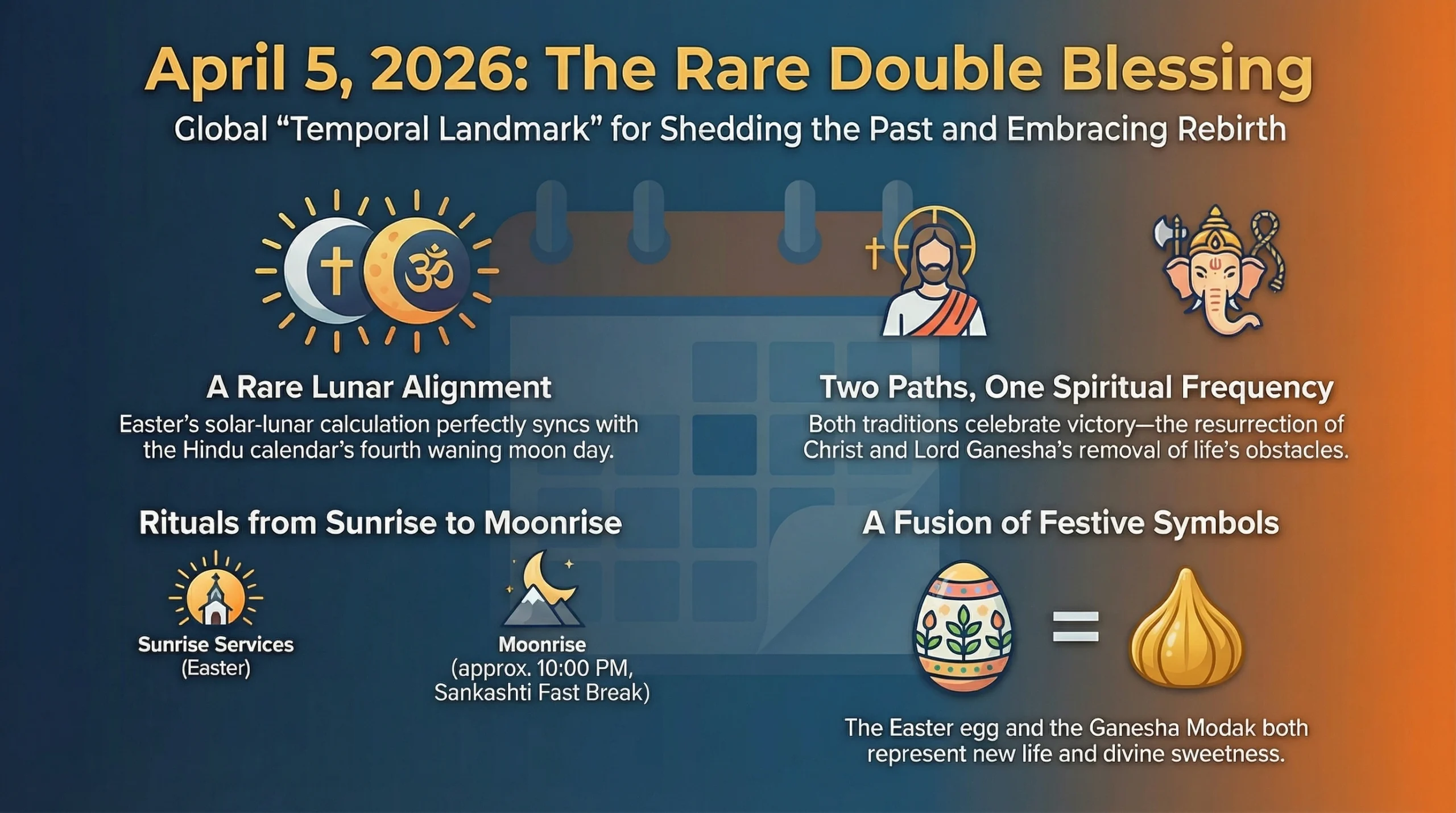
The Spiritual Synchronicity of April 5, 2026: A Rare Double Blessing
Every once in a while, the calendar does something remarkable. It stops being a mere grid of numbers and transforms into a map of cosmic coincidence. On April 5, 2026, we are standing at the center of one of these rare alignments. On this single Sunday, the world will simultaneously observe Easter Sunday and Vikat Sankashti Chaturthi (Sankatahara Chaturthi).
While these two traditions originate from different corners of the globe—one rooted in the resurrection of Christ and the other in the removal of obstacles by Lord Ganesha—they are vibrating on the exact same spiritual frequency this year. This is not just a scheduling quirk; it is a spiritual synchronicity that offers a powerful reset button for our personal journeys in 2026.
The Lunar Link: Why the Dates Align
If you’ve ever wondered why the date of Easter jumps around like a rabbit (pun intended), the answer lies in the sky. Easter is determined by the Paschal Full Moon, falling on the first Sunday after the first full moon following the vernal equinox. Similarly, Sankatahara Chaturthi is entirely lunar-dependent, occurring on the fourth day (Chaturthi) of the waning moon (Krishna Paksha).
In 2026, the lunar cycles have harmonized. This means that as millions of people wake up for Easter sunrise services to celebrate life conquering death, millions more will be beginning a Sankashti Vrat (fast), preparing to break it only when the moon rises that night. Whether you are looking at the sun at dawn or the moon at 9:50 PM, the focus remains the same: The Transition.
From Sacrifice to Victory: The Shared Narrative
The beauty of April 5, 2026, lies in the shared human experience of these festivals. Easter Sunday is the triumphant conclusion of Holy Week—a period of deep reflection and sacrifice. It represents the ultimate new beginning.
Parallel to this, the Vikat Sankashti Chaturthi of the Vaishakha month is specifically dedicated to Lord Ganesha in his form as the Remover of Hardships.For those observing the fast, the day is a discipline of patience and internal cleansing. Just as Easter celebrates the victory over the grave, Sankashti celebrates the victory over the Sankat (obstacles) that hold us back from our true potential.
Why This Matters for You in 2026
In a fast-paced digital world, this convergence is a reminder to slow down and look up. The spiritual significance of April 5, 2026, is about The Great Clearing. It is a day to let go of the heavy burdens of the past year and step into a lighter, more purposeful version of yourself.
Whether you are decorating eggs with family or preparing 21 Modaks for a Ganesha puja, the energy of the day is working in your favor. It is a rare double blessing where the solar energy of Sunday meets the lunar grace of the Chaturthi Tithi.
Easter Sunday 2026: A Global Celebration of Rebirth
Easter Sunday isn’t just a date on a calendar; it’s a global heartbeat of hope. On April 5, 2026, this celebration takes on an even more profound meaning as the world collectively leans into the theme of rebirth. While the theological core of Easter Sunday 2026 is the resurrection of Jesus Christ, the reality of this day transcends religious boundaries, touching anyone who has ever looked for a second chance or a fresh start.
A Mosaic of Traditions: How the World Wakes Up
From the historic cathedrals of Europe to the vibrant streets of Goa, the way we celebrate reflects our local flavors but shares a universal soul. In 2026, we are seeing a shift toward “meaningful gathering.” It’s no longer just about the Easter Bunny or chocolate eggs; it’s about intentional community.
- Sunrise Services: Across the Americas and Africa, millions will gather at dawn. There is something deeply human about standing in the chill of the early morning, watching the first rays of the sun hit the horizon—a literal representation of light overcoming darkness.
- The Symbolism of the Egg: Whether it’s the intricately hand-painted Pysanka in Ukraine or the high-tech Easter egg hunts organized via apps in modern cities, the egg remains the ultimate symbol of new life. In 2026, the trend is moving toward eco-friendly, natural dyes made from turmeric and beets, reflecting a global commitment to rebirth for the planet as well.
- The Paschal Feast: Food is the language of love. Whether you’re sharing Hot Cross Buns, a traditional roast lamb, or regional delicacies like Bebinca in India, the Easter table is a place where hope and renewal are served on a plate.
The Resurrection of the Self
In our fast-paced, often overwhelming digital era, Resurrection Sunday offers a much-needed psychological pause. The meaning of Easter 2026 is increasingly being framed as a period of “mental and spiritual detox. Just as the earth wakes up during the spring equinox, we use this day to shed the winter of our personal lives—the regrets, the stagnant habits, and the obstacles that held us back in the previous year.
Trending searches for Easter 2026 spiritual reset and how to start over in 2026 highlight this collective desire. We aren’t just celebrating a historical event; we are participating in a living metaphor. When we say He is Risen, for many, it also echoes the sentiment: I am rising too.
Why April 5, 2026, is the Ultimate New Beginning
Because Easter falls early in April this year, it perfectly captures the peak of the spring bloom in the Northern Hemisphere and the cooling grace of autumn in the South. This natural transition amplifies the themes of rebirth.
For the content creators and spiritual seekers alike, Easter Sunday 2026 is the pinnacle of topical authority in the realm of wellness and faith. It’s a day to celebrate the impossible becoming possible. As you plan your celebrations—whether they involve a quiet prayer, a massive family brunch, or a simple walk in the park—remember that you are part of a global wave of renewal.
Sankatahara Chaturthi: The Divine Removal of Obstacles
While half the world wakes up to the ringing of church bells on April 5, 2026, millions of others will begin their day in a profound, meditative silence. This Sunday marks the observance of Vikat Sankashti Chaturthi—popularly known as Sankatahara Chaturthi. In the Vedic calendar, Sankatahara literally translates to the destroyer of sorrows, and in 2026, this festival serves as a powerful spiritual anchor for those seeking to clear the path ahead.
The Essence of the Remover of Obstacles
Lord Ganesha, the elephant-headed deity, is revered as Vighnaharta (the one who takes away impediments). However, Sankatahara Chaturthi 2026 isn’t just a religious ritual; it is a deeply human exercise in resilience.
We all carry Sankat (troubles)—whether they are professional roadblocks, emotional weights, or the digital clutter of a hyper-connected world. Observing this day is a symbolic act of handing those burdens over to a higher intelligence. It is the spiritual equivalent of hitting refresh on a stalled browser; it clears the cache of our minds so we can function at our highest capacity again.
The Legend of the Moon and the Ego
To understand the depth of this day, we must look at the ancient story of Ganesha and the Moon God, Chandra. Legend tells us that Chandra once mocked Ganesha’s appearance, leading to a curse that made the moon invisible. Only through humility and prayer was the moon restored.
This story is a timeless lesson in ego and empathy. It reminds us that our “obstacles” often stem from our own pride or our judgment of others. On April 5, 2026, as devotees wait for the moonrise timing, they aren’t just looking for a celestial body—they are looking for a reflection of their own inner light, humbled and renewed.
The Vrat (Fast): A 2026 Perspective on Discipline
In our modern era of instant gratification, the Sankashti Chaturthi Vrat is a radical act of self-control. Devotees fast from sunrise until the moon is sighted at night.
- Physical Detox: Beyond the spiritual merit, many in 2026 are using the Sankashti fast as a seasonal Ayurvedic detox. By consuming only fruits, nuts, or milk products (Sattvic food), you allow your digestive system to reset as the spring heat begins to rise.
- Mental Clarity: The discipline required to stay away from food (and often, social media) for the day creates a mental vacuum that is often filled with creative breakthroughs and peace.
But means going deeper than just timings. It means answering the question: How does Ganesha help me in 2026? The answer lies in the Sankatahara Stotram—a prayer that focuses on the eight names of Ganesha. Reciting this isn’t just about ancient phonetics; it’s about grounding oneself in the attributes of wisdom, patience, and strength.
Why This Double Blessing Matters
Having Sankatahara Chaturthi fall on Easter Sunday is a cosmic reminder that whether we call it Resurrection or The Removal of Obstacles, the goal of the human spirit remains the same: To rise. As we look toward the evening of April 5th, the sighting of the moon will mark the end of the fast and the beginning of a life less burdened by the Sankat of yesterday.
The 2026 Lunar Connection: Why the Dates Align
While our modern lives are dictated by digital clocks and Gregorian calendars, the ancient world looked to the sky. On April 5, 2026, we witness a rare perfect storm of celestial mechanics where two distinct calendars—the Christian Ecclesiastical calendar and the Hindu Luni-Solar calendar—handshake in the moonlight. To understand why Easter Sunday and Sankatahara Chaturthi align so perfectly this year, we have to look at the moon as the ultimate cosmic timekeeper.
The Paschal Full Moon: Easter’s Lunar Logic
Easter is famously a movable feast, meaning its date shifts every year. The rule, established centuries ago, is that Easter falls on the first Sunday following the Paschal Full Moon. This is the first full moon that occurs on or after the vernal equinox (historically fixed by the Church as March 21).
In 2026, the Vernal Equinox occurs on March 20. The first full moon following it—known as the Pink Moon 2026—turns full on Wednesday, April 1. According to the rule, the very next Sunday becomes Easter. Thus, the calendar lands squarely on Sunday, April 5.
The Fourth Day: Sankashti’s Waning Grace
On the other side of the spiritual spectrum, Sankatahara Chaturthi (specifically Vikat Sankashti Chaturthi in 2026) is determined by the waning phase of the moon, known as Krishna Paksha. This festival always falls on the 4th day (Chaturthi) after the Full Moon (Purnima).
Because the full moon reaches its peak on April 1, the countdown to the fourth day begins immediately. By the time we reach the morning of April 5, the Chaturthi Tithi begins (around 11:59 AM). Since the core of the Sankashti ritual is the moonrise sighting, and the Tithi prevails through the night of April 5, the fast and the celebration coincide perfectly with the Sunday of Easter.
The Metonic Cycle: A Rare Convergence
This alignment isn’t just a random fluke; it’s a result of the Metonic Cycle—a 19-year period after which the moon’s phases recur on the same days of the year. While Easter and Sankashti Chaturthi meet occasionally, having them fall on a Sunday adds a layer of “Holiday Energy” that makes April 5, 2026, feel particularly significant for global travellers and spiritual seekers alike.
Why the 2026 Lunar Alignment Matters
From an authority perspective, understanding the 2026 lunar connection is vital. It proves that despite our different cultures, we are all governed by the same natural rhythms. Trending searches like Why is Easter so early in 2026? And Sankashti Chaturthi April 2026 moon timing is essentially asking the same question: What is the moon telling us?
The moon on the night of April 5 will be a waning gibbous, approximately 85% illuminated—a bright, visible reminder of the transition from the Full Light of the Paschal Moon to the Removal of Obstacles symbolised by Ganesha. In 2026, the sky isn’t just a backdrop; it’s the bridge between two of the world’s most beautiful traditions.
Essential Rituals: Step-by-Step Puja Vidhi & Prayers
On April 5, 2026, the spiritual energy is doubled, requiring a thoughtful approach to rituals. Whether you are observing the solemnity of Easter Sunday or the disciplined fast of Vikat Sankashti Chaturthi, the focus is on purification and presence. Here is your comprehensive guide to the essential rituals for this unique day.
Vikat Sankashti Chaturthi: Step-by-Step Puja Vidhi
For devotees of Lord Ganesha, this day is about the Sankalpa (vow) to remove life’s hurdles.
- Morning Preparation: Wake up during Brahma Muhurta (before sunrise). Take a ritual bath and wear clean clothes—preferably red or yellow, which are auspicious colors for Ganesha.
- The Sankalpa: Light a lamp (Diya) in your home temple and take a mental vow to observe the fast with sincerity.
- The Vrat (Fast): Most devotees observe a partial fast, consuming only fruits, milk, or Sattvic foods like Sabudana (tapioca) and peanuts. Avoid grains and salt until the fast is broken.
- Evening Puja (Pre-Moonrise): Clean the puja area and place a Ganesha idol on a wooden pedestal. Offer 21 blades of Durva grass, red flowers, and Modaks or Ladoos.
- Chanting & Katha: Recite the Sankata Nashana Ganesha Stotram (The prayer that destroys sorrows). Reading the Vrat Katha for the month of Vaishakha is essential to complete the ritual.
- Moonrise & Arghya: The fast is only broken after the 2026 moonrise (approximately 10:00 PM, depending on your city). Offer Arghya (a mixture of water, raw milk, and sandalwood) to the Moon God while looking at the lunar reflection or the moon itself.
Easter Sunday: Traditions of the Resurrection
For those celebrating the Victory over Death, the rituals focus on light and communal joy.
- The Sunrise Service: A cornerstone of Easter 2026, this ritual involves gathering at dawn to witness the first light. It represents the “empty tomb” and the beginning of a new era.
- The Paschal Candle: In many church traditions, the lighting of the massive Paschal candle symbolizes the Light of the World. At home, lighting a white candle on the breakfast table can mirror this tradition.
- Blessing the Table: Before the grand Easter feast—featuring lamb, honey cakes, or regional specialties—a prayer of gratitude is shared. This is the moment where the Lenten sacrifice officially ends and the season of joy begins.
- Symbolic Crafts: Decorating eggs is not just for children; it’s a meditative ritual representing the “sealed tomb” that eventually gives way to new life.
Powerful Prayers for April 5, 2026
To bridge the two traditions, you can incorporate these trending prayers into your day:
- For Ganesha: Vakratunda Mahakaya, Surya Koti Samaprabha, Nirvighnam Kuru Me Deva, Sarva Karyeshu Sarvada. (O Lord of the curved trunk and massive body, whose brilliance is like a million suns, please make all my work free of obstacles, always.)
- For Easter: He is not here; he has risen, just as he said. (Matthew 28:6). This simple affirmation is the heartbeat of the day.
By combining the discipline of the Sankashti Vrat with the hope of Easter Sunday, your spiritual practice on April 5, 2026, becomes a powerful tool for personal transformation.
City-Wise Moonrise Timings: The Traffic Driver Section
For those observing the Vikat Sankashti Chaturthi fast on April 5, 2026, the most critical moment is the moonrise. The fast is traditionally broken only after sighting the moon and offering Arghya (ritual water offering).
Because moonrise timings vary significantly based on your geographical coordinates, we have compiled the expected timings for major cities in India and across the globe to help you plan your evening puja with precision.
India: City-Wise Moonrise (April 5, 2026)
In India, the moon will generally rise between 9:15 PM and 10:15 PM IST. Residents in Eastern India will witness the moon slightly earlier than those in the West.
| City | Expected Moonrise Time (IST) |
| Kolkata | 9:18 PM |
| Patna | 9:32 PM |
| New Delhi | 9:54 PM |
| Lucknow | 9:44 PM |
| Hyderabad | 9:51 PM |
| Chennai | 9:48 PM |
| Bengaluru | 9:58 PM |
| Mumbai | 10:12 PM |
| Pune | 10:09 PM |
| Ahmedabad | 10:15 PM |
Global Moonrise Timings (International Devotees)
For our global readers observing the rituals or simply looking to witness the Easter Sunday moon, here are the local timings:
- Singapore: 9:37 PM (Local Time)
- Dubai, UAE: 9:46 PM (Local Time)
- London, UK: The moon rises shortly after midnight (technically early April 6th) at 12:14 AM.
- New York, USA: 11:37 PM (Local Time)
What if the moon is not visible?
It is a common concern—what if clouds or pollution block your view of the moon?
Pro Tip: According to religious scriptures, if the moon is not visible due to weather conditions, you may perform the rituals at the calculated moonrise time for your specific city. You can use a reliable Panchang or a moon-tracking app to confirm the exact minute the moon crosses the horizon in your area.
Quick Ritual Recap for Moonrise:
- Filter some water and mix it with a little raw milk and sandalwood.
- Face the direction of the moon.
- Slowly pour the water (Arghya) while chanting Ganesha or Chandra mantras.
- Offer a small piece of jaggery or a modak as Prasad.
- Break your fast with a Sattvic meal.
A Culinary Fusion: From Hot Cross Buns to Modaks
Food is the universal language of celebration, and on April 5, 2026, your kitchen becomes a sacred space where two distinct culinary worlds collide. While Easter Sunday is synonymous with breaking the Lenten fast with rich, celebratory breads, Sankatahara Chaturthi centers on the Sattvic diet—food that is pure, light, and intended to focus the mind.
Whether you are hosting a traditional Easter brunch or preparing for a Sankashti Vrat parana (breaking the fast), this year offers a unique opportunity for a culinary fusion that honors both traditions.
The Easter Classics: Symbols of Resurrection
The Easter table is steeped in symbolism. In 2026, we see a move toward artisanal and heritage recipes that tell a story.
- Hot Cross Buns: These spiced, sweet buns marked with a cross are the quintessential Easter treat. The spices represent the embalming of Christ, and the orange peel signifies the bitterness of his time on the cross. Pro-tip: For a 2026 twist, try sourdough hot cross buns for better gut health.
- The Easter Lamb: Representing the Lamb of God, a slow-roasted leg of lamb with rosemary and garlic remains the centerpiece of many global tables.
- Easter Eggs & Nest Cakes: From chocolate ganache eggs to birds’ nest cupcakes, these treats celebrate the arrival of spring and the bursting forth of new life.
The Sankatahara Palette: Ganesha’s Favorites
On the other side of the day, the focus is on Ganesha’s legendary love for sweets and the strict requirements of a holy fast.
- Modaks (The Essential 21): No Sankatahara Chaturthi is complete without Modaks. Whether you choose the steamed Ukadiche Modak (rice flour shells with coconut and jaggery) or the fried version, offering 21 of these to Lord Ganesha is the highlight of the evening.
- Vrat Recipes (Fasting Food): Since many will be fasting until moonrise, Sabudana Khichdi (tempered with cumin and green chilies) and Roasted Makhana (fox nuts) are the trending choices for 2026.
- Panchamrit: A divine mixture of milk, curd, honey, sugar, and ghee, used first for the deity’s Abhishek and then shared as a powerful, energy-boosting Prasad.
The 2026 Kitchen Challenge
How do you manage a household celebrating both? The key is in the shared ingredients.
- Saffron & Cardamom: These bridge both worlds perfectly. Use them in your Easter Simnel Cake and your Sankashti Shrikhand.
- The Mindful Brunch: If you are hosting an Easter brunch on April 5th but also observing the Sankashti fast, focus on a Fruit and Nut heavy menu. Fresh seasonal berries, honey-glazed walnuts, and yogurt parfaits satisfy the Easter aesthetic while remaining Vrat-friendly.
- The Evening Transition: As the moon rises at approximately 9:54 PM (New Delhi) or 10:12 PM (Mumbai), the house transitions from the joy of Easter Sunday into the peaceful conclusion of the Ganesha Puja.
By bringing Modaks and Hot Cross Buns to the same table, you aren’t just feeding the body; you are celebrating a rare moment of cultural harmony.
The Human Element: Finding Personal Meaning in 2026
Beyond the logistics of moonrise times and the preparation of festive feasts, April 5, 2026, offers a profound psychological and spiritual opportunity. In the fast-paced, often fragmented world of 2026, this rare convergence is a Temporal Landmark—a moment in time that allows us to draw a line between our past self and our future self.
The Shared Frequency of Ganesha and Christ
At first glance, the elephant-headed deity of wisdom and the resurrected Christ might seem worlds apart. However, when we look through the lens of spirituality, they vibrate on the same frequency of transformation.
- The Removal of Ego: In the story of Ganesha, his original head was replaced by an elephant’s, symbolising the death of the small ego and the birth of vast, divine wisdom.
- The Resurrection of Hope: In the Easter narrative, the stone is rolled away to reveal that death is not the end, but a transition into a higher state of being.
Both traditions ask us the same question on April 5th: What are you ready to leave in the tomb? What obstacles are you ready to dissolve? Whether you call it The Removal of Vighna or “The Victory over Death, the internal process is identical: The release of the old to make room for the new.
The Fresh Start Effect in 2026
Psychologists often speak of the Fresh Start Effect —the surge of motivation we feel at the start of a new season or a significant holiday. Because this date lands in the heart of Spring (in the Northern Hemisphere), the environment itself is echoing this message.
- Biological Reset: The increased sunlight in April boosts serotonin, making us naturally more optimistic and open to change.
- Cognitive Clarity: The discipline of the Sankashti Vrat (fasting) provides a mental detox that clears the noise of digital life, allowing for original thought and creative breakthroughs.
Practical Mindfulness for the Day
You don’t need to be a theologian to harness the energy of this day. You can find personal meaning through simple, actions:
- The Gratitude Journal: At moonrise or during your Easter dinner, write down three obstacles that became opportunities over the last year. This aligns with Ganesha’s role as the teacher who turns challenges into growth.
- Intentional Silence: Spend 15 minutes in total silence. In 2026, silence is a luxury. Use it to listen—as Ganesha’s large ears suggest—to your own inner guidance.
- Acts of Service: Rebirth is most visible when we help others rise. Consider a small donation or an act of kindness to mirror the selflessness celebrated in both faiths.
Why This Alignment is a Gift
April 5, 2026, is a cosmic reminder that we are more alike than we are different. It’s a day to celebrate resilience. As you look at the waning gibbous moon that night, realise that you aren’t just witnessing a calendar event; you are participating in a global wave of renewal.
Wildcard Section: Eco-Friendly Celebrations & Spring Wellness
As we navigate the dual significance of April 5, 2026, a new trend is emerging that unites both Easter and Sankatahara Chaturthi: Conscious Celebration. In 2026, the global shift toward sustainability isn’t just a lifestyle choice—it’s a spiritual practice. Whether you are honouring the resurrection or the removal of obstacles, doing so in harmony with the Earth adds a layer of integrity to your rituals.
The Green Easter: Sustainable Joy
Traditional Easter celebrations often come with a heavy plastic footprint. In 2026, we are resurrecting older, earth-friendly habits:
- The Natural Dye Lab: Ditch the synthetic tablets. Use your kitchen as a laboratory to create a stunning, muted palette for your eggs.
- Turmeric for vibrant gold.
- Beetroot juice for soft pinks.
- Red cabbage (boiled with a pinch of baking soda) for a magical robin’s-egg blue.
- Zero-Waste Baskets: Swap plastic grass for shredded recycled paper or even dried moss. Choose reusable wicker or cloth bags that can serve as storage throughout the rest of the year.
- Seed Bombs vs. Plastic Toys: Instead of plastic trinkets that end up in landfills, fill your Easter eggs with Seed Bombs—small balls of clay and wildflower seeds. They represent new life in its most literal, blooming form.
Eco-Sankashti: Bappa in Harmony with Nature
For those performing the Ganesha Puja, the focus in 2026 is on Home Visarjan and biodegradable offerings.
- Shadu Mati Idols: Ensure your Ganesha idol is made from natural Shadu Mati (river clay) rather than Plaster of Paris. These idols dissolve completely in a bucket of water within hours.
- The Tree Ganesha Initiative: A popular 2026 trend involves idols embedded with seeds (like ladyfinger or tomato). After the rituals, you immerse the idol in a pot at home, and as the clay melts, the seeds sprout—transforming your deity into a living plant.
- Organic Offerings: Use only local, seasonal flowers like Hibiscus or Marigolds, and ensure your Durva grass is sourced from pesticide-free zones.
Spring Wellness: The Bio-Rhythm Reset
Beyond the rituals, the date of April 5, 2026, serves as a metabolic switch. This is the peak of Vasantha Ritu (Spring), a season where Ayurveda suggests our bodies are naturally trying to shed the sludge of winter.
- The Kapha Melt: Just as the snow melts on the mountains, Ayurveda teaches that Kapha (the heavy, earthy element) melts in our bodies during April. This can lead to seasonal allergies or lethargy. The Sankatahara fast acts as a perfect clinical intervention, giving your digestive fire (Agni) a chance to rekindle.
- Digital Detox Rituals: Use the discipline of this day to unplug. Studies in 2026 show that even a 12-hour break from screens can significantly lower cortisol levels. Let the only ight you seek that day be the sunrise of Easter or the moonrise of Sankashti.
- Seasonal Eating: Both traditions lean into the Bitter and Pungent palette of spring. Incorporate leafy greens, radishes, and sprouts into your Easter brunch to align with the body’s natural detox pathways.
The 2026 Takeaway
In 2026, being spiritual is becoming synonymous with being sustainable. When we choose eco-friendly dyes or biodegradable idols, we are acknowledging that the Rebirth we celebrate isn’t just a personal or religious event—it is a global necessity. By protecting the planet, we ensure that there will be many more springs to celebrate.
Frequently Asked Questions: April 5, 2026
1. Is it common for Easter and Sankashti Chaturthi to fall on the same day?
No, it is relatively rare. Easter is determined by the first Sunday after the Paschal Full Moon, while Sankashti Chaturthi occurs on the fourth day of the waning moon (Krishna Paksha) every Hindu month. Their alignment on April 5, 2026, is a unique result of the lunar cycles synchronizing across the Gregorian and Hindu Luni-Solar calendars.
2. What is the moonrise time for Sankashti Chaturthi on April 5, 2026?
In major Indian cities, the moon is expected to rise between 9:50 PM and 10:15 PM IST. For example, New Delhi expects moonrise at 9:54 PM, while Mumbai is slightly later at 10:12 PM. Always check a local Panchang or moon-tracking app for the exact minute in your specific location.
3. Why is Easter Sunday so early in 2026?
Easter 2026 is considered early because the Paschal Full Moon occurs on Wednesday, April 1. Since Easter must be the following Sunday, the date lands on April 5. Easter can fall anywhere between March 22 and April 25; 2026 sits toward the earlier end of that window.
4. Can I observe the Sankashti fast and still participate in Easter brunch?
Yes, with a bit of Sattvic planning. Most Sankashti devotees observe a partial fast, consuming fruits, milk, and nuts. You can participate in an Easter brunch by focusing on fresh fruit platters, yogurt, and nuts, while avoiding grains, salt, and non-vegetarian dishes until the moonrise puja is complete.
5. What should I do if the moon is not visible due to clouds?
If the weather prevents a direct sighting, tradition allows you to perform the Arghya and break your fast based on the calculated moonrise time for your city. The intention (Sankalpa) and devotion are considered more important than the physical sight if nature interferes.
6. Is April 5, 2026, a public holiday?
Easter Sunday is always a public holiday in most Western countries and is observed as a Restricted Holiday in India. Notably, in 2026, the Indian government has even allowed for the rescheduling of major exams (like JEE Main) that originally overlapped with this date to respect the religious significance of the day.
7. What is the significance of the name Vikat Sankashti Chaturthi?
Every monthly Sankashti has a specific name and form of Ganesha associated with it. Vikat refers to the fierce, powerful form of Ganesha who destroys the most difficult obstacles. Worshipping the Vikat form on April 5 is believed to provide the strength needed to overcome deep-seated personal or professional challenges.
8. Are there specific colours to wear on this day?
For Sankashti Chaturthi, yellow and red are highly auspicious as they represent Ganesha’s energy. For Easter Sunday, white and gold are traditional, symbolising purity, light, and the joy of the resurrection. Wearing a combination of a bright floral print perfectly bridges both celebrations.
9. Can children and the elderly observe the Sankashti fast?
While the fast is a powerful spiritual tool, Hindu scriptures emphasise Arogya (health). Children, the elderly, and those with medical conditions are encouraged to observe a Phalahari fast (eating fruits and light snacks) or simply participate in the evening prayers without a strict day-long fast.
10. What is the best way to explain this double holiday to children?
Focus on the theme of The Great Refresh. Explain that whether we are celebrating the stone being rolled away (Easter) or Ganesha clearing the path (Sankashti), the world is getting a Super Fresh Start today. It’s a day to be kind, be brave, and look at the moon together as a symbol of hope.


Leave a Reply