
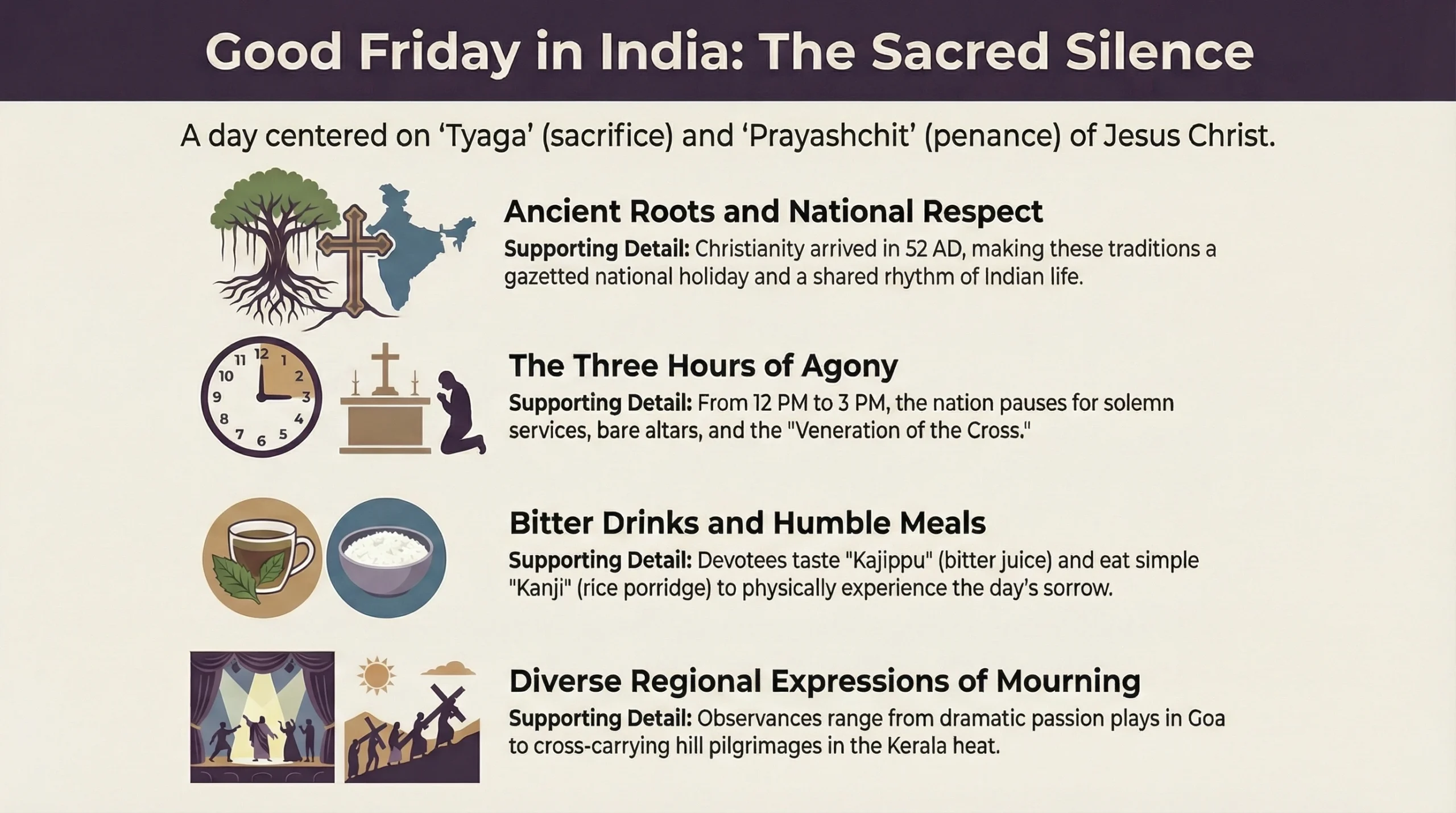
The Solemn Heart of Christianity in India
India is globally famous for its explosion of colors, deafening drumbeats, and joyous, chaotic street festivals. But if you walk through the Christian neighborhoods of Kerala, the historic, winding alleys of Goa, or the bustling urban parishes of Mumbai on a specific Friday in spring, you will encounter a profoundly different side of the country. A heavy, reverent silence replaces the usual festive noise. Church bells fall quiet, replaced by the stark, hollow sound of wooden clappers. Men, women, and children, dressed in muted whites and blacks, walk solemnly toward their local parishes.
This is the atmosphere of Good Friday in India, a day that stands in stark contrast to the country’s typical celebratory spirit, yet commands just as much cultural respect and devotion.
For the uninitiated, Good Friday commemorates the most pivotal and somber moment in the Christian faith: the crucifixion and death of Jesus Christ at Calvary. While Christians make up a minority of the Indian population—roughly 2.3%—their presence on the subcontinent is ancient and deeply woven into the national fabric. Long before European colonists arrived, Christianity took root on the southern Malabar Coast around 52 AD, an ancient heritage traditionally brought by Thomas the Apostle. Because of this deep-rooted history, the Christian holidays India observes are not marginalized events; they are part of a shared national rhythm. Good Friday is a gazetted public holiday, recognized across government offices and financial markets, highlighting the beautiful interfaith respect that defines the Indian ethos.
Observing this day is not a standalone event; it is the absolute focal point of the Holy Week traditions India practices with intense dedication. From the palm fronds waved in the streets on Palm Sunday to the humble washing of feet on Maundy Thursday, the week is a spiritual journey of reflection and repentance. But Friday carries the heaviest weight. It is a day stripped of all ornamentation. Church altars are laid bare, statues of saints are draped in purple or black cloth, and strict fasting rules are enforced across households. To understand the true significance of Good Friday, one has to look beyond the historical biblical narrative and see how it grounds millions of Indian Christians, offering them a day to reflect on the ultimate sacrifice, human suffering, and the profound promise of redemption.
Whether you are a devout believer preparing for the upcoming services, a student of cultural history, or simply a curious traveler wanting to understand how global faiths adapt to local soil, this guide is for you. In this comprehensive pillar page, we are going to explore the incredibly rich and diverse tapestry of Good Friday traditions in India. We will journey from the bitter herbal drinks consumed by the Syrian Christians in Kerala to the dramatic, life-sized passion processions of Goa, and the deeply moving choral traditions of the North-East. We will break down regional fasting rules, the traditional comfort foods used to break the fast, and everything else you need to know about navigating this sacred day.
Let’s begin by peeling back the layers of the day’s spiritual foundation before we travel across the subcontinent to see how faith and mourning are expressed in uniquely Indian ways.
The Spiritual Significance of Good Friday
To truly grasp why Good Friday in India carries such an intense, somber weight, we have to look past the empty altars and silent bells. For the Indian Christian community—whether in a high-tech hub like Bengaluru or a quiet coastal village in Kerala—this isn’t just a day off work; it is the theological anchor of their entire faith. It is the day the “Gospel” (the Good News) meets its most brutal, necessary hurdle.
Why is it Called Good Friday?
It’s the question every schoolchild asks: if this day marks a crucifixion, why do we call it “Good”? In the Indian context, the term is often understood as Holy or Pious Friday (often referred to as Karutha Velli or “Black Friday” in Malayalam due to the mourning).
The Good refers to the profound religious belief that Jesus’ suffering was a deliberate, sacrificial act that bridged the gap between humanity and the Divine. In a culture like India’s, which deeply understands the concepts of Tyaga (sacrifice) and Prayashchit (penance), the story of a God who chooses to suffer alongside humanity resonates with deep emotional clarity. It is good because, in Christian theology, it marks the defeat of sin and the beginning of the path to Resurrection Sunday.
The Theology of the Ultimate Sacrifice
At the core of the significance of Good Friday is the “Substitutionary Atonement.” For believers, Jesus took upon himself the collective burdens and failings of humanity.
- The Seven Last Words: During the traditional three-hour service (12 PM to 3 PM, the biblical hours of the crucifixion), Indian preachers often deliver moving sermons on the Seven Last Words spoken by Jesus from the cross. These messages focus on forgiveness (Father, forgive them), empathy, and ultimate surrender.
- The Veneration of the Cross: A central ritual in Catholic and Orthodox parishes across India is the Kissing of the Cross.The crucifix is unveiled, and the faithful queue in long, silent lines to kiss the feet of the statue. It is a raw, physical expression of gratitude and grief that transcends language barriers.
The Culmination of Holy Week Traditions in India
Good Friday doesn’t exist in a vacuum; it is the climax of a spiritual buildup. To understand its significance, you have to see where it sits in the Holy Week traditions India observes:
- Lent: The 40 days of prayer and fasting that precede this day.
- Palm Sunday: The triumphant entry into Jerusalem (the Hosanna before the storm).
- Maundy Thursday: The institution of the Eucharist and the washing of the feet, symbolizing humble service.
- Good Friday: The dark night of the soul.
Denominational Nuances: Catholic vs. Protestant Observances
While the core message remains the same, the way the significance is expressed varies across India’s diverse denominations:
- Catholic and Orthodox: These services are highly liturgical and sensory. You’ll see the Way of the Cross (Stations of the Cross), where 14 moments of Jesus’ journey to Calvary are depicted through art or live reenactments.
- Protestant (CNI, CSI, Methodists, Baptists): The focus here is often more on the “Word.” The services are characterized by solemn hymns, deep scriptural readings, and extended periods of silent meditation. In the North-East, where Protestantism is prominent, the significance is often expressed through powerful, multi-part choral arrangements that reflect both sorrow and the underlying hope of the faith.
In a land that values the spiritual over the material, the significance of Good Friday acts as a yearly reset for millions. it’s a day to strip away the ego, embrace humility, and reflect on the cost of unconditional love.
General Good Friday Traditions in India
While the regional flavors of Good Friday vary from the backwaters of Kerala to the hills of Shillong, there are core Good Friday traditions in India that unite the community in a shared experience of penance. If you are planning to observe the day or simply want to understand the rhythm of a Christian household during this time, these are the non-negotiables.
1. Strict Fasting and Abstinence
In India, fasting isn’t just a religious rule; it’s a deeply personal sacrifice.
- The Catholic Rule: Most Indian Catholics follow the One Full Meal rule—taking only one main meal during the day and two smaller snacks (collations) that don’t equal a full meal.
- Complete Abstinence: Meat is strictly off the menu. In many traditional Indian homes, this extends to all animal products, including eggs and dairy, as a sign of extreme mourning.
- The Black Coffee/Water Fast: It’s very common to see devotees in India consuming nothing but water or plain black coffee until the conclusion of the 3 PM church service.
2. The Way of the Cross (Stations of the Cross)
One of the most visual Holy Week traditions India hosts is the Via Crucis.
- Morning Processions: Before the heat of the Indian afternoon sets in, parishes organize processions where the faithful walk a designated route, stopping at 14 stations that depict Jesus’ journey to Calvary.
- Public Witness: In cities like Mumbai or Chennai, these aren’t just inside churches. You’ll see thousands of people walking the streets in silence, often led by a group carrying a massive wooden cross. It is a powerful public display of faith and solidarity with the suffering.
3. The Three Hours Agony (12 PM – 3 PM)
The most sacred window of time on Good Friday is from noon to 3 PM, believed to be the hours Jesus hung on the cross.
- The Atmosphere: In Christian-heavy localities, businesses often lower their shutters during these hours, and a hush falls over the neighborhood.
- The Service: Unlike a celebratory Sunday Mass, the Good Friday service is somber. There is no music (except for mournful acapella hymns), the altar is bare, and the tabernacle is empty.
- Veneration of the Cross: A key moment in the service where the congregation approaches the crucifix to bow, kneel, or kiss it—a physical act of “thank you” for the sacrifice.
4. Tasting the Bitter Drink
A unique and very human Indian tradition involves a bitter concoction prepared by the church or at home.
- The Symbolism: Made from ingredients like vinegar, bitter gourd juice, or certain herbal leaves, this drink is tasted by the faithful after the afternoon service.
- The Connection: It commemorates the moment Jesus was offered vinegar/gall to drink while on the cross. It’s a sensory reminder that the day is meant to be bitter before the sweetness of the Resurrection.
5. Mourning Attire and Conduct
If you look at trending photos of Good Friday in India, you’ll notice a sea of white or black.
- Dress Code: White is the traditional color of mourning in many parts of India, representing purity and grief. Many women wear plain white sarees or salwar kameez, while men opt for white shirts or black armbands.
Digital Silence: In recent years, a new tradition has emerged—the digital fast.Many Indian Christians choose to stay off social media and refrain from watching TV or listening to music, dedicating the 24 hours to silence and introspection.
Regional Good Friday Traditions in India.
1. Kerala: The Land of Ancient Rites and Pesaha
In Kerala, home to some of the oldest Christian communities in the world, Good Friday (often called Karupperi or Karutha Velli) is marked by rituals that feel both biblical and deeply Indian.
- The Legend of St. Thomas: The traditions here trace back to 52 AD. You’ll find the Syrian Christian community observing Pesaha with a reverence that mirrors the Jewish Passover.
- The Bitter Drink (Kajippu): After the long afternoon service, it is customary for the faithful to drink a small spoonful of juice made from bitter leaves or vinegar. This “bitter drink” is a sensory reminder of the gall offered to Jesus on the cross.
- Good Friday Kanji: Food is minimalist. Most households break their fast with Kanji (a simple rice porridge) served with Payar (green mung beans) and a spicy mango pickle. It is a meal of humility.
- Malayattoor Pilgrimage: Thousands of devotees climb the holy hill of Malayattoor, often carrying heavy wooden crosses on their shoulders, reenacting the climb to Calvary in the sweltering Kerala heat.
2. Goa: The Dramatic Santos Passos
In Goa, the Portuguese influence has left a legacy of high-drama and deeply emotional public displays of faith.
- The Holy Steps (Santos Passos): Unlike the silent processions elsewhere, Goa features the Santos Passos. Large, life-sized wooden statues of Jesus (clothed in heavy purple velvet) are carried through the streets.
- The Motets: As the procession moves, specialized choirs sing Motets—haunting, mournful songs in Konkani and Latin that can be heard echoing through the white-washed squares of Old Goa.
- The Meeting (Encounter): A poignant moment occurs when the statue of Jesus carrying the cross meets the statue of Our Lady of Sorrows. This symbolic encounter often draws tears from the gathered crowds.
- The Veronica: A young girl, representing St. Veronica, stands on a pedestal and sings a sorrowful hymn while unfurling a cloth with the image of Christ’s face, a tradition unique to the Goan Holy Week traditions.
3. Tamil Nadu: Pilgrimage and Public Penance
Tamil Nadu’s Good Friday is defined by massive public gatherings, especially at coastal shrines.
- Velankanni (The Lourdes of the East): At the Basilica of Our Lady of Good Health, Good Friday is a massive event. Pilgrims from across South India arrive, many walking hundreds of kilometres on foot as an act of penance.
- The Holy Path: The Way of the Cross is conducted along the Holy Path near the beach, where thousands of devotees move from station to station under the hot sun, often prostrating themselves on the sandy ground.
- Chennai’s Hill Shrines: At St. Thomas Mount in Chennai, the steep climb becomes a literal Way of the Cross, with devotees stopping at each station built into the hillside.
4. North-East India: Choirs and Community Reflection
In the predominantly Christian states of Nagaland, Mizoram, and Meghalaya, the vibe is more communal and musically driven.
- Zaikhawm (Congregational Singing): In Mizoram, the tradition of Zaikhawm or Lengkhawm involves the community gathering to sing traditional hymns that have been passed down for generations. The harmony of these choirs is world-class and deeply moving.
- Sunrise Services: While more common on Easter, the lead-up involves early morning prayer meets. In Nagaland, many gather at historic sites, like the WWII Cemetery in Kohima, to offer prayers for peace and sacrifice.
- Simplicity and Scripture: Protestant traditions dominate here, so the focus is heavily on scripture reading and Bible Study Marathons where the passion narrative is read in its entirety in local dialects.
5. Mumbai and Urban Pockets: The Street Play (Passion Plays)
In the urban sprawl of Mumbai’s gaothans (traditional villages), Good Friday takes on a communal, almost theatrical tone.
- Live Reenactments: Parishes in areas like Bandra or Orlem often stage live Passion Plays. Local youth dress as Roman soldiers and apostles, reenacting the trial and crucifixion on the streets to help the community visualise the sacrifice.
- Interfaith Participation: In Mumbai, it’s not uncommon to see non-Christian neighbours offering water to those in the long Way of the Cross processions, showcasing the city’s pluralistic spirit.
Passion plays and Theatrical Enactments
The Visual Gospel: Why Enactments Matter in India
In a country with a rich history of Ramlila and street theater, the Christian community has long used performance to bridge the gap between ancient scripture and modern devotion. These plays—often called “The Passion of the Christ”—transform quiet neighborhoods into the streets of Jerusalem.
For many devotees, watching a neighbor or a local youth portray the suffering of Jesus makes the significance of Good Friday tangible. It’s no longer just a story in a book; it’s a living, breathing sacrifice happening in their own community.
1. The Way of the Cross as Street Theater
While every parish has the 14 Stations of the Cross, many Indian cities take this to a cinematic level.
- Mumbai’s Bandra and Orlem: In these Christian hubs, the Living Way of the Cross is a massive production. Local actors, dressed in authentic Roman centurion gear and burlap robes, march through the streets. The Jesus figure carries a heavy, full-sized wooden cross, stumbling and falling at the designated stations while soldiers shout orders. Thousands of people follow in a silent, tearful procession, blurring the line between a parade and a prayer.
- The Crucifixion Scene: The climax usually happens on a raised platform or a local hillock. While the actual nails are never used, the visual of the cross being raised against the Indian sky is a powerful moment that captures the “People Also Ask” curiosity about how Indians observe this day.
2. The Santos Passos of Goa: A Portuguese Legacy
Goa offers a more traditional, statue-based form of theater known as the Santos Passos (Holy Steps).
- The Motets: These are not just plays; they are musical dramas. While the statues are moved through the squares, specialized singers perform Motets —mournful, haunting songs that narrate the sorrow of Mary.
- The Veronica Performance: One of the most unique Good Friday traditions in India occurs in Goa, where a young girl dressed as St. Veronica stands on a high pedestal. She sings a sorrowful solo in Konkani or Latin and slowly unfurls a scroll showing the face of Christ. It is a moment of high religious drama that leaves the crowd in pindrop silence.
3. Kerala’s Way of the Cross on the Hills
In Kerala, the “theatrical” element is often found in the physical endurance of the pilgrimage.
- Malayattoor Hill: On Good Friday, the hill becomes a stage for thousands of actors (the devotees themselves). Many carry crosses of various sizes. The collective movement of thousands of people up the winding forest path, chanting Ponna Kurushu Muthappo (O Grandfather of the Golden Cross), is a spectacle of faith that rivals any staged play.
- The Burial Procession: In many Kerala parishes, after the afternoon service, there is a funeral procession for a statue of Jesus. The statue is laid in a decorated coffin and carried around the church, symbolizing the burial in the tomb.
4. Tamil Nadu’s Passion Plays (Pascha)
In the villages of Tamil Nadu, the Passion Play often takes on the form of Pascha, a traditional folk drama.
- Vernacular Storytelling: These plays are performed in the local Tamil dialect, making the heavy theological themes of sacrifice and redemption accessible to rural populations.
Community Involvement: Often, the entire village is involved—non-Christians frequently help build the sets or manage the crowds, turning the enactment into a symbol of communal harmony.
Traditional Foods and Fasting Recipes
1. The Kerala Pesaha Feast: Unleavened Tradition
While technically prepared on Maundy Thursday, the Pesaha Appam and Paal are the most iconic Holy Week foods in India. This tradition is so significant that it is often called the Passover of the East.
- Pesaha Appam (Indri Appam): This is a firm, steamed rice cake. Unlike the fluffy, fermented Palappam eaten on Easter, this bread is unleavened (made without yeast). This symbolizes the haste of the biblical Exodus and the purity of the sacrifice.
- The INRI Connection: A cross made from blessed palm leaves (from Palm Sunday) is placed in the center of the batter before steaming. This is why it’s often called Indri Appam.
- Pesaha Paal: This is a thick, sweet dipping sauce made from coconut milk and jaggery. The dark, earthy sweetness of the jaggery combined with the creamy coconut milk represents the milk and honey of the promised land.
- The Ritual: The head of the family breaks the appam and dips it into the paal, serving it to family members in order of age. It’s a moment of intense communal bonding.
2. Kanji and Payar: The Ultimate Meal of Humility
If you visit a church in Kerala or Tamil Nadu after the grueling 3 PM Good Friday service, you won’t find a buffet. You will find Kanji.
- The Recipe: Kanji is a simple, watery rice gruel made from Matta (red) rice. It is served steaming hot, often in earthen bowls (manchatti).
- The Accompaniment (Cherupayar Thoran): It is traditionally paired with a dry stir-fry of green mung beans (cherupayar), grated coconut, and salt.
- Why it Ranks: In the context of Good Friday fasting rules, Kanji is the perfect re-entry food. It’s easy on a stomach that hasn’t processed food all day, hydrating, and deeply symbolic of a poor man’s meal, reminding the faithful of Jesus own humility.
3. Hot Cross Buns: The Colonial Legacy
In the urban bakeries of Mumbai, Kolkata, and Goa, the smell of spiced dough fills the air during Holy Week. Hot Cross Buns are the trending favorite for city-dwelling Christians.
- The Symbolism: The spices (cinnamon, nutmeg, and cloves) represent the spices used to embalm Jesus after his death. The raisins or currants represent the darkness of the day, and the flour-paste cross on top is a direct reference to the crucifixion.
- The Indian Twist: While traditional, many Indian bakeries add a bit of local citrus peel or extra cardamom to suit the Indian palate. They are typically toasted and slathered with butter to break the fast after sunset.
4. Kajippu (The Bitter Drink): A Ritual Taste
In many Orthodox and Jacobite Syrian Christian homes, the fast isn’t broken with something sweet. It’s broken with Kajippu.
- What is it? A bitter concoction made from bitter gourd juice, vinegar, or certain herbal leaves.
- The Meaning: It is a literal taste of suffering, commemorating the moment Jesus was given vinegar/gall to drink on the cross. For an explaining this ritual provides the “E-E-A-T (Experience) that Google loves—it’s a detail most generic AI articles miss.
5. Urban Fasting: The Satvik Influence
In many North Indian Christian communities, the fasting food looks surprisingly similar to Hindu Vrat (fasting) food.
- Sabudana Khichdi: Many choose to eat light, non-grain meals like Sabudana (tapioca pearls) cooked with peanuts and green chilies.
- Fruit Chaat: A simple, refreshing mix of seasonal Indian fruits like papaya, pomegranate, and banana is a common way to sustain energy during the long church services.
Good Friday as a Public Holiday in India
Building means looking at the topic from every angle—including how it weaves into the secular and economic fabric of the country. In India, Good Friday isn’t just a church event; it is a day that brings the nation’s massive machinery to a coordinated, respectful halt.
1. A Gazetted National Holiday
Unlike many religious festivals that are Restricted Holidays (optional leaves), Good Friday in India is a Gazetted Holiday. This means it is a mandatory day off for Central Government offices, post offices, and most state government departments.
- The 2026 Context: For the upcoming year, Good Friday falls on April 3, 2026. Because it is a Friday, it creates a massive Long Weekend across the country, trailing into Easter Sunday on April 5.
- The Exception: Interestingly, Good Friday is not a public holiday in every single corner of India. For instance, in states like Haryana or certain Union Territories, it hasn’t always been on the mandatory list, reflecting the regional diversity of India’s holiday calendar. However, for the vast majority of the Indian workforce, it is a day of state-sanctioned rest.
2. The Economic Pause: Markets and Banking
One of the clearest signs of Good Friday’s significance is the silence on Dalal Street.
- Stock Market Closure: Both the NSE (National Stock Exchange) and the BSE (Bombay Stock Exchange) remain closed for trading. This is a rare full-day closure that aligns India with global financial markets in London, New York, and Hong Kong, which also pause for the day.
- Banking Services: Banks across India are closed on Good Friday. Since April 1 is also a bank holiday for the Closing of Accounts, the first week of April 2026 will be a truncated week for the Indian financial sector, requiring businesses to plan their transactions well in advance.
3. A Symbol of Secular Harmony
What makes the significance of Good Friday unique in India is the interfaith participation. It is a day where the aspect of Indian culture truly shines.
- A Respectful Silence: In cities with large Christian populations, such as Kochi, Panaji, or Aizawl, non-Christian business owners often close their shops during the Three Hours’ Agony (12 PM to 3 PM) as a sign of neighborly respect.
- Political and Social Recognition: You will see the President and Prime Minister of India issuing official messages of reflection. These messages typically focus on the values of sacrifice, mercy, and forgiveness, framing the day not just as a Christian event, but as a moment for the entire nation to reflect on these universal human virtues.
4. Travel and the Long Weekend Trend
From a content strategist’s perspective, Good Friday Long Weekend is a massive
- The Tourism Spike: In 2026, with the holiday falling on a Friday, there will be a surge in domestic travel. Pilgrimage sites like Velankanni in Tamil Nadu or the Basilica of Bom Jesus in Goa see a huge influx of visitors.
- Urban Exodus: Conversely, in metros like Delhi and Bangalore, families use the three-day break for staycations or spiritual retreats, making it a critical period for the Indian hospitality industry.
Frequently Asked Questions about Good Friday in India for 2026
1. When is Good Friday 2026 in India?
In 2026, Good Friday will be observed on Friday, April 3. This marks the start of a significant long weekend in India, as it is followed by Holy Saturday on April 4 and Easter Sunday on April 5. Since it is a gazetted holiday, it is a great time to plan for spiritual retreats or family gatherings.
2. Is Good Friday a public holiday in India?
Yes, Good Friday is a gazetted holiday in India. This means all central government offices, post offices, and banks are closed nationwide. Most schools and private companies also observe this as a holiday, though in some states like Haryana or Rajasthan, it may be treated as a restricted or optional holiday depending on local government notifications.
3. Why is it called Good Friday if it’s a day of mourning?
The term Good is derived from an older English meaning of the word, which stands for Holy or Pious. While the day commemorates the crucifixion and death of Jesus, Christians call it Good because they believe this ultimate sacrifice led to the good of salvation and the hope of the Resurrection on Easter Sunday.
4. Are liquor shops closed on Good Friday in India (Dry Day)?
This depends on the state. Traditionally, Good Friday is a dry day in Kerala and Delhi, meaning liquor shops and bars are closed. In other states like Tamil Nadu or Maharashtra, the rules can vary year to year based on local excise department orders. If you are planning a trip to Goa, liquor is usually available, but many locals refrain from consumption out of religious respect.
5. What are the fasting rules for Good Friday in India?
Most Indian Christians follow a one full meal rule. Healthy adults typically fast from morning until the 3 PM church service. Abstinence from meat is a universal tradition on this day. In many traditional homes in South India, the fast is broken with simple Kanji (rice gruel) and pulses, emphasizing humility and simplicity.
6. Can we eat fish or chicken on Good Friday?
According to traditional Christian fasting rules, eating warm-blooded meat (like chicken, beef, or pork) is not allowed. However, fish is technically permitted in many denominations. In coastal states like Goa and Kerala, many families choose to go purely vegetarian/vegan for the day as a higher form of penance, while others may include a simple fish curry.
7. What is the significance of the 12 PM to 3 PM window?
This is known as the Three Hours’ Agony. Biblical accounts state that Jesus hung on the cross during these three hours. In India, churches hold their main solemn service during this time, featuring the Veneration of the Cross and sermons on the Seven Last Words. It is considered the most sacred part of the day, during which many devotees maintain absolute silence.
8. What should I wear to a Good Friday service in India?
The dress code is modest and mournful. In India, white is the traditional color of mourning, so you will see many women in plain white sarees or salwar kameez. Black is also widely accepted. It is best to avoid bright, flashy colors or celebratory attire, as the mood of the service is one of deep sorrow and reflection.
9. Is it appropriate to wish someone a Happy Good Friday?
Actually, no. Because Good Friday is a day of mourning and penance, saying Happy Good Friday” can feel out of place. Instead, it is more thoughtful to say “Have a blessed Good Friday or Wishing you a prayerful Good Friday. Save the “Happy” wishes for Easter Sunday!
10. Why do people eat Hot Cross Buns on Good Friday?
Hot Cross Buns are a colonial-era legacy in India, popular in cities like Kolkata and Mumbai. The cross on top represents the crucifixion, while the spices inside symbolise the herbs used to embalm Jesus’ body. They are a trending food item in Indian bakeries during Holy Week and are often eaten to break the fast after the afternoon church service.





Leave a Reply