
The Global Celebration of Devotion and Strength
Have you ever noticed how the rhythmic chanting of the Hanuman Chalisa is no longer just echoing within the ancient walls of traditional Indian temples? Over the past few years, a remarkable and undeniable spiritual shift has been unfolding across the globe. From corporate wellness retreats in California to quiet, mindful meditation spaces in London, the deep, transformative resonance of Bajrangbali is experiencing an unprecedented global awakening.
As we eagerly approach Hanuman Jayanti 2026, it is clear that this sacred festival has evolved far beyond a regional religious observance. Today, it stands as a massive worldwide celebration of unwavering devotion, immense psychological resilience, and the kind of selfless, grounded strength that our modern, hyper-connected world so desperately craves.
At its very core, Hanuman Janmotsav marks the divine birth anniversary of Pawanputra Hanuman, celebrated as the ultimate embodiment of Bhakti (pure devotion) and limitless power within Sanatana Dharma. Falling on the highly auspicious full moon day known as Chaitra Purnima, this vibrant festival serves as a powerful annual reminder that true strength is never about ego or physical dominance. Instead, it is about lifting others up, much like Lord Hanuman famously lifting the entire Dronagiri mountain to save a life. In a fast-paced 2026 landscape dominated by digital burnout, economic pressures, and everyday anxieties, people from incredibly diverse backgrounds are actively seeking out the Sankat Mochan (the remover of obstacles) to discover inner peace and unshakable mental fortitude.
So, why exactly is the Hanuman Jayanti 2026 date generating such record-breaking search interest across the internet? The answer lies in the deeply personal and connection that devotees—both old and new—feel with the Monkey God. He isn’t viewed as a distant, unapproachable deity; rather, he is embraced as an accessible protector, an eternal friend, and one of the revered Chiranjeevis (immortal beings) who is believed to still actively guide in the present day.
Whether you are planning to observe the strict traditional fasting rules, lovingly preparing the sacred Bhog (food offerings) for your local temple, or simply taking ten quiet minutes out of your hectic morning commute to listen to his powerful mantras, the spiritual essence of the day remains exactly the same. It is a universal invitation to awaken the dormant courage and loyalty within your own heart.
In this definitive, comprehensive guide, we are breaking down absolutely everything you need to know to celebrate authentically and confidently. If you have been caught in the crossfire of online confusion regarding the exact Hanuman Jayanti 2026 date and time—wondering whether the Shubh Muhurat aligns with April 1 or April 2—we have the precise astrological breakdown for you. Furthermore, we will walk you through the step-by-step Hanuman Jayanti Puja Vidhi, reveal the most potent astrological remedies for modern career success, and explore how these ancient traditions are thriving today.
Let’s dive right in and discover how to channel that supreme divine energy!
Hanuman Jayanti 2026 Date & Time: April 1 or April 2?
If you have been scrolling through your social media feeds or checking various lunar calendars lately, you have likely run into a bit of a debate: When exactly is Hanuman Jayanti 2026? The confusion is real, with some sources pointing to April 1st and others swearing by April 2nd.
As a devotee, getting the timing right is crucial for your Sankalp (intention) and Puja Vidhi. Let’s clear the air with the precise astrological breakdown so you can plan your celebration with absolute confidence.
The Tithi Breakdown: Why the Confusion?
In the Hindu Panchang, Hanuman Jayanti is celebrated on the Purnima Tithi (Full Moon day) of the Chaitra month. In 2026, the celestial timings are as follows:
- Chaitra Purnima Tithi Begins: 07:06 AM on Wednesday, April 1, 2026.
- Chaitra Purnima Tithi Ends: 07:41 AM on Thursday, April 2, 2026.
Because the Tithi starts on the morning of the 1st and carries over into the morning of the 2nd, it creates a split that often leads to conflicting dates online.
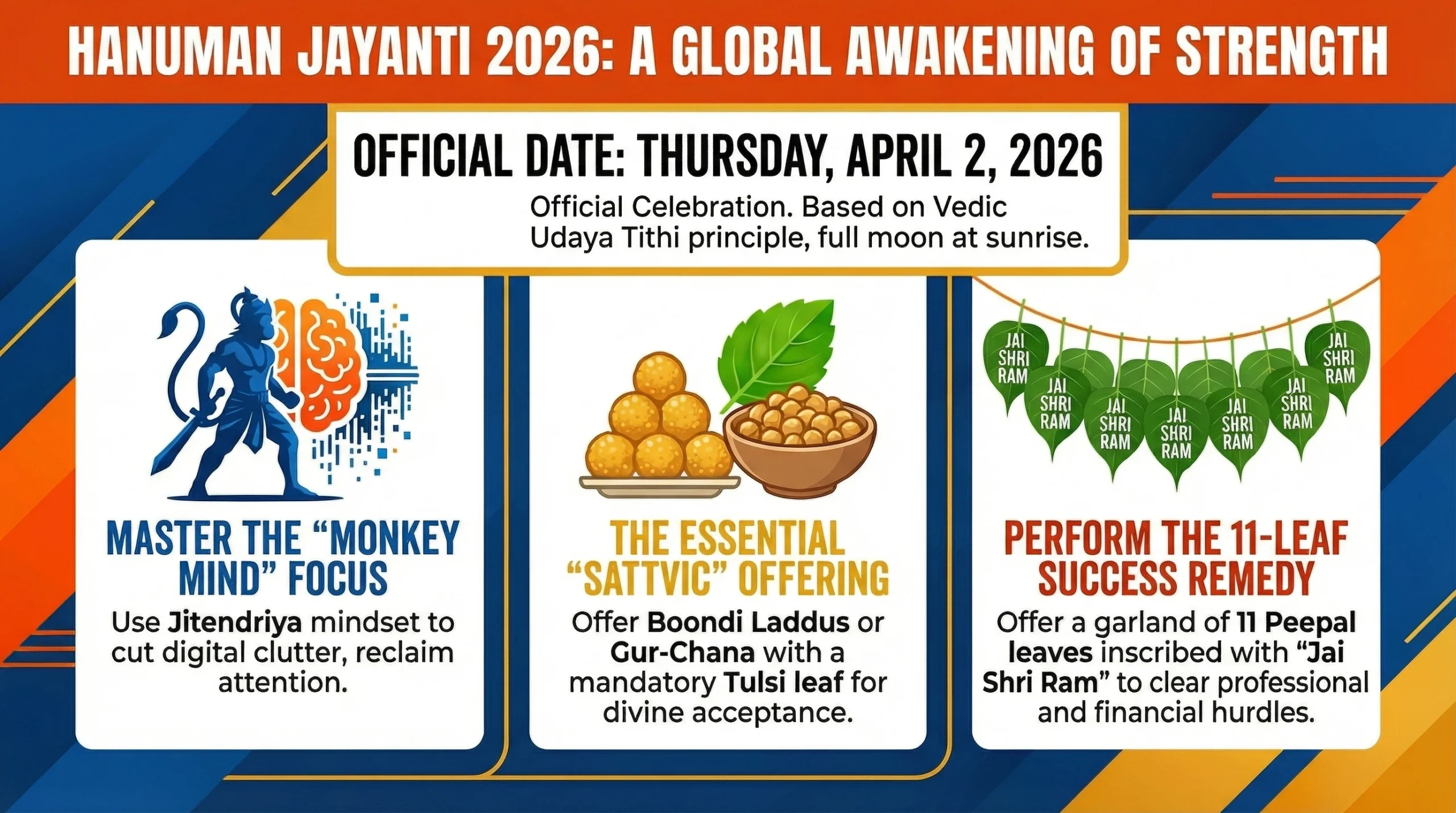
The Verdict: Why April 2nd is the Official Date
In Vedic tradition, festivals are governed by the Udaya Tithi principle. This means the date on which the specific Tithi is prevailing at the time of sunrise is considered the official day for celebration and fasting.
Since the Purnima Tithi is present during the sunrise on Thursday, April 2, 2026, this is the day when the majority of temples across India—from the famous Hanuman Garhi in Ayodhya to the Salasar Balaji Dham—will be holding their grand celebrations.
Pro-Tip for SEO/Readers: While the main festival is on April 2nd, many devout followers begin their 24-hour spiritual vigil or Akhand Path starting on the evening of April 1st to coincide with the Lord’s birth, which is traditionally believed to occur at sunrise.
Shubh Muhurat: The Most Auspicious Puja Timings
To maximise the spiritual vibrations of your prayers, aim to perform your main rituals during these high-energy windows on April 2, 2026:
- Brahma Muhurat: 04:38 AM to 05:24 AM (Ideal for deep meditation and starting the Hanuman Chalisa).
- Abhijit Muhurat: 11:50 AM to 12:40 PM (A powerful “victory” window for special petitions and Sankalp).
- Sunset Window: 06:39 PM onwards (Perfect for evening Aarti and group Bhajans).
Regional Variations to Keep in Mind
While North India and most of the world celebrate on April 2nd, India’s beautiful diversity means some regions observe different dates based on local traditions:
- Telugu States (Andhra & Telangana): Celebrated on May 12, 2026 (following a 41-day Deeksha).
- Tamil Nadu: Observed as Hanumath Jayanthi in December/January.
- Karnataka: Often celebrated during the Margashirsha month.
Summary for your Calendar: For the vast majority of devotees, mark your calendars for Thursday, April 2, 2026. This is your day to immerse yourself in the divine energy of Bajrangbali!
The Divine Birth Of Lord Hanuman
Every great hero has an origin story, but the birth of Lord Hanuman is perhaps the most spiritually layered and visually cinematic tale in ancient history. As we look toward Hanuman Jayanti 2026, understanding the why and how behind his arrival helps us connect deeper with the energy of the day.
If you are looking for the human element behind the deity, this is a story of intense penance, divine intervention, and a mother’s unwavering faith.
The Penance of Anjana and the Blessing of Shiva
Long before the events of the Ramayana, there lived a celestial maiden named Anjana. Due to a curse, she was born on Earth as a Vanara princess, but she was destined to give birth to an incarnation of Lord Shiva to help restore balance to the world.
Anjana and her husband, the powerful Vanara chief Kesari, performed thousands of years of rigorous penance (Tapasya) to please Lord Shiva. Legends say that Shiva, moved by their devotion, decided to take a human-like form as their son. This is why Hanuman is widely revered as the Rudra Avatar—the 11th expansion of Lord Shiva himself.
The Role of the Wind God (Vayu Dev)
How did the divine energy of Shiva reach Anjana? This is where the story gets fascinating and why Hanuman is called Pawanputra (Son of the Wind).
At the same time, Anjana was praying, King Dasharatha of Ayodhya was performing the Putrakameshti Yagna to have children. A divine bird (or in some versions, a gust of wind) snatched a portion of the sacred pudding (Payasam) intended for the Queens of Ayodhya. Vayu Dev, the Wind God, carried this divine essence and placed it into the outstretched hands of Anjana as she meditated.
Upon consuming it, she conceived the child who would become the greatest devotee the world has ever known. This beautiful intersection of events links the birth of Lord Rama and Lord Hanuman from the very beginning—they were literally born from the same divine source.
The Sunrise of Chaitra Purnima
The moment of his birth is just as symbolic as his conception. It is believed that Hanuman was born at the exact moment of sunrise on the Chaitra Purnima (Full Moon).
This is why, on April 2, 2026, the most powerful time for your prayers is during the early morning hours. The rising sun represents the awakening of the soul, and Hanuman—who famously tried to swallow the sun as a child, thinking it was a ripe fruit—embodies that boundless, fiery energy.
Why This Story Matters in 2026
In a world where we often feel small or powerless against global challenges, the story of Hanuman’s birth reminds us that we all have a divine spark within. Hanuman was born with immense power, yet he chose to use it entirely in the service of others.
As you prepare for your Hanuman Jayanti 2026 celebrations, remember that you aren’t just honoring a historical figure. You are tapping into an eternal energy of strength (Shakti) and wisdom (Buddhi) that was birthed specifically to help navigate difficult times.
Significance and Spiritual Lessons for the Modern World
In a 2026 world where digital noise is constant and personal burnout is at an all-time high, the significance of Hanuman Jayanti has shifted from a traditional ritual to a vital blueprint for mental and emotional survival.
Why is a deity from the Treta Yuga trending in the age of AI and global uncertainty? It’s because the spiritual lessons of Bajrangbali provide the exact “software update” our modern minds need.
Here is how the energy of Lord Hanuman translates into powerful lessons for your life today.
1. Strength Tempered with Humility (The ‘Anti-Ego’ Code)
In our current main character energy culture, we are often told to shout our achievements from the rooftops. Lord Hanuman represents the exact opposite: Infinite power paired with zero ego. Despite possessing the ability to change his size at will (Anima and Mahima siddhis) and the strength to carry an entire mountain, he always identified himself simply as a “Ram-Doot” (a messenger of Rama).
- The 2026 Lesson: True authority doesn’t need to brag. Whether you are leading a corporate team or managing a household, the most impactful leaders are those who use their muscles—intellectual or physical—to serve the collective good rather than their own brand.
2. Mastering the ‘Monkey Mind’ (Focus in a Distracted World)
It’s no coincidence that Hanuman is depicted as a Vanara (monkey). In spiritual philosophy, the monkey mind represents our restless, jumping thoughts—the exact feeling of switching between twenty open tabs and endless social media scrolls.
Hanuman is the Jitendriya—the one who has conquered his senses. By channelling all his restless energy toward a single point of focus (Lord Rama), he achieved the impossible.
- The 2026 Lesson: Success in the modern world is a battle of attention. Hanuman Jayanti 2026 is the perfect time to reset your focus. Use his strength to cut through the digital clutter and commit to your “One Big Thing” with unwavering discipline.
3. The Sankat Mochan Mindset: Resilience Under Pressure
We all face Sita-searches in our lives—moments where the goal seems across an impossible ocean and the obstacles seem like literal demons (Sursa or Lankini).
Hanuman didn’t sit on the shore complaining about the distance; he took a leap of faith. He teaches us that resilience is a choice. He is called Sankat Mochan not just because he removes external troubles, but because he gives us the internal grit to face them.
- The 2026 Lesson: When you feel overwhelmed by financial shifts or personal setbacks, tapping into Hanuman’s energy helps you move from a “victim” mindset to a “warrior” mindset. It’s about saying, “The problem is big, but my resolve is bigger.”
4. Emotional Intelligence and Communication
Often overlooked is Hanuman’s role as a master communicator. When he first met Lord Rama, his speech was so refined and wise that Rama immediately recognised him as a scholar of the Vedas.
- The 2026 Lesson: In an era of warriors and divided opinions, Hanuman teaches us the power of Vak-Shakti (the power of speech). To outrank your competition in life, you must learn to speak with clarity, kindness, and purpose.
Summary: Why This Matters for Your 2026 Goals
Celebrating Hanuman Jayanti 2026 isn’t just about the Puja Vidhi; it’s about a lifestyle shift. It’s about becoming a person who is physically strong, mentally sharp, and spiritually grounded.
As we move toward the business and astrological remember: Hanuman’s blessings are for those who are ready to do the work.
To outrank your competitors, this section is designed to be the “ultimate manual.” We aren’t just listing steps; we are providing the context that modern practitioners crave. This guide is structured to capture “how-to” rich snippets and keep readers on the page for those crucial dwell-time minutes.
Hanuman Jayanti 2026 Puja Vidhi
Performing the Hanuman Jayanti Puja is more than just a ritual; it’s a high-vibration energy reset for your home and mind. Whether you are a seasoned devotee or this is your first time setting up a home altar, following the authentic Vidhi ensures you align yourself with the powerful cosmic energy available on April 2, 2026.
Here is your comprehensive, easy-to-follow guide to performing the Puja at home.
1. The Pre-Puja Preparation (The Night Before)
The energy of Hanumanji is Sattvic (pure) and disciplined. To prepare:
- Cleanse the Space: Ensure your Puja room or corner is dust-free.
- Personal Purity: Traditional practitioners suggest a “celibacy of the mind and body” (Brahmacharya) starting 24 hours before the festival.
- The Altar: Place a clean red cloth on a wooden platform (Chowki). Red is the color of Mars and the favorite of Bajrangbali, representing strength and vitality.
2. Morning Rituals & The Sankalp (The Intention)
Wake up during the Brahma Muhurat (04:38 AM – 05:24 AM). After bathing, wear clean clothes (preferably red, orange, or yellow).
- The Sankalp: Take a little water in your right palm and state your name, your location, and your specific wish or intention for the year 2026. This contracts your energy with the divine.
3. Invocation and Sthapana (Placing the Deity)
Place an idol or a picture of Lord Hanuman facing East or North.
- Pro-Tip for 2026: If you have an idol of Hanumanji in a meditative pose, it brings peace; a flying pose (carrying the mountain) is excellent for career momentum and overcoming stagnant projects.
- Offer a small prayer to Lord Ganesha first, as he is the remover of initial hurdles.
4. The Sacred Abhishekam & Chola Offering
If you have a metal idol, perform a simple Abhishekam with water and raw milk. However, the most vital part of Hanuman Puja is the Chola.
- The Sindoor Ritual: Mix Chameli Taila (Jasmine Oil) with orange Sindoor (Vermilion). Apply this paste to the idol.
- The Science Behind It: Jasmine oil is known for its cooling properties and high vibration, while Sindoor represents the life force. It is said that when Hanumanji covered himself in Sindoor for Lord Rama’s longevity, he became the ultimate protector.
5. Offerings: Flowers, Incense, and Deepam
- Flowers: Offer red flowers, specifically hibiscus or marigolds.
- Incense: Light Guggul or Sandalwood incense to purify the air of negative “Vastu” energy.
- The Deepam: Light a lamp using Jasmine Oil or Ghee. Ensure the wick is made of cotton and the flame faces East.
6. The Power of Sound: Path and Mantras
This is the soul of the Puja. Recite the following with deep focus:
- Hanuman Chalisa: Read it 7 times for deep protection.
- Sundarkand: If you have time, this chapter of the Ramayana is the most potent for removing Grah Dosh (astrological imbalances).
- The 2026 Mantra: Chant Om Ham Hanumate Namah108 times using a Rudraksha or Tulsi mala.
7. The Bhog (Divine Food Offering)
Offer sweets that are Sattvic and energy-dense.
- Must-haves: Besan Laddu, Boondi, or Malai Mishri.
- The Secret Ingredient: Always place a Tulsi Leaf on top of the food. Lord Hanuman does not accept any offering without Tulsi, as it represents the presence of Lord Vishnu/Rama.
8. The Aarti and Conclusion
Perform the Hanuman Aarti with a camphor (Kapur) lamp. Once finished, distribute the Prasad among family and neighbours. Sharing the Prasad is a key way to circulate the positive merit (Punya) you’ve earned.
Quick Checklist for your 2026 Puja Shopping
| Item | Significance |
| Jasmine Oil | Essential for the Chola and the Deepam |
| Orange Sindoor | The mark of the devotee and protector |
| Janeu (Sacred Thread) | To be offered to the deity |
| Red Cloth | For the altar (Aasan) |
| Bananas/Laddus | The preferred Bhog |
To maximise you and keep readers engaged, this section is designed to appeal to both the traditional devotee and the modern foodie looking for spiritual meaning. We are going to highlight the specific tastes of Bajrangbali and why certain foods are considered high-vibration in 2026.
Sacred Foods: What Bhog to Offer Lord Hanuman
In the world of Vedic rituals, Bhog (food offering) isn’t just about feeding a deity—it’s about the exchange of energy. When we offer food to Lord Hanuman on his birth anniversary, we are offering the best of our harvest and our devotion.
If you are preparing for Hanuman Jayanti 2026, here is a curated list of the most auspicious foods to offer, along with the spiritual why behind each one.
1. The Golden Standard: Boondi and Motichoor Laddus
If there is one sweet universally associated with Hanumanji, it is the Boondi Laddu.
- The Significance: The bright orange color represents the Tejas (radiance) of the sun, which Hanuman once famously tried to swallow. The sweetness symbolizes the joy he felt in serving Lord Rama.
- Modern Tip: In 2026, many health-conscious devotees are opting for Organic Jaggery (Gur) Laddus instead of refined sugar to keep the offering as Sattvic and natural as possible.
2. The Power Combo: Roasted Chana and Jaggery (Gur-Chana)
This is perhaps the most traditional and offering. It reflects Hanuman’s humble nature as a Vanara.
- The Significance: In ancient times, this was the ultimate energy food for travelers and warriors. Since Hanuman is the deity of strength and stamina, offering protein-rich roasted chickpeas and iron-rich jaggery is seen as a way to fuel the divine energy within us.
- Best For: This is the best Bhog if you are looking for financial stability or a boost in physical health.
3. The Cooling Offering: Bananas (Kela)
Bananas are considered the purest fruit in Sanatana Dharma because the plant is self-propagating and never dies.
- The Significance: Hanumanji is often depicted residing in banana groves (Kadali Vana). Bananas are easy to digest, cooling for the stomach, and represent the simplicity of a forest-dwelling yogi.
- The Rule: Always offer them in pairs (a minimum of two) to symbolize balance and companionship.
4. The Heart of the Offering: Imarti or Jalebi
In many parts of North India, offering deep-fried, syrup-soaked Imartis is a grand tradition.
- The Significance: The intricate, circular shape of the Imarti represents the complex cycle of life and death, which Hanuman helps his devotees navigate with ease.
5. The Essential Secret Ingredient: Tulsi Leaves
This is a non-negotiable step for your Hanuman Jayanti 2026 Puja.
- The Protocol: No matter what you offer—be it a grand feast or a simple piece of fruit—always place a fresh Tulsi (Holy Basil) leaf on top.
- Why? Hanuman is the greatest devotee of Lord Rama (an avatar of Vishnu). It is believed that he only accepts offerings that carry the signature of his Lord, which is the sacred Tulsi leaf.
6. Pan Kasuri (The Betel Leaf Offering)
In many traditions, a Meetha Pan (without tobacco or lime) is offered after the main Bhog.
- The Significance: This represents the conclusion of a royal meal. It is specifically offered to seek Hanuman’s help in completing a difficult task or closing a deal in your professional life.
A Note on Sattvic Cooking for 2026
If you are preparing these at home, remember the golden rules of the Hanuman Jayanti kitchen:
- Strictly No Onion or Garlic: These are considered Tamasic (heavy/dull) and are never used in temple offerings.
- Purity First: Always shower and wear clean clothes before entering the kitchen.
- Taste Test: Never taste the food while cooking. The first bite must always belong to the Divine.
Powerful Astrological Remedies (Upay) for Success and Wealth
Let’s be honest: in today’s fast-paced economy, hard work alone sometimes feels like it isn’t enough. We all experience moments where our career stagnates, a promotion is inexplicably delayed, or money seems to slip through our fingers no matter how carefully we budget.
In Vedic astrology, Lord Hanuman is the ultimate Sankat Mochan (Remover of Obstacles). Because he is closely associated with the planet Mars (Mangal)—the planet that governs action, courage, real estate, and professional drive—appeasing him on his birth anniversary can unblock stagnant energy.
If you want to align your financial and professional life with the high-vibration energy of Hanuman Jayanti 2026, here are the most powerful, time-tested astrological remedies (Upay) you can perform.
1. The 11 Peepal Leaves Remedy for Removing Debt
If you are struggling with loans, EMIs, or stagnant business cash flow, this is considered one of the most potent remedies in astrological texts.
- The Upay: On the morning of April 2, 2026, after taking a bath, pluck 11 clean, whole leaves from a Peepal tree (ensure they are not torn). Wash them with pure water or Gangajal.
- The Process: Using sandalwood paste (Chandan) or Kumkum, write Jai Shri Ram on each leaf. Thread these leaves together to make a garland and offer it to Lord Hanuman at a local temple.
- Why it Works: The Peepal tree represents the universe’s expansive energy. Offering this personalised garland shifts your energetic focus from lack to devotion, clearing karmic financial blockages.
2. The Jasmine & Clove Lamp to Attract Sudden Wealth
For those looking for a sudden breakthrough in their career, a salary hike, or a successful business deal, fire and fragrance are your best tools.
- The Upay: In the evening, light a clay lamp (Diya) using Jasmine Oil (Chameli ka Tel). Before lighting it, drop two whole cloves (Laung) into the oil.
- The Process: Sit facing East or North. Light the lamp and chant the Hanuman Chalisa 11 times continuously.
- Why it Works: Cloves are highly attractive to the energy of wealth, while Jasmine oil cools the aggressive, hurdle-creating aspects of a weak Mars in your birth chart.
3. The ‘Gur-Chana’ Secret for Job Seekers and Promotions
If you are facing heavy office politics, fear of job loss, or anxiety about an upcoming interview, you need to boost your confidence and planetary support.
- The Upay: Take a mixture of roasted chickpeas (Chana) and Jaggery (Gur).
- The Process: Offer this to Lord Hanuman, but here is the key—after the Puja, you must feed this exact Prasad to monkeys or donate it to the needy. Do not consume it all yourself.
- Why it Works: Feeding monkeys is a direct karmic remedy to strengthen Mars and appease Lord Shani (Saturn), who often causes delays in career progression.
4. The South-West Vastu Fix for Buying Property
Are you trying to buy a new home or finalise a real estate deal in 2026? Lord Hanuman is the presiding deity of land and property matters.
- The Upay: Clean the South-West corner of your home, as this direction governs stability and property in Vastu Shastra.
- The Process: Place a small picture of the Panchmukhi (Five-Faced) Hanuman in this corner. Light a mustard oil lamp there for 21 consecutive days starting from Hanuman Jayanti.
- Why it Works: The Panchmukhi form of Hanuman fiercely protects your assets and accelerates delayed paperwork or banking approvals related to real estate.
5. The Ultimate Shield: The Chola for Manglik Dosh
If your career or financial growth is being stunted by Manglik Dosh (an astrological affliction of Mars that causes instability), Hanuman Jayanti is the absolute best day of the year to neutralise it.
- The Upay: Visit a temple and request the priest to help you offer a Chola (a coating of orange Sindoor mixed with Jasmine oil) to the deity.
- The Process: While the Chola is being offered, silently chant the mantra: Om Han Hanumate Namah. Take a tiny pinch of the leftover Sindoor and apply it as a tilak on your forehead before any major business meeting.
Crucial Tip for Success: Remedies only work when paired with the right mindset. While performing these Upay, maintain strict discipline. Avoid alcohol, harsh speech, and negative thinking. You are asking for divine strength, so you must carry yourself with the integrity of a warrior
Hanuman Jayanti in Pop Culture & 2026 Trends
In a world obsessed with fleeting digital trends and cinematic universes, you might think ancient deities would struggle to hold the attention of younger generations. Yet, as we head into Hanuman Jayanti 2026, the exact opposite is happening.
Lord Hanuman isn’t just a temple icon anymore; he has completely taken over our screens, our Spotify playlists, and the global box office. The Sankat Mochan is officially mainstream pop culture, and the fusion of ancient Bhakti with ultra-modern technology is nothing short of spectacular.
If you want to understand how devotion is evolving in 2026, here are the biggest pop culture trends redefining how we celebrate Bajrangbali today.
1. The Cinematic Superhero: Jai Hanuman and AI-Generated Epics
Move over, Hollywood superheroes. Indian mythology is the new cornerstone of global cinema, and Hanuman is leading the charge.
Following the massive, surprise success of the 2024 hit Hanu-Man, the highly anticipated sequel, Jai Hanuman, is completely dominating entertainment news. Starring Rishab Shetty (of Kantara fame) as Lord Hanuman, this Prasanth Varma directorial is expanding India’s mythological superhero universe with a reported mega-budget and mind-bending VFX.
But that’s not all 2026 has to offer. The festival weekend will also see the release of Chiranjeevi Hanuman – The Eternal, heavily marketed as India’s first theatrically positioned, AI-generated mythological feature film. Blending cutting-edge generative AI with Puranic texts, it proves that ancient stories are driving the absolute forefront of modern cinematic technology.
2. The 5-Billion Club: A YouTube Milestone Like No Other
While viral dance trends and pop anthems come and go, true devotion has serious staying power. In late 2025, the T-Series upload of the Shree Hanuman Chalisa (sung by Hariharan) did something no Bollywood blockbuster or Punjabi chart-topper has ever done: it crossed 5 billion views on YouTube.
It is currently the first and only Indian video to reach this monumental milestone, standing tall among global heavyweights. This isn’t just a statistic; it’s a cultural phenomenon. It shows that millions of people are making the Hanuman Chalisa a non-negotiable part of their daily digital routine.
3. The Lo-Fi Hanuman Chalisa Aesthetic
If you walk into a modern co-working space, a college dorm, or a trendy cafe in 2026, there is a good chance you won’t hear standard pop music. Instead, you will hear the soothing, slowed-down, reverb-heavy beats of a Lo-Fi Hanuman Chalisa.
Artists like Rasraj Ji Maharaj and various indie producers have transformed intense Sanskrit and Awadhi mantras into chill, atmospheric background tracks. This Lo-Fi Bhakti trend has exploded on streaming platforms like JioSaavn and Spotify. For Gen Z and young millennials facing unprecedented burnout and anxiety, these lo-fi spiritual tracks provide the perfect auditory hug. It allows them to absorb the protective, grounding energy of Hanuman while studying, coding, or simply trying to decompress.
4. Digital Darshan and Unreal Engine Animation
With the rise of independent creators, platforms like YouTube are flooded with incredibly high-quality, fan-made 3D animations built on Unreal Engine 5 (such as the viral The Rise of Hanuman teasers). Devotees no longer have to wait for big studios to visualise the Ramayana; passionate artists are building hyper-realistic, digital Darshans from their home computers, making the sheer scale of Hanuman’s power more visually accessible than ever before.
The Takeaway for Modern Devotees
The 2026 cultural landscape proves that you do not need to choose between being modern and being deeply spiritual. Whether you are chanting along to a lo-fi beat on your morning commute or buying an IMAX ticket to see Hanuman on the big screen, the core energy of courage, loyalty, and strength remains completely unchanged.
To wrap up this pillar page, we’ve curated the most trending and impactful Hanuman Jayanti 2026 messages. These are designed for high social sharing—perfect for WhatsApp groups, Instagram stories, and professional LinkedIn updates.
Top Hanuman Jayanti 2026 Wishes, Quotes, and WhatsApp Statuses
In 2026, a Happy Hanuman Jayanti text isn’t just a greeting; it’s an injection of strength for your friends and family. Whether you want something deeply traditional in Hindi or a modern vibe for your Instagram grid, here are the best options to copy and share.
1. Best Wishes for Family & Friends (English)
- May Lord Hanuman bless you with the power of a warrior and the heart of a devotee. Wishing you a courageous and peaceful Hanuman Jayanti 2026!”
- On this sacred day, may the Sankat Mochan remove all hurdles from your path and fill your home with health and harmony. Jai Bajrangbali!”
- Just as Hanumanji leapt across the ocean with pure faith, may you rise above every struggle this year. Happy Hanuman Jayanti.
- Wishing you the strength of Hanuman, the wisdom of Rama, and the peace of a balanced soul. Happy Hanuman Janmotsav
2. Viral Hindi Status (with Spiritual Depth)
- “बजरंग जिनका नाम है, सत्संग जिनका काम है, ऐसे प्यारे हनुमान जी को हमारा सादर प्रणाम है। हनुमान जयंती 2026 की हार्दिक शुभकामनाएं!”
- “सब सुख लहै तुम्हारी सरना, तुम रक्षक काहू को डरना। हनुमान जयंती के पावन अवसर पर आपको ढेर सारी बधाई!”
- “रामदूत अतुलित बल धामा, अंजनि-पुत्र पवनसुत नामा। आपके जीवन में सुख, शांति और समृद्धि आए, यही हमारी कामना है।”
- “जिनके मन में है श्री राम, जिनके तन में हैं श्री राम, जग में सबसे हैं वो बलवान, ऐसे प्यारे मेरे हनुमान।”
3. Short & Punchy Captions for Instagram/Facebook
- Grounded in faith, rising in strength. HanumanJayanti2026
- Channelling my inner Bajrangbali today. JaiShreeRam
- In a world of noise, find the focus of Hanuman. SpiritualGoals
- Sankat Mochan: The original superhero.
4. Powerful Quotes for Motivation
- Strength lies not in the body, but in the purity of the heart. — Inspired by Hanuman’s Devotion.
- True leadership is selfless service.
- When you have a protector like Hanuman, fear is just an illusion.
- Faith is the bridge between where you are and where you want to be.
5. 2026 Trending Hashtags
To ensure your posts reach the wider community, use these high-traffic hashtags:
#HanumanJayanti2026 #Bajrangbali #SankatMochan #JaiShreeRam #HanumanChalisa #BhaktiVibes #JaiHanuman
Frequently Asked Questions about Hanuman Jayanti 2026
1. When is Hanuman Jayanti 2026? Is it April 1 or April 2?
While the Purnima Tithi begins on the morning of April 1, 2026, the festival is officially celebrated on Thursday, April 2, 2026. This is because, in Vedic tradition, a festival is observed on the day the tithi is present at sunrise (Udaya Tithi). Since Lord Hanuman was born at dawn, April 2 is the spiritually correct date for the celebrations.
2. What is the most auspicious time (Muhurat) for Puja in 2026?
The most powerful time for Puja is during the Brahma Muhurat (04:38 AM to 05:24 AM) or immediately at sunrise on April 2. Other highly favourable times include the Abhijit Muhurat (12:00 PM to 12:50 PM). Avoid performing the main rituals during Rahu Kaal to ensure the flow of positive energy.
3. Why is Lord Hanuman called Bajrangbali?
The name is a combination of two words: Vajra (diamond/thunderbolt) and Ang (body), meaning one whose body is as hard as a diamond. In local dialects, Vajrang became Bajrang. Bali refers to his immense strength. Together, they honour his status as the invincible warrior who cannot be broken by any weapon.
4. Can women worship Lord Hanuman or chant the Hanuman Chalisa?
Yes, absolutely. There is no scriptural prohibition preventing women from worshipping Lord Hanuman. Hanumanji is the epitome of respect and protection toward women (as seen in his devotion to Mata Sita). While some local temple traditions ask women not to touch the idol directly out of respect for his Bal Brahmachari (celibate) form, women can fast, pray, and chant the Chalisa with full devotion.
5. Is Lord Hanuman still alive in Kali Yuga?
According to Hindu scriptures, Hanuman is a Chiranjeevi (an immortal being). He was granted the boon of immortality by Mata Sita and Lord Rama to stay on Earth as long as the name of Rama is chanted. Many believe he resides in a meditative state in the Gandhamardan Mountains or visits the Mathang tribe in Sri Lanka, appearing to those with pure hearts.
6. What should I offer as Bhog to Lord Hanuman for success?
The most preferred offerings include Boondi Laddus, Imarti, or Besan Laddus. For immediate relief from life’s hurdles, offering Gur-Chana (Jaggery and Roasted Gram) is highly recommended. Always remember to place a Tulsi leaf on the offering, as Hanumanji does not accept Bhog without it.
7. Why is Sindoor (Vermilion) offered to Lord Hanuman?
Legend says Hanuman once saw Mata Sita applying Sindoor and asked why. She explained it was for Lord Rama’s long life. In his extreme devotion, Hanuman covered his entire body in Sindoor to ensure Rama’s immortality. Pleased by this, Rama blessed him, saying that anyone who offers Sindoor to Hanuman will see their obstacles vanish.
8. How many times should I chant the Hanuman Chalisa on this day?
While chanting it once is beneficial, reciting the Hanuman Chalisa 7, 11, or 100 times on Hanuman Jayanti is believed to grant Siddhis (spiritual powers) and provide a shield against negative energies. The number 7 is particularly significant as it represents the 7 chapters of the Ramayana.
9. What are the benefits of fasting on Hanuman Jayanti?
Fasting on this day is not just religious; it is a mental detox. It improves willpower, discipline, and physical stamina. Astrologically, it helps neutralize the negative effects of a weak Mars (Mangal) or Saturn (Shani) in your birth chart, bringing stability to your career and health.
10. Why is he called Sankat Mochan?
Sankat means trouble or danger, and Mochan means to liberate or remove. Hanuman earned this title by repeatedly saving the characters of the Ramayana from impossible situations—from bringing the Sanjivani herb to saving Lakshmana, to finding Sita in Lanka. For modern devotees, he remains the ultimate troubleshooter for life’s crises.
To dominate the search rankings for 2026, your conclusion needs to do more than just summarise; it must provide a clear next step for the reader and reinforce your site’s authority.
Conclusion: Embracing the Strength of Bajrangbali in 2026
As we celebrate Hanuman Jayanti on April 2, 2026, it is clear that the devotion to Lord Hanuman has evolved far beyond traditional temple walls. Whether you are performing the 11 Peepal Leaves Upay for financial growth, listening to a Lo-Fi Hanuman Chalisa to de-stress, or watching the latest mythological cinematic epic, the core message remains the same: unwavering faith and selfless service.
Lord Hanuman is not just a deity of the past; he is a living energy (Chiranjeevi) that empowers us to face the unique anxieties of the modern world with the heart of a warrior. By aligning your rituals with the Udaya Tithi sunrise and following the Sattvic traditions outlined in this guide, you aren’t just participating in a festival—you are performing a spiritual reset for the year ahead.
May the Sankat Mochan ignite the spark of courage, wisdom, and prosperity in your life this year. Jai Shri Ram! Jai Hanuman!




Leave a Reply