
Introduction: Finding Stillness in a Noisy World
Picture this: your smartphone screen time is steadily creeping up, your daily to-do list is constantly overflowing, and the daily news cycle feels heavier by the minute. In our modern, relentless pursuit of “more”—more wealth, more followers, more achievements—we often find ourselves burned out and craving the exact opposite: simplicity, silence, and genuine inner peace. If you have been feeling this modern-day fatigue, you are certainly not alone. Millions of people are actively searching for a way to hit the pause button and reconnect with what truly matters. This is exactly where the timeless wisdom of Mahavir Jayanti 2026 steps in, offering a profound, centuries-old antidote to our modern chaos.
Celebrated with immense devotion and joy across the globe, Mahavir Janma Kalyanak (widely known as Mahavir Jayanti) marks the auspicious birth anniversary of Lord Mahavira, the revered 24th Tirthankara of Jainism. But to view this day merely as a red mark on a religious calendar is to miss out on its massive transformative potential. Whether you are a devout follower of Jain philosophy or someone simply exploring the paths of mindfulness and minimalism, Lord Mahavira’s teachings provide a stunningly relevant blueprint for living a balanced life today. He wasn’t just a historical figure who lived over 2,600 years ago; he was the original champion of radical compassion, sustainable living, and intentional detachment.
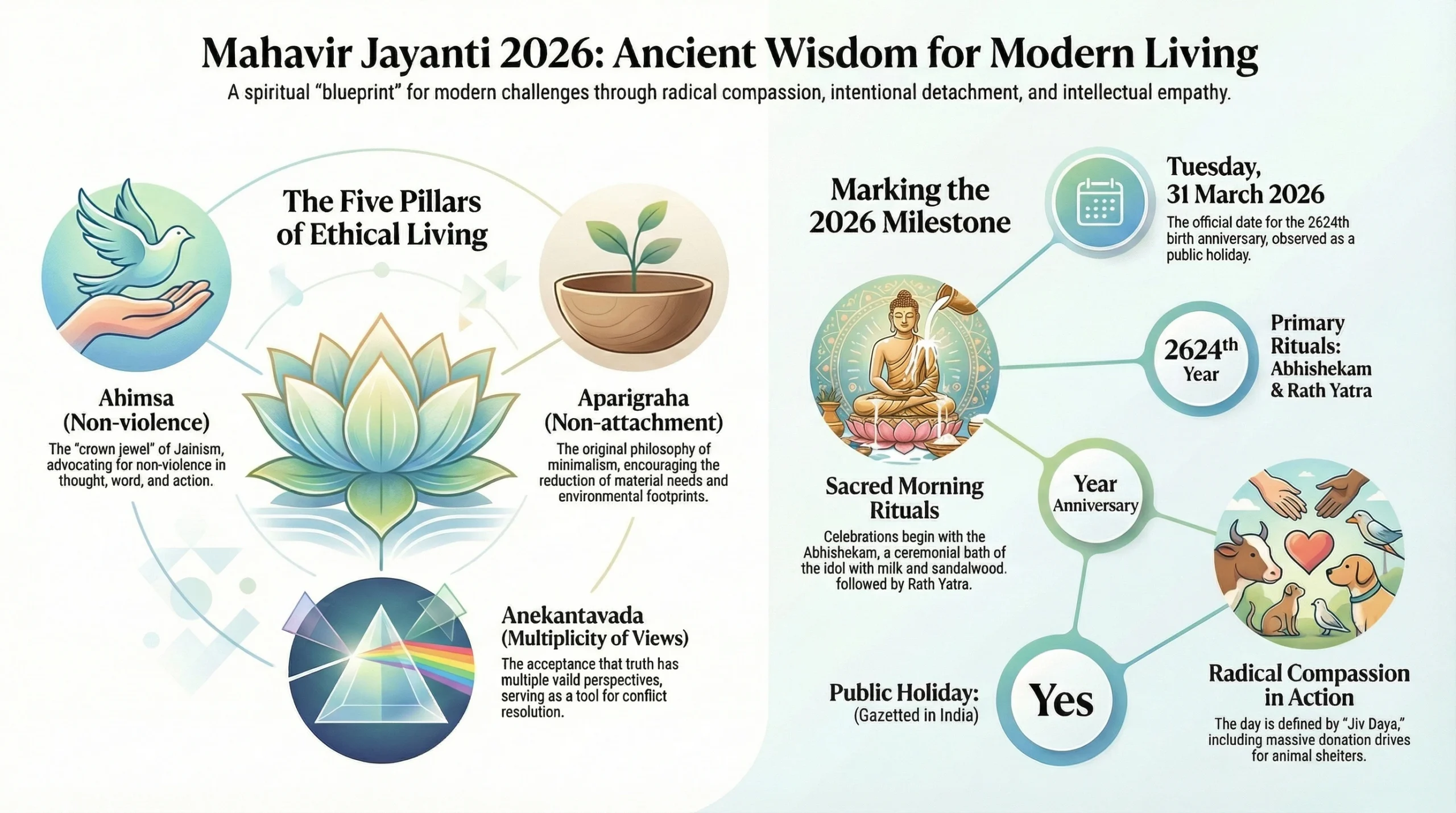
As we gear up for the highly anticipated March 31 2026 festival, it is the perfect time to reflect on why his philosophy continues to trend so heavily in the 21st century. Long before eco-minimalism and mindful living became popular social media hashtags, Lord Mahavira was teaching Ahimsa (absolute non-violence in thought and action) and Aparigraha (non-attachment to material things). His life reminds us that true ultimate liberation doesn’t come from accumulating possessions, but from having the courage to let them go. Furthermore, in a world deeply divided by polarized opinions, his core philosophy of Anekantavada—the acceptance that truth has multiple valid perspectives—feels like a refreshing cure for our collective anxiety.
Welcome to your ultimate, all-in-one guide to Mahavir Jayanti. If you want to dive deep into the spiritual roots of this sacred day, you are in exactly the right place. In this comprehensive pillar page, we are going to explore the inspiring, almost cinematic life of Prince Vardhamana before his grand spiritual awakening. We will break down the exact dates, timings, and rituals for 2026, decode the Five Great Vows in a way that directly applies to your daily life, and share the most beautiful ways this festival is celebrated across the world.
Grab a cup of tea, take a deep breath, and let’s embark on a journey of self-discovery through the magnificent legacy of the greatest spiritual teacher of our time.
What is Mahavir Jayanti? The Heart of Jain Devotion
At its core, Mahavir Jayanti is the most significant and spiritually charged festival in the Jain calendar. It commemorates the birth anniversary of Lord Mahavira, the 24th Tirthankara of the current time cycle. In the Jain tradition, this day is formally known as Mahavir Janma Kalyanak. The word Kalyanak signifies an auspicious event that brings “welfare” or “blessing” to the entire universe—and that is exactly how followers view the arrival of this great soul.
But to truly understand what Mahavir Jayanti is, we have to look beyond the surface level of a “birthday celebration.” In Jainism, a Tirthankara is a “ford-maker”—a rare spiritual pioneer who has conquered their own inner enemies (like anger, greed, and pride) to achieve Kevala Jnana (infinite knowledge). They then build a metaphorical bridge (a “ford”) across the ocean of worldly suffering so that others may follow.
The Birth of a “Great Hero”
Born as Prince Vardhamana in the 6th century BCE in Kundagrama, Bihar, his arrival was heralded by 14 (or 16, depending on the tradition) auspicious dreams seen by his mother, Queen Trishala. These dreams foretold the birth of a child who would either become a world-conquering emperor or a world-enlightening teacher. Choosing the latter, Vardhamana eventually renounced his kingdom to seek the ultimate truth, earning the title Mahavira (The Great Hero) for his incredible bravery in the face of physical and spiritual hardships.
Why We Celebrate It in 2026
In a modern context, Mahavir Jayanti 2026 is more than a ritualistic observation; it is a global “reboot” for our collective ethics. It is a day dedicated to the philosophy of “Live and Let Live.” While the air is filled with the scent of incense and the sound of temple bells, the true essence lies in the internal shift toward Ahimsa (non-violence).
For the community, it is a time of:
- Reflective Silence: Many practitioners engage in deep meditation to mirror Mahavira’s 12 years of silence.
- Radical Compassion: It is common to see large-scale charitable acts, such as feeding the underprivileged or donating to animal shelters, as a direct application of his teachings.
- Community Connection: Vibrant processions called Rath Yatras take place, where the idol of Lord Mahavira is carried through the streets, accompanied by bhajans and spiritual discourses.
Ultimately, Mahavir Jayanti is a reminder that every soul has the potential to achieve greatness. It’s a day to celebrate the victory of the spirit over the material, and it invites everyone—regardless of their background—to take one small step toward a more compassionate existence.
Mahavir Jayanti 2026: Exact Date, Timings, and Muhurat
If you are planning your travels, temple visits, or fasting schedule, timing is everything. Because the Jain calendar is lunar-based, the date shifts slightly every year on the Gregorian calendar.
- The Date: Mahavir Jayanti 2026 will be celebrated on Tuesday, March 31, 2026.
- The Lunar Tithi: It falls on the Trayodashi Tithi (13th day) of the Shukla Paksha (bright fortnight) in the month of Chaitra.
Auspicious Timings (Muhurat):
To ensure your prayers and rituals align with the most potent spiritual hours, keep an eye on the Tithi timings:
- Trayodashi Tithi Begins: 01:45 PM on March 30, 2026.
- Trayodashi Tithi Ends: 11:15 AM on March 31, 2026.
Since the festival is traditionally observed at sunrise (Udayatithi), the main celebrations and the ceremonial bath (Abhishekam) of the Lord’s idol will take place on the morning of March 31st.
Mahavir Jayanti 2026: Exact Date, Timings, and Muhurat
If you are planning your travels, temple visits, or fasting schedule, timing is everything. Because the Jain calendar is lunar-based, the date shifts slightly every year on the Gregorian calendar. In 2026, the community will celebrate the 2624th Birth Anniversary of Lord Mahavira.
- The Date: Mahavir Jayanti 2026 will be celebrated on Tuesday, March 31, 2026.
- The Lunar Tithi: The festival falls on the Trayodashi Tithi (13th day) of the Shukla Paksha (bright fortnight) in the month of Chaitra.
Auspicious Timings (Muhurat)
To ensure your prayers and rituals align with the most potent spiritual hours, keep an eye on these specific Tithi timings:
- Trayodashi Tithi Begins: 07:09 AM on March 30, 2026.
- Trayodashi Tithi Ends: 06:55 AM on March 31, 2026.
Since the festival is traditionally observed based on the sunrise timing (Udayatithi), the main celebrations, the ceremonial bath (Abhishekam) of the Lord’s idol, and the grand Rath Yatras will primarily take place on the morning of March 31st.
Pro-Tip for 2026: March 31st is a Gazetted Holiday in India, meaning government offices, banks, and schools will be closed. This makes it an ideal day to plan a visit to major Jain heritage sites like Pawapuri (Bihar) or Palitana (Gujarat), but do expect larger crowds at these spiritual hubs.
Quick Facts for Your 2026 Calendar
| Key Detail | Information for 2026 |
| Official Date | March 31, 2026 (Tuesday) |
| Birth Anniversary | 2624th Year |
| Nakshatra | Uttaraphalguni |
| Primary Ritual | Abhishekam & Rath Yatra |
| Public Holiday | Yes (Gazetted) |
The Inspiring Life History of Lord Mahavira: From Royalty to Renunciation
To understand the magnitude of **Mahavir Jayanti**, one must first journey back over 2,600 years to the ancient kingdom of **Kshatriyakunda** (modern-day Bihar, India). The story of Lord Mahavira is not just a religious chronicle; it is a timeless human saga of courage, extreme self-discipline, and the ultimate quest for truth.
The Princely Beginnings: Born as Vardhamana
In 599 BCE, a child was born to **King Siddhartha** and **Queen Trishala**. Named **Vardhamana** (meaning “the one who grows”), his arrival was said to have brought immense prosperity and joy to the kingdom.
Before his birth, Queen Trishala experienced **14 auspicious dreams** (16 in the Digambara tradition), including a white elephant, a lion, and a garland of flowers. Royal astrologers interpreted these as a sign that the child would either be a *Chakravartin* (a world-conquering emperor) or a *Tirthankara* (a supreme spiritual teacher).
The Calling: Choosing the Harder Path
Growing up in the lap of luxury, Prince Vardhamana had every material comfort imaginable. However, even as a young man, he remained detached from worldly pleasures. He was deeply moved by the cycle of birth, suffering, and death that affected all living beings.
At the age of 30, following the passing of his parents and with the permission of his elder brother, Vardhamana made a radical decision. He stripped off his royal ornaments, gave away all his wealth to the poor, and walked into the forest. This event is known as the **Mahabhinishkramana**—the Great Renunciation.
Imagine leaving behind a literal kingdom in the prime of your life to seek answers to the universe’s most difficult questions. It wasn’t a flight from responsibility, but a deep dive into the responsibility of the soul.
12 Years of Silence and Penance
Vardhamana’s journey toward enlightenment was not an overnight miracle. For the next twelve and a half years, he lived as a wandering ascetic. He practiced:
Severe Austerity:** He often fasted for days and remained in deep meditation under the scorching sun or in the freezing cold.
Extreme Non-violence:** He was so committed to *Ahimsa* that he would sweep the ground before him to avoid stepping on tiny insects.
The Vow of Silence:** For long periods, he did not speak, turning his gaze entirely inward.
During this time, he faced immense physical hardships and even ridicule from villagers, yet he remained unshaken—earning the title **”Mahavira”** or the “Great Hero.”
Kevala Jnana: The Dawn of Infinite Knowledge**
At the age of 42, while meditating under a **Sala tree** on the banks of the Rijupalika River, Mahavira attained **Kevala Jnana**. This state of omniscience meant he had conquered his senses and understood the true nature of the universe.
He had become a **Jina** (a Conqueror), and from this word, the term **Jainism** is derived.
The Final Mission and Nirvana
For the next 30 years, Lord Mahavira traveled barefoot across India, spreading the message of compassion, equality, and mental purity. He broke social barriers by teaching people from all walks of life—from kings to commoners—that the path to liberation was open to everyone.
At the age of 72, in the town of **Pawapuri** (Bihar), Lord Mahavira attained **Moksha** (final liberation from the cycle of birth and death). His departure is celebrated by Jains as **Diwali**, the festival of lights, symbolizing the lighting of the lamp of knowledge within ourselves.
- Early Life & Royal Lineage: Born as Prince Vardhamana in 599 BCE in Kundagrama (modern-day Bihar) to King Siddhartha and Queen Trishala.
- The Great Renunciation: At age 30, leaving behind endless wealth, luxury, and family to seek ultimate truth. Discuss the courage it takes to leave one’s comfort zone).
The Core Teachings of the 24th Tirthankara: A Blueprint for Modern Living
Why do the teachings of Lord Mahavira still resonate so deeply in 2026? It’s because his philosophy isn’t just a set of religious rules—it is a sophisticated psychological and ethical framework for finding peace in a chaotic world. At the heart of his message is the radical idea that every soul is potentially divine and that our liberation lies in our own hands.
To truly honor Mahavir Jayanti 2026, we must look beyond the rituals and dive into the transformative principles that define the 24th Tirthankara’s legacy.
The Pancha Mahavratas: The Five Great Vows
Lord Mahavira laid down five ethical pillars, known as the Pancha Mahavratas. While monks follow these with absolute rigor, for the layperson, they serve as “Anuvratas” (lesser vows) that provide a roadmap for an intentional, ethical life.
1. Ahimsa (Non-violence)
This is the “crown jewel” of Jain philosophy. However, Mahavira’s definition went far beyond just avoiding physical harm.
- The Modern Twist: In 2026, Ahimsa applies to our digital lives too. It means practicing non-violence in our thoughts and words—refraining from cyberbullying, harsh comments, and judgmental thinking. It’s about recognizing the life force in every living being, from the largest mammal to the smallest microscopic organism.
2. Satya (Truthfulness)
Mahavira taught that truth is not just about avoiding lies; it’s about living with integrity.
- The Modern Twist: In an era of “fake news” and curated social media personas, Satya is a call to be authentic. It’s the courage to speak the truth even when it’s uncomfortable, provided that the truth is spoken with kindness and does not violate the principle of Ahimsa.
3. Asteya (Non-stealing)
This vow forbids taking anything that is not freely given.
- The Modern Twist: Beyond physical theft, Asteya in the 21st century includes respecting intellectual property, not “stealing” someone’s time, and not taking more than your fair share of global resources.
4. Brahmacharya (Chastity/Sensory Control)
While for monks this means celibacy, for the general public, it translates to “sensory moderation.”
- The Modern Twist: It’s about not becoming a slave to our desires. Whether it’s mindless scrolling, emotional eating, or impulsive shopping, Brahmacharya encourages us to find joy within ourselves rather than seeking constant external stimulation.
5. Aparigraha (Non-attachment/Non-possession)
Perhaps the most “trending” of his teachings today, Aparigraha is the original philosophy of minimalism.
- The Modern Twist: Lord Mahavira observed that “possessions possess us.” By limiting our material needs, we reduce our environmental footprint and free our minds from the anxiety of accumulation. It’s about shifting from a “consumer” mindset to a “custodian” mindset.
The Tri-Ratna: The Three Jewels of Soul Awakening
To achieve spiritual clarity, Mahavira proposed the Three Jewels, which work together like a tripod. If one leg is missing, the structure falls.
- Samyak Darshan (Right Faith): Developing a clear-sighted intuition and belief in the true nature of reality. It’s the “Eureka” moment when you realize you are a soul inhabiting a body, not the other way around.
- Samyak Gyan (Right Knowledge): This isn’t just book learning; it is the deep, experiential understanding of the universe, free from doubt or delusion.
- Samyak Charitra (Right Conduct): Knowing the truth is useless unless you live it. This jewel is about putting your faith and knowledge into action through ethical behavior.
Anekantavada: The Philosophy of Multiplicity
In a world often blinded by “either/or” thinking, Anekantavada is Lord Mahavira’s most profound intellectual gift. It is the doctrine that reality is complex and has many facets (An-eka-anta).
- The Elephant Analogy: You’ve likely heard the story of the blind men and the elephant. One feels the trunk and says it’s a snake; another feels the leg and says it’s a pillar. Mahavira taught that both are right from their specific perspective, but both are wrong if they claim to have the only truth.
- Why it matters in 2026: Anekantavada is the ultimate tool for conflict resolution. It encourages us to say, “From your point of view, you are right, but let me show you my perspective.” It fosters empathy and shuts down the “us vs. them” mentality that fuels global polarization.
The Scientific Logic of Karma
Unlike many traditions that view Karma as “reward and punishment” from a divine judge, Jainism views it as a science. Mahavira taught that Karma is a form of subtle matter (Pudgala) that sticks to the soul based on our intentions and actions.
- The Goal: Our aim is to stop new karma from sticking (Samvara) and to shed the old karma we’ve already accumulated (Nirjara). When the soul is completely free of this “karmic dust,” it attains Moksha—a state of infinite bliss, knowledge, and power.
Modern Relevance: Why Mahavira’s Teachings Matter Today
In a world that feels increasingly fragmented, noisy, and environmentally fragile, why is a 2,600-year-old philosophy trending in 2026? It’s because the teachings of the 24th Tirthankara aren’t just ancient religious tenets—they are a survival manual for the modern human.
As we approach Mahavir Jayanti 2026, we find that Lord Mahavira’s “radical” ideas on equality, consumption, and perspective are the very solutions we are searching for in our Google queries and self-help books. Here is how his legacy bridges the gap between ancient wisdom and our 21st-century reality.
The Antidote to the “Attention Economy”: Mental Sovereignty
We live in an era of constant pings, notifications, and the relentless pressure to “perform” our lives online. Lord Mahavira’s emphasis on internal validation is the ultimate antidote to the anxiety caused by the “attention economy.”
- The Modern Shift: While we spend hours scrolling for external approval, Mahavira’s life reminds us that true power—Kevala Jnana—comes from within. His practice of deep meditation and silence is essentially the original “digital detox.” By reclaiming our focus, we reclaim our lives.
Sustainability and the “Aparigraha” Lifestyle
The modern world is finally waking up to the dangers of over-consumption, but Lord Mahavira was teaching Aparigraha (non-attachment) long before the term “carbon footprint” existed.
- The Minimalism Movement: From the rise of “capsule wardrobes” to the “zero-waste” movement, the world is moving toward the Jain ideal of taking only what you need.
Mahavir Jayanti 2026 serves as a global reminder that our worth isn’t defined by our possessions. By practicing deliberate minimalism, we don’t just find personal peace; we actively participate in the healing of our planet.
Healing Polarization through Anekantavada
Perhaps the most urgent teaching for 2026 is Anekantavada—the philosophy of the multiplicity of viewpoints. Our current social climate is often defined by “cancel culture” and rigid “us vs. them” narratives.
- Intellectual Empathy: Anekantavada teaches us that truth is multifaceted. In a professional or personal conflict, instead of asking “Who is right?”, this philosophy asks us to consider “What part of the truth am I missing?” It is the ultimate tool for conflict resolution and emotional intelligence. Applying this today means replacing judgment with curiosity, leading to more inclusive and compassionate communities.
Radical Compassion: Beyond the Plate
While Ahimsa (non-violence) is often associated with vegetarianism or veganism—trends that continue to grow in 2026—Mahavira’s vision was even broader.
- Emotional Non-violence: In a world where words are often used as weapons, practicing Ahimsa today means choosing “non-violent communication.” It’s about being kind to ourselves and others, recognizing that everyone is fighting a battle we know nothing about. It’s a call for global empathy, suggesting that we cannot be truly happy while others (human or animal) are suffering.
A Social Reformer Ahead of His Time
Long before modern movements for social justice, Lord Mahavira was a vocal advocate for equality. He rejected the rigid caste system and insisted that spiritual liberation was the birthright of every individual, regardless of their social standing or gender.
- Inclusivity in 2026: His teachings remind us that a truly “civilized” society is one that protects its most vulnerable members. Whether it’s advocating for animal rights, environmental protection, or social equity, the spirit of Mahavira is present in every act of justice.
The Takeaway: Lord Mahavira didn’t just give us a religion; he gave us a mirror. In 2026, his teachings challenge us to look at our reflections and ask: Am I living consciously? Am I speaking kindly? Am I consuming mindfully? This Mahavir Jayanti, the greatest celebration isn’t found in the temples—it’s found in the small, compassionate choices we make every single day.
How is Mahavir Jayanti Celebrated? Rituals, Traditions, and Global Observances
Walking through the streets on March 31, 2026, you will notice a distinct shift in the atmosphere. Unlike the loud, high-energy festivals that define much of the cultural calendar, Mahavir Jayanti (or Mahavir Janma Kalyanak) is characterized by a profound sense of “serene celebration.” It is a day where external festivities are designed to trigger internal reflection.
From the ancient temples of Vaishali to modern urban centers, here is how the world honors the 24th Tirthankara.
The Morning Glow: Prayers and Abhishekam
The day begins long before the sun hits the horizon. Devotees wake up during the Brahma Muhurta to purify themselves through a holy bath, often wearing simple, white clothing to symbolize purity and detachment.
- The Ritual Bath: The centerpiece of the morning is the Abhisheka. The idol of Lord Mahavira is ceremonially bathed with milk, water, saffron, and sandalwood paste. This ritual isn’t just about cleaning a statue; it symbolizes the washing away of our own karmic impurities and ego.
- The Navkar Mantra: The air in Jain temples (Basadis) hums with the collective chanting of the Navkar Mantra, the most sacred prayer in Jainism, which pays homage to all liberated souls.
The Grand Procession: Rath Yatra
One of the most visually stunning aspects of the festival is the Rath Yatra.
- The Chariot: A beautifully decorated chariot carries the idol of Lord Mahavira through the streets. Devotees pull the chariot, while others walk alongside, singing bhajans (devotional songs) and reciting verses from the Jain Agamas.
- Tableaux and Teachings: In many cities, these processions include vibrant tableaux (floats) depicting scenes from Mahavira’s life—from Queen Trishala’s 14 dreams to his final attainment of Nirvana.
The Heart of the Day: Charity and Jiv Daya
In 2026, the focus on “Social Impact” is higher than ever. For Jains, celebration is incomplete without Daan (charity).
- Feeding the Needy: Community kitchens are set up to distribute Sattvic meals to the underprivileged.
- Jiv Daya (Compassion for Animals): This is perhaps the most unique aspect of the day. In the spirit of Ahimsa, Jain organizations often organize “Ahimsa Runs,” rallies for veganism, and massive donation drives for animal shelters (Gaushalas). It’s common to see devotees spending the day feeding birds or rescuing stray animals, embodying the message of “Live and Let Live.”
Spiritual Hubs: Where to Witness the Grandeur
If you are looking for the most authentic experience of Mahavir Jayanti 2026, these locations are the epicenters of devotion:
- Vaishali (Bihar): As the birthplace of Lord Mahavira, this town hosts the famous Vaishali Mahotsav, attracting spiritual seekers from across the globe.
- Palitana (Gujarat): Known for its thousands of hilltop temples, the sight of hundreds of monks and devotees climbing the hills in silent prayer is unforgettable.
- Pawapuri (Bihar): The site of Mahavira’s Nirvana, where the stunning Jal Mandir (Water Temple) seems to float on a lake of lotuses.
- Shravanabelagola (Karnataka): Home to the massive Gomateshwara statue, where grand anointing ceremonies take place.
Modern Celebrations: 2026 Trends
Today, the festival has evolved to meet modern challenges. In 2026, you will see:
- Digital Pravachans: High-definition live streams of spiritual discourses by renowned monks, making ancient wisdom accessible to the global diaspora.
- Eco-Friendly Initiatives: Many temples are now prioritizing “Green Jayanti,” using biodegradable decorations and organizing tree-plantation drives to honor Mahavira’s teachings on environmental stewardship.
- Mindful Minimalism: Many young professionals use this Gazetted Holiday as a day for a “personal audit”—donating excess clothes and gadgets as a practical application of Aparigraha.
Inspiring Quotes & Wishes for Mahavir Jayanti 2026
In our fast-paced digital world, the way we share our values has shifted to screens and status updates. However, the essence remains the same: spreading a message of peace, mindfulness, and radical compassion.
To help you celebrate Mahavir Jayanti 2026, we have curated a collection of timeless wisdom from the 24th Tirthankara and modern wishes you can share with your community. Whether you’re looking for a profound thought to meditate on or a heartfelt message for a WhatsApp group, these are designed to inspire.
Timeless Wisdom: Authentic Lord Mahavira Quotes
These quotes are the foundation of Jain philosophy. They aren’t just religious “sayings”; they are psychological insights into the human condition.
- On Self-Conquest: “A man is passing through a forest. He sees a lion. He is afraid. But a man who has conquered his own mind—he is the real lion.”
- On Compassion: “Kill not, cause no pain. Non-violence is the highest religion.” (Ahimsa Parmo Dharma)
- On Equality: “All breathing, existing, living, sentient creatures should not be slain, nor treated with violence, nor abused, nor tormented, nor driven away.”
- On Inner Peace: “Fight with yourself, why fight with external foes? He who conquers himself through himself will obtain happiness.”
- On Truth: “Respect for all living beings is non-violence. Truth is that which is beneficial to all.”
Heartfelt Mahavir Jayanti 2026 Wishes & Messages
Feel free to copy and share these messages with your friends, family, and colleagues on March 31, 2026.
For Family & Friends:
- “May the light of Lord Mahavira’s teachings guide you toward a path of peace and kindness. Wishing you and your family a blessed and soulful Mahavir Jayanti 2026!”
- “On this auspicious day of Mahavir Janma Kalyanak, let’s vow to practice Ahimsa in our thoughts and Aparigraha in our lives. Have a peaceful year ahead.”
- “Sending you warm wishes on Mahavir Jayanti. May your soul find the strength to conquer inner shadows and embrace infinite joy.”
Professional & Formal Wishes:
- “Wishing you a serene Mahavir Jayanti. May the principles of truth and non-violence inspire success and harmony in all your professional endeavors.”
- “Happy Mahavir Jayanti 2026. Let’s celebrate the spirit of ‘Live and Let Live’ as we work toward a more compassionate and inclusive world.”
Trending Social Media Captions (Instagram/X/Facebook)
- The Minimalist: “Choosing Aparigraha over accumulation this Mahavir Jayanti. Less stuff, more soul. ✨ #MahavirJayanti2026 #Minimalism #Jainism”
- The Peacemaker: “In a world where you can be anything, be kind. Embracing the power of Ahimsa today and every day. 🙏 #LiveAndLetLive #Ahimsa”
- The Seeker: “Finding the ‘Great Hero’ within. Happy Mahavir Jayanti! 🕊️ #InnerPeace #24thTirthankara #Spirituality”
- The Thoughtful: “Truth is multifaceted. Practicing Anekantavada to see the world through a lens of empathy. 🌍 #Mindfulness #MahavirJayanti”
A Digital Meditation for 2026
Take a moment today to put your phone on ‘Do Not Disturb.’ Close your eyes and breathe. Remember that Lord Mahavira’s greatest miracle wasn’t walking on water or flying; it was the absolute stillness he found within himself while the world continued its chaos. You carry that same stillness within you.
Conclusion: Your Journey with the Great Hero
As we wrap up this comprehensive guide to Mahavir Jayanti 2026, it’s clear that the legacy of the 24th Tirthankara is more alive today than ever before. From the scientific logic of Karma to the environmental necessity of Aparigraha, Lord Mahavira didn’t just speak to the people of ancient India—he spoke to the future of humanity.
This March 31st, whether you are visiting a temple in Palitana, participating in a Rath Yatra in your local community, or simply practicing a moment of silent reflection, remember his core message: The power to change the world starts with the power to change yourself.
Wishing you a transformative and deeply peaceful Mahavir Jayanti 2026!
Frequently Asked Questions about Mahavir Jayanti 2026
1. When is Mahavir Jayanti in 2026?
Mahavir Jayanti will be celebrated on Tuesday, March 31, 2026. This date is determined by the Hindu lunar calendar and falls on the Trayodashi Tithi of the Shukla Paksha in the month of Chaitra. While the Tithi (lunar day) actually begins on the afternoon of March 30, the festival is observed on the 31st because the sunrise occurs during the Trayodashi period, which is the traditional standard for Vedic and Jain observances.
2. Is Mahavir Jayanti 2026 a public holiday in India?
Yes, Mahavir Jayanti is a Gazetted Holiday in India. This means that all central and state government offices, banks, and schools will remain closed on March 31, 2026. Most private sector companies in India also observe this as a paid holiday, allowing families to visit temples and participate in community processions.
3. Who was the 24th Tirthankara of Jainism?
The 24th Tirthankara was Lord Mahavira, also known as Vardhamana. In Jainism, a Tirthankara is a supreme teacher who has conquered the cycle of birth and death and paved a “ford” (path) for others to follow. Mahavira is the final Tirthankara of the current cosmic age (Avasarpini). He is credited with revitalizing Jain philosophy and organizing the community into the fourfold order of monks, nuns, laymen, and laywomen.
4. What are the 5 main teachings of Lord Mahavira?
Lord Mahavira’s philosophy is built on the Pancha Mahavratas (Five Great Vows), which are essential for spiritual growth:
- Ahimsa (Non-violence): Not causing harm to any living being in thought, word, or action.
- Satya (Truth): Living with honesty and integrity.
- Asteya (Non-stealing): Not taking anything that hasn’t been given freely.
- Brahmacharya (Chastity/Sensory Control): Exercising self-restraint over worldly desires.
- Aparigraha (Non-attachment): Limiting possessions and practicing minimalism to avoid greed.
5. How is Mahavir Jayanti celebrated at home and in temples?
The celebration is a blend of grand rituals and quiet reflection. In temples, the idol of Mahavira is given a ceremonial bath called Abhishekam. Statues are then placed on chariots for a Rath Yatra (procession). At home, devotees often perform Puja, chant the Navkar Mantra, and prepare Sattvic (pure vegetarian) meals. Many also choose to fast or spend the day in meditation to honor the Lord’s ascetic life.
6. Why do Jains avoid certain foods on Mahavir Jayanti?
Jains practice a strict form of vegetarianism rooted in Ahimsa. On Mahavir Jayanti, many devotees follow a “Green” or “Sattvic” diet, avoiding root vegetables (like onions, garlic, and potatoes) because harvesting them involves uprooting and potentially harming micro-organisms in the soil. The goal is to minimize the “Karmic footprint” and show respect for all forms of life, no matter how small.
7. What is the difference between Mahavir Jayanti and Mahavir Janma Kalyanak?
While both terms refer to the same day, Mahavir Janma Kalyanak is the more traditional and spiritually accurate term used within the Jain community. Janma means birth, and Kalyanak refers to an event that brings welfare to the entire universe. In Jainism, every Tirthankara has five Kalyanaks (auspicious life events), and the birth anniversary is the second and most publicly celebrated one.
8. Where are the best places to visit for Mahavir Jayanti 2026?
If you want to experience the festival in its full glory, consider visiting:
- Pawapuri (Bihar): The site of Mahavira’s Nirvana.
- Vaishali (Bihar): His birthplace.
- Dilwara Temples (Mount Abu, Rajasthan): Famous for their stunning marble carvings.
- Palitana (Gujarat): A sacred hill with over 800 temples.
- Shravanabelagola (Karnataka): Home to the iconic Bahubali statue.
9. What is the significance of the 14 dreams of Queen Trishala?
According to Jain scriptures, before Lord Mahavira was born, his mother, Queen Trishala, had 14 (or 16 in the Digambara sect) highly symbolic dreams. These included a White Elephant, a Lion, Goddess Lakshmi, and the Sun. These dreams were interpreted by seers to mean that her child would be exceptionally great and would choose the path of spiritual leadership to liberate humanity from suffering.
10. How can non-Jains participate in Mahavir Jayanti 2026?
Lord Mahavira’s message is universal. Non-Jains can participate by:
- Practising Meat-Free Monday (or Tuesday, in 2026) to honour the principle of Ahimsa.
- Donating to an animal shelter or a local food bank (Daan).
- Engaging in a “Digital Detox” for an hour to practice Mauna (silence).
- Reading about Anekantavada (multiplicity of views) to improve personal relationships and conflict resolution.





Leave a Reply