
The Divine Presence in the Little Ones
Imagine a crisp spring morning in 2026. The air is thick with the scent of desi ghee, roasting semolina, and the spicy aroma of black chickpeas. But the true signal that Maha Ashtami or Ram Navami has arrived isn’t found in the kitchen—it’s heard in the streets. It’s the rhythmic jingle-jangle of silver anklets and the innocent, high-pitched laughter of little girls dressed in their finest lehengas and bright red chunris.
This is the magic of Kanya Pujan, or Kanjak—a tradition that transcends mere ritual to become a living, breathing celebration of the Divine Feminine.
The Living Goddess Among Us
In the Vedic tradition, the universe is governed by Shakti—the primordial cosmic energy. While we spend seven or eight days of Navratri chanting mantras and offering prayers to beautifully sculpted idols of Maa Durga, Kanya Pujan is the moment that energy takes a human form. By inviting young girls (typically aged 2 to 10) into our homes, we aren’t just hosting neighbors; we are welcoming the Kumari—the purest, unmanifested form of the Goddess herself.
In a world that often moves too fast, Kanya Pujan 2026 serves as a spiritual pause button. It reminds us that the “Parashakti” (Supreme Power) isn’t just a distant celestial concept; she resides in the purity, innocence, and fierce potential of the girl child. When we bow down to wash their tiny feet, we aren’t just following an ancient Ashtami ritual; we are practicing humility and acknowledging that the source of all creation stands right there on our doorstep, perhaps asking for an extra serving of halwa.
Why 2026 Needs This Tradition More Than Ever
As we navigate an era of AI and digital complexity, the humanized essence of Kanya Pujan becomes our anchor. This ritual is a powerful statement on girl child empowerment and social equality. It teaches us that every girl is a vessel of strength, wisdom, and prosperity. Whether you are performing the vidhi on Ashtami to honor Maa Mahagauri or on Navami for Maa Siddhidhatri, the intent remains the same: to seek blessings from the “Chaitanya” (consciousness) that these children radiate.
The joy of Kanya Pujan lies in the details—the meticulous application of the kumkum tilak, the tying of the sacred kalawa thread, and the sight of nine little “Devis” sitting in a row, their faces glowing with the thrill of being honored. It is a day where the home transforms into a temple, and the meal becomes Prasad.
As you prepare your home for Kanya Pujan 2026, remember that you aren’t just completing a religious obligation. You are participating in a timeless celebration of life, purity, and the maternal force that protects the universe. You are inviting the Goddess to sit at your table, laugh in your hallways, and leave her divine footprints in your heart.
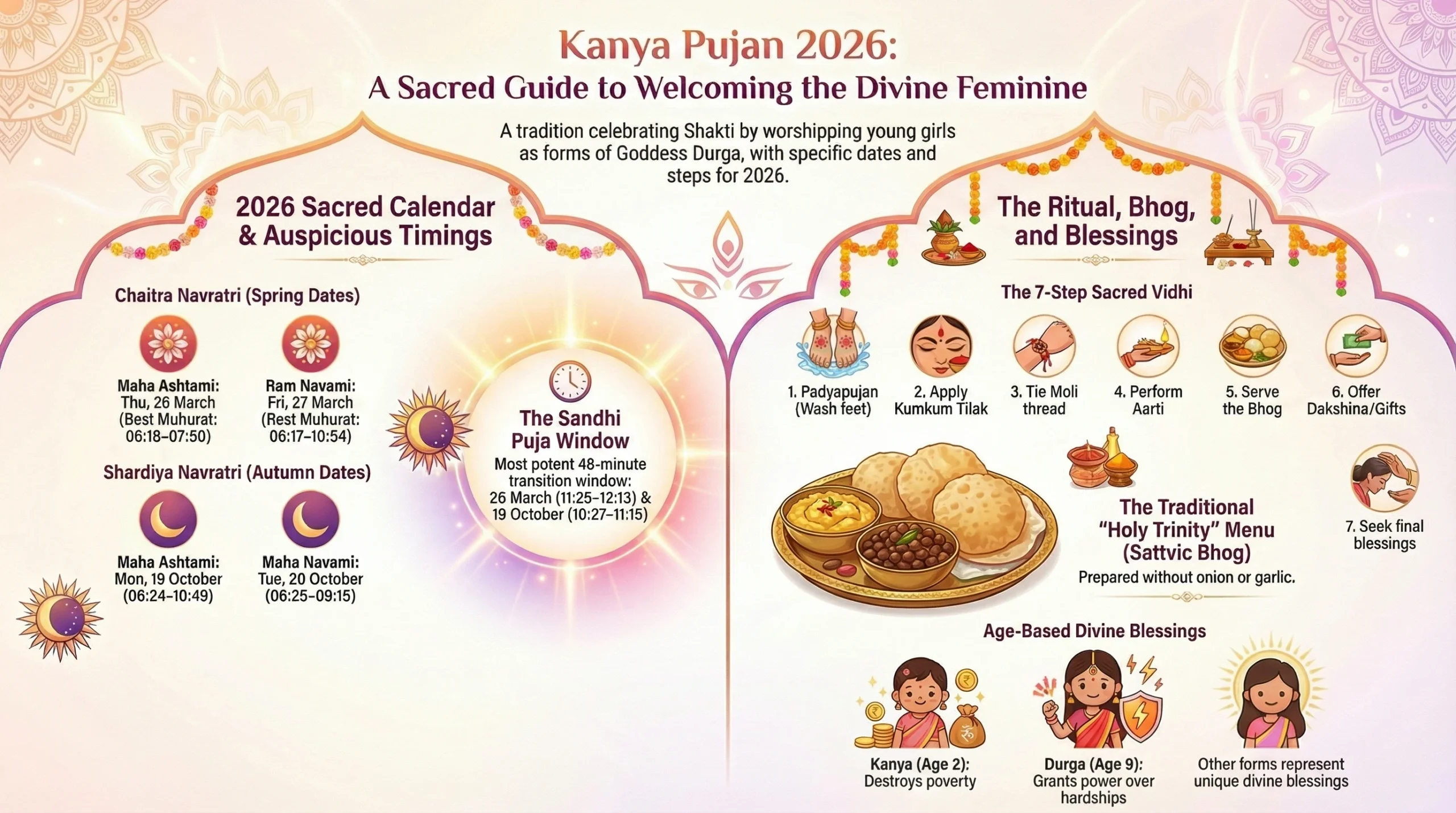
Kanya Pujan 2026: Important Dates & Auspicious Muhurat
Timing is everything when it comes to inviting the Divine into your home. In the Hindu calendar, rituals are governed by the Tithi (lunar day), which doesn’t always align perfectly with our 24-hour clock. For Kanya Pujan 2026, there is a significant focus on the Udaya Tithi—the tithi prevailing at sunrise—which determines the day of the fast and the puja.
Whether you are celebrating the spring Chaitra Navratri or the grand autumn Shardiya Navratri, here is your definitive 2026 calendar.
Chaitra Navratri 2026 (March)
The spring Navratri culminates in late March. This year, there is a slight overlap in tithis, making the morning hours particularly potent for Kanjak Pujan.
| Event | Date (2026) | Day | Best Muhurat for Kanya Pujan |
| Maha Ashtami | March 26 | Thursday | 6:18 AM – 7:50 AM (Brahma Muhurat)
10:55 AM – 1:59 PM (Shubh/Amrit) |
| Ram Navami | March 27 | Friday | 6:17 AM – 10:54 AM (Early Morning)
12:27 PM – 1:59 PM (Abhijit/Madhyahna) |
Pro-Tip: If you are performing Kanya Pujan on Ashtami (March 26), the tithi ends at 11:49 AM. Try to finish the vidhi and the meal before noon to align with the maximum spiritual energy of the day.
Shardiya Navratri 2026 (October)
The “Maha Navratri” in October is when the festive spirit reaches its peak. In 2026, the alignment of the stars suggests a powerful window for seekers.
| Event | Date (2026) | Day | Best Muhurat for Kanya Pujan |
| Maha Ashtami | October 19 | Monday | 6:24 AM – 10:45 AM |
| Maha Navami | October 20 | Tuesday | 6:25 AM – 9:15 AM (Early Morning)
11:43 AM – 12:29 PM (Abhijit Muhurat) |
Understanding the “Udaya Tithi” Logic
You might notice that neighbors or family members in different cities observe Kanya Pujan on different days. This is because Udaya Tithi depends on the local sunrise time.
- For 2026: Most Vedic scholars recommend performing the puja on the day the tithi is present at sunrise.
- If you follow the Ashtami tradition, March 26 and October 19 are your primary dates.
- If your family tradition (Kul-Reeti) dictates Navami, then March 27 and October 20 are the most auspicious.
The “Sandhi Puja” Window
For those following the Bengali tradition of Durga Pujo, the Sandhi Puja is the most critical 48-minute window (the last 24 minutes of Ashtami and first 24 minutes of Navami).
- Chaitra Navratri Sandhi Time: March 26, 2026 (11:25 AM – 12:13 PM)
- Shardiya Navratri Sandhi Time: October 19, 2026 (10:27 AM – 11:15 AM)
Performing Kanya Pujan during or immediately after this window is believed to yield “Akshaya Phal”—undying fruit for your prayers.
The Deep Spiritual Significance of Kumari Puja
In the vast tapestry of Indian spirituality, few rituals are as profound and heart-touching as Kumari Puja. While Navratri is often associated with grand pandals and rigorous fasting, the act of bowing before a child brings the practice down to its most essential, humanized level. To understand why we perform Kanya Pujan in 2026, we must look beyond the tradition and into the “Shakti” that these young girls embody.
The “Why” Behind the Worship: Purity as Power
In Vedic philosophy, a pre-pubescent girl is considered the most potent vessel for the Divine Mother. Why? Because she is “Nishpap”—free from the complex web of worldly desires, ego, and malice that adults often carry.
When we worship a Kanya, we are acknowledging the Unmanifested Energy (Avyakta Shakti). Much like a seed contains the entire blueprint of a massive banyan tree, these children hold the potential of the Universe. By inviting them into our homes, we aren’t just performing a religious duty; we are performing a “soul-reset,” reminding ourselves to return to a state of innocence and unconditional love.
The Legend of Kalasura: The Power of the Virgin Goddess
The spiritual roots of Kanya Pujan are deeply embedded in the story of the demon Kalasura. According to the Puranas, Kalasura had gained a boon that protected him from being killed by any man or god. Over time, his arrogance turned into tyranny, and he began to terrorize the three worlds.
The gods realized that his boon had a loophole: he could only be defeated by a virgin girl. It was then that Maa Durga manifested in the form of a young girl to slay the demon, proving that strength isn’t measured by age or physical stature, but by the purity of one’s spirit. This legend is why we honor young girls today—to celebrate the victory of light over darkness and to acknowledge the fierce protection the Goddess offers her devotees.
Mapping the Nine Devis: The Significance of Age
Did you know that in the traditional Kumari Puja vidhi, the age of the girl determines which specific form of the Goddess she represents? Each year of a child’s life (from 2 to 10) corresponds to a different blessing.
| Age | Form of the Goddess | Spiritual Blessing Offered |
| 2 Years | Kanya / Kumarika | Destroys poverty and brings peace. |
| 3 Years | Trimurti | Grants prosperity and longevity (Ayushya). |
| 4 Years | Kalyani | Brings overall well-being and success in all tasks. |
| 5 Years | Rohini | Bestows health and freedom from diseases. |
| 6 Years | Kalika | Grants victory over enemies and obstacles. |
| 7 Years | Chandika | Brings wealth, splendor, and royal abundance. |
| 8 Years | Shambhavi | Blesses the home with fame and glory. |
| 9 Years | Durga | Grants the power to overcome impossible hardships. |
| 10 Years | Subhadra | Fulfills all desires and ensures a bright future. |
Ashtami vs. Navami: When Should You Perform the Puja?
If you’ve ever found yourself in a group chat debating whether to invite the Kanjaks on Thursday or Friday, you aren’t alone. The “Ashtami vs. Navami” debate is one of the most common discussions during Navratri. In 2026, this choice becomes even more interesting due to a unique lunar alignment.
Choosing between Maha Ashtami and Maha Navami isn’t about which day is “better”—it’s about aligning with your family’s ancestral traditions (Kul-Reeti) and the specific energy of the Goddess you wish to invoke.
The 2026 Tithi Overlap: A Rare Spiritual Window
During Chaitra Navratri 2026, we see a fascinating astrological phenomenon. The Ashtami Tithi concludes around midday on March 26, immediately followed by the start of Navami. This means that for many households, the “energy” of both days exists within the same 24-hour cycle.
- Ashtami Lovers: Most North Indian families (Punjab, Haryana, Delhi, UP) will stick to Thursday, March 26 for their Kanya Pujan, taking advantage of the morning Udaya Tithi.
- Navami Devotees: Those who follow the birth of Lord Rama or the worship of Maa Siddhidhatri will likely observe their rituals on Friday, March 27.
Why Choose Maha Ashtami? (The Power of Mahagauri)
Ashtami is dedicated to Maa Mahagauri, the symbol of purity and serenity. Culturally, this day marks the moment Goddess Durga was invited by the gods to defeat the demon Mahishasura.
- The Vibe: It’s about “Suddhikaran” or purification. Performing Kanya Pujan on Ashtami is believed to wash away past sins and bring mental peace to the household.
- Regional Dominance: If you are in a neighborhood where “Kanjak” is the trending buzzword, you’ll likely see the most activity on this day.
Why Choose Maha Navami? (The Victory of Siddhidhatri)
Navami is the grand finale. It is dedicated to Maa Siddhidhatri, the giver of all Siddhis (supernatural powers and meditative successes).
- The Vibe: It’s about “Siddhi” or fulfillment. This day represents the absolute completion of the nine-day journey. Many believe that the blessings received on Navami are the “seal” of the entire Navratri fast.
- The Ram Navami Connection: Since Navami also celebrates the birth of Lord Rama, performing Kanya Pujan on this day is seen as a double blessing—combining the strength of Shakti with the righteousness (Dharma) of Rama.
Regional Traditions: From Bengal to South India
The beauty of Kanya Pujan 2026 lies in its diversity:
- West Bengal & East India: The focus is heavily on Maha Ashtami. The “Sandhi Puja”—the 48 minutes where Ashtami meets Navami—is the most sacred time, often involving the worship of 108 lotus flowers.
- North India: It’s a split. While the majority perform it on Ashtami, families who have traditionally celebrated the “Birth of the Goddess” wait until Navami.
- South India: Many observe Saraswati Puja on Navami, focusing on books, musical instruments, and tools of trade, with Kanya Pujan acting as a bridge to seek wisdom.
The Final Verdict: Intent Over Calendar
In 2026, the best day for Kanya Pujan is the one that allows you to perform the ritual with a calm, devoted mind. If your office schedule or the availability of the little girls in your society makes one day easier than the other, do not stress. The Devi Bhagwat Purana mentions that the Goddess is pleased by the Bhaav (intention) of the devotee. Whether you choose the fierce grace of Ashtami or the ultimate fulfillment of Navami, the “Divine Presence” remains equally accessible.
Preparing Your Home for the Divine Guests
Preparing for Kanya Pujan 2026 is about more than just a deep clean; it is about shifting the vibration of your home to welcome the Goddess herself. In Hindu tradition, your home is considered a temple during Navratri, and on the day of Kanjak, it becomes the sanctuary where the Divine resides.
To create an environment that feels both spiritually charged and warm for the little girls, follow this holistic preparation guide.
The Ritual of Purification (Shuddhikaran)
Cleanliness is the foundation of any Vedic ritual. Start by decluttering the area where the puja will be performed.
- The Vastu Touch: Ensure the northeast corner (Ishan Konya) of your room is spotless, as this is the most auspicious direction for inviting positive energy.
- Natural Cleansing: After dusting, sprinkle Ganga Jal (holy water) or water mixed with a pinch of turmeric throughout the house to purify the air.
- The Scent of Devotion: Light pure Bhimseni camphor or natural Guggal dhoop early in the morning. The fragrance doesn’t just smell “festive”; it is scientifically known to clear negative vibes and sharpen focus.
Trending 2026 Decor: Traditional Meets Sustainable
For Navratri home decor in 2026, the trend is moving toward “Eco-Luxe”—combining traditional elements with sustainable materials.
- The Entrance: Use a Toran made of fresh mango leaves and marigolds. In 2026, “MDF wood lotus hangings” and fabric-based wall buntings are also trending for a reusable yet regal look.
- The Floral Urli: Place a brass or clay urli at your entrance filled with water, fresh rose petals, and floating tea-light candles to set a serene tone.
- Rangoli: Instead of chemical powders, use flower petals or rice paste (Aipan) to draw footprints leading from your door to the puja altar, symbolizing the arrival of the Goddess.
The “Kanjak” Shopping Checklist
| Category | Must-Have Items |
| Ritual Essentials | Red Kumkum, Akshat (unbroken rice), Moli (sacred thread), Sandalwood paste. |
| Offerings | Red Chunris (9 for girls, 1 for the altar), fresh flower garlands, and a coconut. |
| For the Girls | Bangles, Bindis, and the “Shringaar Kit” (the most searched gift trend for 2026). |
| Seating | Clean floor mats (Asans) or colorful cushions for the girls to sit comfortably. |
Creating a Sattvic Environment
A “Sattvic” home is one that is calm, clean, and filled with love.
- The Soundscape: Play soft instrumental mantras or Durga Chalisa in the background to maintain a meditative frequency.
- Mindful Prep: When preparing the Bhog (halwa, poori, and chana), try to remain in a state of gratitude. The energy you put into the food is what the little Devis will consume as Prasad.
- Kid-Friendly Space: Remember, your guests are children! Ensure the seating area is safe and “toddler-proof” so the little ones can enjoy the ritual without feeling restricted.
Step-by-Step Kanya Pujan Vidhi (2026 Guide)
Performing the Kanya Pujan 2026 ritual is an act of deep meditative surrender. It is the moment where your home officially becomes a “Shakti Peeth.” To ensure your ceremony flows with grace and spiritual alignment, follow this step-by-step Kanya Pujan Vidhi. This guide is designed to help you honor the nine forms of Maa Durga while keeping the experience joyful and comfortable for your young guests.
1. The Divine Invitation
Traditionally, you invite nine girls (representing the Navdurga) and one young boy (representing Bhairav or Langur). In 2026, many families also choose to include any number of girls available (5 or 7) if nine isn’t possible, as the “Bhaav” (intent) is what truly matters.
- Ages: Ideally between 2 and 10 years.
- The Welcome: Greet them at the door with a smile and a “Jai Mata Di.” In the Vedic tradition, a guest is God (Atithi Devo Bhava), and today, these children are the Goddess herself.
2. Padyapujan: Washing the Sacred Feet
This is the most humbling part of the Navratri ritual.
- Have the girls sit on a clean mat or Asan.
- Place their feet in a large brass or clay bowl (Paraat).
- Gently wash their feet with clean water (some add a drop of milk or rose water).
- The Significance: This act symbolizes the washing away of the host’s ego and the purification of the home. Dry their feet with a fresh, soft towel.
3. The Tilak and Akshat Ceremony
Once seated comfortably, apply a Kumkum (Vermillion) Tilak on their foreheads.
- Place a few grains of Akshat (unbroken rice) on the tilak.
- Tie a Moli (sacred red thread) on their right wrists.
- The Spiritual Touch: As you do this, silently chant the name of a Devi form for each girl (e.g., Om Brahmacharinyai Namah).
4. Invoking the Light: Aarti
Before serving the meal, perform a brief Aarti.
- Wave a ghee lamp or incense sticks in a clockwise direction in front of the girls.
- This is the moment to visualize the “Tejas” (divine glow) of Maa Durga radiating from them into your home.
5. Serving the Bhog (The Sacred Feast)
Now comes the highlight—the Kanjak Prasad.
- Serve the traditional trio: Suji Halwa, Sookhe Kale Chane, and fluffy Pooris.
6. Dakshina and Gifts
After the meal, offer Dakshina (a small amount of money) and gifts.
- 2026 Trending Gifts: Red Chunris, bangles, and colorful bindis remain classics. However, modern sustainable gifts like seed pencils, illustrated storybooks of Indian legends, or small copper water bottles are also becoming popular “conscious” choices.
7. Seeking the “Ashirwaad” (Blessings)
The ritual concludes when you bow down and touch the feet of each girl to seek her blessings.
- It is believed that the prayers of an innocent child go directly to the Divine.
- Bid them farewell with respect, perhaps walking them to the door or to their homes.
The Traditional “Bhog” Menu: Recipes for the Soul
Food is the language of love, and in Kanya Pujan 2026, the Bhog (offering) is the heart of the celebration. The goal is to prepare a Sattvic meal—pure, wholesome, and completely free of onion and garlic—that tastes like a divine blessing.
The “Holy Trinity” of the Kanjak plate remains Sookhe Kaale Chane, Danedaar Sooji Halwa, and Fluffy Pooris.
1. Sookhe Kaale Chane (The “Prasad” Style)
These are not your average chickpeas; they are spicy, tangy, and carry a distinct earthy aroma.
- The Secret Step: Soak 1.5 cups of black chana overnight. Pressure cook with a pinch of salt and a tea bag (optional, for that deep dark color) for 5–6 whistles until they are melt-in-the-mouth soft.
- The Tadka: Heat 2 tbsp of Desi Ghee in an iron kadai (the iron gives it an authentic dark hue). Add cumin seeds, a pinch of hing (asafoetida), and grated ginger.
- The Spice Mix: Instead of adding dry powders directly (which can burn), mix coriander powder, amchur (dry mango powder), red chili powder, and roasted cumin powder in 2 tbsp of water first. Pour this paste into the ghee, sauté, and then add the boiled chana.
- Pro-Tip: Don’t drain all the chana water! Use a little of it while sautéing to help the spices “hug” the chickpeas perfectly.
2. Danedaar Sooji Halwa (The Golden Offering)
The most common complaint is halwa being too sticky. In 2026, the trend is “Kila-Khila” or grainy (danedaar) halwa.
- The Golden Ratio: Use the 1:1:3 rule—1 cup Sooji (Semolina), 1 cup Desi Ghee, and 3 cups Water (or a mix of milk and water for richness).
- The Roast: Roast the sooji in ghee on low-medium flame. This requires patience! Stop only when it turns a beautiful golden-brown and your kitchen smells like heaven.
- The Sugar Syrup: Boil the water with 1 cup of sugar, saffron strands, and cardamom powder separately. Pour this hot syrup into the roasted sooji while stirring continuously to avoid lumps.
- The “Covering” Trick: Once the water is absorbed, cover the pan with a lid and let it steam on the lowest heat for 2 minutes. This “blooms” the semolina grains, making them soft yet distinct.
3. Fluffy “Gubaare” Pooris
A perfect poori should puff up like a balloon and stay soft.
- The Dough: Use whole wheat flour (Atta) and knead it into a stiff dough using lukewarm water. Adding a teaspoon of oil and a pinch of salt to the flour prevents the pooris from absorbing too much oil.
- The Temperature: The oil must be smoking hot. To test, drop a tiny piece of dough; if it zips to the top immediately, you’re ready.
The 2026 “Grand Thali” Additions
If you want to go the extra mile, consider adding these trending side dishes to your Kanya Pujan 2026 menu:
- Aloo Tamatar Sabzi: A simple, tangy potato curry made with ginger and green chilies.
- Creamy Kheer: A slow-cooked rice pudding garnished with rose petals.
- Boondi Raita: To balance the spices and keep the little ones’ tummies cool.
- Fresh Fruit Salad: Pomegranates and bananas are considered particularly auspicious.
Note on Hygiene: In the post-pandemic era, cleanliness remains a top priority for parents. Ensure the food is served in clean, preferably biodegradable (leaf-based) plates or traditional stainless steel, and that the serving area sanitized.
50+ Kanjak Gift Ideas for 2026
In 2026, the art of gifting during Kanya Pujan has evolved. While the tradition remains rooted in respect, the “gifts” have shifted from generic plastic items to thoughtful, sustainable, and educational tokens. Whether you are looking for traditional “Shringaar” items or modern DIY kits, this exhaustive list ensures every little Devi leaves your home with a smile.
The “Top 10” Trending Gifts for 2026
If you want to stay ahead of the curve, these are the most searched and appreciated gifts this season:
- Seed Pens & Pencils: Pens that can be planted to grow into herbs or flowers.
- Personalized Sippers: Steel or bamboo bottles with the child’s name.
- DIY Bead-Making Kits: Encourages creativity and fine motor skills.
- Mini Succulents: Teaching children the responsibility of nurturing life.
- Shringaar Hampers: A curated set of bindis, bangles, and hair accessories.
- Mythological Storybooks: Beautifully illustrated tales of Maa Durga’s bravery.
- Ethnic Brocade Pouches: Traditional silk purses for keeping their “Dakshina.”
- Kaleidoscopes: A classic toy that never fails to spark wonder.
- Scented Stationery Sets: Erasers and notebooks that smell like fruits or flowers.
- Copper Water Bottles: Combining health benefits with a premium traditional feel.
Categorised Gift List (50+ Ideas)
Traditional & Spiritual (The Classics)
- 11. Red Chunris with Golden Gota work.
- 12. Glass Bangles (multi-colored sets).
- 13. Silver-plated coins for prosperity.
- 14. Small Brass Diyas or Samayis.
- 15. Miniature Durga or Saraswati idols (Polyresin or Brass).
- 16. Designer Haldi-Kumkum dibbis.
- 17. Sandalwood (Chandan) sticks or powder sets.
- 18. Small prayer books (Chalisa) with a large font.
- 19. Meenakari Elephant showpieces.
- 20. Decorative Ganesha or Lotus wall hangings.
Educational & Creative (The “Brainy” Gifts)
- 21. 3D Puzzles of Indian monuments.
- 22. DIY Clay Magnet painting kits.
- 23. “Color-Your-Own” canvas tote bags.
- 24. Solar-powered toy kits.
- 25. Sudoku or Crossword books for kids.
- 26. Glow-in-the-dark stars/planets for bedroom ceilings.
- 27. Magnifying glasses for “little explorers.”
- 28. Watercolor brush pen sets.
- 29. Origami paper folding kits.
- 30. Abacus or simple counting toys for younger girls.
Fashion & Accessories (The “Princess” Picks)
- 31. Artificial flower Tiaras (very popular in 2026).
- 32. Satin bow hairbands.
- 33. Holographic or glittery hair clips.
- 34. Silicon slap-bands in vibrant colors.
- 35. Toy digital wristwatches.
- 36. Clip-on earrings (no piercing required).
- 37. Colorful scrunchies (velvet or silk).
- 38. Scented lip balms (organic/kid-safe).
- 39. Jewelry boxes with mirrors.
- 40. Temporary “Mata Di” or floral tattoos.
Eco-Friendly & Practical (The “Conscious” Choices)
- 41. Wheat-straw lunch boxes (BPA-free).
- 42. Jute drawstring pouches for stationery.
- 43. Bamboo toothbrushes with colorful bristles.
- 44. Cotton handkerchiefs with hand-embroidered initials.
- 45. Recycled paper notebooks.
- 46. Stainless steel straws with cleaning brushes.
- 47. Fruit-shaped erasers (non-toxic).
- 48. Small umbrellas with cartoon or floral prints.
- 49. Skipping ropes with wooden handles.
- 50. Miniature bird feeders.
Sweet Treats & Extras
- 51. Small boxes of premium Dates or Almonds.
- 52. Homemade chocolate bark in festive packaging.
- 53. Fruit-shaped cushions or plushies.
- 54. Bubble-blowing wand sets.
- 55. Stickers (Holographic “Super Girl” or “Devi” themes).
Gift Selection by Budget (Quick Reference)
| Budget (Per Child) | Best Value Option | Spiritual Significance |
| Under ₹50 | Stationery Set + Bindi Sheet | Utility + Traditional Touch |
| ₹50 – ₹100 | Steel Sipper or Ethnic Pouch | Durability + Style |
| ₹100 – ₹250 | DIY Kit or Storybook | Cognitive Growth + Values |
| ₹250+ (Premium) | Silver Coin or Copper Bottle | Prosperity + Long-term Health |
The “Golden Rule” of Kanjak Gifting
In 2026, presentation is as important as the gift. Instead of using single-use plastic bags, try wrapping your gifts in vibrant cotton fabric (Potlis) or paper bags. Adding a handwritten note saying “Jai Mata Di” or “May you shine like Maa Durga” adds a personal, touch that children and parents will remember long after the festival is over.
The Role of the ‘Langur’: Why a Boy is Essential in Kanya Pujan
If you’ve ever witnessed a Kanya Pujan ceremony, you’ve likely noticed a slightly different guest sitting at the end of the row of little girls. Amidst the bright red chunris and floral tiaras, there sits a young boy—often looking quite pleased with the extra serving of halwa coming his way.
In the heart of North Indian tradition, this boy is affectionately called the ‘Langur’ or ‘Langoora’. But his presence is far from accidental; he carries a deep spiritual responsibility that completes the entire Navratri 2026 ritual.
The Legend of Batuk Bhairav: The Divine Protector
To understand the role of the Langur, we must look at the relationship between Maa Durga and Lord Bhairav. According to Vedic legends, Bhairav (a fierce manifestation of Lord Shiva) is the appointed protector of the Goddess. It is said that no pilgrimage to a Shakti Peeth—like Vaishno Devi—is considered complete without paying respects at the Bhairav temple.
In the setting of your living room, the young boy represents Batuk Bhairav (the child form of Bhairav).
- The Guardian Energy: Just as Bhairav Baba stands guard at the gates of the Goddess’s abode, the Langur represents the protective energy that ensures the puja is conducted without obstacles (Vighna).
- The Boon of Completeness: Ancient texts suggest that the Mother Goddess herself granted a boon: her worship would only yield its full “Phal” (fruit) when accompanied by the worship of her guardian. By seating a boy alongside the nine Devis, you are essentially “locking in” the blessings of your nine-day fast.
Why the Name ‘Langur’?
While the term literally translates to “monkey,” in this spiritual context, it is a nod to Lord Hanuman. Hanuman ji is often referred to as the “Langoora” because of his monkey form and his role as the ultimate devotee and protector of the Divine. In many households, the boy is seen as a representation of Hanuman’s selfless service and unwavering strength.
The “Langur” Vidhi: Treating the Little Guardian
In 2026, the etiquette for honoring the Langur is just as detailed as that for the Kanjaks:
- Padyapujan: His feet are washed with the same reverence as the girls.
- The Tilak: A black teeka (or a standard kumkum tilak) is applied to his forehead to ward off the “evil eye.”
- The Meal: He is served the same Bhog—chana, halwa, and poori.
- The Whistle (Siti): In some traditional pockets of rural India, the Langur is given a small whistle to blow, symbolically announcing the arrival of the Goddess and scaring away negative energies.
What if You Can’t Find a Boy for Kanya Pujan?
In urban settings or high-rise apartments in 2026, finding a young boy available during the morning muhurat can sometimes be a challenge. If you find yourself in this situation, don’t worry—the tradition is flexible:
- The Symbolic Guest: You can place a small idol or a picture of Lord Ganesha or Batuk Bhairav in the row.
- The Vahana Offering: Since the dog is the Vahana (vehicle) of Lord Bhairav, you can take a portion of the Prasad and feed it to a local street dog or a pet with the same intention of seeking Bhairav Baba’s blessings.
A Modern Perspective for 2026
The presence of the Langur is a beautiful reminder of the balance of energies. While Navratri is a celebration of the feminine, the inclusion of a boy highlights that protection and strength are partners to creation and purity. As you perform your Kanya Pujan 2026, treat your little Langur with the same love you show the Devis. After all, he is the “peheredaar” of your home’s spiritual peace.
Essential Dos and Don’ts: Honoring the Divine Decorum
While Kanya Pujan is a celebration of joy and innocence, it is also a Vedic ritual with specific spiritual protocols. To ensure your Navratri 2026 ceremony is performed with the right “Bhaav” (intention) and yields the maximum blessings, keep these essential guidelines in mind.
The “Dos”: Enhancing the Spiritual Vibration
- Prioritize Purity: Take a bath with fresh water (adding a few drops of Ganga Jal if available) before starting the preparations. Ensure the kitchen and the puja area are deep-cleaned.
- The Invitation Rule: Invite the girls and the boy (Langur) at least one day in advance. In the Vedic tradition, a formal invitation shows respect to the Goddess residing within them.
- Maintain the “Sattvic” Standard: Use only pure Desi Ghee for cooking the Bhog. Avoid even a trace of onion or garlic in the entire house during these days.
- Observe the Muhurat: Try to perform the pujan during the auspicious time slots. For March 26, 2026 (Ashtami), the primary windows are 6:18 AM – 7:50 AM and 10:55 AM – 3:31 PM.
- Equality is Key: Treat every child equally. Whether it’s the amount of Dakshina, the size of the gift, or the portion of halwa, ensure there is no discrimination. The Devi is present in each one of them.
- Seek Consent and Comfort: Ensure the children are comfortable. If a child is shy or doesn’t want their feet washed, do not force them. A gentle sprinkle of water or a simple flower offering at their feet is a perfectly acceptable alternative.
The “Don’ts”: Common Mistakes to Avoid
- No Black or Dark Colors: Avoid gifting black-colored clothes, accessories, or toys. In Hindu rituals, black is associated with negative energy. Opt for vibrant reds, yellows, or oranges.
- Avoid Leather & Sharp Objects: Never gift items made of leather (belts, wallets) or sharp objects (scissors, compasses). These are considered “Tamarsic” or disruptive to the peaceful energy of the puja.
- Don’t Force-Feed: While it’s tempting to insist they eat “one more poori,” remember that these are young children. Forcing them to eat or take gifts they aren’t interested in can cause distress, which is considered inauspicious.
- Don’t Clean Immediately: Avoid sweeping or mopping the exact spot where the girls sat for at least an hour after they leave. It is believed that the “Divine Dust” from their feet should linger to bless the home.
- Control the Temper: Never lose your cool or speak harshly to the children, even if they are being mischievous. On this day, their antics are seen as the “Lilas” (divine play) of the Goddess.
- No Used Items: Ensure all gifts, Chunris, and even the towels used to dry their feet are brand new and unused.
Quick Checklist: The “Mistake-Proof” Ritual
| Aspect | Mistake to Avoid | The Right Way |
| Gifts | Steel or Iron utensils | Brass, Copper, or Eco-friendly items |
| Behavior | Checking your phone during the meal | Being fully present and serving with love |
| Bhog | Using store-bought sweets | Freshly prepared home-made Prasad |
| Photography | Intrusive or “staged” photos | Candid shots (with parental consent) |
By following these simple yet profound rules, you transition from “hosting an event” to “performing a Sadhana.” The goal of Kanya Pujan 2026 is to leave the children feeling respected and the host feeling spiritually renewed.
Troubleshooting: What If You Can’t Find 9 Girls for Kanya Pujan?
In a perfect world, our homes on Ashtami or Navami would be easily filled with nine little girls and one energetic Langur. However, the reality of modern urban living in 2026—with gated high-rises, nuclear families, and busy school schedules—means finding exactly nine children isn’t always possible.
If you are stressing over the numbers, take a deep breath. In Sanatan Dharma, the rigid mechanics of a ritual never overpower the purity of your devotion (Bhaav). If you are struggling to find nine girls for your Kanya Pujan 2026, here are the most spiritually sound and practical alternatives.
The Flexibility of the Shastras: The Power of Odd Numbers
Vedic texts are incredibly accommodating. While nine is the ideal number representing the Navdurga, you are not disqualified from receiving Maa Durga’s blessings if you fall short.
- Worshipping Fewer Girls: You can respectfully invite and worship 1, 3, 5, or 7 girls.
- The “Dakshina” Workaround: If you can only host three girls, perform the complete vidhi for them. For the remaining six, set aside their portion of the dry Prasad (fruits, sweets) and Dakshina (gifts or money). You can later hand this over to girls in your neighborhood, domestic helpers’ daughters, or at a local temple.
The “Alternative Bhaav” Matchmaker Guide
| Your Situation | The Best Alternative Action | Spiritual Significance |
| Found only 1 or 2 girls | Treat her as the ultimate embodiment of Parashakti. Give her the primary Bhog and set aside the rest of the portions to distribute later. | Represents Eka Kanya worship, focusing all devotion on the singular, undivided cosmic energy. |
| No girls available locally | Visit a local orphanage or NGO and sponsor a meal, or donate books and stationery. | Aligns with the highest modern virtue: Girl Child Empowerment. Service to humanity is service to the Divine. |
| Stuck at work or abroad | Perform Manas Puja (Mental Worship). Close your eyes, visualize washing the feet of the Navdurga, and mentally offer them a feast. | According to the Puranas, Manas Puja requires zero physical items but yields the exact same spiritual merit. |
Digital Devotion: The 2026 Trend
One of the most heartwarming trends for Kanya Pujan in 2026 is digital sponsorship. Many families are choosing to donate the exact budget of their Kanjak feast and gifts to verified charities that support female education and healthcare.
- Why it works: You are literally shaping a girl’s future, which is the ultimate way to honor the Goddess. If you choose this route, prepare a small symbolic Bhog at home, offer it to the Devi idol in your temple, and then process your donation.
Feeding the Voiceless (Gau Mata & Bhairav)
If you prepare the Kanjak Prasad (Halwa, Poori, Chana) but cannot find any children, the food must not go to waste, nor should it be eaten by adults before being offered.
- Gau Mata: Feeding the holy cow is considered equivalent to feeding 33 crore deities. Offer a portion of the Bhog to a cow.
- Street Dogs: Since the dog is the vehicle (Vahana) of Lord Batuk Bhairav, feeding the stray dogs in your locality is a powerful way to complete the protective aspect of the Navratri ritual.
The Golden Rule: The Goddess does not carry a calculator. She looks at the warmth in your heart. Whether you wash the feet of nine girls in your living room or fund the schooling of one girl miles away, your Kanya Pujan is complete and accepted.
Frequently Asked Questions about Kanya Pujan for 2026
1. Can we perform Kanya Pujan on Saptami or Dashami?
Traditionally, Kanya Pujan is strictly observed on Maha Ashtami or Maha Navami. However, if unavoidable circumstances (like severe illness or travel) prevent you from doing so, some scholars suggest you can perform a symbolic puja on Dashami (Dussehra). Saptami is generally reserved for the invocation of Goddess Saraswati or Kaalratri and is not standard for Kanjak.
2. What is the exact age limit for girls sitting for Kanya Pujan?
The scriptures define a Kumari as a pre-pubescent girl. Therefore, the ideal age is between 2 and 10 years old. Girls under the age of 2 are generally not included as they cannot consume the Bhog properly or sit for the rituals. Each age from 2 to 10 represents a specific manifestation of Maa Durga.
3. Is it mandatory to wash the girls’ feet during the ritual?
Yes, Padyapujan (washing of feet) is one of the most vital steps of the ceremony. It symbolizes washing away the host’s ego and purifying the home by acknowledging the divine footprint of the Goddess. If a child is uncomfortable, you may gently sprinkle a few drops of pure water on her feet as a symbolic gesture.
4. Can we eat food or drink tea before Kanya Pujan?
If you are observing the Navratri fast, you must not break it until the Kanya Pujan is fully complete and the girls have eaten. Drinking water or a light cup of tea early in the morning is acceptable for health reasons, but no solid food should be consumed by the hosts before offering the Prasad.
5. What should menstruating women do during Kanya Pujan?
In traditional Vedic practice, women who are menstruating are advised to rest and not participate in the direct preparation of the Bhog or the physical touching of the girls’ feet. Another family member can step in to perform the cooking and the vidhi. The intention (Bhaav) remains pure, and you can still mentally pray and seek blessings from a distance.
6. Can boys sit for Kanya Pujan?
Yes, but with a specific role. While the nine girls represent the Navdurga, one young boy (often referred to as the Langur or Bhairav) is seated with them. He represents Lord Batuk Bhairav, the divine protector of the Goddess. In North Indian regions, particularly across Delhi NCR and Haryana, this inclusion is considered highly auspicious and necessary to complete the ritual.
7. Can we give money (Dakshina) instead of physical gifts?
Absolutely. Giving Dakshina (cash) is a very traditional and acceptable practice. Many modern families prefer this as it allows the parents of the girls to use the money for the child’s actual needs, such as education or savings, which perfectly aligns with the spirit of girl-child empowerment.
8. What should we do with the leftover Kanjak Prasad?
The Bhog (Halwa, Poori, Chana) offered to the Goddess and the children is highly sacred. Leftovers should be consumed by the family members as a blessing to break their fast. It should never be thrown in the dustbin. If there is excess, distribute it to neighbours, the less fortunate, or feed it to cows and street dogs.
9. Can we make the Halwa and Chana the night before?
No. The Sattvic principles of Navratri dictate that the Bhog must be freshly prepared on the morning of the puja after taking a bath. Stale food (cooked the previous night) is considered Tamasic and is strictly prohibited for offering to the deities. You can, however, soak the black chickpeas overnight.
10. How to do Kanya Puja at home without a Pandit?
Kanya Pujan is fundamentally a household, heartfelt ritual and does not require a Pandit. By following the simple steps—cleaning the home, preparing pure Bhog, washing the children’s feet, applying tilak, serving them lovingly, and seeking their blessings—you are performing a complete and perfect puja. Pure devotion is the only true requirement.
Conclusion: The Heart of Navratri
As the beautiful festival of Navratri culminates, Kanya Pujan stands as its most profound milestone. Whether you are lighting the diya on the crisp morning of Ashtami or offering the final poori on Navami, you are doing much more than following a calendar. You are nurturing the Divine Feminine.
This Kanya Pujan 2026, let the focus shift from flawless execution to flawless devotion. Welcome the little Goddesses, honour their innocence, and let the joyous echoes of their laughter bring lasting peace, prosperity, and health to your home. Jai Mata Di!





Leave a Reply