
The Divine Descent: Why Ram Navami 2026 Feels More Significant Than Ever
As the vibrant colors of spring begin to settle and the fragrant breeze of the Chaitra month sweeps across the world, millions of hearts prepare for a singular, rhythmic pulse: Ram Navami. On Thursday, March 26, 2026, we aren’t just marking a date on a calendar; we are celebrating the birth of the 7th Avatar of Lord Vishnu, the descent of the Maryada Purushottam—the Supreme Being who chose to live as the most disciplined of men.
But why, in our hyper-digital, fast-paced 2026, does the story of a prince born thousands of years ago in Ayodhya still trend across social media and resonate in our quietest moments?
The Cosmic Context of the Seventh Avatar
The “Divine Descent” of Lord Ram wasn’t a mere historical event; it was a cosmic intervention. Ancient scriptures tell us of a time when the world was tilting under the weight of Adharma (unrighteousness). The demon-king Ravana, armed with boons that made him invincible to gods and demons alike, had forgotten the power of the humble. To restore the balance of the universe, the Divine had to take a human form—one that would be bound by human limitations, yet guided by infinite virtue.
When the Navami Tithi aligned with the Punarvasu Nakshatra during the Madhyahna (midday) period, Lord Ram was born to King Dasharatha and Queen Kaushalya. This was the moment the sun stood still in the sky—a celestial salute to the birth of the Suryavanshi prince.
Beyond the Rituals: A Beacon for 2026
In an era where we are often overwhelmed by “fake news,” shifting ethics, and the quest for mental peace, the history of Lord Ram serves as a grounding force. Ram Navami 2026 is a reminder that Dharma isn’t a complex theological concept; it is the simple, often difficult, choice to do what is right over what is easy.
Whether you are performing the Chaitra Navratri rituals or simply reflecting on the lessons of Lord Ram, this day represents the triumph of light. The “Divine Descent” teaches us that even the Supreme, when in human form, had to face exile, loss, and struggle. It the divine, giving us a blueprint for how to navigate our own “Vanvas” (exile) with grace and grit.
The Universal Pulse
As the Ram Mandir in Ayodhya prepares for its grand 2026 festivities, the energy is palpable. From the traditional Panakam served in the south to the massive Shobha Yatras in the north, the celebration is a masterclass in “Unity in Diversity.” It’s a day where the “Universal Lessons of Lord Ram”—compassion, integrity, and selfless service—take center stage, proving that while the world changes, the North Star of human character remains the same.
This Ram Navami, as we witness the Shubh Muhurat, let’s look beyond the idols. Let’s welcome the “Divine Descent” into our own consciousness, striving to bring a little bit of Ram Rajya—a kingdom of peace and justice—into our daily lives
Ram Navami 2026: Precise Dates, Tithi, and Shubh Muhurat
Timing in Vedic traditions is not just about the clock; it’s about aligning our internal energy with the cosmic window of divine manifestation. For Ram Navami 2026, the celestial configuration is unique, falling on a Thursday (Guruvaar)—a day dedicated to Lord Vishnu, making the birth anniversary of his seventh avatar exceptionally potent.
While the festivities span a 48-hour window, the peak spiritual energy centers on the moment of the sun’s zenith. Here is the definitive breakdown of the timings you need to plan your rituals, fasts, and visits to the Ayodhya Ram Mandir.
The 2026 Calendar Breakdown
Due to the way the lunar calendar (Panchang) interacts with the solar day, there is a slight overlap in 2026. However, for the purpose of the Ram Janmotsav (Birth Celebration), the following timings are confirmed:
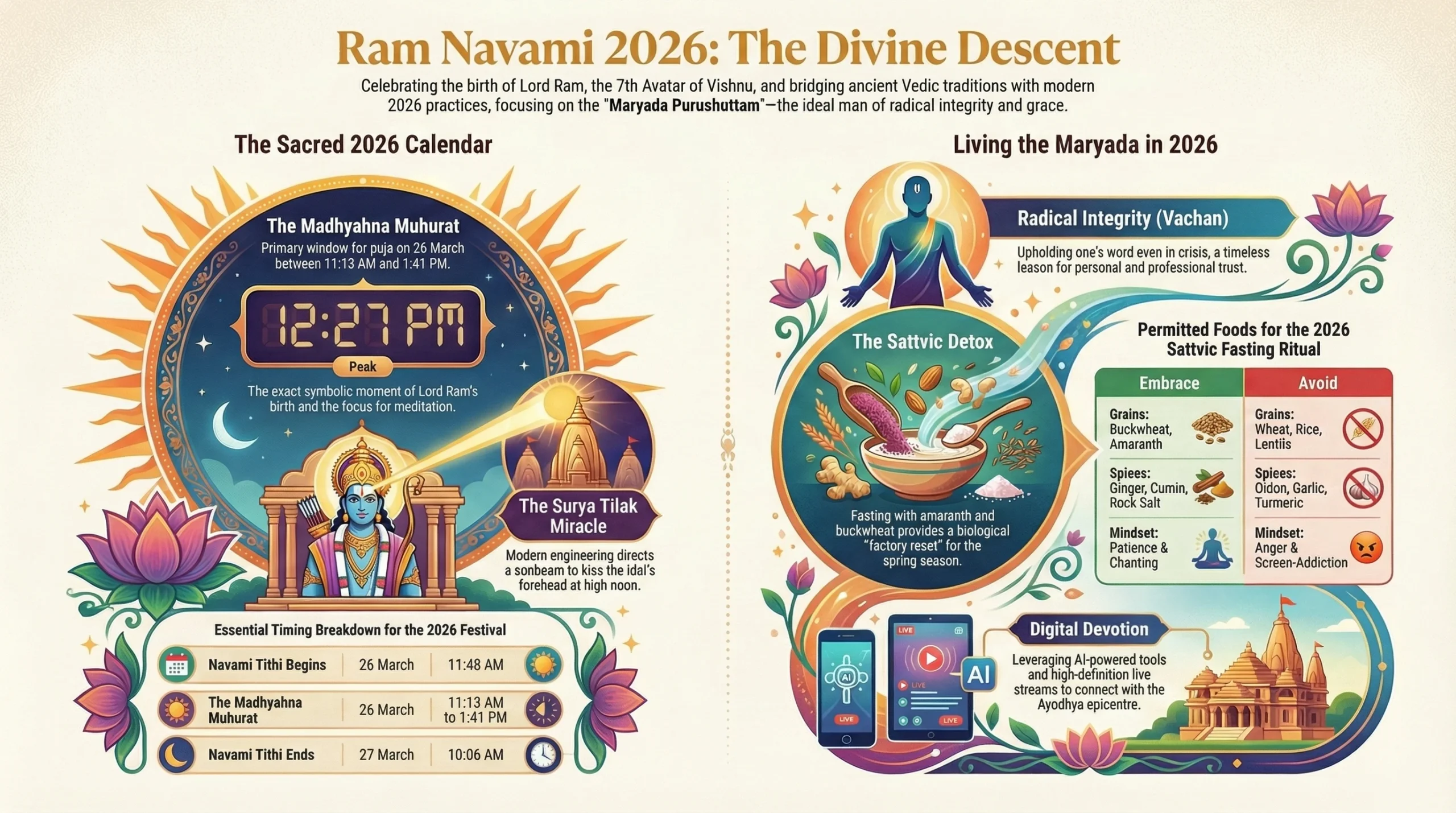
| Event | Date | Timing (IST) |
| Ram Navami Date | Thursday, March 26, 2026 | All Day |
| Navami Tithi Begins | March 26, 2026 | 11:48 AM |
| Navami Tithi Ends | March 27, 2026 | 10:06 AM |
| Madhyahna Muhurat (Puja Window) | March 26, 2026 | 11:13 AM to 01:41 PM |
| The Moment of Birth (Peak) | March 26, 2026 | 12:27 PM |
Understanding the 2026 “Date Confusion”
You might see some calendars mentioning March 27. This is because of the Udaya Tithi rule (the Tithi present at sunrise). While the Navami Tithi begins on the morning of the 26th, it stays through the sunrise of the 27th.
Pro-Tip for SEO/Readers: For the most authentic experience, the birth celebration (Janmotsav) is traditionally observed when the Navami Tithi prevails during Madhyahna (midday). In 2026, this happens on Thursday, March 26. If you follow the Vaishnava tradition or the Udaya Tithi, your local temple might hold additional celebrations on Friday morning, the 27th.
The Significance of the 2026 Shubh Yogas
This year, the stars align to create a “triple threat” of auspiciousness:
- Shobhan Yoga: Present throughout the day on March 26, this yoga is believed to bring prosperity and fulfill long-held desires.
- Sarvartha Siddhi Yoga: Beginning at 04:19 PM, this window is perfect for starting new ventures or “Shubh Arambh.”
- Ravi Yoga: Also starting in the late afternoon, this alignment is said to provide protection and “Arogaya” (good health).
Essential Tips for Your 2026 Puja
- The 12:27 PM Window: If you are at work or traveling, try to take a “mindful minute” at 12:27 PM. This is the exact symbolic moment Lord Ram appeared in Ayodhya.
- Brahma Muhurat Start: To capture the full energy of the day, begin your day during the Brahma Muhurat (04:44 AM – 05:30 AM) with a purifying bath.
- Fast Timing: If you are observing a fast, most devotees continue until the completion of the Madhyahna Puja at 01:41 PM before taking Phalahari (fruit-based) meals.
The Historical & Mythological Epicentre: The Soul of Ayodhya
To truly understand Ram Navami 2026, one must travel back through the layers of time to the ancient city of Ayodhya—a name that literally translates to “The Unconquerable.” This isn’t just a dot on a map; it is the spiritual ground zero where the divine met the earthly.
Whether you view the Ramayana through the lens of history, archaeology, or pure devotion, the narrative of Lord Ram’s birth is a masterclass in cosmic timing and human emotion.
The Miraculous Birth: A King’s Prayer and a Golden Bowl
The story begins with a silent palace. King Dasharatha, the powerful ruler of the Ikshvaku dynasty, had everything a monarch could desire—except an heir. This void led to the Putrakameshti Yagna, a high-stakes Vedic ritual performed by the sage Rishyasringa.
As the sacrificial fire roared, a divine figure emerged from the flames, carrying a golden bowl of Payasam (sacred pudding). This wasn’t just food; it was the carrier of divine essence. Dasharatha divided the pudding among his three queens—Kaushalya, Kaikeyi, and Sumitra.
On the ninth day of the Chaitra month, under the Punarvasu Nakshatra, the prophecy was fulfilled. Queen Kaushalya gave birth to Ram, the eldest, embodying the perfection of Vishnu. Soon after, Bharat, Lakshman, and Shatrughna were born, completing the four pillars of the solar dynasty.
The Purpose of the Avatar: Restoring the Moral Compass
Why did the Divine choose to be born as a human prince rather than appearing in a fearsome, god-like form? The answer lies in the “Maryada” (boundaries/ethics).
The demon-king Ravana had acquired a boon that made him invincible to gods, celestial beings, and spirits. In his arrogance, he omitted “humans” and “monkeys” from his list of threats, considering them beneath his notice. By descending as a man, Lord Ram exploited this loophole, proving that human character and righteousness are the ultimate weapons against ego and chaos.
2026: The Convergence of History and Faith
In 2026, the historical narrative feels more alive than ever. With the Ayodhya Ram Mandir now a global pilgrimage site, the “Mythological Epicentre” has transitioned into a tangible reality for millions.
- The Science of the Surya Tilak: Modern engineering in the temple now allows the sun’s rays to fall directly on the forehead of the Ram Lalla idol at exactly 12:27 PM—the Madhyahna moment. This “Sun-Kissed” ritual bridges ancient solar symbolism with 21st-century precision.
- Archaeological Echoes: For those seeking historical footprints, the descriptions of the Sarayu River and the layout of ancient Kosala in the Valmiki Ramayana continue to be studied by scholars as a blueprint for early Indian civilization.
The Two Great Epics: Valmiki vs. Tulsidas
While we celebrate the same Lord Ram, the “Historical Epicentre” is enriched by two primary perspectives:
- The Adiguru Valmiki’s Ramayana: Written in Sanskrit, portraying Ram as the Ideal Man (Itihasa).
- Goswami Tulsidas’s Ramcharitmanas: Written in Awadhi, portraying Ram as the Supreme Lord (Bhakti).
Together, these texts ensure that the story of Ram Navami isn’t just a static myth, but a living, breathing history that evolves with every generation.
Universal Lessons from the “Maryada Purushottam”: A Blueprint for 2026
In a world increasingly defined by “hustle culture,” shifting moral goalposts, and digital noise, the life of Lord Ram offers a grounding sanctuary. He is titled “Maryada Purushottam”—the Supreme Man who lived within the boundaries of ethics (Maryada).
Unlike other avatars who showcased divine miracles, Ram’s life was a masterclass in human resilience. His “Universal Lessons” aren’t just for the devout; they are actionable strategies for leadership, mental health, and social harmony in 2026.
1. The Power of “Vachan” (The Integrity of the Word)
In the age of “terms and conditions” and fine print, the concept of Pran Jaye Par Vachan Na Jaye (Life may depart, but a promise must not) sounds radical.
- Modern Application: Lord Ram’s willingness to accept a 14-year exile to uphold his father’s word is the ultimate lesson in Radical Integrity. In 2026, where brand trust and personal credibility are the highest currencies, “doing what you said you would do” remains the most powerful leadership trait.
2. Radical Empathy: The Bridge-Builder
Lord Ram’s journey from Ayodhya to Lanka was a journey of inclusivity. He didn’t build an elite army; he empowered the marginalized.
- The Sabari Moment: By eating the tasted berries of Sabari, he shattered the barriers of caste and status, proving that devotion and character outweigh social hierarchy.
- The Vanara Sena: He led an army of the “forest dwellers,” teaching us that a true leader finds potential in the overlooked. In today’s corporate and social world, this translates to Inclusive Leadership—valuing every contributor, regardless of their background.
3. Emotional Intelligence in the Face of Crisis
When informed of his exile on the day of his coronation, Ram did not react with anger or “victimhood.” He maintained a Sthitapragya (equanimous) state of mind.
- Mental Health in 2026: We live in a time of high anxiety and “instant reactions.” Ram’s ability to pause, process, and respond with grace is the ancient equivalent of High EQ. He teaches us that while we cannot control external “exiles” (job losses, personal setbacks), we can absolutely control our internal response.
4. The “Ram Rajya” Philosophy: Ethical Governance
The term Ram Rajya is often cited as the gold standard for a perfect society. It wasn’t about a religious state; it was about a Value-Based State.
- Justice and Equality: A kingdom where the weakest citizen felt heard and protected.
- The Lesson: For modern entrepreneurs and policymakers, Ram Rajya is a reminder that success is hollow if it doesn’t trickledown to the most vulnerable. It’s about Sustainable Success—ensuring the collective thrives alongside the individual.
5. Brotherhood and Loyalty: The Lakshman-Hanuman Bond
Lord Ram’s relationships with Lakshman and Hanuman redefine loyalty.
- Selfless Service: Hanuman’s devotion wasn’t about “what’s in it for me?” It was about Seva (service).
- The Lesson: In our “networking” driven world, Ram Navami 2026 encourages us to build Deep Connections. True strength comes from a circle of trust where loyalty is reciprocal and ego is absent.
The 2026 Takeaway: To “be like Ram” doesn’t mean being perfect; it means being principled. It’s about choosing Dharma (duty) over Swarth (selfishness) when the stakes are high.
The Science and Spirit of Fasting (Vrat): A 2026 Holistic Perspective
In the traditional Hindu calendar, fasting (Vrat) is never just about deprivation; it is a sophisticated technology for “Chitta Shuddhi” (purification of the mind and subconscious). As we approach Ram Navami 2026, the ancient practice of the Ram Navami Vrat is seeing a massive resurgence, rebranded by wellness experts as the “Sattvic Detox.”
Whether you are a devout seeker or a health-conscious millennial, understanding the bridge between the spiritual “Why” and the biological “How” is key to mastering this seasonal transition.
The Spiritual “Why”: Aligning with the Divine
Spiritually, fasting is an act of Tapa (austerity). By consciously stepping away from sensory indulgence—specifically taste—we redirect our vital energy (Prana) toward higher consciousness. On Ram Navami, devotees fast to:
- Mimic the Maryada: Just as Lord Ram maintained restraint and discipline, we practice self-control.
- Deepen Meditation: A light, “Sattvic” stomach is the best foundation for chanting the Ram Raksha Stotra or meditating on the name of Ram.
The Biological “How”: The Science of Vasant Ritu
The timing of Ram Navami isn’t accidental. It occurs during Vasant Ritu (Spring), a major seasonal junction (Ritu Sandhi). According to Ayurveda, this is when the body’s Kapha (earth/water element) begins to liquefy, making us prone to seasonal allergies, sluggishness, and digestive issues.
- Metabolic Reset: Transitioning to a light, grain-free diet for 24 hours acts as a “factory reset” for the gut microbiome.
- Autophagy & 2026 Trends: Modern science calls this “Intermittent Fasting” or “Autophagy”—the process where cells clean out “junk” proteins. By fasting on March 26, 2026, you are essentially triggering a cellular spring cleaning.
- Blood Sugar Stability: Traditional Vrat ingredients like Buckwheat (Kuttu) and Water Chestnut (Singhara) are low-glycemic, preventing the energy crashes associated with processed wheat and rice.
The 2026 “Sattvic” Fasting Menu
To keep your energy high while staying within the Maryada of the fast, here is the trending 2026 approach to Vrat food:
- The Super-Grain: Amaranth (Rajgira): Packed with protein and fiber, it’s the 2026 “ancient grain” of choice for Ladoo and Porridge.
- The Electrolyte King: Sabudana (with a twist): Move over heavy Sabudana Khichdi. The 2026 trend is Air-Fried Sabudana Vadas or Sabudana Salad with pomegranate and mint.
- Natural Hydration: Avoid sugary sodas. Stick to Panakam (Jaggery, Ginger, and Cardamom water) or Neer Mor (Spiced Buttermilk) to balance the Pitta (heat) of the shifting season.
- The Salt Rule: Use Sendha Namak (Himalayan Pink Salt). It is unprocessed, cooling, and less likely to cause the bloating associated with regular table salt.
| Category | What to Embrace | What to Avoid |
| Grains | Buckwheat, Amaranth, Water Chestnut | Wheat, Rice, Corn, Lentils |
| Vegetables | Potato, Sweet Potato, Bottle Gourd | Onion, Garlic, Mushrooms |
| Spices | Black Pepper, Cumin, Ginger | Turmeric, Red Chili Powder, Hing |
| Mindset | Patience, Chanting, Silence | Anger, Gossiping, Screen-Addiction |
Fasting Rules: Dos and Don’ts Pro-Tip for 2026 Fasting
If you cannot observe a full Nirjala (waterless) fast due to work commitments, the “Ekana” (eating once a day) or “Phalahari” (fruit-only) fast is widely accepted. The goal is the sentiment of the fast, not the physical torture of the body.
How to Celebrate Ram Navami 2026 at Home: A Step-by-Step Puja Vidhi
Celebrating Ram Navami 2026 at home is a beautiful way to anchor your family in Dharma and peace. Since the festival falls on a Thursday (Guruvaar), the spiritual vibrations for honoring Lord Vishnu’s seventh avatar are at an all-time high.
Phase 1: The Morning Preparation (Purification)
The energy of the day begins long before the sun rises.
- Brahma Muhurat Awakening: Aim to wake up between 4:44 AM and 5:30 AM. This is the time of “Divine Consciousness.”
- Ritual Bath: Add a few drops of Ganga Jal (holy water) to your bathing water. Wear clean, preferably yellow or light-colored traditional clothes, as yellow is highly auspicious for Lord Ram.
- Sanctifying the Space: Clean your entire home, specifically the Northeast corner (Ishan Kon). Sprinkle Ganga Jal to purify the air and light a natural incense stick to set the frequency.
Phase 2: Setting the Ram Darbar (Altar Setup)
A “Ram Darbar” includes Lord Ram, Mata Sita, Lakshman, and the humble Hanuman.
- The Platform: Place a wooden chowki and cover it with a fresh yellow cloth.
- The Kalash Sthapana: Place a copper or brass Kalash filled with water, topped with five mango leaves and a coconut. This represents the presence of the universe.
- The 2026 Essential: If you can, bring home a new Tulsi plant or a Brass Shankh (conch shell) on this day. These are trending “positive energy” anchors for 2026.
Phase 3: The Step-by-Step Ritual (Puja Process)
- Sankalp (The Vow): Take a little water in your right palm. State your name, your location, and your intention—whether it is for world peace, family harmony, or personal growth. Let the water flow to the ground.
- Abhishek (The Holy Bath): Gently bathe the idol with Panchamrit (milk, curd, honey, sugar, and ghee), followed by clean water.
- Alankar (Adornment): Apply a tilak of Ashtagandha or Sandalwood paste. Offer fresh yellow flowers and the most important ingredient: Tulsi leaves. (Note: Lord Ram’s puja is considered incomplete without Tulsi).
- The Madhyahna Janmotsav (12:27 PM): * As the clock hits 12:27 PM, the peak moment of birth, ring a small bell or blow the Shankh.
-
- The Cradle Ceremony: If you have a small idol of Ram Lalla (Baby Ram), place Him in a decorated cradle and swing it gently while singing “Ram Janmotsav” bhajans.
Phase 4: Offerings and Aarti (Bhog)
Prepare a Sattvic Bhog (no onion or garlic). Traditional favorites for 2026 include:
- Panakam: The refreshing jaggery and ginger drink.
- Panjiri: A nutritious roasted wheat and dry fruit mix.
- Kheer: Saffron-infused rice pudding.
Finish the ritual by performing the Aarti with a camphor-lit lamp. Ensure the flame is waved in a circular, clockwise motion.
The 2026 Digital Tip: “Mindful Connection”
If you are working during the Muhurat on March 26, don’t worry. Spend the window between 11:13 AM and 1:41 PM listening to the Ram Raksha Stotra on your headphones or silently chanting “Shri Ram Jai Ram Jai Jai Ram.” In the eyes of the Divine, the purity of your intent outshines the complexity of the ritual.
Regional Flavors of Ram Navami: A Pan-Indian Celebration in 2026
While the core of Ram Navami 2026 is the celebration of Dharma, the way this devotion manifests across India is a vibrant tapestry of local culture, music, and culinary traditions. From the temple towns of the North to the grand “Kalyanotsavams” of the South, each region adds a unique “flavor” to the festival on March 26, 2026.
1. Ayodhya: The Heart of the Solar Dynasty
In 2026, Ayodhya remains the undisputed epicenter of celebrations. With the Ram Mandir now fully established, the city expects nearly 2.5 million devotees during the Ram Navami Mela (March 19–26).
- The Surya Tilak Miracle: At exactly 12:27 PM, a sophisticated opto-mechanical system will direct a beam of sunlight to form a glowing Tilak on the forehead of the Ram Lalla idol. This 3–4 minute event is 2026’s most-watched spiritual broadcast.
- The Shobha Yatra: Grand processions with decorated chariots and “Ram Sevaks” wind through the streets, accompanied by the thunderous chanting of “Jai Shri Ram.”
2. South India: The Celestial Wedding (Sita Rama Kalyanam)
In the South, the focus shifts from the birth of a child to the union of the Divine Couple.
- Bhadrachalam (Telangana): Known as the “Ayodhya of the South,” this temple on the banks of the Godavari is famous for the Sita Rama Kalyanam. In a beautiful 2026 tradition, the State Government will officially present Mutyala Talambralu (pearls and silk garments) for the wedding.
- Vontimitta (Andhra Pradesh): Here, the wedding ritual is uniquely performed under the full moon (Moonlit Kalyanam), creating a breathtaking atmosphere that draws millions to the Vijayanagara-style Kodandarama Temple.
- Rameswaram (Tamil Nadu): Devotees take a holy dip in the 22 Theerthams (sacred water bodies), bridging the gap between the Shaiva and Vaishnava traditions at the spot where Lord Ram worshipped Shiva.
3. Maharashtra: The Tradition of “Grantha Parayana”
In Western India, the celebration is more literary and community-driven.
- Continuous Recitation: For nine days leading up to March 26, 2026, communities engage in uninterrupted reading of the Ramayana. This Parayana concludes on Navami afternoon, followed by a communal feast.
- Palatial Palanquins: In cities like Nashik (Panchavati), the Palkhi of Lord Ram is carried by devotees in a massive display of local fervor.
4. North & East India: Kanya Pujan and Ramlila
In states like Uttar Pradesh, Bihar, and West Bengal, Ram Navami marks the culmination of Chaitra Navratri.
- Kanya Pujan: Before the midday Ram Janmotsav, families invite nine young girls (symbolizing the nine forms of Durga) to their homes, washing their feet and serving them Halwa, Puri, and Chana.
- Sitamarhi (Bihar): As the birthplace of Goddess Sita, this region hosts a massive fair at the Janaki Mandir, focusing on the divine feminine energy that supported Lord Ram’s journey.
5. The 2026 Culinary Map
No regional celebration is complete without its signature Prasad:
- South India: Panakam (jaggery water), Neer Mor (spiced buttermilk), and Kosambari (moong dal salad).
- North India: Kheer, Suji Halwa, and Panchamrit.
- Maharashtra: Sunthada (a digestive mixture of ginger powder and sugar).
2026 Travel Tip for Seekers
If you are planning to travel to these hubs on the Ram Navami Long Weekend (March 26–29), ensure you book your “Sugam Darshan” or VIP passes weeks in advance. Ayodhya and Bhadrachalam typically see their accommodation fully booked by early March.
Ram Navami in the Modern Era: Digital Devotion & The 2026 Resurgence
As we step into Ram Navami 2026, the celebration of the Seventh Avatar has transcended physical boundaries. While the ancient rituals remain the bedrock, the way we express our devotion has been “upgraded” for a tech-savvy, globally connected generation. Today, the Maryada Purushottam is as much a presence on our smartphone screens as He is in our temple altars.
1. Digital Darshan: The Ayodhya Experience Anywhere
In 2026, the Ayodhya Ram Mandir isn’t just a destination; it’s a digital phenomenon. For those who can’t navigate the millions-strong crowds on March 26, technology bridges the gap:
- Live Virtual Poojas: Many devotees now participate in the Ram Raksha Stotra Path Online directly from Ayodhya, feeling the vibrations of the birthplace through high-definition live streams.
- The “Surya Tilak” Broadcast: The scientific miracle—where sunlight is funneled to kiss the forehead of Ram Lalla at 12:27 PM—is the most viral spiritual event of the year, shared by millions on WhatsApp and Instagram within seconds of occurring.
2. The Rise of AI-Powered Devotion
2026 has seen a surge in AI-generated spiritual content. From personalized AI greeting cards to “Cinematic Devotional Prompts,” technology is helping the youth visualize the epic in ultra-realistic detail.
- Viral Trends: Young creators are using AI tools to craft “Epic Religious Celebration” portraits—depicting themselves in traditional saffron attire against the backdrop of a golden Ayodhya.
- Customized Chants: AI-assisted meditation apps now offer personalized chanting schedules based on your 2026 Ram Navami Muhurat, helping busy professionals find a “Digital Detox” through ancient sounds.
3. “Ram Rajya” as a Modern Social Contract
The concept of Ram Rajya (The Ideal Kingdom) is being reclaimed in 2026 as a blueprint for Ethical Living and Sustainability.
- Eco-Dharma: Inspired by Lord Ram’s 14-year connection with the forest, many communities now observe the day by launching Tree-Planting Initiatives or “Plastic-Free” temple drives.
- Corporate Ethics: Leaders are increasingly citing the “Maryada” of Lord Ram to promote Transparent Governance and Social Responsibility in their businesses—proving that integrity is the ultimate 2026 power move.
4. Social Media: The New “Shobha Yatra”
If the streets are filled with saffron flags, the digital world is filled with “Digital Yatras.”
- Stickers & Stories: Individually created Ram Navami stickers and AR filters (like the “Dhanush” filter) allow everyone to carry the symbol of Lord Ram in their pocket.
- Global Community: Whether you are in New York, London, or Sydney, 2026’s social media allows the global diaspora to sync their prayers, creating a 24-hour cycle of “Jai Shri Ram” that follows the sun across the globe.
The 2026 Perspective: We aren’t moving away from tradition; we are moving with it. Ram Navami in the modern era proves that Sanatan Dharma is fluid—it adopts the tools of the future to preserve the values of the past.
Frequently Asked Questions about Ram Navami 2026
1. When is Ram Navami 2026? What is the best time for Puja?
Ram Navami will be celebrated on Thursday, March 26, 2026. The most auspicious time for worship, known as the Madhyahna Muhurat, is between 11:13 AM and 01:41 PM. The exact moment of Lord Ram’s birth is traditionally observed at 12:27 PM.
2. Is there a holiday for Ram Navami 2026?
Yes, Ram Navami is a gazetted holiday in many Indian states. Most government offices, schools, and banks will remain closed on March 26. However, in some states like Telangana, Andhra Pradesh, and Bihar, the bank holiday may be observed on March 27 due to local variations in the Tithi. Always check your local state holiday list for confirmation.
3. What is the “Surya Tilak” in Ayodhya, and will it happen in 2026?
The Surya Tilak is a spectacular event where a system of lenses and mirrors directs a beam of sunlight to fall exactly on the forehead of the Ram Lalla idol at noon. In 2026, this will occur at 12:00 PM (noon) on March 26. It symbolizes the blessing of the Sun (Lord Ram’s ancestor) upon the deity.
4. Can we eat salt during the Ram Navami fast?
Traditional Vedic fasting suggests avoiding regular table salt. Instead, devotees use Sendha Namak (Himalayan Pink Salt), which is considered pure and unprocessed. If you are observing a strict Nirjala (waterless) or Phalahari (fruit-only) fast, even Sendha Namak is typically avoided until the fast is broken.
5. What can I eat while fasting on Ram Navami?
For a Sattvic (pure) fast, you can consume:
- Fruits: All varieties.
- Dairy: Milk, curd, paneer, and buttermilk.
- Vrat Grains: Sabudana (sago), Kuttu (buckwheat), Rajgira (amaranth), and Singhara (water chestnut).
- Vegetables: Potatoes, sweet potatoes, and bottle gourd.
- Avoid: Wheat, rice, lentils, onion, garlic, and non-vegetarian food.
6. How do I break the Ram Navami fast (Parana)?
The fast is typically broken after the Madhyahna Puja (after 1:41 PM on March 26). Some devotees wait until the following morning (March 27) after sunrise. The best way to break the fast is with a light meal consisting of the Prasad offered during the puja, such as fruits, Panakam, or Kheer.
7. Why is Ram Navami celebrated on two different days (March 26 & 27)?
This happens due to the Udaya Tithi (sunrise rule). While the Navami Tithi begins on the morning of March 26, it extends into the morning of March 27. Most people celebrate on the 26th because the Tithi is present during the crucial midday (birth) hour. However, the Vaishnava tradition often observes the fast on the day the Tithi is present at sunrise, which may lead to celebrations on the 27th in certain regions.
8. What are the essential items for Ram Navami Puja at home?
To set up a basic Ram Darbar, you need:
- Idols or photos of Lord Ram, Sita, Lakshman, and Hanuman.
- A yellow cloth for the platform.
- Ganga Jal, sandalwood paste, and flowers (preferably yellow).
- Tulsi leaves (mandatory for Vishnu-avatars).
- Incense, a diya (lamp), and sweets for Bhog.
9. Can women perform Ram Navami Puja during their periods?
Traditional customs often suggest resting from active ritual participation during this time to maintain the sanctity of the altar. However, many modern practitioners believe that mental chanting (Manas Puja) and listening to the Ramayana or bhajans are perfectly acceptable ways to connect with the Divine during this period.
10. What is the significance of the “Panakam” drink?
Panakam (jaggery, ginger, and cardamom water) is the traditional prasad of Ram Navami, especially in South India. Beyond its spiritual significance, it is scientifically designed to balance body temperature and provide an electrolyte boost during the seasonal transition from spring to summer.




Leave a Reply