
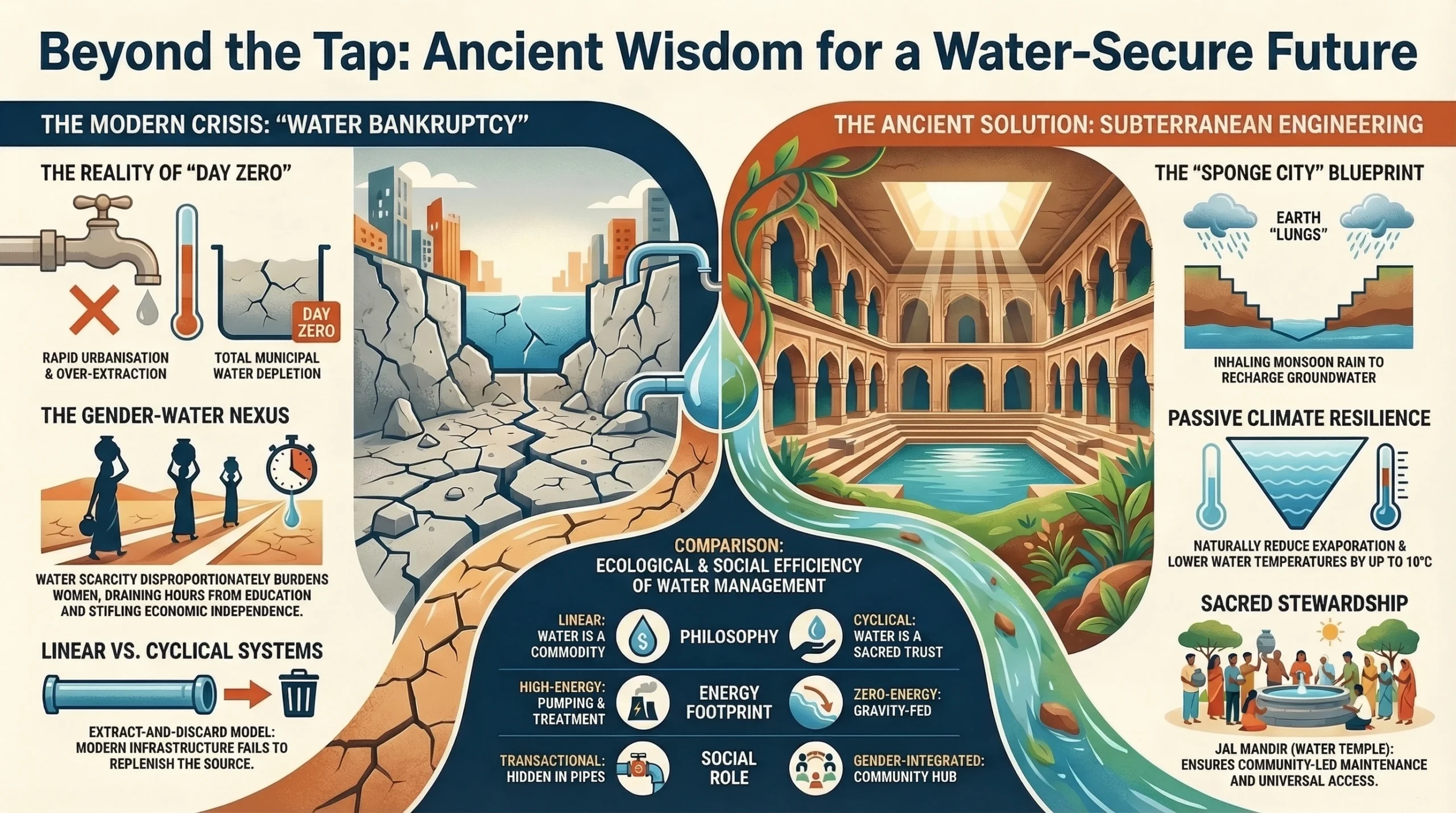
The Timeless Value of Water
Imagine waking up, turning the tap, and hearing nothing but the hollow hiss of air. For millions across the globe, “Day Zero”—the day a city’s municipal water supply completely runs dry—is no longer a dystopian movie plot. It is a looming, terrifying reality. As climate change accelerates, erratic monsoons and rapidly depleting aquifers are pushing our modern infrastructure to its absolute breaking point. Yet, the story of water isn’t just a tale of modern scarcity; it is a deeply human story of survival, ingenuity, and community.
As we celebrate World Water Day 2026, the global spotlight is focused on a critical, often overlooked intersection: Water and Gender. Under this year’s powerful theme, we are forced to acknowledge a stark reality. When local reservoirs fail, the heavy burden of fetching water disproportionately falls on the shoulders of women and girls. A drought doesn’t just drain the earth; it drains hours away from a young girl’s education, stifles economic independence, and deepens social divides. Ultimately, sustainable water management is inextricably linked to the fight for gender equality.
But to navigate this modern crisis, what if we didn’t just look forward to expensive, energy-hungry technologies? What if the ultimate blueprint for our survival is already etched into the stone of our past?
Long before the invention of electric pumps and sprawling concrete dams, the Indian subcontinent—a region historically defined by blistering summers and unpredictable rains—mastered the intricate science of hydrology. Ancient Indian water conservation methods were not primitive, temporary fixes. They were highly sophisticated works of geo-engineering and climate resilience. The ancient architects and rulers understood something our modern cities have largely forgotten: water is not merely a transactional commodity to be consumed, but a sacred, life-giving force to be deeply respected and nurtured.
This profound reverence birthed architectural masterpieces that served as the lifelines of entire civilizations. We see this in the breathtaking, subterranean stepwells of India (locally known as baolis or vavs) and the expansive, sacred temple tanks (kunds and pushkarinis).
These structures were brilliant by design. They were built to catch every precious drop of monsoon runoff, naturally filter it through layers of earth, and actively recharge the local groundwater table. By building inverted pyramids deep into the earth, ancient engineers effectively halted evaporation, creating cool, subterranean oases even in the harshest of deserts.
More importantly, these ancient water bodies were deeply spaces. They were vibrant community hubs, cool summer retreats, and democratic centers of daily life where women often led the rituals and social gatherings surrounding the water. They seamlessly married breathtaking aesthetics with flawless utility, proving that infrastructure can nourish both the land and the community’s soul.
If we want to build a future that truly honors the 2026 mandate of water and equality, we must look back. By unearthing the wisdom of ancient Indian temples and stepwells, we discover that the timeless value of water lies not just in its ability to quench our physical thirst, but in its profound power to unite, sustain, and equalize our world.
This section is designed to bridge the gap between 11th-century architectural history and the UN-Water 2026 theme, ensuring your pillar page remains hyper-relevant to current global trends while maintaining a soulful, human narrative.
World Water Day 2026: The Intersection of “Water and Gender”
As we observe World Water Day 2026, the global conversation has shifted toward a profound realization: water is not gender-neutral. Under the 2026 campaign slogan, “Where water flows, equality grows,” international climate leaders are highlighting a truth that ancient Indian civilizations understood centuries ago. In the tapestry of human history, women have always been the primary custodians of water. When a well runs dry, it is the feet of women and girls that must trek further; when a tank is contaminated, it is the health of the household, managed by women, that falters first.
The Silent Water Bearers: A Historical Perspective
In the sun-drenched plains of Gujarat and the arid corridors of Rajasthan, water collection was never just a chore; it was a defining social ritual. Ancient Indian water conservation methods were designed with this human element at their core. The stepwells of India (Baolis and Vavs) served as subterranean community centers. While the men worked the fields, the village women gathered at these cool, carved retreats.
Descending into the earth, away from the 45°C heat, these women found more than just water. They found a sanctuary for sisterhood. The architecture of the stepwell, with its wide landings and shaded galleries, allowed for a “slow” collection of water. It was here that news was traded, songs were sung, and the social fabric of the village was woven. In 2026, as we discuss water and gender equality, we must recognize that these ancient sites were the original “safe spaces” for women’s empowerment and social integration.
The Queen’s Legacy: Rani ki Vav
Perhaps the most stunning testament to female leadership in water management is the Rani ki Vav (The Queen’s Stepwell) in Patan, a UNESCO World Heritage site. Commissioned in 1063 AD by Queen Udayamati in memory of her husband, this wasn’t just a monument of grief—it was a monumental gift of life to her people.
At a time when the world often views ancient history through a patriarchal lens, Rani ki Vav stands as a 7-story marvel of sustainable water management led by a woman. Queen Udayamati’s vision ensured that her subjects had access to a reliable, filtered water source that tapped into the Saraswati River’s alluvial architecture. It is a masterpiece of “feminine engineering”—focusing on long-term storage, accessibility, and the aesthetics of the water experience.
Why This Matters in 2026
Today, the “water-gender nexus” is a critical pillar of the Sustainable Development Goals (SDGs). Modern research proves that when women are involved in the design and maintenance of water systems:
- Transparency increases: Local water committees led by women show higher accountability.
- Sustainability improves: Systems are maintained more diligently because women feel the immediate impact of failure.
- Education rises: Efficient water access (like the proximity of a village kund) directly correlates with higher school enrollment for girls.
The ancient Indian stepwells were more than just holes in the ground; they were the physical manifestation of a society that placed water—and the women who managed it—at the center of the universe. As we face the climate uncertainties of 2026, reviving the spirit of the Jal Mandir (Water Temple) means restoring dignity to the water-fetching process and ensuring that “water for all” truly means “equality for all.”
This section explores the spiritual and philosophical bedrock that made India’s water systems so resilient. By treating water as a deity rather than a commodity, ancient societies ensured its protection through “sacred stewardship”—a concept that is trend-shifting in World Water Day 2026 discussions around circular water economies and indigenous climate wisdom.
The Philosophy of “Jal” in Ancient India: More Than a Resource
In the modern world, we often view water through a purely utilitarian lens: something that flows from a tap, is measured by a meter, and is billed by a utility company. But to step into the world of ancient Indian water conservation is to enter a realm where water—Jal—was whispered about in hymns before it was captured in stone.
The philosophy of water in India was never about “ownership”; it was about “belonging.” This distinction is the secret ingredient that allowed these systems to thrive for millennia.
The Sacred Element: “Apo Hi Stha Mayobhuvah”
The Vedic scriptures are filled with a profound reverence for the liquid element. One of the most famous Sanskrit invocations, “Apo hi stha mayobhuvah,” translates to “O Water, you are the source of bliss.” In the ancient Indian mind, water was one of the Pancha Bhoota (five primordial elements). It was seen as a living, breathing entity with the power to purify both the body and the soul.
This philosophical grounding created a “culture of conservation” that didn’t require a government mandate. When you believe that a river is a Goddess and a well is a shrine, you do not pollute it. You do not waste it. This spiritual sustainability is exactly what modern environmentalists are trying to replicate today through community-led water management.
The “Jal Mandir” Concept: Architecture as Worship
Why are the most stunning water structures in India located inside or adjacent to temples? The concept of the Jal Mandir (Water Temple) was a stroke of psychological and social genius. By intertwining a water source with a place of worship, ancient rulers ensured two things:
- Sanctity and Maintenance: Because the water was “sacred,” the community took collective responsibility for its cleanliness. Desilting a temple tank or cleaning a stepwell was seen as a Seva (selfless service), earning spiritual merit.
- Universal Access: Temples were the heart of the village. Placing the primary water source there ensured that water was a shared, public good, protected from being monopolized by a few.
Water as a Mirror of Society
The philosophy of Jal also emphasized the cyclical nature of life. Ancient Indians understood that water follows a circle—from the heavens as rain, to the earth as runoff, into the deep aquifers, and back up through the well. Their architecture, like the inverted pyramid of a stepwell, mirrored this philosophy. It was a physical manifestation of “giving back to the earth.”
As we celebrate World Water Day 2026, this ancient philosophy offers a powerful solution to our modern “throwaway” culture. We are learning that sustainable water management isn’t just about better pipes; it’s about a better mindset. By reviving the “Jal” philosophy—the idea that water is a sacred trust passed down from our ancestors to our children—we can move from being “consumers” of water to being its “guardians.”
“The earth, the air, the land, and the water are not an inheritance from our forefathers but on loan from our children. So we have to hand over to them at least as it was handed over to us.” — This ancient sentiment remains the heartbeat of India’s water legacy.
Stepwells (Baolis / Vavs): Engineering Marvels of the Desert
If you were to stand at the edge of a Rajasthani Baoli or a Gujarati Vav during the peak of a 48°C summer, you would witness a miracle of physics. As you descend the stone steps, the air grows noticeably heavier and cooler. By the time you reach the water’s edge, deep within the earth’s embrace, the temperature has plummeted by nearly 10 degrees.
These are not just “wells with stairs.” The stepwells of India represent a pinnacle of subterranean geo-engineering that modern architects are only now beginning to fully decode. In an era of global warming and rapid desertification, these ancient structures offer a masterclass in climate-resilient infrastructure.
The Anatomy of an Inverted Pyramid
Unlike a traditional circular well where you drop a bucket from the top, a stepwell invites the user to journey down to the water table. This “inverted pyramid” design was a deliberate response to the harsh, arid climate of Western India.
- Evaporation Control: By tucking the water body deep underground and shielding it with high stone walls and intricate colonnades, ancient engineers minimized the surface area exposed to direct sunlight. This drastically reduced evaporation—the silent thief of open reservoirs.
- The Phreatic Tap: Stepwells were strategically built to tap into the phreatic (water-saturated) zone of the soil. They didn’t just catch rain; they acted as a massive “lung” for the earth, inhaling water during the monsoons and exhaling it back to the community during the lean winter months.
- Natural Filtration: The walls of these wells were often constructed without mortar, allowing groundwater to seep through the porous stone. As the water traveled through the earth and the stone layers, it underwent a natural filtration process, ensuring that the water at the bottom was silt-free and potable.
Iconic Masterpieces of Hydrological Art
To understand the scale of this ancient Indian water conservation, one must look at specific examples that have survived centuries of neglect.
1. Chand Baori, Abhaneri (Rajasthan)
With 3,500 perfectly symmetrical steps descending 13 stories, Chand Baori is perhaps the most visually stunning stepwell in the world. Its geometric precision isn’t just for show; the multiple levels allowed people to access water regardless of how high or low the water table fluctuated between seasons. It is a living lesson in seasonal water adaptability.
2. Adalaj ni Vav (Gujarat)
Built in 1498, this five-story deep stepwell is a fusion of Islamic floral patterns and Hindu symbolism. Beyond its beauty, Adalaj served as a vital “rest stop” on ancient trade routes. Its design includes ventilated shafts that allowed hot air to escape while keeping the lower galleries breezy—a 15th-century version of zero-energy air conditioning.
3. Agrasen ki Baoli (Delhi)
Located in the heart of modern-day New Delhi, this L-shaped baoli proves that even urban centers once relied on groundwater recharge systems. While modern skyscrapers now surround it, the baoli remains a reminder that the city’s water security was once managed through decentralized, community-accessible architecture.
The Ecological Impact: Recharging the Soul of the Earth
In the context of World Water Day 2026, the most relevant feature of the stepwell is its role in aquifer recharge.
Modern “efficient” piping systems take water from point A to point B, but they do nothing to replenish the source. In contrast, a stepwell is a two-way street. During the torrential Indian monsoons, the stepwell acts as a collection basin. The weight of the collected water creates “recharge pressure,” forcing water back into the parched surrounding soil. This raises the water table for kilometers around, feeding local vegetation and smaller village wells.
Why We Need “New-Age Baolis”
As we face the “Water and Gender” challenges of 2026, the revival of the stepwell concept is more than nostalgic—it’s a necessity. By decentralizing water storage, we reduce the energy required for long-distance pumping and empower local communities (especially women) to manage their own resources.
The stepwell reminds us that the solution to our thirst isn’t always to dig deeper or build bigger dams; sometimes, it’s about building smarter, cooler, and in harmony with the natural rhythm of the earth.
Iconic Stepwells to Know:
- Chand Baori (Rajasthan): 3,500 symmetrical steps, temperature control (degrees cooler at the bottom).
- Adalaj ni Vav (Gujarat): Indo-Islamic architecture and its role on ancient trade routes.
- Agrasen ki Baoli (Delhi): A marvel surviving amidst a modern concrete jungle.
The Ecological Impact: How they prevented evaporation, managed seasonal monsoon fluctuations, and served as drought mitigators.
While the stepwells of the desert were subterranean lungs, the temple tanks of Southern and Central India were the “spiritual reservoirs” that kept entire civilizations hydrated for millennia. In the context of World Water Day 2026, these structures—known variously as Kunds, Pushkarinis, or Kalyanis—represent the world’s oldest and most successful model of community-led rainwater harvesting.
In these sacred spaces, engineering wasn’t just a utility; it was an act of devotion. To build a tank was to ensure that the “tears of the sky” (the monsoon) were never wasted.
Temple Tanks: The Science of Spiritual Sustainability
Walk into any ancient temple complex in Hampi, Madurai, or Modhera, and you’ll find a massive, stepped water body at its heart. These aren’t merely for ritual bathing. They are sophisticated hydrological systems designed to manage local micro-climates and recharge the earth.
The Anatomy of a Sacred Reservoir
Though they vary by region, these tanks share a common architectural DNA:
- Kunds: Typically found in Northern and Western India, these are often circular or square with steps leading down to the water. They were the primary source of drinking water for the community surrounding the temple.
- Pushkarinis/Kalyanis: Common in the South (Karnataka and Tamil Nadu), these are often grand, rectangular structures with intricate stone masonry. They served as the “balancing tanks” for the local ecosystem.
Rainwater Harvesting: From Temple Roof to Tank
One of the most overlooked aspects of ancient Indian water conservation is the use of the temple itself as a giant catchment area.
- The Slope Logic: The sprawling stone roofs of temples were designed with subtle inclines.
- The Conduit System: Hidden stone channels and gargoyles (often shaped like the mythical Makara) directed every drop of monsoon rain from the temple’s vast surface area into the central tank.
- Sedimentation Traps: Before entering the main tank, the water often passed through smaller “silt traps,” ensuring that the reservoir remained clean and the storage capacity wasn’t reduced by mud and debris.
The Invisible Service: Groundwater Recharge
Unlike modern concrete tanks that “hold” water but isolate it from the earth, ancient temple tanks were designed to “breathe.”
- Unpaved Bottoms: Many tanks featured bottoms made of sand or porous stone. This allowed the stored water to slowly percolate into the ground.
- The “Sponge” Effect: By keeping a massive body of water in one place, the temple created a “pressure head” that forced water into the surrounding aquifers. This meant that even during a drought, the village wells within a 2-3 kilometer radius of the temple would remain full. This is the gold standard of sustainable water management.
The 2026 Perspective: Water, Gender, and the Temple Square
As we dive into the World Water Day 2026 theme of “Water and Gender,” the temple tank takes on a deeper social significance. Historically, the Kalyani or Pushkarini was the central theater of a woman’s public life.
- Social Connectivity: For women, the temple tank was a place of agency. It was where they managed the water needs of their households, performed rituals for the health of their children, and shared knowledge.
- Equality Through Access: Because these tanks were “God’s property,” they theoretically offered a level of communal access that private wells did not. Today, reviving these tanks is a direct way to bring water security back to the doorstep of rural women, reducing the “water-carrying” labor that hinders their economic progress.
Case Studies in Hydrological Brilliance
1. The Golden Lotus Tank (Meenakshi Amman Temple, Madurai)
This tank is a masterclass in urban water management. Even in a crowded city, this ancient reservoir collects rainwater and maintains a consistent level, symbolizing the “purity” of the city’s water table.
2. The Stepped Tank of Hampi (Karnataka)
Discovered during excavations, this perfectly preserved schist-stone tank is a marvel of modular geometry. It was fed by an intricate system of stone aqueducts that brought water from the Tungabhadra River, miles away—a precursor to modern canal systems but with zero carbon footprint.
3. Surya Kund (Sun Temple, Modhera)
More than just a tank, this is a geometric symphony. With 108 miniature shrines carved into its steps, it reminds the user that every step toward water is a step toward the divine. Its design ensures that even as the water level drops in summer, the “access points” remain easy for the community to reach.
The 2026 “Take-Home” Message: Our ancestors didn’t wait for a “Water Crisis” to build these tanks; they built them as a prerequisite for civilization. They understood that a community without a thriving water body is a community without a future.
Beyond Temples: Regional Water Conversation Techniques.
While the grand stepwells and temple tanks often steal the architectural spotlight, the true backbone of India’s water resilience lay in the “common sense” engineering found in its villages. Across the diverse landscape of the subcontinent, ancient communities developed indigenous water wisdom tailored to their specific soil, rainfall, and terrain.
As we address the World Water Day 2026 theme of Water and Gender, these regional systems are particularly relevant. They weren’t just about large-scale storage; they were about bringing water closer to the home, directly reducing the physical burden on women and ensuring that “equality grows where water flows.”
The Johads of Rajasthan: Healing the Desert
In the golden sands of Alwar, the Johad is a humble hero. These are simple, crescent-shaped earthen check dams built across a slope to catch rainwater.
- The Logic: A Johad doesn’t just “hold” water on the surface; it forces the water into the earth to recharge the dry underground aquifers.
- The Human Impact: In the late 20th century, the revival of Johads led by local communities (and the “Waterman of India,” Rajendra Singh) brought five dried-up rivers back to life. For the women of Rajasthan, this meant the end of walking 5 kilometers for a single pot of water, allowing them more time for education and local governance.
The Taankas: Household Independence
If a Johad was for the village, a Taanka was for the family. This is an underground, cylindrical cistern, often found in the courtyards of Bikaner and Barmer.
- The Design: Rainwater from the roof is diverted into the Taanka, which is then sealed to keep the water cool and free from contamination.
- Sustainability: This decentralized approach to rainwater harvesting gave households—specifically the women managing them—sovereignty over their water supply, insulating them from the “water-politics” of the village.
The Eris of Tamil Nadu: The Cascade Effect
In the South, the Chola and Pandyan dynasties perfected the Eri (tank) system. These weren’t isolated ponds; they were a sophisticated “cascade” of interconnected lakes.
- The Engineering: When the Eri at a higher elevation filled up, the excess water flowed through a channel into the next Eri downstream.
- Flood & Drought Control: This system prevented flash floods during the monsoon and ensured that water was distributed equitably across the landscape. Today, these systems are being reimagined as “blue-green infrastructure” for climate-hit cities like Chennai.
Ahar Pynes of Bihar: Turning Floods into Fortune
In the flood-prone plains of South Bihar, the Ahar Pyne system is a masterclass in sustainable water management.
- Ahars are reservoirs with embankments on three sides, while Pynes are diversion channels leading from rivers.
- The Benefit: This system effectively captures the “wealth” of floodwaters and redirects it for irrigation and groundwater recharge, proving that water management isn’t just about storage—it’s about movement and timing.
Why Regional Wisdom is the 2026 Blueprint
These regional techniques prove that ancient Indian water conservation was never a “one-size-fits-all” solution. It was a localized, democratic, and gender-inclusive approach to survival. In 2026, as we face a global water crisis, the lesson is clear: our best defense against climate change is to stop trying to “conquer” nature and start listening to the geography of our own backyards.
The Modern Crisis: What Went Wrong?
How did we go from being a civilization that worshipped water to one that is running out of it? The transition from the architectural brilliance of stepwells to our current modern water crisis wasn’t an overnight failure; it was a slow decoupling of culture from nature.
The Colonial Disconnect: From Sacred to “Unhygienic”
The decline began during the British Raj. To the colonial eye, the communal, subterranean nature of stepwells was seen as “unhygienic” and “primitive.” In a push for Western-style “progress,” the British introduced centralized piped water systems. While this brought convenience, it came at a devastating cost: the death of community responsibility. When water began to flow from a tap rather than being drawn from a shared baoli, the sacred bond was broken. Traditional systems were abandoned, falling into ruin or being used as literal dumping grounds.
The Era of “Water Bankruptcy”
In 2026, we are facing what experts call water bankruptcy. Our modern cities have become concrete fortresses. Through rapid asphaltization, we have paved over the “earth’s pores,” preventing rainwater from reaching the aquifers below. Instead of recharging the ground, monsoon rains now flood our streets and vanish into toxic drains.
The Invisible Crisis of Groundwater Depletion
Unlike a drying lake, groundwater depletion is an invisible emergency. Across India’s “Day Zero” cities like Bengaluru and Delhi, we are drilling borewells 1,000 feet deep—mining “fossil water” that took centuries to accumulate. Powered by subsidized electricity and fueled by the demand for water-guzzling crops, we are withdrawing from our “environmental savings account” without making a single deposit.
As we celebrate World Water Day 2026, the “Modern Crisis” reminds us that our biggest mistake wasn’t a lack of technology, but a lack of respect. We traded climate resilience for convenience, and now, the tap is running dry.
Ancient vs. Modern Water Management
In the spirit of World Water Day 2026, this comparison highlights the shift from “water as a community treasure” to “water as a utility bill,” and how that shift has directly impacted gender equality and environmental health.
Ancient Wisdom vs. Modern Infrastructure: A Tale of Two Systems
As we navigate the complexities of the 21st century, we often assume that “newer is better.” However, when it comes to sustainable water management, our ancestors were lightyears ahead of our current “extract-and-discard” model. The difference isn’t just in the materials used—stone versus PVC—it’s in the very philosophy of how we interact with the planet.
The Comparative Breakdown
| Feature | Ancient Indian Systems (Stepwells/Kunds) | Modern Urban Water Infrastructure |
| Philosophy | Cyclical: Water is a sacred trust to be recharged and reused. | Linear: Water is a commodity to be extracted, used, and flushed. |
| Energy Footprint | Zero-Energy: Relies on gravity, natural topography, and manual labor. | High-Energy: Dependent on massive pumps, treatment plants, and electricity. |
| Groundwater Impact | Recharge-Centric: Acts as a “sponge,” forcing monsoon rain into the aquifers. | Depletion-Centric: Prevents seepage through concrete; over-extracts via borewells. |
| Maintenance | Community-Led: Seva (service) ensured tanks were desilted and kept clean. | Bureaucratic: Managed by distant municipal bodies; often reactive, not proactive. |
| Social Role | Gender-Integrated: A social hub for women; a center for community bonding. | Invisible/Transactional: Water is “hidden” in pipes; social connection is lost. |
| Climate Resilience | High: Designed to withstand multi-year droughts and erratic monsoons. | Low: Vulnerable to power outages, pipe bursts, and “Day Zero” scenarios. |
Why the Ancient Model Wins in 2026
1. The “Sponge City” vs. The “Concrete Jungle”
Our modern cities are designed to get rid of water as fast as possible. Storm drains are built to whisk rainwater away into rivers or oceans, often taking urban pollutants with them. In contrast, an ancient temple tank or Johad treats the ground as a bank. Every drop of rain is a deposit. By 2026, as urban flooding becomes more frequent due to climate change, we are realizing that we need to turn our cities back into “sponges”—a concept the builders of Hampi mastered 500 years ago.
2. Decentralization: The Key to Water Equity
Modern systems are centralized. If a main pipe bursts or a treatment plant fails, an entire district goes thirsty. This puts an immense burden on women, who must then find alternative, often expensive, sources. Ancient Indian water conservation was decentralized. Every village had its own baoli; every temple had its own kund. This “localized security” meant that even if one source failed, the community had backups. It empowered local people—especially women—to be the masters of their own thirsty fates.
3. The Hidden Cost of “Convenience”
We love the convenience of the tap, but we ignore the carbon footprint of the pump. To bring water from a distant dam to a high-rise apartment requires a massive amount of energy. Ancient systems used the natural contours of the land. They were “passive” systems that worked with gravity, not against it. In the 2026 push for Net Zero cities, the low-energy model of the Vav is the ultimate green blueprint.
The Synthesis: A Hybrid Future
The goal for World Water Day 2026 isn’t to abandon modern technology and go back to carrying pots from a well. It is to integrate ancient hydrological wisdom into our modern “Smart Cities.” Imagine skyscrapers that use their vast surface area to feed subterranean “modern baolis” for groundwater recharge. Imagine community-managed “water temples” in every neighborhood that act as both parks and reservoirs.
By bridging the gap between the stone-carved past and the digital future, we can create a system that is not only efficient but also soulful and sustainable.
| Feature | Ancient Indian Methods (Stepwells/Kunds) | Modern Urban Infrastructure |
| Energy Source | Gravity-fed, natural topography | Energy-intensive pumps and pipes |
| Evaporation Control | Subterranean design minimizes sunlight | Open reservoirs, high evaporation |
| Groundwater Impact | Active percolation and aquifer recharge | Runoff lost to storm drains |
| Community Role | Centralized social and cultural hubs | Decentralized, transactional |
As we approach World Water Day 2026, the most inspiring stories aren’t coming from high-tech desalination plants or billion-dollar mega-dams. They are coming from the mud, the silt, and the forgotten corners of our cities. Across India, a quiet revolution is underway: the “Great Unearthing.”
Architects, environmentalists, and local communities are realizing that the answer to our parched future was buried under centuries of neglect. By restoring ancient Indian stepwells and temple tanks, we aren’t just preserving history—we are rebooting a 1,000-year-old survival system that still works perfectly.
Reviving the Past: Successful Restoration Projects
For decades, many of India’s most magnificent stepwells (Baolis) were treated as glorified trash cans. Filled with debris, stagnant water, and urban waste, these engineering marvels were hidden in plain sight. But today, “Restoration Architecture” is the new frontier of sustainable water management.
The Resurrection of Bansilalpet (Hyderabad)
Perhaps the most famous success story of this decade is the Bansilalpet Stepwell in Secunderabad. For nearly 40 years, this 17th-century multi-layered well was used as a dumping ground. It took the removal of over 500 truckloads of garbage and silt to find the heartbeat of the structure.
- The Result: Once the debris was cleared, the ancient aquifers began to breathe again. Within months, fresh, clean groundwater naturally filled the well to a depth of 30 feet.
- The 2026 Impact: Today, it isn’t just a tourist spot; it provides water for local parks and has significantly lowered the ambient temperature of the surrounding neighborhood, acting as a “natural air conditioner” for the community.
The Delhi Baoli Renaissance
In the heart of the national capital, where the modern water crisis is a daily struggle, a massive initiative has seen the restoration of sites like Ugrasen ki Baoli and the Gandhak ki Baoli.
- The Science: By desilting these structures and reconnecting them to their original catchment areas, urban planners are creating “recharge pits.”
- The Outcome: During the 2025 monsoons, these restored baolis prevented localized flooding by absorbing excess runoff and funneling it directly into the depleting water table. It’s a masterclass in how ancient hydrology can fix modern “Smart City” flaws.
Women-Led Revival in Rural Gujarat and Rajasthan
Aligning perfectly with the World Water Day 2026 theme of “Water and Gender,” many rural restorations are being spearheaded by women’s collectives (Mahila Mandals).
- Case Study: In the arid districts of Gujarat, women have taken over the maintenance of village Vavs and Kunds. They realized that when the local well is functional, they save up to 4 hours of labor a day—hours that are now spent on education and small-business ventures.
- Empowerment: These women aren’t just “fetching” water anymore; they are the “Water Managers.” This shift from labor to leadership is exactly what the slogan “Where water flows, equality grows” is all about.
Why Restoration Outperforms Replacement
Why spend months digging out an old well when you could just install a new RO plant? The answer lies in the total cost of ownership and ecological health.
- Zero Carbon Footprint: A restored stepwell requires no electricity to “store” water. It uses the earth’s natural cool temperature and the laws of gravity.
- Longevity: Modern pipes have a lifespan of 20–30 years. A stone-carved temple tank has already lasted 500 years and, if maintained, will last another 500.
- Community Pride: You can’t gather around a plastic tank to celebrate a festival. Restoring a Jal Mandir restores the soul of a neighborhood, creating a shared space that fosters social cohesion.
The 2026 Vision: From Monuments to Living Systems
As we conclude this exploration for World Water Day, the message is clear: the stepwells of India were never meant to be museums. They were meant to be living, breathing parts of our infrastructure. The success of these restoration projects proves that we don’t need to “reinvent the wheel” to solve the climate crisis—we just need to “unearth” it.
By treating these ancient sites as active assets in our rainwater harvesting strategy, we honor our ancestors’ wisdom while securing our children’s future.
- Case Study: The recent restoration of the 17th-century Bansilalpet Stepwell in Hyderabad. Describe the removal of 3,000 tonnes of garbage to reveal fresh, usable groundwater.
- The Blueprint for Cities: How NGOs and civic bodies are looking at these restorations to solve urban water shortages.
Frequently Asked Questions about Your Guide to Ancient Indian Water Wisdom
1. What is the theme for World Water Day 2026?
The official theme for World Water Day 2026 is “Water and Gender”, with the campaign slogan “Where water flows, equality grows.” This year focuses on how the global water crisis disproportionately affects women and girls—who are often the primary water-bearers—and how providing decentralized water access is a fundamental step toward achieving gender equality and economic independence.
2. What is the difference between a Baoli, a Vav, and a Kund?
While all three are ancient Indian water conservation methods, they vary by region and design:
- Vav: The term used in Gujarat for a stepped well, often featuring intricate carvings and multiple stories.
- Baoli: Common in North India (Delhi and Rajasthan), these are also stepped wells but often have more utilitarian or secular designs compared to the highly ornate Vavs.
Kund: A stepped reservoir or tank, usually square or rectangular, found near temples. Unlike wells that tap into deep aquifers, Kunds primarily collect and store rainwater runoff.
3. How did ancient stepwells keep water cool in the desert heat?
Stepwells are masterpieces of passive cooling architecture. By digging deep into the earth, the water was shielded from direct sunlight and the searing desert winds. The heavy stone masonry acted as a thermal mass, absorbing the heat of the day and keeping the subterranean air and water nearly 10°C to 15°C cooler than the surface temperature.
4. Why were ancient water systems always built near temples?
This was a deliberate strategy of “Spiritual Sustainability.” By designating water as a “Jal Mandir” (Water Temple), ancient societies ensured that the water remained sacred and clean. Communities were more likely to protect and maintain a water source if it was tied to their religious and social identity, preventing the pollution and neglect we often see in modern “secular” infrastructure.
5. Can ancient Indian water methods really solve modern “Day Zero” crises?
Absolutely. While we might not build new 7-story stepwells today, the principles of decentralized recharge are the only long-term solution to urban water scarcity. By turning our modern cities into “Sponge Cities”—using permeable paving and “modern kunds” to recharge the groundwater table—we can stop the cycle of “water bankruptcy” caused by over-extracting borewells.
6. Who was Queen Udayamati, and why is she significant for World Water Day 2026?
Queen Udayamati was the 11th-century visionary who commissioned Rani ki Vav in Gujarat. She is a historical icon for the 2026 Water and Gender theme because she proved that water management was a position of female leadership. Her legacy shows that when women lead water infrastructure projects, the focus shifts toward long-term community survival and architectural beauty.
7. How do temple tanks (Pushkarinis) help with groundwater recharge?
Most temple tanks were built with unpaved or sandy bottoms. When the tank filled during the monsoon, the sheer weight of the water created “hydrostatic pressure,” forcing the water to seep through the earth and into the surrounding aquifers. This raised the water table for all the wells in the nearby village, providing a safety net during dry months.
8. Are these ancient stepwells still functional today?
Many are! While thousands fell into ruin during the colonial era, recent restoration projects (like the Bansilalpet Stepwell in Hyderabad) have proven that once you remove the modern garbage and silt, the ancient springs still flow. These wells are capable of providing thousands of liters of naturally filtered groundwater to local communities even today.
9. Why did the British Raj fill in many of India’s stepwells?
The British viewed stepwells through a Western lens, labeling them “breeding grounds for disease” and “unhygienic.” They preferred centralized, piped water systems that were easier to tax and control. Unfortunately, this led to the abandonment of traditional rainwater harvesting, causing the structural decay of these monuments and the eventual depletion of India’s groundwater.
10. How can I practice ancient water wisdom in my modern home?
You don’t need a palace to save water! You can apply “Ancient Wisdom” by:
- Permeable Surfaces: Replace concrete driveways with gravel or “living pavers” that let the earth breathe and absorb rain.
- Rainwater Catchment: Install a simple rain barrel system to mimic the “Taanka” method of desert households.
Local Advocacy: Support the restoration of local ponds and tanks in your city to help recharge the collective water table.





Leave a Reply