
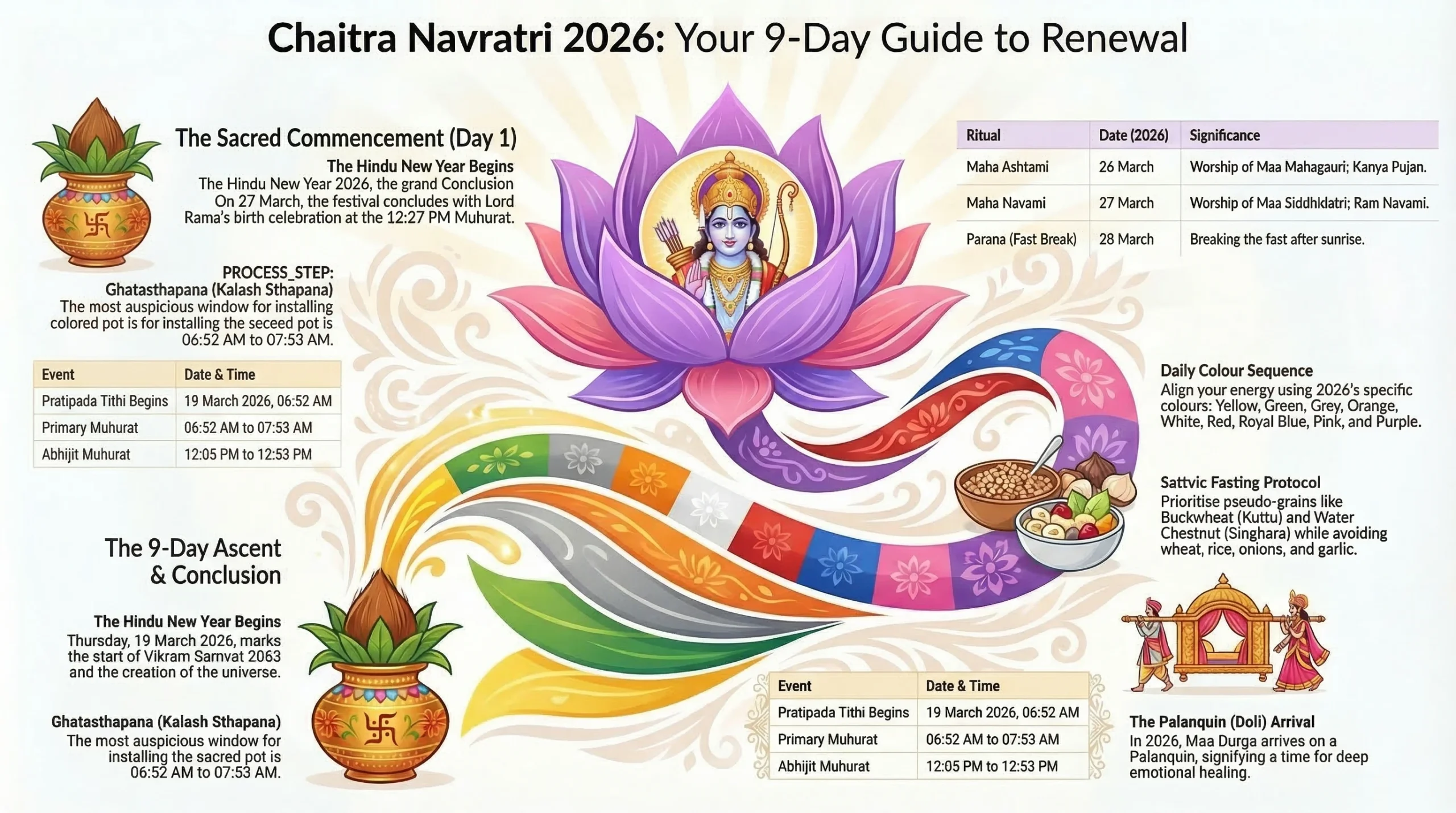
Introduction: Welcoming the Divine Feminine During Chaitra Navratri 2026
As the lingering, biting chill of winter finally begins to fade, making way for warm, golden sunshine and the vibrant blossoming of spring, we experience a profound shift—not just in the weather, but in the cosmic energy around us. This beautiful, natural transition period marks the highly anticipated arrival of Chaitra Navratri 2026, one of the most spiritually significant and widely revered festivals in the Hindu calendar. It is a time when the earth visibly rejuvenates itself, and similarly, we are gently invited to pause, reflect, and cleanse our own minds, bodies, and souls.
At its very core, Chaitra Navratri is a powerful nine-day spiritual journey dedicated to the worship of Maa Durga and her nine majestic manifestations, collectively known as the Navadurga. However, this festival carries a much deeper astronomical and cultural weight. According to ancient Vedic scriptures and the traditional lunar calendar, the start of this festival perfectly aligns with Chaitra Shukla Pratipada. This is no ordinary date; ancient texts proclaim this as the exact day Lord Brahma initiated the creation of the entire universe. Consequently, this highly auspicious day also marks the grand commencement of the Hindu New Year, ushering in the brand-new Vikram Samvat 2083.
While much of the modern world follows the Gregorian calendar, hitting the “reset” button on January 1st, the Hindu lunar calendar beautiful aligns human existence with the natural, cyclical rhythms of the sun, the moon, and the changing seasons. Beginning on Thursday, March 19, 2026, and concluding with the glorious celebrations of Lord Rama’s birth on Ram Navami on Friday, March 27, 2026, these nine days offer a rare, transformative window. It is an opportunity to connect deeply with Shakti—the ultimate cosmic energy and the supreme divine feminine force that runs the universe.
For millions of devotees across India and the global diaspora, the Chaitra Navratri dates symbolize a necessary internal reset. It is a dedicated period of mindful fasting, deep meditation, rhythmic mantra chanting, and unwavering devotion. Whether you are seeking spiritual enlightenment, seeking to heal from emotional turmoil, or simply wishing to invite prosperity and peace into your household, honoring the Goddess during this specific time is said to effectively remove negativity and attract immense divine blessings. From the initial, sacred installation of the Kalash to the heartwarming joy of Kanya Pujan, every single ritual is steeped in profound scientific and spiritual purpose.
We deeply understand how important it is to observe these sacred days with absolute precision, respect, and devotion. That is exactly why we have meticulously curated this comprehensive guide for you. If you have been searching the web for the most accurate and easy-to-follow Navratri 9 days calendar, you have finally arrived at the perfect destination.
In this ultimate, all-encompassing guide, we will walk you through everything you need to know for a spiritually fulfilling festive season. We have detailed the precise Ghatasthapana Muhurat so you don’t miss the most auspicious cosmic window, the day-by-day Navratri colors to help you align your personal energy with the Goddess, essential fasting rules for a healthy physical detox, and step-by-step puja rituals. Let us embark on this beautiful nine-day journey of faith, devotion, and divine grace together.
When is Chaitra Navratri 2026? Exact Dates & Tithi Timings
For those meticulously planning their spiritual calendar, the big question is: When does Chaitra Navratri 2026 begin? In 2026, the nine-day celebration of the Divine Feminine begins on Thursday, March 19, 2026, and concludes on Friday, March 27, 2026.
While the dates are set on the Gregorian calendar, the festival’s spiritual pulse is governed by the Tithi (lunar day). Understanding these timings is crucial for performing rituals like Ghatasthapana at the precisely right moment to harness maximum cosmic energy.
The Vital Tithi Timings for 2026
The festival commences on the Pratipada Tithi (the first lunar day) of the Chaitra month’s Shukla Paksha (waxing moon phase). This year, we see a rare and auspicious alignment:
- Pratipada Tithi Begins: March 19, 2026, at 06:52 AM
- Pratipada Tithi Ends: March 20, 2026, at 04:52 AM
Because the Tithi is active during sunrise on March 19th, this day is officially recognized as the first day of Navratri and the start of the Hindu New Year (Vikram Samvat 2083).
Day-by-Day Tithi Breakdown
To help you stay aligned with the lunar cycle, here is the exact progression of the Tithis for Chaitra Navratri 2026:
| Navratri Day | Date (2026) | Day | Lunar Tithi |
| Day 1 | March 19 | Thursday | Pratipada |
| Day 2 | March 20 | Friday | Dwitiya |
| Day 3 | March 21 | Saturday | Tritiya |
| Day 4 | March 22 | Sunday | Chaturthi |
| Day 5 | March 23 | Monday | Panchami |
| Day 6 | March 24 | Tuesday | Shashthi |
| Day 7 | March 25 | Wednesday | Saptami |
| Day 8 | March 26 | Thursday | Ashtami (Maha Ashtami) |
| Day 9 | March 27 | Friday | Navami (Ram Navami) |
The Significance of the “Thursday Start”
In Vedic astrology, the day a festival begins carries a specific “Vahana” or vehicle for the Goddess. Since Chaitra Navratri 2026 begins on a Thursday, it is believed that Maa Durga arrives on a Palanquin (Doli). This transition is traditionally associated with a period that requires extra care regarding health and global stability, but it also brings immense grace to those who focus on internal spiritual growth and “Sadhana.”
A Rare 72-Year Cosmic Alignment
Interestingly, 2026 presents a unique astronomical event. The Ghatasthapana Muhurat this year is influenced by a rare combination of Shukla Yoga and Brahm Yoga. Astrologers note that such a specific alignment during the Chaitra Pratipada has not occurred in nearly 72 years. This makes Chaitra Navratri 2026 an exceptionally powerful time for Sankalpa (setting deep intentions) and starting new spiritual practices
Ghatasthapana(Kalash Sthapana)2026: Muhurat and Vidhi
Chaitra Navratri ki shuruat sabse mahatvapurn rasam, Ghatasthapana ya Kalash Sthapana se hoti hai. Yeh rasam Maa Durga ke avahan ka prateek hai, jisme hum Devi Shakti ko apne ghar aur hriday mein birajman hone ka nimantran dete hain.
2026 mein Chaitra Navratri ke pehle din, yaani 19 March, 2026, ko Kalash Sthapana ke liye bahut hi shubh aur sateek samay ban raha hai. Neeche humne aapke liye 2026 ke sabse shubh Muhurat aur vidhi ki poori jankari di hai.
Ghatasthapana Shubh Muhurat 2026 (Chaitra Navratri)
Vedic panchang ke anusar, Kalash Sthapana hamesha shubh choghadiya ya Abhijit Muhurat mein hi karni chahiye. 19 March 2026 ko do bade shubh windows ban rahe hain:
- Pratahkaal (Morning) Muhurat: Subah 06:52 AM se 07:53 AM tak.
(Yeh sabse uttam samay hai kyunki is waqt Pratipada Tithi aur Suryodaya ka sangam ho raha hai.) - Abhijit Muhurat (Mid-day): Dopahar 12:05 PM se 12:53 PM tak.
(Agar aap subah ki puja chook jaate hain, to Abhijit Muhurat bina kisi sandeh ke sabse shubh mana jata hai.)
Dhyan dein: Is saal Ghatasthapana ke waqt Shukla Yoga lag raha hai, jo kisi bhi naye aur dharmik kaam ki shuruat ke liye behad phaldayi mana jata hai.
Ghatasthapana Puja Samagri (Checklist)
Pillar page ke liye zaroori hai ki hum apne pathakon (readers) ko poori list dein taaki unki puja mein koi badha na aaye:
- Mitti ka Kalash aur ek mitti ka patra (jau bone ke liye).
- Saff mitti (khet ya nadi ki mitti).
- Saptadhanya (7 prakar ke anaj ya Jau).
- Ganga Jal aur shuddh jal.
- Lal Kalawa (moli) aur Monal (shringar ka saman).
- Supari, Akshat (sabut chawal), aur Sikka.
- Aam ke patte (5 ya 7).
- Jata wala Nariyal (Lal chunri mein lipta hua).
- Lal kapda (bajot ya chowki par bichane ke liye).
Ghatasthapana ki vidhi ko humne bahut hi saral bhasha mein samjhaya hai taaki naye bhakt bhi ise aasani se kar sakein:
- Sthan ki Safai: Sabse pehle apne mandir ya puja sthal ko Ganga Jal chidak kar pavitra karein. Ek lakdi ki chowki rakhein aur us par lal kapda bichayein.
- Jau Bona: Mitti ke patre mein thodi mitti daalein aur usmein Jau (Barley) ke beej boyein. Iske upar thodi aur mitti daal kar halka jal chidkein.
- Kalash Taiyari: Kalash par moli bandhein aur ‘Swastik’ banayein. Kalash mein Ganga Jal aur shuddh jal bharein. Ismein supari, ek sikka, aur thode chawal daalein.
- Pallav aur Nariyal: Kalash ke mukh par aam ke patte rakhein. Nariyal ko lal chunri mein lapet kar kalash ke upar is tarah rakhein ki uska mukh upar ki taraf ya apni taraf ho.
- Avahan aur Sankalpa: Haath jodkar Maa Durga ka dhyan karein. Sankalpa lein ki “Hey Maa, main agle 9 dino tak aapki bhakti aur vrat ka palan karunga/karungi, kripya mere ghar mein padharein.”
- Deepak Prajwalan: Kalash ke daayi (right) taraf akhand jyot ya ghee ka diya jalayein aur ‘Om Aim Hreem Kleem Chamundayai Vichche’ mantra ka jap karein.
Vigyan aur Parampara ka Mel
Chaitra Navratri mein Jau (Barley) bona sirf ek parampara nahi hai, balki yeh “Srishti ki shuruat” ka prateek hai. Jau jitni tezi se aur hari-bhari ugti hai, utna hi shubh ghar ki pragati ke liye mana jata hai. 2026 mein, jab hum nayi umeedon ke saath Hindu Nav Varsh mein pravesh kar rahe hain, yeh Ghatasthapana hamare jeevan mein naye avsaron ke dwar kholegi.
The Detailed 9-Day Chaitra Navratri Calendar 2026
The 9-day journey of Chaitra Navratri is a spiritual ascent. Each day, we move closer to the divine by honoring a specific manifestation of Maa Durga. For Chaitra Navratri 2026, this journey begins on a Thursday, bringing with it the grounding energy of the Palanquin (Doli).
Here is your detailed, day-by-day guide to the Navdurga, including the 2026 Navratri colors, the specific bhog (offerings), and the spiritual significance of each day.
Day 1: Maa Shailputri – The Daughter of Mountains
- Date: March 19, 2026 (Thursday)
- Navratri Color 2026: Yellow (Symbolizes happiness and vitality)
- Bhog: Pure Cow Ghee
- Spiritual Focus: Grounding. Focus on the Muladhara (Root) Chakra to build stability for the week ahead.
- Mantra: Om Devi Shailaputryai Namah
Maa Shailputri represents the peak of consciousness. By offering pure ghee, devotees pray for a disease-free life and the strength of the Himalayas.
Day 2: Maa Brahmacharini – The Embodiment of Penance
- Date: March 20, 2026 (Friday)
- Navratri Color 2026: Green (Symbolizes growth and peace)
- Bhog: Sugar and Fruits
- Spiritual Focus: Willpower. Meditate on the Swadhisthana (Sacral) Chakra to cultivate patience and emotional balance.
- Mantra: Om Devi Brahmacharinyai Namah
This day is dedicated to the goddess who performed thousands of years of tapasya. It is an ideal day to set new spiritual goals and practice self-discipline.
Day 3: Maa Chandraghanta – The Destroyer of Fear
- Date: March 21, 2026 (Saturday)
- Navratri Color 2026: Grey (Symbolizes balance and the strength to protect)
- Bhog: Milk, Kheer, or Milk-based sweets
- Spiritual Focus: Bravery. Focus on the Manipura (Solar Plexus) Chakra to remove negative vibrations.
- Mantra: Om Devi Chandraghantayai Namah
With a crescent moon shaped like a bell on her forehead, she stands ready for battle. Offering milk on this day is believed to remove all worldly sorrows.
Day 4: Maa Kushmanda – The Cosmic Creator
- Date: March 22, 2026 (Sunday)
- Navratri Color 2026: Orange (Symbolizes enthusiasm and energy)
- Bhog: Malpua
- Spiritual Focus: Creativity. Meditate on the Anahata (Heart) Chakra to invite light into the darkest corners of your life.
- Mantra: Om Devi Kushmandayai Namah
Legend says she created the universe with a mere smile. Worshipping her on this day enhances intellect and decision-making power.
Day 5: Maa Skandamata – The Nurturing Mother
- Date: March 23, 2026 (Monday)
- Navratri Color 2026: White (Symbolizes purity and maternal grace)
- Bhog: Bananas
- Spiritual Focus: Family Harmony. Focus on the Vishuddha (Throat) Chakra to purify your speech and intent.
- Mantra: Om Devi Skandamatayai Namah
As the mother of Lord Skanda (Kartikeya), she represents the fierce, protective side of a mother. This day is exceptionally auspicious for those seeking blessings for their children.
Day 6: Maa Katyayani – The Warrior Goddess
- Date: March 24, 2026 (Tuesday)
- Navratri Color 2026: Red (Symbolizes power and fierce devotion)
- Bhog: Honey
- Spiritual Focus: Overcoming Obstacles. Focus on the Ajna (Third Eye) Chakra for clarity and intuition.
- Mantra: Om Devi Katyayanyai Namah
Born to destroy the demon Mahishasura, she is the goddess of righteous anger. Offering honey is a tradition to invite sweetness into your soul even while fighting life’s battles.
Day 7: Maa Kalaratri – The Destroyer of Darkness
- Date: March 25, 2026 (Wednesday)
- Navratri Color 2026: Royal Blue (Symbolizes confidence and the vastness of the cosmos)
- Bhog: Jaggery (Gur)
- Spiritual Focus: Fearlessness. Meditate on the Sahasrara (Crown) Chakra to transcend the ego.
- Mantra: Om Devi Kalaratryai Namah
Though her form is fierce, she is Shubhankari (the one who does good). She destroys the “demons” of anxiety and fear, leaving her devotees protected.
Day 8: Maa Mahagauri – The Goddess of Serenity
- Date: March 26, 2026 (Thursday)
- Navratri Color 2026: Pink (Symbolizes compassion and hope)
- Bhog: Coconut
- Spiritual Focus: Purification. This is the day of Maha Ashtami and the powerful Sandhi Puja (transition period).
- Mantra: Om Devi Mahagauryai Namah
Representing the purity of the mind, her worship is said to wash away past sins. Most families perform Kanya Pujan on this day, honoring young girls as living goddesses.
Day 9: Maa Siddhidatri – The Giver of Siddhis
- Date: March 27, 2026 (Friday)
- Navratri Color 2026: Purple (Symbolizes spiritual knowledge and luxury)
- Bhog: Halwa, Puri, and Chana
- Spiritual Focus: Fulfillment. The culmination of the 9-day journey into total enlightenment.
- Mantra: Om Devi Siddhidatryai Namah
As the name suggests, she grants all Siddhis (supernatural powers) and divine wisdom. This day also marks Ram Navami 2026, celebrating the birth of Lord Rama.
Ram Navami 2026: The Grand Conclusion
The nine-day spiritual journey of Chaitra Navratri reaches its magnificent crescendo on Friday, March 27, 2026, with the celebration of Ram Navami. While the previous eight days are dedicated to the diverse forms of Shaktism, the ninth day—Maha Navami—beautifully intertwines with the birth of Lord Rama, the seventh avatar of Lord Vishnu.In 2026, this day carries an even deeper significance as it marks the completion of the first Navratri of the new Hindu year (Vikram Samvat 2083), symbolizing the triumph of Dharma over Adharma.
The Auspicious Timings for Ram Navami 2026
For devotees looking to perform the Madhyahna (mid-day) Puja—the exact time Lord Rama was born—the following Muhurats are vital:
- Ram Navami Madhyahna Muhurat: 11:13 AM to 01:41 PM
- Moment of Rama Janma: 12:27 PM
- Navami Tithi Begins: 04:52 AM on March 27, 2026
- Navami Tithi Ends: 04:36 AM on March 28, 2026
The Spiritual Symbiosis of Shakti and Vishnu
Ram Navami is not just a birthday celebration; it is the spiritual “Grand Conclusion” where the energy of the Goddess (Shakti) meets the righteousness of the Preserver (Vishnu). It is believed that Lord Rama himself worshipped Goddess Durga before his battle with Ravana. Therefore, observing the fast on this day and completing the Navratri Parana (breaking the fast) brings the combined blessings of strength and wisdom.
Core Rituals of the Day
To capture the essence of this day at home, these traditional practices are followed across the globe:
- Shobha Yatra: In many cities, vibrant processions featuring idols of Rama, Sita, Lakshmana, and Hanuman take to the streets, accompanied by bhajans and chants of “Jai Shree Ram.”
- Ramayana Path: Devotees spend the morning reciting the Ramcharitmanas or the Vishnu Sahasranama. Many households organize a “Sundarkand Path” to invite protection and peace.
- The Cradle Ceremony: At exactly 12:27 PM, a small idol of Baby Rama (Ladoo Rama) is placed in a decorated cradle (Palna) and swung gently by devotees, symbolizing his birth in Ayodhya.
- Kanya Pujan (The Living Goddesses): For those who did not perform it on Ashtami, Navami is the final opportunity to feed nine young girls. They are served a traditional Sattvic meal of Sooji Halwa, Poori, and Sookha Kala Chana.
The Meaning of ‘Maryada Purushottam’ in 2026
In a world that is increasingly fast-paced and digital, the “Grand Conclusion” of Chaitra Navratri 2026 serves as a reminder of Lord Rama’s title: Maryada Purushottam (the supreme man of virtue). As we conclude our 9-day fast and prayer, the goal is to carry the discipline of the Navratri days into our daily lives—practicing truth, empathy, and resilience.
Chaitra Navratri Fasting Rules & Sattvie Diet Guide
In the rhythmic cycle of the Hindu calendar, fasting during Chaitra Navratri 2026 is more than a religious obligation; it is a profound scientific and spiritual detox. As the season shifts from the coolness of winter to the heat of summer, our digestive systems naturally become more sensitive. By following a Sattvic diet, we give our bodies a much-needed “reset” while elevating our mental clarity for meditation.
Whether you are observing a full 9-day fast or just a partial one, understanding the “how” and “why” behind the rules will make your journey much more rewarding.
The Golden Rules of Navratri Fasting
To maintain the purity of your Sadhana (spiritual practice), certain traditional guidelines must be followed. These rules ensure that your energy remains focused on the divine rather than on heavy, lethargic digestion.
- Mindful Consumption: The goal is Sattva (purity). Avoid “Rajasic” (stimulating) and “Tamasic” (heavy/dark) foods.
- The Salt Switch: Replace regular table salt with Sendha Namak (Himalayan Rock Salt). It is unprocessed, cooling for the body, and mineral-rich.
- Kitchen Purity: Traditionally, grains and non-Sattvic ingredients are stored away, and the kitchen is thoroughly cleaned before the first day of Navratri.
- Abstinence: Strict avoidance of alcohol, tobacco, non-vegetarian food, and even “heating” ingredients like onions and garlic is mandatory.
Your Sattvic Diet Guide: What to Eat & What to Avoid
Navratri is a great time to experiment with ancient, gluten-free grains and superfoods that we often overlook in our daily routines.
The “Yes” List (Foods to Embrace)
- Pseudo-Grains (Vrat ka Anaaj): Since real grains are avoided, we use Kuttu ka Atta (Buckwheat flour), Singhare ka Atta (Water chestnut flour), Rajgira (Amaranth), and Sama ke Chawal (Barnyard Millet).
- The Energy Boosters: Sabudana (Sago) is the go-to for instant energy. You can make khichdi, vada, or kheer.
- Daily Dairy: Milk, yogurt (curd), paneer, and buttermilk are essential for keeping the gut cool and providing protein.
- The “Vrat” Vegetables: Stick to grounding vegetables like potatoes, sweet potatoes (shakarkandi), pumpkins, bottle gourd (lauki), and arbi (colocasia).
- Dry Fruits & Seeds: Almonds, walnuts, and especially Makhana (Foxnuts) are perfect for healthy snacking.
- Fruits: All seasonal fruits are welcomed and encouraged.
The “No” List (Foods to Avoid)
- Grains & Legumes: Wheat, rice, semolina (suji), corn flour, and all types of pulses/dals are strictly prohibited.
- The Pungent Duo: Onion and garlic are believed to increase “Tamas” or lethargy and should be avoided.
- Processed Salts & Spices: Avoid common salt and spices like turmeric (in some traditions), mustard seeds, and asafoetida (hing). Use black pepper and cumin instead.
Staying energetic at work or home while fasting is all about balance. Here’s a quick idea of how to structure your day:
- Morning: Start with a handful of soaked almonds and a glass of warm lemon water or coconut water.
- Lunch: A bowl of Sama rice khichdi with plenty of curd, or Kuttu ki poori with a light potato curry (Aloo ki sabzi).
- Evening Snack: Roasted Makhana or a fruit salad with a sprinkle of Sendha Namak.
- Dinner: Keep it light. A glass of milk or a sweet potato chaat is ideal to ensure you wake up feeling light on Day 1 through Day 9.
The Deeper Purpose: Spiritual Detox
In 2026, as we juggle high-tech lives, this fasting period is your chance to practice ‘Mita-Hara’ (balanced eating). By eating lightly, you’ll find that your mind stays sharper and your meditation during the Chaitra Navratri days becomes deeper. It’s not about starving; it’s about nourishing the soul while resting the body.
Kanya Pujan(Ashtami/ Navami): Significance & Rules
The heartbeat of Chaitra Navratri lies in the realization that the Divine Feminine is not just a statue in a temple, but a living, breathing energy present in every girl. This brings us to Kanya Pujan (also known as Kanjak), the most soul-stirring ritual of the festival.
In 2026, Kanya Pujan will primarily be observed on March 26 (Maha Ashtami) and March 27 (Maha Navami). It is the moment where the devotee’s nine days of penance culminate in a beautiful act of humility and service.
The Spiritual Essence: Why Kanya Pujan?
According to our ancient scriptures, a young girl who hasn’t reached puberty is the purest manifestation of Maa Durga. When you perform Kanya Pujan, you are essentially telling the universe that you recognize the divinity in the human form. It is a ritual designed to instill respect for women and the girl child, reminding us that the “Shakti” we pray to in idols resides in the heart of every daughter.
In the context of Chaitra Navratri 2026, which marks the start of the Hindu New Year, this ritual serves as a pledge to protect and honor this feminine energy throughout the coming year.
The Meaning of the Nine Girls
While many people invite any number of girls, tradition suggests inviting nine girls, each representing one of the Navadurga forms:
- Kumarika: Grants freedom from poverty.
- Trimurti: Bestows prosperity and progeny.
- Kalyani: Brings education and success.
- Rohini: Helps in healing and health.
- Kali: Grants victory over enemies.
- Chandika: Brings wealth and luxury.
- Shambhavi: Removes obstacles.
- Durga: Grants protection from grand difficulties.
- Subhadra: fulfills all desires.
It is also a tradition to invite a young boy, representing Batuk Bhairav (the protector), as it is believed that the worship of the Devi is incomplete without acknowledging the protective presence of Bhairav.
Rules & Vidhi for a Meaningful Kanya Pujan
To ensure your 2026 Kanya Pujan is performed with the right “Bhav” (intent), follow these traditional steps:
- The Welcome: As the girls enter your home, greet them with joy. Wash their feet with water and milk in a decorative plate and wipe them with a clean cloth. This act symbolizes washing away your own ego.
- The Tilak: Apply a sandalwood or kumkum tilak on their foreheads and tie a sacred red thread (Moli) on their wrists.
- The Feast (Bhog): Serve the traditional Sattvic meal. In 2026, the classic menu remains undefeated: Desi Ghee Halwa, Poori, and Sookha Kala Chana. Ensure the food is prepared with the utmost hygiene and love.
- The Dakshina (Gifts): After the meal, it is customary to offer gifts. While many give money, in 2026, consider gifting items that are useful or sustainable—like stationery, red clothes, small plants, or fruits.
- Seeking Blessings: The most important part—touch their feet and seek their blessings. It is said that at this moment, the Goddess herself speaks through their innocent smiles.
When to Perform Kanya Pujan in 2026?
- Ashtami Kanya Pujan: Thursday, March 26, 2026. (Ideal for those who follow the Mahagauri tradition).
- Navami Kanya Pujan: Friday, March 27, 2026. (Ideal for those concluding the fast with Ram Navami).
Pro-Tip for 2026: Since the world is moving toward conscious living, try to avoid plastic packaging for the gifts you give to the “Kanjaks.” Opt for cloth bags or eco-friendly materials to honor the Earth Mother along with the Goddess.
To truly outrank the competition, your pillar page must address the specific “search intent” found in Google’s People Also Ask (PAA) boxes. These FAQs are designed to provide high-value, expert-led answers that boost your E-E-A-T (Experience, Expertise, Authoritativeness, and Trustworthiness).
Frequently Asked Questions about Chaitra Navratri 2026
1. What are the exact dates for Chaitra Navratri 2026?
Chaitra Navratri 2026 begins on Thursday, March 19, 2026, and concludes on Friday, March 27, 2026. The festival starts with Ghatasthapana on the Pratipada Tithi and ends with the celebration of Ram Navami on the ninth day.
2. What is the best time for Ghatasthapana (Kalash Sthapana) in 2026?
The most auspicious time (Shubh Muhurat) for Ghatasthapana on March 19, 2026, is during the morning window from 06:52 AM to 07:53 AM. If you miss this window, you can perform the ritual during the Abhijit Muhurat, which falls between 12:05 PM and 12:53 PM.
3. Why is Chaitra Navratri 2026 considered the Hindu New Year?
Chaitra Navratri begins on Chaitra Shukla Pratipada, which is the first day of the Hindu lunar calendar. In 2026, this day marks the beginning of Vikram Samvat 2083. According to Vedic tradition, this is the day Lord Brahma began the creation of the universe, making it the “official” spiritual New Year.
4. What are the 9 colors of Chaitra Navratri 2026?
Following the 2026 planetary alignments, the daily colors are:
- Yellow (March 19)
- Green (March 20)
- Grey (March 21)
- Orange (March 22)
- White (March 23)
- Red (March 24)
- Royal Blue (March 25)
- Pink (March 26)
- Purple (March 27)
5. Can we perform Chaitra Navratri Puja during Kharmas?
Yes. While Kharmas (a period when the Sun enters Pisces) is generally considered inauspicious for Manglik work like weddings or buying property, it does not restrict daily worship, fasting, or Navratri Puja. In fact, spiritual activities and Sadhana during Kharmas are believed to yield double the rewards.
6. When is Ashtami and Navami for Kanya Pujan in 2026?
Maha Ashtami falls on Thursday, March 26, 2026, and Maha Navami falls on Friday, March 27, 2026. Depending on your family tradition (Kul-Parampara), you can perform Kanya Pujan on either of these two days.
7. What foods are allowed and forbidden during Navratri fasting?
- Allowed: Kuttu (buckwheat), Singhara (water chestnut), Sabudana, Sama rice, Makhana, fruits, dairy products, and Sendha Namak (rock salt).
- Forbidden: Wheat, rice, lentils (dals), onions, garlic, common table salt, alcohol, and non-vegetarian food.
8. What is the significance of the “Doli” (Palanquin) Vahana in 2026?
Since Chaitra Navratri 2026 starts on a Thursday, the Goddess is said to arrive on a Palanquin (Doli). In Vedic astrology, this Vahana suggests a time for humanity to be cautious about health but promises divine grace for those who engage in deep prayer and emotional healing.
9. Can I start a new business or job during Chaitra Navratri 2026?
Navratri is one of the most powerful times to start a new venture because the 9 days are considered Siddha Muhurats (self-proven auspicious times). Despite the overlap with Kharmas, the period between March 19 and March 27 is excellent for signing contracts or launching digital projects.
10. When should I break my Navratri fast (Parana)?
The fast should ideally be broken after the Navami Tithi ends or after performing the Ram Navami Puja. In 2026, the Parana can be done on the morning of March 28, 2026, after sunrise, or after the conclusion of Navami rituals on the afternoon of March 27.
Final Conclusion: Embracing the Light
As we draw this guide to a close, remember that Chaitra Navratri 2026 is more than just a date on a calendar. It is a cosmic invitation to shed the old and embrace the new. By following the Ghatasthapana Muhurat, honoring the daily colors, and observing the fast with a pure heart, you align yourself with the powerful rhythms of the universe.
May Maa Durga bless your home with health, prosperity, and the courage to face every challenge. Jai Mata Di!
The Spiritual Synthesis: Navigating Chaitra Navratri 2026
As we stand on the threshold of Vikram Samvat 2083, it is clear that Chaitra Navratri 2026 is not merely a ritualistic observance, but a profound opportunity for a holistic “life-reset.” Over these nine sacred days—from the first sowing of the Jau on March 19 to the divine celebrations of Ram Navami on March 27—we are invited to participate in a tradition that is as much about inner engineering as it is about outer devotion.
In the fast-paced, digital-first world we inhabit, the discipline of the Navratri fast, the vibrance of the daily colors, and the precision of the Ghatasthapana Muhurat serve as grounding anchors. They remind us that while technology may change, the cosmic rhythms of Shakti (energy) and Dharma (righteousness) remain constant. This festival teaches us that strength is not just found in the warrior form of Maa Katyayani, but also in the serene patience of Maa Brahmacharini and the nurturing grace of Maa Skandamata.
Your Path Forward
As you prepare your home and heart for the Goddess’s arrival on her palanquin this year, remember that every small act of devotion—be it lighting a single Diya, offering a piece of jaggery, or simply treating a young girl with extra kindness—contributes to your spiritual growth. Chaitra Navratri is a journey from the “Root” to the “Crown,” a path that cleanses our past and illuminates our future.
We hope this ultimate 9-day guide serves as your spiritual compass for 2026. May the blessings of the Navdurga bring an abundance of health, mental clarity, and prosperity to you and your loved ones.
“Ya Devi Sarvabhuteshu Shakti-Rupena Samsthita, Namastasyai Namastasyai Namastasyai Namo Namah.”
(To that Goddess who dwells within all beings in the form of Power, I bow to her again and again.)





Leave a Reply