
If you’ve stepped into Ujjain this February, you know the air hits differently. We are officially in the “Mahakal Lok” era, and the spiritual energy following the Mahashivratri celebrations on February 15, 2026, is still vibrating through the city’s ancient cobblestones.
Whether you are a solo backpacker or visiting with family, navigating the Mahakal Lok Corridor and securing that elusive Bhasma Aarti booking requires a mix of digital savvy and traditional patience. Here is your boots-on-the-ground guide for late February 2026.
The Mahakal Lok Experience: More Than Just a Walkway
The Mahakal Lok isn’t just a corridor; it’s a portal into the Shiva Purana. Spanning nearly 900 meters, this grand plaza has redefined the pilgrimage experience.
- The Vibe: Walking past the 108 intricately carved sandstone pillars, you’ll see the stories of Tripurasura Vadh and the Kamal Talab come to life.
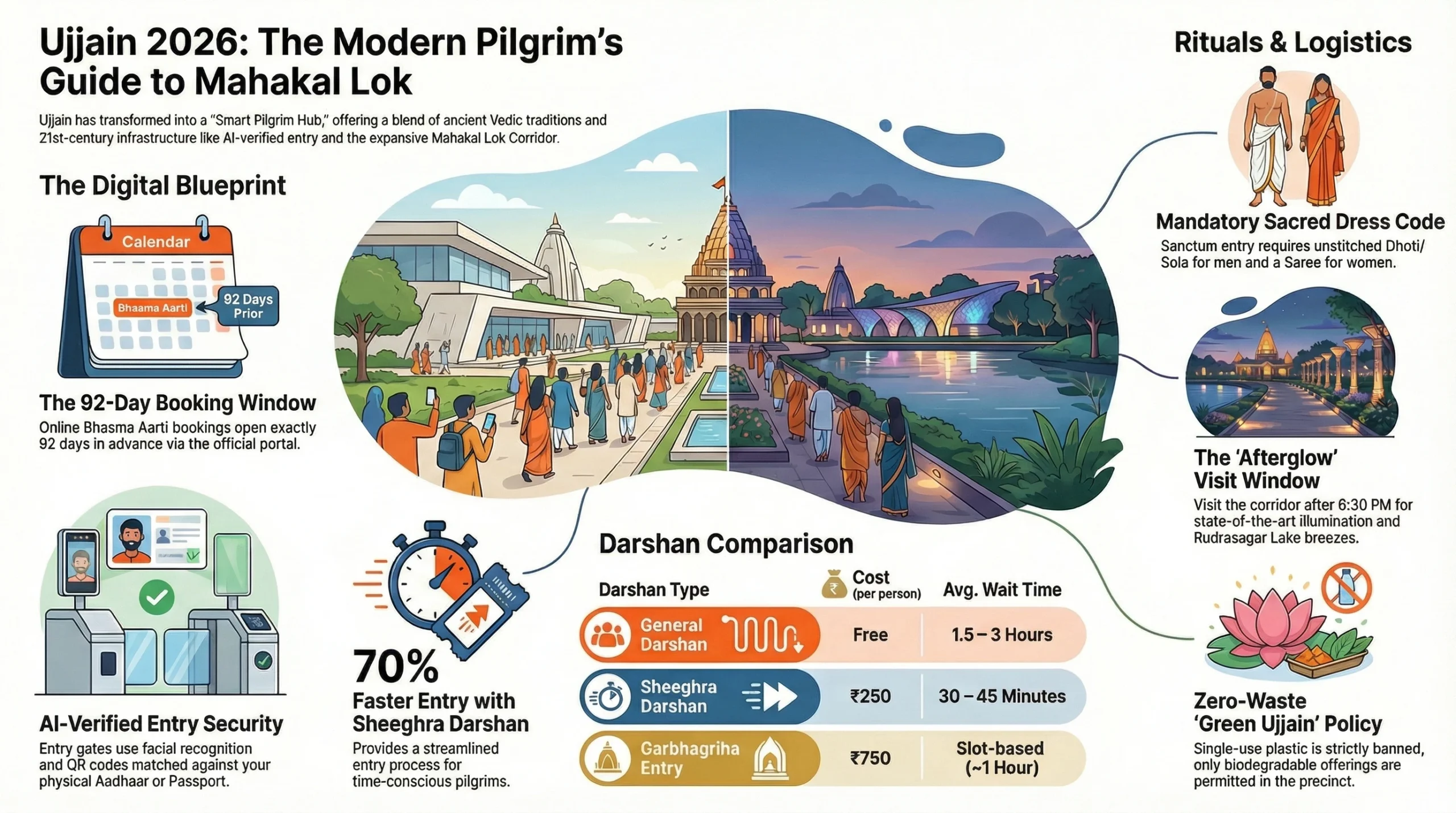
- Pro-Tip for Feb 2026: Even though the daytime weather in Ujjain is pleasant right now, visit the Corridor after 6:30 PM. The state-of-the-art lighting system transforms the murals into a glowing masterpiece, and the breeze from the Rudrasagar Lake is the perfect companion for your evening stroll.
Bhasma Aarti Online Booking: The 2026 Digital Blueprint
The Bhasma Aarti remains the “Holy Grail” of the Ujjain experience. In 2026, the administration has tightened the digital loop to prevent black marketing, making the official website your only reliable friend.
- The 3-Month Window: Online bookings open exactly 92 days in advance. If you’re planning for a post-winter trip, mark your calendars.
- The Lottery System: Due to the massive surge in post-Mahashivratri visitors, many slots are now allocated via a localized lottery. Ensure your Aadhaar or Passport details are scanned clearly; the AI-verified gate entry is strict about mismatched IDs.
- The Offline “Jugaad”: If you missed the online slot, the Koutilya Bhakt Niwas counter still issues a limited number of “On-Arrival” permissions at 7:00 AM the day before. Be prepared to join the queue by 4:00 AM.
The Mahashivratri 2026 Afterglow
While the main festival has passed, the “Shiv Navratri” energy lingers throughout February. This year, the temple recorded a record-breaking footfall, but the new Advanced Queue Management System (AQMS) has made the wait times much more manageable compared to five years ago.
- Dress Code Reminder: For Bhasma Aarti and Garbhagriha (Sanctum) entry, the rules are non-negotiable. Men must wear a Sola/Dhoti (unstitched), and women must be in a Saree.
- The VIP Shortcut: If your schedule is tight, the ₹250 Sheegra Darshan tickets are available at multiple kiosks around the Corridor. It cuts your wait time by nearly 70%, especially during the weekend rush.
Final Thought: Stay Grounded
Ujjain in 2026 is a blend of high-tech infrastructure and raw, ancient faith. While the apps and corridors make things easier, the soul of the journey is still that moment when you hear the chant of “Jai Mahakal” echoing through the halls.
Introduction: The Spiritual Renaissance of Ujjain
There is a specific kind of magic that settles over the city of Avantika (modern-day Ujjain) in late February. As the echoes of the massive Mahashivratri 2026 celebrations (held on February 15th) begin to harmonize with the daily rhythms of the city, you can feel it—a profound, multi-layered spiritual renaissance. This isn’t just about a temple anymore; it’s about the rebirth of one of the world’s oldest living cities into a global spiritual powerhouse.
For centuries, devotees flocked to the Mahakaleshwar Jyotirlinga to seek the blessings of the “Lord of Time.” But today, the experience has transcended the traditional temple visit. With the successful completion of the Mahakal Lok Phase 2 and the ongoing aesthetic transition from fiber statues to permanent, intricately carved stone and metal idols, the landscape of Ujjain has been permanently altered. The corridor is no longer just a path; it is a sprawling, 47-hectare open-air museum of Vedic wisdom and Shiv Puranic lore.
Why 2026 is the Year of Ujjain
If you are visiting in February 2026, you are witnessing the city at its peak. The “renaissance” isn’t just spiritual—it’s economic and cultural. This month, the city didn’t just host millions of pilgrims; it simultaneously celebrated the Vikramotsav 2026 and the Vikram Trade Fair, proving that Ujjain is reclaiming its ancient status as a center of trade, education, and faith.
The Spiritual Renaissance of Ujjain is characterized by:
- A Digital First Approach: From Bhasma Aarti online booking systems that utilize AI-verified IDs to real-time crowd management apps, the pilgrimage is now seamless.
- Infrastructure Marvels: The rejuvenation of the Rudrasagar Lake and the expansion of the pedestrian-friendly Mahakal Path have turned a once-congested area into a serene sanctuary.
- Authentic Restoration: Under the leadership of CM Mohan Yadav, the city is moving back to its roots, replacing temporary structures with authentic ancient architectural art, ensuring that the Mahakal Lok lasts for generations to come.
The Call of the Mahakal Lok Corridor
Stepping into the Mahakaleshwar Ujjain Corridor in 2026 feels like walking through a portal. Whether you are here for the soul-stirring Bhasma Aarti or to simply lose yourself in the 108 ornate pillars of the corridor, the energy is undeniable. It’s a place where the 4th-century descriptions by Kalidasa meet 21st-century urban planning.
As a traveller on Colcasac.com, you aren’t just looking for a “how-to” guide; you’re looking for a connection. This guide is designed to help you navigate this new era of Ujjain. We’ll dive into the nuances of Sheeghra Darshan, the hidden corners of the corridor you shouldn’t miss, and the practicalities of visiting a city that just hosted 10 lakh devotees in a single day.
Welcome to the new Ujjain. The Lord of Time is waiting, and the renaissance has only just begun.
Understanding the Mahakal Lok Corridor
If the Mahakaleshwar Temple is the soul of Ujjain, the Mahakal Lok Corridor is its grand, living heartbeat. Spanning over 900 meters and covering a staggering 47 hectares, this isn’t just a walkway; it’s an immersive journey through the cosmos of Lord Shiva. As of February 2026, the corridor has fully transitioned into its second phase, offering a seamless blend of ancient stone craftsmanship and high-tech pilgrim facilities.
The Architecture of Divinity: Pillars and Murals
The first thing that hits you as you enter is the sheer scale. The corridor is dotted with 108 ornate sandstone pillars, each representing the Anand Tandav (the dance of bliss) performed by Lord Shiva.
- The Mural Wall: A 365-meter-long mural wall acts as a stone-carved storyboard of the Shiva Purana. You’ll see the Tripurasura Vadh, the marriage of Shiva and Parvati, and the descent of the Ganga.
- The 2026 Upgrade: A major trending update for this year is the replacement of the original fiber statues with permanent, hand-carved stone and metal idols. This move, recently finalized by the state government, ensures that the Mahakal Lok maintains its ancient aesthetic while supporting local artisans from Ujjain and Rajasthan.
Navigating the Corridor: Entries and E-Carts
For a first-timer, the corridor can be overwhelming. To save your legs (and your time), keep these entry points in mind:
- Nandi Dwar: The primary majestic gateway, perfect for that “first-look” photo. It leads directly into the main plaza.
- Pinaki Dwar: Located near the parking area, this is usually less crowded and offers a quicker route to the temple entrance.
- Neelkanth Path (Phase 2): This newly developed section connects the Maharajwada complex to the main temple. It’s shaded and features lush green landscapes, making it the preferred route for afternoon visits.
Pro-Tip: If you’re traveling with kids or elderly parents, utilize the battery-operated e-carts available at the visitor plaza. They are a lifesaver given the 900-meter trek.
Phase 2 Magic: Maharajwada & Rudrasagar
February 2026 visitors are among the first to fully experience the Maharajwada Restoration. This historic building has been converted into a high-end heritage guesthouse and a “Kumbh Museum.”
The rejuvenation of Rudrasagar Lake is another highlight. In the evenings, the lake becomes the stage for a spectacular Water Screen Projection show at 8:00 PM. Seeing the reflection of the illuminated temple shikhara in the clean waters of Rudrasagar is, quite frankly, a core memory waiting to happen.
Photography and Ethics
While the Mahakal Lok is a dream for creators and photographers, remember the “Spiritual First” rule. Mobile photography is encouraged in the corridor, but strictly prohibited once you enter the inner temple precincts. Use the smart cloakrooms near the entry gates to safely store your devices before your main Darshan.
The Darshan Guide: Types & Timings (Feb 2026 Updated)
Navigating the Mahakaleshwar Temple in late February 2026 is a unique experience. We are currently in the “Afterglow” period of the massive Mahashivratri 2026 (Feb 15) celebrations and on the cusp of the Ujjain Simhastha Kumbh 2026 preparations.
While the 44-hour non-stop darshan window has closed, the crowd management systems implemented this month have set a new standard for efficiency. Here is how you can plan your visit today.
1. Types of Darshan: Which One is Right for You?
In 2026, the temple administration has streamlined entry into three distinct categories to ensure everyone—from the budget traveler to the time-pressed pilgrim—gets their moment with the Lord of Time.
| Darshan Type | Cost per Person | Average Wait Time (Feb 2026) | Best For |
| General Darshan | Free | 1.5 – 3 Hours | Budget-conscious devotees; those who want to experience the full Mahakal Lok walk. |
| Sheeghra Darshan | ₹250 | 30 – 45 Minutes | Families with children or seniors; travelers on a tight schedule. |
| Garbhagriha Entry | ₹750 | Slot-based (approx. 1 hour) | Devotees wishing to touch the Jyotirlinga and perform personal Jalabhishek. |
Note: As of February 24, 2026, Garbhagriha entry is generally restricted on Mondays and during peak evening hours (6:00 PM – 8:00 PM) to manage the post-festival influx.
2. Updated Timings for February 2026
The temple follows a “Winter Schedule” until the end of Falgun (March). Please note that timings are subject to slight shifts during lunar eclipses or special VIP movements.
- Temple Opening: 4:00 AM (Sharp)
- Bhasma Aarti: 4:00 AM to 6:00 AM (Online booking mandatory)
- Dadyodak Aarti: 7:30 AM to 8:15 AM
- Bhog Aarti: 10:30 AM to 11:15 AM
- Sandhya Aarti: 6:30 PM to 7:15 PM
- Shayan Aarti: 10:30 PM to 11:00 PM
- Temple Closing: 11:00 PM
3. The “Sheeghra Darshan” Protocol (₹250 Ticket)
In 2026, you no longer need to stand in long physical queues just to buy the “Fast Track” ticket.
- How to Book: Use the Official Mahakal App or the kiosks located at Gate No. 4.
- Digital Verification: Your ticket will have a QR code. At the entry, AI-enabled cameras verify your face against the ID provided during booking (Aadhaar/Passport).
- Entry Point: The Sheeghra Darshan queue starts primarily from Gate No. 4, bypassing the main Mahakal Lok detour, saving you nearly 1.2 km of walking.
4. Dress Code: Don’t Get Turned Away
The administration is stricter than ever in 2026. While general darshan allows for modest casuals, specific rituals have “hard” rules:
- Garbhagriha (Sanctum) & Bhasma Aarti:
- Men: Must wear a Sola or Dhoti (Unstitched cloth). A simple kurta-pajama is not allowed inside the sanctum.
- Women: Must wear a Saree. Salwar suits are generally discouraged for sanctum entry but allowed for viewing from the halls (Nandi Hall).
- General Darshan: Modest Indian or Western wear is fine, but strictly avoid shorts, sleeveless tops, or clothing with offensive graphics.
5. Pro-Tips for the Post-Mahashivratri Rush
- The “Zero-Waste” Rule: Ujjain is strictly enforcing a plastic-free zone. Avoid carrying plastic bags for offerings; use the biodegradable baskets provided by authorized vendors.
- Mobile Phone Ban: In Feb 2026, mobile phones are strictly prohibited beyond the visitor plaza. Use the Smart Lockers near the entry. They use biometric locks, so you don’t have to worry about losing a physical key.
- Best Time to Visit: If you aren’t doing the Bhasma Aarti, try the 2:00 PM to 4:00 PM window. Most of the morning crowd has cleared, and the evening “Light Show” crowd hasn’t arrived yet
Bhasma Aarti; The holygrail of Booking
Witnessing the Bhasma Aarti is often described as the “Holy Grail” of the Ujjain pilgrimage. It is the only ritual of its kind in the world where the Jyotirlinga is “awakened” with sacred ash at the break of dawn (4:00 AM).
In 2026, with the completion of the Mahakal Mahalok Phase 2, the booking process has become a high-stakes digital race. Here is your survival guide to securing a spot.
The Digital “Hunger Games”: Online Booking
The administration has streamlined the process, but the demand remains astronomical. As of February 2026, slots for major dates are often gone within minutes of opening.
- The Window: Bookings open 30 to 60 days in advance. For example, if you are planning a summer visit in June, the portal typically opens on February 15th.
- The Official Portal: Only use the Official Mahakaleshwar Website. Avoid “agents” promising “guaranteed entry”—they are often scams.
- The Requirement: You will need a scanned copy of a government-verified ID (Aadhaar, Passport, or PAN). The system now uses QR-coded E-passes that are cross-referenced with your physical ID at the gate.
The “Hail Mary”: Offline Booking
If you missed the online window, you have one last shot—the Offline Lottery.
- Location: Head to the Koutilya Bhakt Niwas or the specialized counters near Gate No. 4.
- Timing: You must report by 10:00 AM the day before you wish to attend.
- The Catch: This is a first-come, first-served quota. On peak days (Mondays or post-Mahashivratri weeks), people start queuing at 6:00 AM just for the chance to get an offline ticket.
Bhasma Aarti 2026: Fast Facts
| Detail | Requirement / Info |
| Aarti Timing | 4:00 AM to 6:00 AM |
| Reporting Time | 1:00 AM to 2:00 AM (Security checks are intensive) |
| Price (Normal) | ₹100 – ₹200 (Maintenance fee) |
| VIP/Combo | ₹2,500 (Includes Bhasma Aarti + Garbhagriha Entry) |
| Entry Gate | Usually Manasrovar Gate or Gate No. 4 (Check your pass) |
The Strict Protocol: Dress Code & AI Verification
The temple management in 2026 has doubled down on traditional sanctity. If you aren’t dressed correctly, you will be turned away at the final gate, even with a confirmed ticket.
- For Men: You must wear a Dhoti and Shola (unstitched cloth). You cannot wear a shirt or vest underneath during the actual ritual if you are in the Nandi Mandapam or Garbhagriha.
- For Women: A Saree is mandatory. Note that “Suit-Saluwar” is generally permitted for the gallery, but a Saree is required for any ritual participation near the sanctum.
- Tech Entry: 2026 introduced AI-integrated crowd monitoring. The gates now use biometric/facial recognition matched against your uploaded ID to prevent the reselling of passes.
Pro Tip: In the “Afterglow” of Mahashivratri (February 15th, 2026), the temple remains exceptionally crowded for two weeks. If you are visiting in late February, expect reporting times to be pushed back to midnight to accommodate the 5-layer security check.
Essential Online Bookings & Digital Services
In February 2026, Ujjain is no longer just an ancient city; it’s a Smart Pilgrim Hub. Gone are the days of wandering aimlessly looking for a receipt counter. To navigate the post-Mahashivratri rush and prepare for the upcoming Simhastha Kumbh, the Shri Mahakaleshwar Temple Management Committee (SMTMC) has integrated a “Digital-First” protocol.
If you want to spend more time in prayer and less time in queues, you need to master these four digital pillars.
1. The Official Digital Portals
To avoid the heartbreak of fake tickets and “middleman” scams, bookmark only the authorized sites.
- Official Website: shrimahakaleshwar.mp.gov.in — This is your command center for Bhasma Aarti, Sheeghra Darshan, and specialized Pujan bookings.
- The “Mahakal Official” App: Available on both Android and iOS, this app is essential for real-time crowd density updates. In late February, before you leave your hotel, check the app’s “Live Wait Time” feature to decide whether to take the general entry or the ₹250 Sheeghra Darshan route.
2. New for 2026: Paid Seated Aarti Bookings
A major change introduced in February 2026 is the ticketing of the evening and night rituals. To manage the surge in “spiritual tourism,” the committee has introduced a seated booking system:
- Sandhya Aarti (Evening) & Shayan Aarti (Night): While walking darshan remains free, a reserved seat now costs ₹250.
- Why book? It guarantees you a spot in the Nandi Hall to sit and absorb the vibrations of the chants without being moved along by the security staff. These slots open 7 days in advance on the website.
3. The “Smart” Locker & Cloakroom System
One of the biggest pain points—what to do with your phone—has been solved.
- Smart Lockers: Located near Nandi Dwar and Pinaki Dwar, these are biometric-enabled.
- Digital Pre-booking: You can now “pre-reserve” a locker via the app for a 4-hour slot. Once you arrive, you simply scan your QR code, and the locker pops open. No more carrying around physical keys while you are in your Sola or Saree.
4. Online Prasad & Virtual Pujan
If you can’t make it to Ujjain but still want the blessings of the February Falgun month, the digital services have you covered:
- Prasad Home Delivery: You can order the famous Ladoo Prasad directly from the official portal. In 2026, they have partnered with major logistics providers to ensure “Sanctity-sealed” packaging reaches you within 3–5 days across India.
- Virtual Abhishekam: For those abroad, the temple offers a “Video Call Pujan.” A priest performs the ritual in your name at a designated sub-shrine, and you can join via a secure link provided in your booking confirmation.
Digital Checklist for Feb 2026 Travelers
| Service | Booking Window | Requirement |
| Bhasma Aarti | 30–60 Days | Aadhaar/Passport PDF |
| Sheeghra Darshan | Same Day / 1 Day Prior | QR Code on Phone |
| Atithi Niwas (Stay) | 15 Days Prior | Mobile Verification |
| Audio Guide App | On-the-spot | Headphones (Bring your own!) |
Insider Secret: If the website shows “Full” for Bhasma Aarti, check the app at exactly 8:00 AM IST the day before your visit. The “cancellation quota” is released then, and you might just snag a last-minute miracle entry.
February 2026 Special: The Mahashivratri Aftermath
If you are visiting Ujjain right now, on February 24, 2026, you are witnessing one of the most serene yet spiritually charged windows of the year. The chaotic peak of Mahashivratri (February 15) has passed, but the city hasn’t quite returned to “normal.” Instead, it is basking in the Vivah-Utsav (wedding celebration) aftermath of Lord Mahakal and Mata Parvati.
Here is what makes the late-February period unique:
1. The “Sehra” Distribution & Post-Wedding Vibe
On the morning after Mahashivratri (Feb 16), the famous Sehra Darshan took place, where the Jyotirlinga was adorned with a massive 1.5-quintal floral veil, representing the Lord as a groom.
- Today’s Benefit: While the Sehra itself has been removed, the energy of the “Divine Wedding” persists. Many devotees visit this week specifically to seek blessings for marital harmony and the resolution of delayed marriages. The “wedding feast” atmosphere still lingers in the local Ashrams, where Bhandaras (community meals) are still frequent.
2. Transition from Shiv Navratri to Simhastha Prep
Ujjain just concluded its unique 10-day Shiv Navratri (Feb 6–15). As of today, the temple has transitioned from the intense “Shringar” cycles (where the deity changed forms daily) back to its classic Nirakaar (formless) and Bhasma centric rituals.
- The 2026 Factor: You’ll notice heavy construction and beautification drives around the Kshipra river banks. This is because the city is in “war footing” mode for the 2026 Simhastha Kumbh Mela. Visiting now allows you to see the new heritage corridors and riverfronts before the 100-million-strong Kumbh crowd arrives.
3. Crowd Patterns: The “Sweet Spot”
The 10-lakh (1 million) person surge from the 15th has subsided.
- Wait Times: While the wait was 8–10 hours during the festival, it has now dropped to a manageable 1.5 to 2 hours for general darshan.
- Pro-Tip: Early morning (post-Bhasma Aarti) and late night (post-8 PM) are currently the best times to experience the Mahakal Lok without the tourist shuffle.
4. Weather & The “Phalguna” Breeze
Late February in Ujjain is arguably the best weather window.
- The afternoons are warm (around 28°C) but the evenings are crisp and cool (14°C – 16°C).
- The Mahakal Lok Corridor looks its best right now because the evening winds from the Rudrasagar Lake make the 900-meter walk incredibly pleasant—something that becomes difficult by the time April’s heat kicks in.
Summary of the “Aftermath” Week
| Feature | Status (Feb 24–28, 2026) |
| Crowd Level | Moderate (Steady flow of “afterglow” pilgrims) |
| Temple Decor | Transitioning from floral wedding themes to permanent stone aesthetics |
| Accommodation | Prices have stabilized after the Mahashivratri peak |
| Vibe | Meditative, celebratory, and “Spring-like” |
Logistics: How to Reach & where to stay.
Ujjain in 2026 has become a model for “Digital Pilgrimage.” With the city preparing for the Simhastha Kumbh 2026 (starting late 2026 into 2027), the transit and lodging systems are more organized than ever.
Here is your logistics blueprint for a smooth visit.
How to Reach Ujjain
1. By Air (The Indore Gateway)
- Nearest Airport: Devi Ahilyabai Holkar Airport (IDR), Indore.
- Distance: ~55 km (roughly 1 hour 15 minutes by road).
- Transit to Ujjain:
- Pre-paid Taxi: Available at the IDR arrival gate (approx. ₹1,800–₹2,500).
- Uber/Ola Intercity: Very reliable; usually costs slightly less than airport taxis.
- The “Bus-Train” Hybrid: Take a local city bus (Electric) from the airport to the Indore Railway Station, then hop on the Vande Bharat Express or a local Intercity train to Ujjain (1 hour).
2. By Rail (Ujjain Junction – UJN)
Ujjain is a major hub. In 2026, several high-speed trains connect it to the rest of India:
- Vande Bharat: Connects Ujjain to Bhopal, Indore, and Delhi.
- Station Logistics: Ujjain Junction has been renovated. Use the new Platform 8 exit for quicker access to the city’s newer hotel districts and to avoid the old city congestion.
3. By Road
- From Indore: The 4-lane highway is excellent.
- Bus Services: Chartered Bus and Intercity Travels offer luxury Volvo/Electric services every 20 minutes from Indore’s Sarwate Bus Stand and AiCTSL campus.
Where to Stay: 2026 Recommendations
Accommodation in Ujjain is now classified by “Corridor Proximity.”
1. The “Spiritual Central” (Right at the Temple)
Best for those attending Bhasma Aarti (2 AM slots).
- Madhav Seva Nyas (Shree Mahakaleshwar Bhakt Niwas): * The Gold Standard: Managed by the trust, it’s clean, secure, and has its own canteen.
- Booking: Must be done via the Official Website or their dedicated portal.
- Hotel Bholenath Palace: Located literally steps from the entrance. Ideal if you want to walk to the temple in your Sola (ritual cloth).
2. Mid-Range & Modern (1-3 km away)
- Hotel Abika Elite: A favorite for families. It offers great vegetarian food and organized temple transfers.
- Hotel Shreem: Known for its “Corridor Views” and professional service.
3. Luxury & Resorts (Away from the chaos)
- MPT Samrat Vikramaditya: A government-run heritage property. High ceilings and a sense of old-world Ujjaini royalty.
- Anjushree: The top-tier luxury choice. If you want a pool and a global buffet after a long day of walking the Mahakal Lok, this is it.
Getting Around Ujjain
- E-Rickshaws: These are the heartbeat of the 2026 “Green Ujjain” initiative. They cost ₹20–₹50 for most distances within the city.
- Mahakal Lok Shuttle: There are small electric buggies that run within the Corridor for elderly and disabled pilgrims.
- Parking: If you are driving, park at the Karkraj Parking or Hari Phatak multi-level lots. Don’t try to take your car into the narrow temple lanes; you will get stuck.
Quick Logistics Table
| Mode | Typical Cost | Travel Time | Best For |
| Taxi (Indore-Ujjain) | ₹2,000 | 75 Mins | Comfort & Luggage |
| Train (Indore-Ujjain) | ₹150 (Gen) – ₹500 (VB) | 60 Mins | Speed & Punctuality |
| E-Rickshaw (Local) | ₹40 | 10 Mins | Temple Hops |
Beyond the Temple: The panch koshi yatra circuit.
While the Mahakaleshwar Temple is the center of the Ujjaini universe, the Panch-Koshi Yatra represents the outer cosmic boundary. In local tradition, the “true” pilgrimage to Ujjain isn’t complete until you’ve acknowledged the protective deities guarding the city’s four directions.
In February 2026, this circuit is particularly vibrant as devotees walk the path to “seal” their Mahashivratri blessings. Here is the spiritual layout of the circuit.
1. The Meaning of “Panch-Koshi”
The name refers to a journey of five kosh (an ancient unit of distance). In Ujjain, this is a 118-km circumambulation (parikrama) of the holy city. While hardcore pilgrims do this on foot over five days, most modern travelers visit the key “pillar” temples of the circuit by car in a single day.
2. The Four Pillars & The Center
The circuit is designed like a protective square with the Mahakaleshwar Jyotirlinga at the center.
| Temple | Direction | Significance |
| Pingaleshwar | East | Dedicated to the “Tawny-Eyed” Shiva; the first stop of the traditional walk. |
| Kayavarohaneshwar | South | Located in the village of Jaisinghpura; symbolizes the “descent of the body.” |
| Durdhareshwar | West | Protects the western flank; known for its deep spiritual silence. |
| Bilveshwar | North | Surrounded by Bel (wood apple) trees, sacred to Lord Shiva. |
3. Must-Visit “Power Spots” Beyond the Circuit
If you aren’t doing the full 118-km trek, ensure your February 2026 itinerary includes these three “High Energy” sites that are part of the broader spiritual fabric:
- Kaal Bhairav (The Kotwal of Ujjain): You must visit here after Mahakaleshwar. Legend says Bhairav is the guardian of the city, and your pilgrimage isn’t “signed off” until you visit him.
- The Ritual: The deity is famously offered liquor. In 2026, the temple has streamlined the queue system, but expect a 45-minute wait on Sundays.
- Harsiddhi Mata (The Shaktipeeth): Just a short walk from the Mahakal Lok. This is where Sati’s elbow fell.
- 2026 Night Tip: Don’t miss the lighting of the two 13th-century lamp pillars at sunset. It takes a team of workers to climb and light hundreds of diyas simultaneously—it’s the most Instagrammed spot in Ujjain right now.
- Mangalnath (The Birthplace of Mars): Perched on a hill overlooking the Shipra river.
- Why Visit: Ancient Indian geography considers this the “Center of the Earth.” If you have “Mangal Dosh” in your horoscope, this is the global hub for Bhaat Puja (rice offerings). In Feb 2026, the river views from here are stunningly clear.
4. The “Sandipani Ashram” Stop
Before you finish your circuit, stop at the Sandipani Ashram. This is the ancient “University” where Lord Krishna, Balarama, and Sudama studied.
- The 64-Day Miracle: Legend says Krishna mastered 64 arts in 64 days here.
- Look for: The stone where the numbers 1 to 100 are still engraved, believed to be the original slate used by the Guru.
5. Logistics for the Circuit
- Hire a Local Driver: Don’t try to navigate the Panch-Koshi villages yourself; many roads are currently under expansion for the 2026 Kumbh.
- Timing: Start at 7:00 AM to finish all four direction temples and the Kaal Bhairav temple by 2:00 PM.
- The Shipra Dip: It is customary to end your circuit with a holy dip at Ram Ghat. In Feb 2026, the water quality is at its peak due to the recent “River Linking” project completions.
Practical Travel Tips for the Modern Pilgrim
Visiting Ujjain in February 2026 is a vastly different experience than it was even two years ago. The city has fully embraced its “Smart City” status, meaning the modern pilgrim needs to be as tech-savvy as they are devout. To ensure your journey is about meditation and not frustration, keep these practical “insider” tips in your pocket.
1. The Digital “Lifeblood”: Apps & Connectivity
- Download the “Ujjain Smart City” App: This is your Swiss Army knife. It provides real-time parking availability, bus routes, and most importantly, live queue wait times for the Mahakal Temple.
- Carry a Power Bank: Between using GPS to navigate the Mahakal Lok and showing your QR-coded Bhasma Aarti passes, your phone battery will drain faster than usual.
- Reliable Network: While 5G is excellent across the Mahakal Lok, signal strength can drop inside the thick stone walls of the older temples (like the inner sanctum of Harsiddhi). Download your offline maps of the city just in case.
2. Managing Your Belongings: The Locker Strategy
- The “No Phone” Zone: Mobile phones, smartwatches, and even certain electronic car keys are strictly prohibited inside the main temple.
- Biometric Smart Lockers: Don’t leave your valuables in your shoe rack. Use the Biometric Lockers near Gate No. 4 or the Manasrovar Entrance. They use your fingerprint or face ID to lock, so you don’t have to carry a physical key while wearing your Sola or Saree.
- Footwear: You will walk a lot. Wear slip-on shoes or crocs. Avoid expensive leather footwear, as the shoe-stands can get chaotic during the evening rush.
3. The “Mahakal Lok” Walking Guide
- Hydration Stations: The corridor is 900 meters long. While there are water fountains, carry a reusable (non-plastic) bottle. Ujjain is a Strictly Plastic-Free Zone in 2026; carrying single-use plastic bottles can result in a fine.
- Timing Your Walk: The stones can get warm by 11:00 AM. If you are visiting during the day, try to stick to the shaded mural pathways.
- E-Carts: There is a dedicated lane for battery-operated carts. If you have seniors with you, don’t hesitate to use them; they are free for the elderly and disabled.
4. Health & Hygiene
- The “Annakshetra” (Free Meals): The Mahakal temple runs one of the cleanest mass kitchens in India. If you eat at the Annakshetra, it is nutritionally balanced and prepared with high hygiene standards.
- Crowd Safety: Since it’s the post-Mahashivratri window, crowds are still significant. If you are prone to anxiety in tight spaces, avoid the “General Entry” on Mondays. Opt for the Sheeghra Darshan (₹250) which offers a much wider, ventilated queue path.
5. Essential “What to Carry” Checklist
| Item | Why? |
| Physical Aadhaar/ID | Digital copies are great, but some security checkpoints still ask for the original. |
| Small Cloth Bag | To carry your shoes if you decide to enter from one gate and exit from another. |
| Hand Sanitizer & Tissues | Essential after performing Jalabhishek or eating local street food. |
| Medicines | Specifically for digestion (Ujjain’s Poha and Kachoris are irresistible but spicy!). |
| Extra Saree/Dhoti | If you plan on doing a second Abhishek, you’ll need a fresh, dry set of ritual wear. |
6. Money & Payments
- UPI is King: From the smallest bel-patra vendor to the temple’s official donation counter, UPI is accepted everywhere.
- Cash for “Dakshina”: If you plan on performing a private Puja at the Ram Ghat or with a Panda (priest), keep small denominations of cash (₹50, ₹100) handy, as digital payments are sometimes awkward in ritual settings.
Sustainability & Conduct
As we step into the Mahakal Lok era in 2026, the definition of a pilgrimage has evolved. It is no longer just about what blessings you take home, but about what you leave behind. With millions flocking to Ujjain post-Mahashivratri, the city’s infrastructure is tested daily. As a modern devotee, your conduct contributes directly to the sanctity of this ancient space.
Here is how you can be a responsible “Guardian of the Corridor.”
1. The “Zero-Waste” Offering Protocol
Ujjain has implemented one of the strictest Single-Use Plastic Bans in India.
- The “Dona” Rule: When buying flowers or Bilva Patra, insist on leaf bowls (donas) or bamboo baskets. If a vendor offers a plastic bag, politely refuse.
- The “Pushpa-Seva” Cycle: Did you know the flowers you offer don’t end up in a landfill? In 2026, the temple’s Flower Recycling Unit converts tons of floral waste into organic incense sticks and compost. Ensure you deposit your used flowers in the designated “Nirmalya” bins to keep this green cycle moving.
2. Respecting the Water: Kshipra & Rudrasagar
The Rudrasagar Lake, which mirrors the Mahakal Temple, has been painstakingly revitalized.
- No Soap at Ram Ghat: If you plan to take a holy dip in the Shipra river, do not use soap, shampoo, or oil. The river’s ecosystem is fragile. Use the designated shower areas on the banks for cleansing before or after the dip.
- Don’t Feed the Fish (Plastic): While feeding fish is a tradition, throwing plastic packets of food into the water is a crime against nature. Use the dough balls provided by authorized vendors.
3. Digital Decorum: The “Instagram” vs. “Inner” Balance
The Mahakal Lok is undeniably photogenic—the lighting, the statues, the murals are designed to be captured. However, there is a thin line between appreciation and intrusion.
- The “Privacy” of Prayer: Avoid filming other devotees who are in deep meditation or emotional distress. A pilgrimage is a vulnerable experience for many; respect their moment.
- The Sanctum Sanctorum: The ban on photography inside the Garbhagriha is not just for security; it is to maintain the spiritual frequency of the space. In 2026, getting caught filming a “Reel” inside the inner sanctum can lead to a permanent ban from online booking portals.
4. Patience is Your Greatest Offering
In late February 2026, despite the high-tech queue management, you will wait.
- Treat Staff with Grace: The security personnel and Sewadars (volunteers) often work 12-hour shifts managing waves of crowds. A simple smile or cooperation during frisking goes a long way.
- The “Queue Jumper” Myth: Don’t try to cut lines. The AI-monitored corridor tracks movement patterns, and security is alerted immediately to disruptions. It’s not worth the embarrassment.
5. Begging vs. Supporting
- Official Donations Only: Avoid giving cash to beggars within the corridor complex. instead, donate to the Mahakal Annakshetra (Free Kitchen) or the Goshala (Cow Shelter) via the QR codes placed throughout the temple. This ensures your money actually feeds the hungry and protects the cows.
Frequently Asked Questions about the Mahakaleshwar Ujjain Corridor Guide
Here are the answers to the most common questions flooding the search engines in February 2026.
1. How can I book Bhasma Aarti if the online slots are full?
Answer:
As of February 24, 2026, online slots are fully booked until May 2026. Your only option is the Offline Counter.
- Where: Go to the counter near Gate No. 4 or the Koutilya Bhakt Niwas.
- When: You must queue up by 6:00 AM on the day before you want to visit (e.g., queue on Tuesday morning for Wednesday morning Aarti).
- What to bring: Original Aadhaar/Passport of every family member.
- Success Rate: It is a lottery system; approximately 1,500 – 2,000 offline tickets are issued daily.
2. What is the ticket price for Sheeghra Darshan in 2026?
Answer:
The Sheeghra Darshan (Fast Track) ticket costs ₹250 per person.
- Booking: You can book it on the Official Website or at the Protocol Office near bada Ganesh temple.
- Benefit: It reduces the wait time from 2–3 hours to approximately 30–45 minutes.
- Entry Gate: Usually Gate No. 4 (subject to crowd management changes).
3. Are mobile phones allowed inside the Mahakal Temple?
Answer:
Strictly NO.
In 2026, the ban is rigorously enforced, especially for Bhasma Aarti and Garbhagriha entry.
- Storage: You must deposit your phone in the Smart Lockers near the main entrances (Gate 4 or Mansarovar).
- Photography: Photography is permitted only in the Mahakal Lok Corridor (outside the main temple complex). Inside the main temple, being caught with a phone can lead to a fine and confiscation.
4. Is there an entry fee for the Mahakal Lok Corridor?
Answer:
No, entry to the Mahakal Lok Corridor is Free.
- Timings: It is open 24/7.
- Best Time: Visit between 7:00 PM and 10:00 PM to see the stunning illumination and the laser/light show at Rudrasagar Lake.
5. Can I touch the Jyotirlinga (Garbhagriha Entry)?
Answer:
General entry into the sanctum (Garbhagriha) to touch the Shivling is restricted during peak hours (morning 6–10 AM, evening 5–8 PM) and on Mondays.
- Paid Entry: A special receipt (₹750 or ₹1500, subject to slot) is often required for sanctum entry during non-peak hours (1:00 PM – 4:00 PM).
- Dress Code: Men must wear unstitched Dhoti/Sola and women must wear a Saree to enter the Garbhagriha.
6. Is the temple wheelchair friendly?
Answer:
- Mahakal Lok Corridor: Fully wheelchair accessible with ramps and electric buggies.
- Main Temple: Wheelchairs can go up to the Nandi Hall (Ganesh Mandapam) via designated ramps. However, wheelchairs are not allowed inside the Garbhagriha (Sanctum) or the narrow Bhasma Aarti exits.
- Assistance: Ask for a “Sahayak” (helper) at the administrative office if you are traveling alone.
7. How do I reach Omkareshwar from Ujjain?
Answer:
Omkareshwar is about 135 km from Ujjain.
- Bus: Direct buses leave from Dewas Gate Bus Stand and Nanakheda every 30 minutes. The journey takes 3.5 to 4 hours.
- Train: There are limited direct trains; buses or private taxis are faster and more reliable.
- Taxi Cost: A round-trip private taxi charges between ₹3,500 – ₹4,500 in Feb 2026.
8. What is the new “Seated Aarti” booking (Feb 2026)?
Answer:
This is a new facility launched to manage crowds. You can now pay ₹250 to book a guaranteed seat in the hall for:
- Sandhya Aarti: (Evening 6:30 PM – 7:15 PM)
- Shayan Aarti: (Night 10:30 PM)
- Booking: Online only via the official website. This ensures you don’t have to stand in the moving queue during the Aarti.
9. Can I wear jeans/western wear?
Answer:
- General Darshan (from a distance): Yes, modest western wear (Jeans, T-shirts) is allowed. Avoid shorts, sleeveless tops, or ripped jeans.
- Garbhagriha/Sanctum Entry: NO. Strict traditional Indian attire (Dhoti/Saree) is mandatory.
10. Where is the best place to buy Prasad?
Answer:
Always buy the Laddu Prasad from the Official Temple Counters located inside the complex and near the exit gates.
- Why: It is subsidized, pure (Desi Ghee), and supports the temple kitchen.
- Avoid: Private shops outside claiming to sell “Temple Prasad”—it is often not the authentic Bhog offered to the deity.



Leave a Reply