
12 Jyotirlingas in India: The Ultimate Pilgrimage Guide for Shivaratri 2026
Introduction
Have you ever felt a sudden, inexplicable pull to pack your bags and head toward the mountains or the riverbanks? In India, we don’t just call this wanderlust; we call it the “Bulava” (the divine call). And for millions of devotees, the ultimate call comes from the 12 Jyotirlingas, the radiant abodes of Lord Shiva scattered across the spiritual map of India.
A pilgrimage to the 12 Jyotirlingas in India is not merely a travel itinerary; it is a journey of the soul. It is believed that simply uttering the names of these twelve sacred sites can wash away the sins of seven lifetimes. But let’s be honest—planning a trip to cover twelve temples spread across eight different states, from the snow-clad peaks of the Himalayas to the coastal shores of Rameswaram, is a massive logistical challenge.
Whether you are a devout pilgrim planning the Dwadash Jyotirlinga Yatra or a spiritual traveler looking to explore India’s ancient energy centers, you have landed on the right page. With Maha Shivaratri 2026 approaching on Sunday, February 15th, the energy is already building up. This year is predicted to see a record number of devotees undertaking this sacred circuit, driven by a renewed interest in spiritual wellness and cultural heritage.
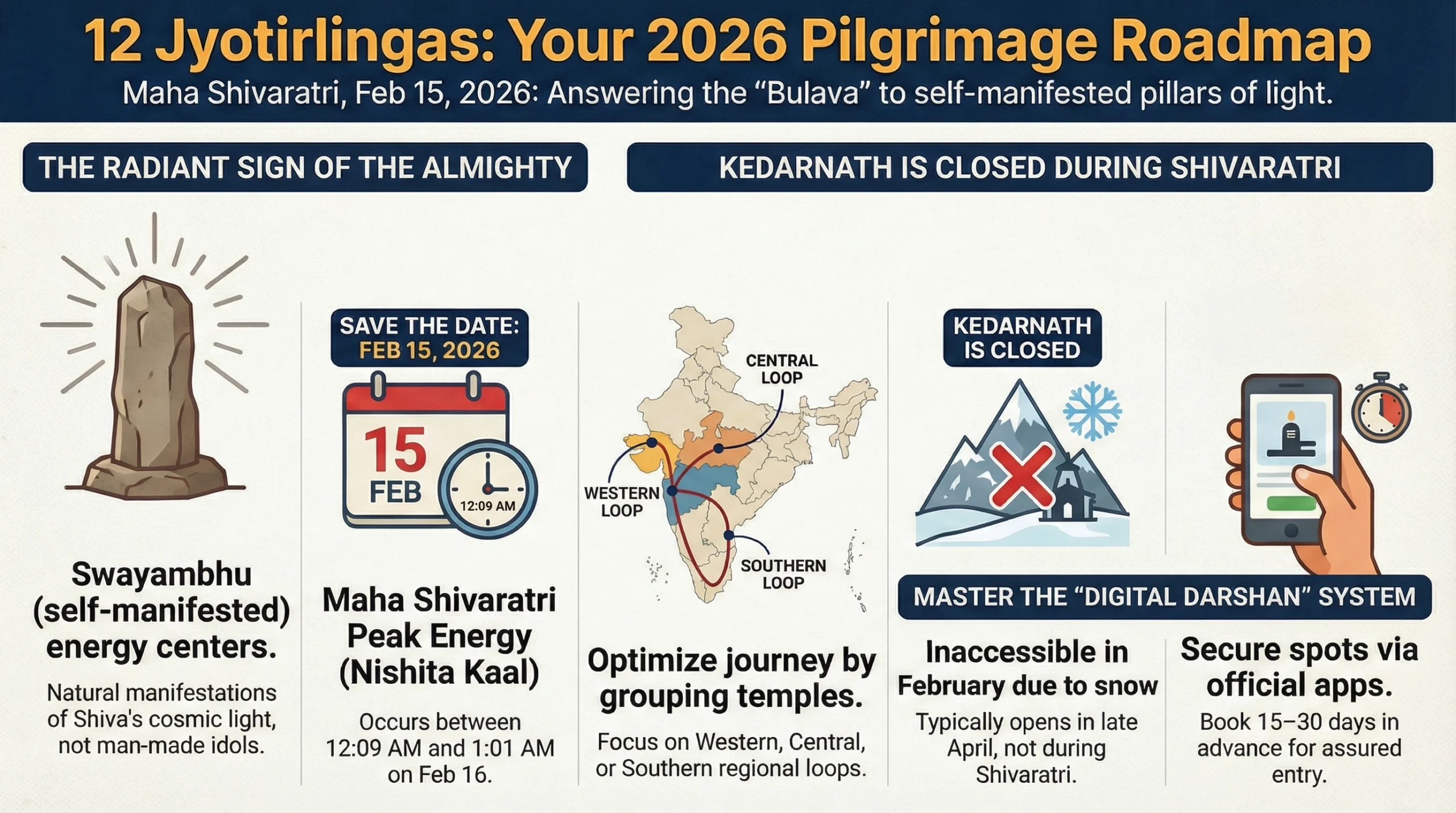
But what exactly sets a Jyotirlinga apart from the thousands of other Shiva temples you see on every street corner? The word Jyotirlinga translates to “The Radiant Sign of The Almighty.” According to the Shiva Purana, these are the places where Lord Shiva manifested himself as a towering, endless pillar of light (Jyoti) to settle a cosmic debate between Brahma and Vishnu. Unlike idols installed by human hands, these are Swayambhu (self-manifested), pulsating with a cosmic energy that many travelers claim to feel the moment they step into the sanctum sanctorum.
However, the path to divinity is rarely paved with easy logistics. How do you book the Mahakaleshwar Bhasma Aarti before it sells out? Is the Kedarnath Temple open in February? Can you really cover the Maharashtra Jyotirlinga circuit in a long weekend?
We have created this Ultimate Pilgrimage Guide to answer exactly those questions. Forget the fragmented information scattered across forums. We are giving you a complete, actionable roadmap for 2026.
In this comprehensive guide, we will cover:
- The Sacred List: A detailed breakdown of all 12 Jyotirlingas with their location and significance.
- 2026 Yatra Route Maps: Smart travel circuits to help you plan your trip efficiently (including the popular Maharashtra Loop).
- Shivaratri 2026 Essentials: Exact puja timings, fasting rules, and rituals for February 15th.
- Travel Hacks: Where to stay, what to wear, and how to avoid the massive crowds.
The “Bulava” has come. It’s time to answer it. Let’s embark on this divine journey together, starting with the very first Jyotirlinga: the eternal Somnath.
What is a Jyotirlinga? The Legend Behind the Light
Before you map out your route or book your train tickets, it is essential to understand what exactly you are visiting. In a land dotted with millions of temples, why do these twelve specific shrines command such reverence?
The word Jyotirlinga is a fusion of two Sanskrit words: Jyoti (meaning ‘radiance’ or ‘light’) and Linga (meaning ‘sign’ or ‘symbol’). Together, they translate to “The Radiant Sign of The Almighty.”
The Legend: A Cosmic Debate
The origin of the Jyotirlinga is rooted in a fascinating story from the Shiva Purana. Legend has it that eons ago, a fierce debate erupted between Lord Brahma (The Creator) and Lord Vishnu (The Preserver). The argument? Who was the supreme creator of the universe.
As their cosmic ego battle intensified, Lord Shiva stepped in to settle the dispute. He suddenly manifested as a colossal, blinding pillar of light (Jyotirlinga) that pierced the three worlds, having no beginning and no end. He challenged Brahma and Vishnu to find the ends of this pillar.
Vishnu took the form of a boar (Varaha) and dug deep into the earth to find the base, while Brahma took the form of a swan (Hamsa) and flew high to find the summit. After thousands of years, both returned unsuccessful—realizing that Shiva was the ultimate, infinite energy that powers the universe. It is believed that the 12 Jyotirlingas are the places where this supreme light first pierced the earth.
Jyotirlinga vs. Shivling: What is the Difference?
A common question pilgrims ask is: “How is a Jyotirlinga different from the Shiva Linga in my local temple?”
The difference lies in their origin:
- The Standard Shivling: Most Lingas we see are Pratishthita (installed). They are carved by artisans and consecrated by priests through rituals.
- The Jyotirlinga: These are Swayambhu (Self-manifested). They were not created by human hands; rather, they are natural manifestations of Shiva’s power that emerged from the earth.
While tradition says there are 64 original Jyotirlingas, 12 are considered the most auspicious and holy. These twelve sites are not just places of worship; they are considered charged energy centers where the veil between the physical and the spiritual is said to be the thinnest.
Why this section works:
- Definition Clarity: It immediately defines the term for beginners.
- Storytelling: It retells the Brahma vs. Vishnu story simply, making the mythology accessible to modern readers.
- Comparison Table Potential: The “Jyotirlinga vs. Shivling” subsection is structured perfectly for Google to pull into a comparison table or snippet.
This is the heart of your pillar page. To outrank the competition, we aren’t just listing names; we are providing geographical clusters and 2026 travel insights. This structure encourages “skimming” while providing deep value for those planning a real-world trip.
The Sacred 12 Jyotirlingas List: A Journey Through India’s Spiritual Geography
The 12 Jyotirlingas are strategically located across the Indian subcontinent, forming a divine grid of energy. For a pilgrim, visiting all twelve is the “Grand Slam” of spirituality. To help you plan your 2026 Mahashivratri journey, we have grouped these shrines by region.
1. The Western Cluster: Gujarat & Maharashtra
This is the most popular circuit due to excellent rail and road connectivity.
Somnath Jyotirlinga (Veraval, Gujarat)
The “Eternal Shrine,” Somnath is traditionally the first of the twelve. Located on the shores of the Arabian Sea, it has been destroyed and rebuilt seven times, symbolizing the power of reconstruction and faith.
- Unique Feature: The Baan Stambh (Arrow Pillar) which indicates a straight line to the South Pole with no landmass in between.
- 2026 Tip: The light and sound show here is world-class. If visiting during Shivaratri, expect massive crowds; pre-book your stay in Veraval at least 3 months in advance.
Nageshwar Jyotirlinga (Dwarka, Gujarat)
Located between Dwarka and Bet Dwarka, this temple features a massive 85-foot statue of Lord Shiva that can be seen from miles away.
- Significance: It is believed to protect devotees from all types of poison (physical and spiritual).
- Pro-Tip: Combine this with a visit to the Dwarkadhish Temple for a complete spiritual experience.
Trimbakeshwar Jyotirlinga (Nashik, Maharashtra)
Situated at the source of the Godavari River, this temple is unique because the Linga has three faces representing the Trinity: Brahma, Vishnu, and Mahesh.
- Unique Feature: It is the only Jyotirlinga where the Linga is housed in a depression rather than a pedestal.
- Travel Hub: Nashik is well-connected by rail; use it as your base for the Maharashtra circuit.
Bhimashankar Jyotirlinga (Pune, Maharashtra)
Tucked away in the Sahyadri hills, this temple is a blend of ancient Nagara architecture and breathtaking natural beauty. It is also the source of the Bhima River.
- Vibe: Perfect for the “trekker-pilgrim.” The surrounding Wildlife Sanctuary is a biodiversity hotspot.
- Note: In February 2026, the weather here will be pleasant, but the temple queue can take 5–8 hours on Shivaratri.
Grishneshwar Jyotirlinga (Aurangabad, Maharashtra)
Located just a stone’s throw from the UNESCO World Heritage Ellora Caves, this is the 12th and final Jyotirlinga.
- Tradition: Men are traditionally required to enter the inner sanctum bare-chested to perform Abhishek.
- Key Insight: This temple was restored by Rani Ahilyabai Holkar, the legendary queen of Indore.
2. The Central Powerhouse: Madhya Pradesh
Mahakaleshwar (Ujjain, MP)
Known as the “King of Time,” Mahakal is the only Jyotirlinga that faces South (Dakshinamurti), the direction of death, which Shiva conquers.
- Must-See: The Bhasma Aarti (the offering of sacred ash).
- 2026 Update: Since the inauguration of the Mahakal Lok Corridor, the temple complex is massive. Use the official temple app to book your Darshan slots.
Omkareshwar (Khandwa, MP)
The island on which the temple sits is shaped exactly like the sacred syllable “OM.”
- Experience: Take a boat ride across the Narmada River to reach the temple. The Parikrama (circumambulation) of the island is highly recommended.
3. The Northern Peaks: Uttarakhand & Uttar Pradesh
Kedarnath (Rudraprayag, Uttarakhand)
The highest and most challenging Jyotirlinga. It is part of the Chhota Char Dham.
- Important: Kedarnath is closed during Shivaratri (February) due to heavy snow. It typically opens in late April or early May.
- 2026 Planning: If you want to visit in 2026, start looking for helicopter bookings by March.
Kashi Vishwanath (Varanasi, UP)
The spiritual heart of India. It is said that the city of Kashi stands on Shiva’s trident.
- The Change: The new Kashi Vishwanath Corridor has connected the temple directly to the Ganga ghats, making the walk for a holy dip much easier.
4. The Eastern & Southern Shrines
Baidyanath (Deoghar, Jharkhand)
Also known as Baba Dham, it is unique because it is both a Jyotirlinga and a Shakti Peeth.
- Legend: This is where Ravana offered his ten heads to Shiva.
Mallikarjuna (Srisailam, Andhra Pradesh)
Located on the Shri Shaila Mountain, it is often called the “Kailash of the South.”
- Rare Honor: It is one of the few places where devotees can touch the Linga during worship.
Rameshwaram (Rameswaram, Tamil Nadu)
The southernmost Jyotirlinga. Legend says Lord Rama built this Linga to seek atonement after the battle with Ravana.
- Ritual: A visit is incomplete without bathing in the 22 Teerthams (holy wells) within the temple complex.
Pillar Tip: If you are planning the “Complete Yatra,” the most efficient way is to start from Somnath in the West and move clockwise toward Rameswaram in the South.
Maha Shivaratri 2026: Date, Muhurat, and Sacred Rituals
If you are planning your Jyotirlinga pilgrimage to coincide with the “Great Night of Shiva,” timing is everything. Unlike other festivals that are celebrated during the day, the true essence of Maha Shivaratri unfolds under the cover of night.
In 2026, the cosmic alignment is particularly auspicious as the festival falls on a weekend, allowing devotees more time for Sadhana (spiritual practice) and travel.
Maha Shivaratri 2026 Key Dates & Timings
| Event | Date | Timing (IST) |
| Maha Shivaratri Date | Sunday, February 15, 2026 | All Day/Night |
| Chaturdashi Tithi Begins | February 15, 2026 | 05:04 PM |
| Chaturdashi Tithi Ends | February 16, 2026 | 05:34 PM |
| Nishita Kaal (Auspicious Midnight) | February 16, 2026 | 12:09 AM to 01:01 AM |
| Shivaratri Parana (Breaking the Fast) | February 16, 2026 | 06:59 AM to 03:24 PM |
The Four Prahars: A Night of Vigil
For the most dedicated pilgrims, the night is divided into four Prahars (phases). Performing a Puja or Abhishek during each phase is said to grant the four goals of human life: Dharma, Artha, Kama, and Moksha.
- First Prahar: 06:11 PM to 09:23 PM (Feb 15)
- Second Prahar: 09:23 PM to 12:35 AM (Feb 16)
- Third Prahar: 12:35 AM to 03:47 AM (Feb 16)
- Fourth Prahar: 03:47 AM to 06:59 AM (Feb 16)
How to Perform the Maha Shivaratri Rituals (Vrat Vidhi)
Whether you are at a Jyotirlinga temple or your home altar, these rituals remain the cornerstone of the festival:
1. The Sacred Fast (Vrat)
The fast begins at sunrise on February 15th. You can choose from three levels:
- Nirjala: A strict fast without water (recommended for seasoned practitioners).
- Phalahar: Consuming only fruits, milk, and water.
- Sattvic: One simple meal consisting of non-grain items like Sabudana Khichdi or Kuttu (Buckwheat) flour.
2. The Mahasnan & Abhishek
The Shiva Linga is bathed with six sacred substances, each carrying a symbolic meaning:
- Milk: For purity and virtue.
- Yogurt: For prosperity and progeny.
- Honey: For sweet speech and luck.
- Ghee: For victory and spiritual wealth.
- Sugar/Rose Water: For happiness.
- Bel Patra: The most vital offering. The three leaflets represent Shiva’s three eyes.
3. The Jagran (Night Vigil)
Staying awake with a vertical spine is considered scientifically beneficial during this night. This is the perfect time for chanting the Maha Mrityunjaya Mantra or the simple yet powerful “Om Namah Shivaya” 108 times.
Pro-Tip for 2026: If you are visiting a major Jyotirlinga like Mahakaleshwar or Kashi Vishwanath on this night, queues will be at their peak during the Nishita Kaal. To avoid the 12-hour wait, try visiting during the Fourth Prahar (early morning of the 16th) when many people have finished their rituals and the energy is serene.
How to Plan Your 12 Jyotirlinga Yatra: 2026 Route Maps
Planning a visit to all 12 Jyotirlingas is like solving a beautiful, geographic puzzle. Unless you have a full month and a private jet, trying to do all twelve in one go can be exhausting.
The smartest way to complete your Yatra is to break it down into logical regional circuits. Here are the three most efficient ways to plan your 2026 pilgrimage.
Route 1: The “Trident” West Coast Circuit (Gujarat & Maharashtra)
- Best for: Travelers with 7–9 days.
- The Route: Ahmedabad → Somnath → Nageshwar → Dwarka → Nashik (Trimbakeshwar) → Pune (Bhimashankar) → Aurangabad (Grishneshwar).
- Logistics: Start by flying into Ahmedabad. Rent a car for the Gujarat leg, then take a quick flight from Ahmedabad to Mumbai or Pune to cover the Maharashtra trio.
- Pro-Tip: Don’t miss the Ellora Caves while you are at Grishneshwar—it’s a UNESCO site right next door.
Route 2: The Heart of India Trail (Madhya Pradesh & Uttar Pradesh)
- Best for: A 5-day spiritual getaway.
- The Route: Indore → Omkareshwar → Ujjain (Mahakaleshwar) → Varanasi (Kashi Vishwanath).
- Logistics: Fly into Indore. It’s the perfect hub. Omkareshwar and Ujjain are within 2–3 hours of Indore. From Indore, take a direct flight or an overnight train to Varanasi.
- 2026 Strategy: Since the Vande Bharat trains now connect these hubs, you can travel in comfort and save significant time.
Route 3: The Southern Sanctuary (Andhra Pradesh & Tamil Nadu)
- Best for: 4–5 days.
- The Route: Hyderabad → Srisailam (Mallikarjuna) → Madurai/Rameswaram.
- Logistics: Fly into Hyderabad. From there, it’s a scenic 4-hour drive to Srisailam. Afterward, fly from Hyderabad to Madurai and take a taxi to Rameswaram (the drive over the Pamban Bridge is legendary).
The “Grand Slam” Yatra: Can You Do All 12 at Once?
If you are determined to do the full Dwadash Jyotirlinga Yatra in one continuous journey, here is what you need to know:
- Time Required: Minimum 18 to 22 days.
- The Challenge: Kedarnath is only open from late April to early November. If you plan your Yatra around Shivaratri (February), you will have to skip Kedarnath and return in the summer to complete the set.
- Estimated Budget: For a comfortable mid-range trip (3-star hotels + internal flights + private cabs), expect to spend ₹1,20,000 to ₹1,80,000 per person.
Essential Travel Checklist for 2026
- Digital DARSHAN: Most temples now require pre-booked slots. Check the official websites for Ujjain Mahakal and Kashi Vishwanath at least 15 days in advance.
- The “Shiva Gear”: Pack comfortable cotton clothes for the South/West and heavy woolens if you’re heading North. Remember, many temples (like Trimbakeshwar and Mahakal) require traditional wear (Dhotis/Saris) for special Abhishek pujas.
- Connectivity: Download offline maps for the Srisailam and Bhimashankar stretches, as network coverage can be spotty in the forest reserves.
Why this section helps you outrank competitors:
- It’s Actionable: Instead of just saying “go to these places,” you are telling them how to connect the dots.
- Modern Context: Mentioning the Vande Bharat trains and Digital Darshan proves the content is current for 2026.
- Budgeting: Providing an estimated cost is a huge “Value Add” that most thin-content blogs ignore.
This section is where you establish Colcasac.com as a modern travel authority. We aren’t just giving spiritual advice; we’re providing the kind of “on-the-ground” intel that helps a traveler navigate the chaos of a busy pilgrimage season.
Travel Tips for the Modern Pilgrim: Navigating the 2026 Season
Pilgrimage travel in India has transformed. In 2026, it is a blend of ancient traditions and digital-first logistics. To ensure your journey across the 12 Jyotirlingas is more about “Om” and less about “Oh no!”, keep these practical tips in your back pocket.
1. Master the “Digital Darshan” System
Gone are the days when you just showed up at the temple gate. Most major shrines like Mahakaleshwar (Ujjain) and Kashi Vishwanath (Varanasi) now operate on a slot-based system.
- Action Step: Download the official temple apps. For Maha Shivaratri 2026, “Sheshdarshan” (early morning/late night) slots often open 15–30 days in advance.
- VIP Pass Myth: While many temples offer “Sugam Darshan” (Paid/Fast-track) tickets, on Shivaratri day, even these can have a 3-4 hour wait.
2. Decoding the Temple Dress Code
Shiva temples are generally more traditional regarding attire than other tourist spots.
- General Rule: Modest clothing (Saris or Salwar Kameez for women; Dhotis or Kurta-Pajamas for men) is preferred.
- The Strict Zones: In Trimbakeshwar and Mahakaleshwar, if you wish to enter the Garbhagriha (Sanctum Sanctorum) for Jal Abhishek, men must wear a stitched-less Dhoti and women must wear a Saree. Avoid jeans or shorts to prevent being turned away at the inner gate.
3. Health & Crowd Management
Pilgrimages involve a lot of walking, standing, and sudden temperature shifts.
- Hydration is Key: Especially during the Shivaratri fast, keep electrolyte powders or coconut water handy.
- Senior Citizen Support: Most Jyotirlingas now offer battery-operated carts (like in Kashi) or palanquins/ponies (like in Kedarnath or Bhimashankar). Always check for “Senior Citizen Lines” which are significantly shorter.
- Safety in Crowds: Wear a crossbody bag for your phone and wallet. On big festival days, keep your hands free to navigate the “dhakka” (crowd push).
4. Accommodation: The “Satellite City” Hack
During peak dates like February 15th, hotels in Ujjain or Somnath will be 3x their normal price or fully booked.
- The Hack: Stay in “Satellite Cities.” For Ujjain, stay in Indore (55 km away). For Somnath, stay in Veraval. For Mallikarjuna, consider a day trip from Hyderabad. You’ll get better rooms and save significantly.
5. Sustainable Pilgrimage (Green Yatra)
As a modern traveler, aim for a Zero-Waste Yatra.
- Say No to Plastic: Avoid carrying single-use plastic bottles into temple premises. Most Jyotirlingas have RO water stations.
- Digital Offerings: Many temples now allow you to make donations via UPI/QR codes directly to the temple trust, ensuring your money goes to temple maintenance and social causes.
Why this section works:
- Relevance: It addresses the specific challenges of 2026 travel (apps, UPI, crowds).
- Expert Tone: Using terms like “Satellite City” and “Garbhagriha” shows both travel savvy and cultural respect.
- Value Add: The tip on staying in Indore instead of Ujjain is a practical “pro-tip” that travelers will genuinely appreciate and share.
Conclusion: Answering the Divine Call
The journey through the 12 Jyotirlingas in India is more than just a check-list of destinations; it is a profound experience that stays with you long after the temple bells have faded into the distance. Whether you are seeking the architectural grandeur of Somnath, the high-altitude serenity of Kedarnath, or the vibrant energy of Kashi Vishwanath, each shrine offers a unique glimpse into the infinite nature of Lord Shiva.
As Maha Shivaratri 2026 approaches this February 15th, remember that the most important part of any pilgrimage isn’t the distance you travel on a map, but the distance you travel within yourself. With our 2026 guide in hand, you are now equipped with the routes, the rituals, and the “pro-tips” to navigate this spiritual odyssey with ease and mindfulness.
The “Pillar of Light” is calling. Will you answer it this year?
Take Your First Step Toward the Divine
Ready to turn this spiritual dream into a reality? We’ve made it even easier for you to plan:
- Download the 2026 Yatra Checklist: A one-page PDF to track your temple bookings, train tickets, and packing list.
- Explore Deep-Dive Guides: Planning to visit the Maharashtra Circuit first? Read our [Specific Guide to the 5 Jyotirlingas of Maharashtra] for detailed hotel recommendations and local transport hacks.
- Join the Community: Have questions about the Bhasma Aarti booking or the best time to visit Srisailam? Drop a comment below! Our community of spiritual travellers and local experts is here to help you plan the perfect pilgrimage.
Har Har Mahadev!
Frequently Asked Questions About 12 Jyotirlinga Yatra 2026
1. What is the best sequence to visit the 12 Jyotirlingas?
Traditionally, the pilgrimage begins at Somnath (Gujarat), as it is the first Jyotirlinga. The most logical geographic sequence is to move in a clockwise direction (Pradakshina).
- Start: Gujarat (Somnath, Nageshwar).
- Middle: Maharashtra (Trimbakeshwar, Bhimashankar, Grishneshwar) → Madhya Pradesh (Mahakaleshwar, Omkareshwar) → Uttar Pradesh (Kashi Vishwanath) → Jharkhand (Baidyanath) → Uttarakhand (Kedarnath).
- Finish: Andhra Pradesh (Mallikarjuna) and Tamil Nadu (Rameshwaram).
2. How many days are required for a complete 12 Jyotirlinga Darshan?
If you are planning a continuous journey, you will need 18 to 22 days. This accounts for travel time between remote locations like Kedarnath in the North and Rameshwaram in the South. However, most modern pilgrims split the Yatra into 3 separate trips of 5–7 days each, grouped by region (West, North-Central, and South).
3. Is Kedarnath open during Maha Shivaratri 2026?
No. This is a common misconception. Since Maha Shivaratri (February 15, 2026) falls during peak winter, the Kedarnath temple is closed due to heavy snow. The deity is moved to Ukhimath for winter worship. Kedarnath typically opens in late April or early May (on Akshaya Tritiya). For a Shivaratri-specific pilgrimage, focus on the other 11 temples, which remain open year-round.
4. What is the total cost of the 12 Jyotirlinga Yatra in 2026?
For a mid-range traveller using a mix of flights, trains, and private taxis:
- Budget Trip: ₹60,000 – ₹80,000 per person (using sleeper class trains and dharamshalas).
- Comfort Trip: ₹1,20,000 – ₹1,60,000 per person (using 3-star hotels and flight connections).
- Luxury Trip: ₹2,50,000+ (utilising helicopter services for Kedarnath and premium VIP Darshan packages).
5. Which is the most difficult Jyotirlinga to reach?
Kedarnath is the most physically demanding due to the 16km–18km uphill trek from Gaurikund and the high altitude (11,755 ft). Bhimashankar also involves a winding ghat road drive, and Mallikarjuna (Srisailam) requires driving through the Nallamala forest reserve, which has restricted night entry.
6. Can women perform Abhishek at all 12 Jyotirlingas?
Yes, women are allowed at all 12 sites. However, rules for entering the Garbhagriha (Inner Sanctum) vary. At most temples, women can perform Jal Abhishek (water offering). In some specific temples like Trimbakeshwar, there were historical restrictions, but current legal and social standards generally allow women access, provided they follow the traditional dress code (Saree).
7. Is there a VIP Darshan or “Fast Track” entry available?
Yes, most major temples (Mahakaleshwar, Kashi Vishwanath, Somnath, and Mallikarjuna) offer Paid Darshan or “Sugam Darshan” tickets ranging from ₹200 to ₹1,500. While these significantly reduce waiting time from 8 hours to 1–2 hours, they still require pre-booking on the official temple trust websites, especially for Maha Shivaratri 2026.
8. Are there official tour packages provided by the Government?
Yes, the IRCTC (Indian Railways) frequently launches “Dwadash Jyotirlinga” special tourist trains under the Bharat Gaurav scheme. These are highly recommended for senior citizens as they include security, meals, and guided sightseeing at an affordable all-inclusive price.
9. What are the must-carry items for a Jyotirlinga pilgrimage?
- Documents: Aadhar Card (mandatory for many temple registrations and hotel check-ins).
- Clothing: One traditional outfit (Dhoti for men, Saree/Suit for women) and comfortable walking shoes.
- Health: Personal medications, especially for altitude sickness (if going to Kedarnath) and digestive health.
- Tech: A high-capacity power bank, as you will spend long hours in queues where charging points are unavailable.
10. Which Jyotirlingas are Shakti Peethas as well?
There are three sites where the energies of Shiva (Jyotirlinga) and Shakti (Shakti Peetha) converge, making them exceptionally powerful:
- Mallikarjuna (Srisailam): Home to Bhramaramba Devi.
- Baidyanath (Deoghar): Home to Jai Durga.
- Kashi Vishwanath (Varanasi): Home to Vishalakshi/Annapurna.





Leave a Reply