
The Essence of Maha Shivaratri 2026: More Than Just a Ritual
Maha Shivaratri isn’t simply another date on the Hindu calendar; it is a cosmic phenomenon that invites us to pause and reconnect with the vast stillness within. On February 15, 2026, millions across the globe will observe the “Great Night of Shiva,” but for the modern seeker, the essence of this festival goes much deeper than tradition. It is a night of spiritual awakening, a “digital detox” for the soul, and a rare opportunity to align our personal energy with the rhythms of the universe.
The Spiritual Significance of 2026
What makes Maha Shivaratri 2026 stand out in our fast-paced world? While ancient scriptures celebrate this as the night Lord Shiva performed the Tandava—the cosmic dance of creation and destruction—the modern interpretation is about inner transformation. In 2026, as we navigate an era of hyper-connectivity and mental noise, the festival serves as a “soft reset.”
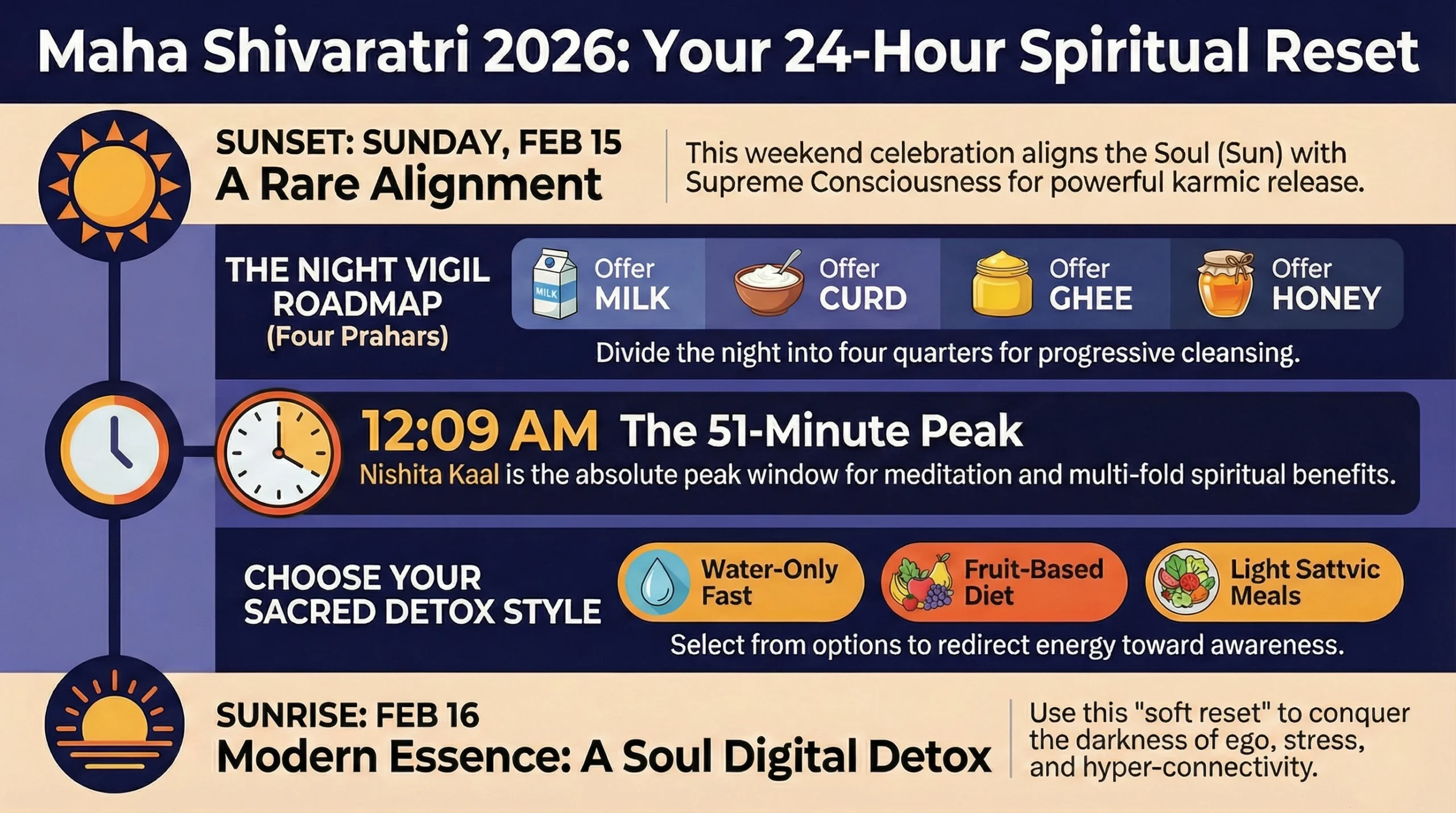
This year’s celebration falls on a Sunday, which carries unique weight in Vedic astrology. Sunday is ruled by the Sun (the Soul), while Shiva represents the Supreme Consciousness. This rare alignment creates a powerful window for karmic release and mental clarity. It’s a day to transition from the “doing” to the “being,” allowing the noise of our daily lives to fade into the background.
A Night of Conscious Awakening
While most festivals are about outward celebration—lights, music, and social gatherings—Maha Shivaratri is a journey inward. The hallmark of the night is the Jagaran (night vigil). But staying awake isn’t just about fighting sleep; it’s about remaining “aware” in the darkness.
In a world where we often live on autopilot, the spiritual essence of 2026 emphasizes mindfulness. By keeping the spine erect and the mind focused through meditation and chanting, devotees tap into a natural upsurge of energy that occurrs on this specific lunar night. Whether you are chanting “Om Namah Shivaya” in a crowded temple in Varanasi or in the quiet of your apartment, the intention remains the same: to conquer the “darkness” of ego, ignorance, and stress.
The Union of Shiva and Shakti
At its heart, the night commemorates the divine marriage of Lord Shiva and Goddess Parvati. This isn’t just a mythological wedding; it represents the perfect balance of Shiva (Consciousness) and Shakti (Energy). For many, this translates to finding balance in their own lives—balancing the professional with the personal, and the logical with the intuitive.
As we approach February 15, the trending conversation isn’t just about Puja Vidhi; it’s about mental health, peace, and resilience. The essence of Maha Shivaratri in 2026 is a reminder that no matter how chaotic the world becomes, there is a place of absolute stillness inside us all. By honoring the “Great Night,” we aren’t just worshipping a deity—we are celebrating the infinite potential of our own spirit.
The Sacred Calendar: Maha Shivaratri 2026 Date & Shubh Muhurat
Mark your calendars for Sunday, February 15, 2026. Because this sacred night falls on a weekend, it offers a perfect opportunity for families and professionals alike to fully immerse themselves in the 24-hour spiritual journey without the rush of a typical workday.
In the Vedic tradition, timing is everything. The energy of Maha Shivaratri is tied to the Chaturdashi Tithi (the 14th lunar day) of the Krishna Paksha in the month of Phalguna. For 2026, the cosmic alignment is particularly potent. Below is the precise breakdown of the timings you need to plan your day and night.
Key Tithi Timings for 2026
| Event | Date | Time (IST) |
| Chaturdashi Tithi Begins | February 15, 2026 | 05:04 PM |
| Chaturdashi Tithi Ends | February 16, 2026 | 05:34 PM |
| Nishita Kaal (The Golden Window) | February 16, 2026 | 12:09 AM to 01:01 AM |
| Shivaratri Parana (Breaking the Fast) | February 16, 2026 | 06:59 AM to 03:24 PM |
The Most Auspicious Moment: Nishita Kaal
If you only have one hour to dedicate to prayer, make it the Nishita Kaal. This is the specific moment when Lord Shiva is said to have manifested as the Jyotirlinga (the pillar of light). In 2026, this 51-minute window from 12:09 AM to 01:01 AM is considered the peak of spiritual vibration. Chanting or meditating during this time is believed to yield multi-fold benefits for mental peace and prosperity.
The Four Prahars: A Night-Long Roadmap
For those performing the full Jagaran (night vigil), the night is divided into four quarters, or Prahars. Each quarter has a specific focus for the Abhishekam (ritual bathing of the Shiva Lingam):
-
First Prahar (06:11 PM to 09:23 PM): Focus on Milk (representing purification).
-
Second Prahar (09:23 PM to 12:35 AM): Focus on Curd (representing stability).
-
Third Prahar (12:35 AM to 03:47 AM): Focus on Ghee (representing spiritual growth).
-
Fourth Prahar (03:47 AM to 06:59 AM): Focus on Honey (representing sweetness and liberation).
Global City-Wise Timings
While the tithi remains the same, the local sunset and midnight timings shift slightly based on your geography. Here is when to begin your main rituals in major hubs:
-
Delhi/NCR: 12:09 AM to 01:01 AM
-
Mumbai: 12:28 AM to 01:19 AM
-
Bengaluru: 12:10 AM to 12:59 AM
-
New York (EST): 11:58 PM (Feb 15) to 12:48 AM (Feb 16)
-
London (GMT): 12:01 AM to 12:52 AM
The Four Prahars: Your Strategic Roadmap for the 2026 Night Vigil
In the spiritual realm, staying awake on Maha Shivaratri isn’t about endurance; it’s about alignment. To truly tap into the “Great Night,” the vigil is traditionally divided into four quarters, or Prahars, each lasting roughly three hours.
As we approach February 15, 2026, understanding the “Night Vigil Strategy” is key to transforming a tired night into a transcendent experience. Each Prahar represents a different stage of spiritual cleansing, requiring specific offerings (Abhishekam) and mantras to unlock the energy of the hour.
1st Prahar: The Foundation of Devotion (Evening)
-
Time: 06:11 PM to 09:23 PM (Feb 15)
-
The Ritual: The first quarter is about Shuddhi (purification). We begin by bathing the Shiva Lingam with Milk.
-
The Intent: Think of this as clearing the “clutter” of the day. In our modern context, use this time to unplug from your devices and set a clear intention (Sankalpa) for the night.
-
Chant: Om Namah Shivaya (focus on steady, rhythmic breathing).
2nd Prahar: The Quest for Stability (Midnight Transition)
-
Time: 09:23 PM to 12:35 AM (Late Night)
-
The Ritual: In the second quarter, we offer Curd (Yogurt).
-
The Intent: Curd symbolizes stability and patience. This is the “transition” phase where the mind often begins to wander or feel fatigue. Use this Prahar to pray for emotional resilience and the strength to overcome life’s obstacles.
3rd Prahar: The Peak of Transcendence (The Deep Night)
-
Time: 12:35 AM to 03:47 AM (Feb 16)
-
The Ritual: This is the most potent phase of the night, during which Ghee (Clarified Butter) is offered.
-
The Intent: Ghee represents the “essence” of the soul. This Prahar coincides with the Nishita Kaal, the moment Shiva’s energy is at its peak. This is the best time for deep meditation and silence. The goal here is Atma-Jnana—self-knowledge and inner light.
4th Prahar: The Dawn of Liberation (Pre-Dawn)
-
Time: 03:47 AM to 06:59 AM (Feb 16)
-
The Ritual: In the final hours before sunrise, we offer Honey.
-
The Intent: Honey symbolizes sweetness, beauty, and the “juice of life.” As the night ends and the sun begins to rise, this Prahar is about gratitude and liberation (Moksha). It’s the time to offer your prayers for the well-being of your family and the world.
-
Closing: Conclude with the Maha Mrityunjaya Mantra to invoke healing and protection.
The “Modern Vigil” Pro-Tip
If you are celebrating at home in 2026, keep your environment “Sattvic.” Use natural incense, dim the lights, and keep the spine erect. Even if you cannot perform the full rituals, simply sitting in silence during these four windows—especially the third Prahar—can lead to immense mental clarity and stress relief.
The Ultimate Fasting (Vrat) Guide: Nourishing Your Body and Soul
Fasting on Maha Shivaratri is more than just a physical challenge; it’s an ancient technology for body detoxification and mental clarity. By stepping away from heavy, complex meals, we allow our digestive energy to be redirected toward spiritual awareness. In 2026, with the festival falling on a Sunday, many are choosing to embrace the “vrat” (fast) as a holistic wellness ritual.
Whether you are a first-timer or a seasoned devotee, here is how to navigate the fasting rules for February 15, 2026, with a modern, health-conscious twist.
Choosing Your Vrat Style
There isn’t a “one-size-fits-all” approach to Shiva’s grace. Choose the path that aligns with your health and lifestyle:
-
Nirjala Vrat (The Purest Detox): A complete fast without water or food for 24 hours. Best for those with high physical fitness and spiritual experience.
-
Phalahar Vrat (The Fruit Path): The most popular choice. You consume fresh fruits, milk, curd, and water. It keeps the body hydrated and the mind light for the night vigil.
-
Partial Fasting (Sattvic Meal): For those with busy schedules or health constraints, one light meal consisting of “vrat-friendly” ingredients is permitted during the day.
The “No-Go” List: Foods to Avoid
To maintain the Sattvic (pure) nature of the day, certain foods are strictly off-limits. These are considered “Tamasic” (dulling) or too heavy for a day of meditation:
-
Grains & Pulses: No wheat, rice, lentils, or legumes (dals).
-
Regular Salt: Switch to Sendha Namak (Rock Salt), which is unprocessed and mineral-rich.
-
Onion & Garlic: These are avoided as they stimulate restlessness.
-
Non-Veg & Alcohol: Strictly prohibited to maintain the sanctity of the ritual.
Trending Vrat Recipes for 2026
Fasting doesn’t have to be bland. On Colcasac, we believe in “Sattvic Soul Food.” Here are the trending dishes for this year:
1. The Modern Sabudana Khichdi
Skip the oily versions of the past. In 2026, the trend is Light & Zesty Sabudana. Use minimal ghee, plenty of roasted crushed peanuts for protein, and a generous squeeze of lemon to keep your energy levels steady without the “carb crash.”
2. Air-Fried Kuttu (Buckwheat) Cutlets
Buckwheat is a nutritional powerhouse—gluten-free and high in fiber. Instead of deep-frying, try air-frying patties made of Kuttu flour and mashed sweet potatoes. Season with black pepper and ginger for a metabolism-boosting snack.
3. Low-Fat Makhana Kheer
Fox nuts (Makhana) are the ultimate “superfood” snack. Simmer them in almond or skimmed milk with a touch of jaggery or honey. Add saffron strands to elevate the flavor for your midnight offering.
4. The “Shakti” Smoothie
For those staying awake through the four Prahars, a blend of banana, dates, and coconut water provides instant electrolytes and sustained energy.
The Golden Rule: Breaking the Fast (Parana)
In 2026, the auspicious time to break your fast is between 06:59 AM and 03:24 PM on February 16. Pro-tip: Do not jump straight into a heavy, oily meal. Start with a glass of lukewarm lemon water or a small bowl of curd to gently wake up your digestive system.
Step-by-Step Puja Vidhi at Home: Invoking Shiva’s Grace
Performing the Maha Shivaratri Puja at home in 2026 is a beautiful way to transform your living space into a sanctuary of peace. Whether you have a dedicated prayer room or a small corner, the most important “Samagri” (ingredient) is your devotion.
For Sunday, February 15, 2026, here is a professional guide to conducting a traditional yet accessible Puja Vidhi.
1. Preparation: Setting the Sacred Space
Before the rituals begin, physical and environmental cleanliness is paramount.
-
Purify Yourself: Wake up during the Brahma Muhurta (pre-dawn) and take a bath. If possible, add a few drops of Gangajal (holy water) to your bathing water. Wear clean, preferably white or light-colored cotton clothes to maintain a Sattvic vibration.
-
The Altar: Clean your Puja altar and place a fresh cloth (yellow or red). Install your Shivling or an idol of Lord Shiva. If you don’t have one, a picture or even a small stone (symbolizing the formless Shiva) works perfectly.
2. The Essential Samagri List (2026 Essentials)
To outrank competitors, ensure your checklist is comprehensive yet practical:
-
Abhishekam Liquids: Water, raw milk, curd, honey, and ghee (the Panchamrit).
-
Sacred Offerings: Bel Patra (ensure they are not torn), Dhatura flowers/fruits, and white flowers (Mogra or Hibiscus).
-
Fragrance & Light: Sandalwood paste (Chandan), Bhasma (sacred ash), incense sticks, and a Diya (oil or ghee lamp).
-
Prasad: Seasonal fruits, sweets (like Makhana Kheer), or dry fruits.
3. The Step-by-Step Ritual (Vidhi)
Step 1: Sankalp (The Intention)
Hold a little water in your right palm and state your name, location, and the purpose of your puja (e.g., seeking inner peace or family well-being). This is your “spiritual contract” for the night.
Step 2: Ganesh Puja
In every Hindu ritual, we first invoke Lord Ganesha, the remover of obstacles. Light the Diya and offer a few flowers to Ganesha, seeking his blessings for a smooth Maha Shivaratri vigil.
Step 3: The Panchamrit Abhishek
This is the heart of the Puja. Bathe the Shivling with the five sacred liquids in this specific order:
-
Water: To symbolize purification.
-
Milk: For a long life and purity.
-
Curd: For prosperity and stability.
-
Ghee: For victory over ego.
-
Honey: For sweetness in speech and life.
Pro-tip: Continuously chant “Om Namah Shivaya” during the pour.
Step 4: Decoration & Shringaar
Gently wipe the Shivling with a clean cloth. Apply Chandan (sandalwood) and Vibhuti (bhasma). Offer the Bel Patra—traditionally, three leaves on one stalk represent the three eyes of Shiva. Place them with the smooth side touching the Lingam.
Step 5: Mantra Japa & Meditation
Sit comfortably with your spine erect. Use a Rudraksha mala to chant the Maha Mrityunjaya Mantra or simply “Om Namah Shivaya” 108 times. In 2026, the silence of the night is your greatest ally; spend at least 10 minutes in pure meditation (Dhyana) following the chants.
Step 6: Aarti & Kshama Prarthana
Conclude the puja by waving the Diya in a clockwise direction while singing the Shiva Aarti. Finally, bow down and ask for forgiveness (Kshama Prarthana) for any mistakes made during the ritual, intentionally or unintentionally.
Common Mistakes to Avoid in 2026
-
The Flower Rule: Never offer Ketaki flowers to Lord Shiva; they are traditionally forbidden in his worship.
-
The Circumambulation (Parikrama): If you are doing parikrama, remember never to cross the Abhishek water outlet (Nirmali). Always return from that point to complete a half-circle.
-
The Turmeric/Kumkum Rule: Unlike other deities, Shiva (the ascetic) is not offered Turmeric (Haldi) or Kumkum on the Shivling; use Bhasma and Chandan instead.
Astrological Impact & Zodiac (Rashi) Predictions: The Cosmic Shift of 2026
Maha Shivaratri isn’t just a religious celebration; it is a moment of profound astronomical and astrological significance. In 2026, the planetary configuration during the “Great Night” is set to create a powerful surge of transformative energy. As the Sun enters Aquarius (Kumbha Rashi) and the Moon nears its weakest point before the New Moon, the cosmic “void” allows for the maximum infusion of spiritual light.
For 2026, the highlight is the position of Saturn (Shani) and Jupiter (Guru). Their specific alignment during this Shivaratri suggests a year of “Karmic Justice” and “Spiritual Growth.” Here is how the energy of Maha Shivaratri 2026 will impact each Zodiac sign (Rashi):
Aries, Leo & Sagittarius (The Fire Signs)
-
The Vibe: High Energy & Bold Decisions.
-
The Impact: For Fire signs, this Shivaratri is about burning away old ego patterns. You may feel a sudden surge of clarity regarding your career.
-
Shiva Tip: Perform Abhishekam with honey and red flowers to channel your intensity into constructive growth.
Taurus, Virgo & Capricorn (The Earth Signs)
-
The Vibe: Stability & Financial Grounding.
-
The Impact: 2026 brings a focus on material security. Shiva’s energy will help you find the patience needed for long-term projects. It’s an excellent time to pray for property or home-related matters.
-
Shiva Tip: Offer raw milk and white sandalwood paste to the Shivling for mental peace and steady progress.
Gemini, Libra & Aquarius (The Air Signs)
-
The Vibe: Intellectual Awakening & Networking.
-
The Impact: As the Sun transits through Aquarius, Air signs are the “stars” of this Shivaratri. You will experience a creative breakthrough. It is a potent time for those in tech, media, or communication.
-
Shiva Tip: Offer Bel Patra and meditate during the Nishita Kaal to sharpen your intuition and decision-making.
Cancer, Scorpio & Pisces (The Water Signs)
-
The Vibe: Deep Emotional Healing & Intuition.
-
The Impact: This is a highly emotional and spiritual time for you. Maha Shivaratri 2026 acts as a cleansing wave, washing away past traumas. You may feel a pull toward solitude and deep meditation.
-
Shiva Tip: Offer pure Ganga water and sugarcane juice. Chanting the Maha Mrityunjaya Mantra will provide an emotional shield against stress.
2026 Special: The Saturn-Rahu Influence
In 2026, the subtle influence of Rahu may cause some mental restlessness or “illusion” in decision-making. Observing the Maha Shivaratri Jagaran (night vigil) is particularly recommended this year, as it helps ground your energy and protects you from impulsive choices.
Pro-Tip for Colcasac Readers: Regardless of your sign, 2026 is a year of “Digital Fasting.” Use the hours of the Shivaratri vigil to disconnect from the “Air” energy (internet/social media) and reconnect with the “Earth” and “Ether” through silent chanting.
Modern Celebration: Bridging Tradition and Technology in 2026
Maha Shivaratri has evolved into a global phenomenon that transcends religion, becoming a massive cultural and spiritual movement. In 2026, the shift toward “conscious celebration” is stronger than ever. From high-tech meditative gatherings to traditional pilgrimages, the options for February 15, 2026 are diverse and accessible.
Whether you’re looking for a silent retreat or a high-energy “bhajan rave,” here is where the world is gathering for the Great Night.
1. Isha Yoga Center (Coimbatore): The Night of Exuberance
The celebration at the Isha Yoga Center, led by Sadhguru, remains the most iconic modern gathering. In 2026, millions are expected to join both in person at the foothills of the Velliangiri Mountains and via global live streams.
-
The Highlight: The Adiyogi Divya Darshanam, a stunning 3D laser mapping show on the 112-foot Adiyogi statue.
-
The Experience: A 12-hour vigil (6:00 PM to 6:00 AM) featuring explosive meditations, the Pancha Bhuta Kriya (elemental cleansing), and performances by world-renowned artists and the Sounds of Isha band.
2. Art of Living (Bengaluru): The Path of Silence & Song
At the Art of Living International Center, Gurudev Sri Sri Ravi Shankar hosts a celebration focused on deep inner peace and collective chanting.
-
The Highlight: The Maha Rudrabhishekam, a massive Vedic ritual where the vibration of ancient chants is said to resonate for miles.
-
The Experience: A blend of Satsangs (spiritual music), profound wisdom discourses, and guided meditations that focus on the “Shiva Tattva” (the Shiva principle) within everyone.
3. The “Techno-Cultural” Wave: New Delhi & Global Hubs
A trending shift in 2026 is the rise of spiritual clubbing and techno-cultural nights. Events like Shiv Anandam 3.0 in New Delhi are redefining the festival for the younger generation.
-
The Concept: Imagine a 9-foot LED Lingam, immersive lasers, and “aerial flower showers” paired with high-energy devotional trance music.
-
Why it’s Trending: These events bridge the gap between ancient devotion and modern art, proving that Jagaran (staying awake) can be as much about celebration and dance as it is about silence.
4. Traditional Powerhouses: Kashi & Ujjain
If you crave the raw, ancient energy of the “City of Light,” Varanasi (Kashi Vishwanath) and Ujjain (Mahakaleshwar) remain the spiritual epicenters.
-
Kashi: Witness the Shiv Baraat—a grand wedding procession of Shiva where the streets come alive with people dressed as deities and spirits.
-
Ujjain: The world-famous Bhasma Aarti at 4:00 AM on February 16 is the ultimate culmination of the night’s energy.
5. Digital Participation: The Virtual Altar
For those who cannot travel, 2026 offers unprecedented “Phygital” (physical + digital) experiences. Many temples now offer Digital Pujan, where you can register online to have an Abhishekam performed in your name while you watch the high-definition live stream from your home altar.
FAQ: Your Quick Guide to 2026
-
Is Maha Shivaratri 2026 a bank holiday? Yes, in most Indian states, February 16 (Monday) will be observed as a holiday following the night-long celebrations.
-
Can I attend Isha Mahashivratri for free? Yes, there are many “open bays” at the Coimbatore ashram, though prior registration is mandatory.
-
What should I wear? Light-colored, traditional Indian attire (like cotton kurtas) is recommended to keep your energy flowing and stay comfortable during the long vigil.
Deep Dive: The Legends of the Blue God – Stories of Resilience and Love
To truly understand the “why” behind Maha Shivaratri 2026, we must look beyond the calendars and into the heart of the legends that have shaped human consciousness for millennia. These aren’t just myths; they are psychological blueprints for overcoming life’s darkest moments.
As we prepare for the celebrations on February 15, let’s dive into the three core legends that define the “Blue God” and why his stories are trending in the modern quest for mental health and resilience.
1. The Legend of Neelkanth: Turning Poison into Power
The most famous story associated with Shiva’s blue throat is the Samudra Manthan (The Churning of the Ocean). When the gods and demons churned the cosmic ocean to find the nectar of immortality, they first encountered Halahala—a lethal poison that threatened to consume all of creation.
-
The Sacrifice: While everyone else fled in fear, Shiva stepped forward. He drank the poison to save the universe. However, his consort, Goddess Parvati, placed her hand on his throat to stop the venom from spreading to his stomach, causing his neck to turn blue.
-
The 2026 Perspective: This legend is a powerful metaphor for emotional intelligence. We all face “poison” in life—stress, negativity, or trauma. Shiva teaches us not to swallow the negativity (which harms us) nor to spit it out (which harms others), but to hold it in the throat, process it through meditation, and transform it. This is why he is the ultimate patron of mental resilience.
2. The Great Union: Shiva and Parvati’s Divine Marriage
Maha Shivaratri is celebrated as the wedding anniversary of Shiva and Parvati. This story represents the transition of Shiva from an ascetic (Vairagi) to a householder (Grihastha).
-
The Balance: It symbolizes the meeting of Purusha (Consciousness) and Prakriti (Nature). Parvati’s unwavering devotion (Tapasya) eventually moved the stoic Shiva to embrace the world.
-
The 2026 Perspective: In a world that often feels polarized, this legend celebrates the harmony of opposites. It’s a reminder that spiritual growth doesn’t require us to abandon our families or careers; rather, it’s about bringing a sense of “Shiva-like” stillness into our everyday “Shakti-like” activities.
3. The Origin of the Lingam: The Infinite Pillar of Fire
Legend has it that Brahma (The Creator) and Vishnu (The Preserver) once argued over who was superior. To settle the dispute, Shiva appeared as a Jyotirlinga—an infinite pillar of fire with no beginning and no end.
-
The Lesson: Brahma flew upward as a swan to find the top, and Vishnu dived down as a boar to find the base. Both failed. This humbled the gods and established that the Supreme Reality is infinite and beyond the ego’s grasp.
-
The 2026 Perspective: This story is the root of the Nishita Kaal worship. It encourages us to look beyond our “ego-driven” goals and realize that we are part of something much larger and infinite.
Why the “Blue God” Narrative Matters Today
In the professional world of 2026, where “burnout” is a common keyword, Lord Shiva—the Neelkanth—is the ultimate icon of someone who can handle the pressures of the world without losing his cool. He is the original “Minimalist” and “Stoic,” teaching us that true power lies in silence and self-mastery.
Fun Fact for the Pillar Page: Did you know that the “Tandava” dance performed by Shiva is often cited by physicists as a metaphor for the dance of subatomic particles? This “Cosmic Dance” is why you’ll find a statue of Nataraja at CERN, the world’s largest particle physics lab!
Frequently Asked Questions about Maha Shivaratri 2026
1. What is the exact date and time for Maha Shivaratri 2026?
Maha Shivaratri falls on Sunday, February 15, 2026. The most auspicious time for worship, the Nishita Kaal Muhurat, begins at 12:09 AM and ends at 01:01 AM on the night between February 15 and February 16. Because it falls on a Sunday, it is expected to be one of the most widely attended celebrations in recent years.
2. Can we sleep during the night of Maha Shivaratri?
While there is no “punishment” for sleeping, the tradition of Jagaran (staying awake) is highly recommended. The night is characterised by a unique planetary position that causes a natural upsurge of energy in the human spine. To benefit from this, devotees stay awake and maintain an upright posture to allow this energy to flow freely, aiding in physical and mental rejuvenation.
3. What are the specific rules for breaking the Shivaratri fast in 2026?
The timing for breaking the fast, known as Parana, is crucial. For 2026, the Parana time is between 06:59 AM and 03:24 PM on Monday, February 16. It is best to break the fast after the Chaturdashi Tithi ends or during the morning window after the fourth Prahar Puja is complete. Start with light foods like curd, coconut water, or a simple fruit to avoid digestive distress.
4. Why is the “Nishita Kaal” so important for Puja?
The Nishita Kaal is the time when Lord Shiva is believed to have manifested in the form of the Lingodbhava Moorti (the infinite pillar of fire). Astrologically, the earth’s northern hemisphere is positioned in a way that maximizes a person’s receptivity to spiritual vibrations. Performing a simple Abhishekam or even a 10-minute meditation during this 51-minute window is said to be equivalent to months of regular prayer.
5. Can women perform Shiva Puja and touch the Shivling?
Yes, absolutely. Lord Shiva represents the ultimate consciousness that is beyond gender. Ancient scriptures and modern spiritual leaders like Sadhguru and Sri Sri Ravi Shankar emphasize that anyone, regardless of gender, can perform the Abhishekam and touch the Shivling with devotion. In fact, many rituals specifically celebrate the union of Shiva and Shakti (the masculine and feminine).
6. What should I do if I accidentally eat grains during my fast?
Don’t panic. Spiritual traditions emphasize Bhava (intention) over rigid perfection. If a mistake happens, simply acknowledge it, offer a silent prayer of apology (Kshama Prarthana), and continue with your fast or prayers. The goal is to keep the mind focused on the divine, not to become stressed by technical errors.
7. What are the “Four Prahars” and do I have to do all of them?
The night is divided into four 3-hour segments called Prahars.
-
1st: 06:11 PM – 09:23 PM
-
2nd: 09:23 PM – 12:35 AM
-
3rd: 12:35 AM – 03:47 AM
-
4th: 03:47 AM – 06:59 AM
Doing all four is a deep commitment for serious seekers. However, if you are a beginner or a busy professional, focusing on just the third Prahar (which includes the Nishita Kaal) is considered highly effective.
8. Which flowers and leaves are forbidden in Shiva Puja?
While Shiva is easily pleased (Ashutosh), tradition holds that Ketaki (Screw Pine) flowers should never be offered to him due to a legendary curse. Similarly, Tulsi (Holy Basil) is generally not used in Shivling puja (except in specific Shiva-Vishnu temples). Always prioritize Bel Patra, Dhatura, and Shami leaves.
9. Is Maha Shivaratri 2026 a public holiday in India?
Maha Shivaratri is a gazetted holiday in many Indian states. In 2026, since the main tithi starts on Sunday (Feb 15), the official government holiday for banks and offices in several states is observed on Monday, February 16, allowing devotees to rest after the night-long vigil.
10. What is the difference between Shivaratri and Maha Shivaratri?
There is a “Shivaratri” every month on the 14th night of the new moon (Masik Shivaratri). However, the one that falls in the month of Magha/Phalguna is called Maha Shivaratri (The Great Night). This specific night is believed to have the highest spiritual charge of the entire year due to the tilt of the Earth and the lunar cycle.
Summary Table for Quick Reference
| Question | Short Answer |
| Best Color to Wear? | White, Cream, or Light Yellow (Sattvic colors). |
| Main Mantra? | Om Namah Shivaya or Maha Mrityunjaya Mantra. |
| Can I drink water? | Yes, unless you are doing the strict Nirjala fast. |
| Significance of 2026? | Falls on a Sunday; high “Karmic Justice” astrological alignment. |



Leave a Reply