
Understanding World Cancer Day 2026
Every year on February 4, the world pauses to reflect, advocate, and act. World Cancer Day 2026 isn’t just another date on the health calendar; it is a global heartbeat of solidarity. Led by the Union for International Cancer Control (UICC), this day serves as a powerful reminder that while the “Big C” is a formidable adversary, our collective resilience is stronger.
The 2026 Theme: “United by Unique”
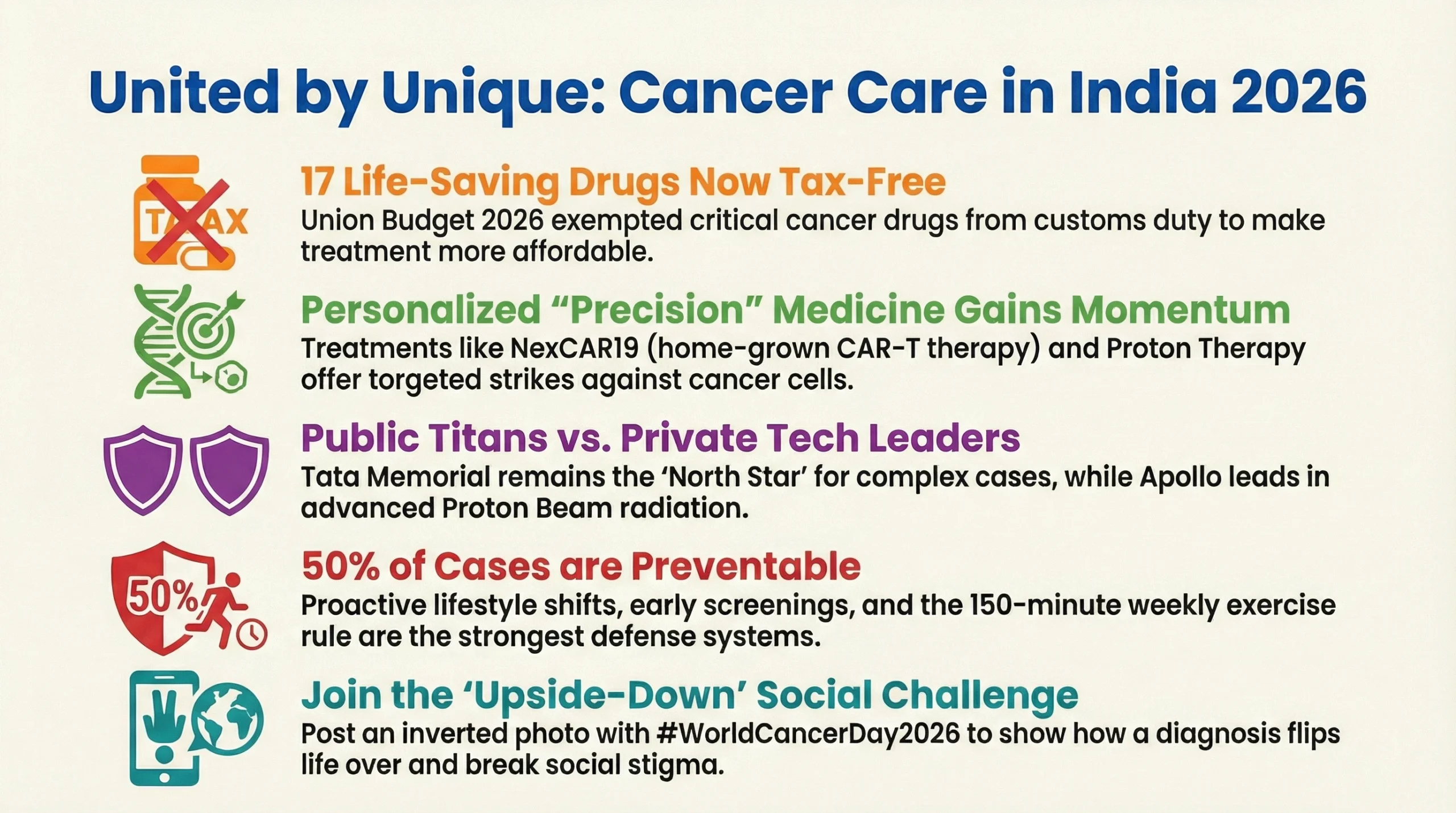
We are currently in the second year of the transformative three-year campaign (2025–2027), “United by Unique.” In 2026, the focus has shifted from general awareness to real-world experiences.
The philosophy is simple yet profound: United in our goals, unique in our needs. While the global community is united in the fight to reduce the cancer burden, we must acknowledge that no two journeys are the same. A patient in rural Bihar faces vastly different hurdles than one in a South Delhi super-speciality hospital. This year, the movement calls for person-centred care—moving beyond the “patient” label to see the individual’s medical, emotional, and social DNA.
Why 2026 is a Turning Point in India
In India, the conversation is shifting toward precision medicine and early detection. With the recent Union Budget 2026 exempting 17 life-saving cancer drugs (like Ribociclib and Trastuzumab) from customs duty, the “unique” needs of patients are finally becoming more affordable.
The 2026 campaign emphasises:
-
Empowering Voices: Highlighting survivor stories to identify gaps in the healthcare system.
-
Closing the Care Gap: Ensuring that life-saving immunotherapy and targeted therapies aren’t just for the elite.
-
The “Upside-Down Challenge”: A trending social media movement where people post inverted photos to symbolize how a cancer diagnosis turns a life upside down—aiming to break the lingering stigma in Indian society.
Understanding World Cancer Day 2026 means recognizing that awareness without action is just noise. Whether it’s scheduling that long-overdue mammogram, advocating for better rural screening facilities, or simply sharing a “humanised” story of victory, every effort counts. This year, let’s pledge to look beyond the disease. We are United by Unique, and together, we are rewriting the future of oncology in India.
The Public Titans: Subsidised Excellence
For many, these institutions are more than hospitals—they are beacons of hope that ensure financial constraints don’t dictate the quality of care.
-
Tata Memorial Hospital (Mumbai): Still the undisputed “North Star” of Indian oncology. In 2026, TMH continues to lead in clinical trials and high-volume surgeries. It is the best choice for complex cases where multidisciplinary expertise is non-negotiable.
-
AIIMS – Dr. B.R.A. Institute Rotary Cancer Hospital (New Delhi): A national referral hub known for its advanced hematopoietic stem-cell transplant program. The recent expansion at the National Cancer Institute (Jhajjar) has added much-needed public-sector Proton Therapy access.
-
Regional Cancer Centre (RCC), Thiruvananthapuram: A pioneer in population-based cancer care. It remains a top choice in South India for its research-driven protocols and holistic patient support systems.
The Private Leaders: Cutting-Edge Innovation
If you are looking for the latest global technology like robotic surgery or CyberKnife, these centers lead the way.
-
Apollo Proton Cancer Centre (Chennai): The first of its kind in Southeast Asia. It specializes in Proton Beam Therapy, which is highly precise radiation that minimizes damage to surrounding healthy tissues—ideal for pediatric and brain tumors.
-
Medanta – The Medicity (Gurugram): Known for its “Tumor Board” approach, where specialists from various departments sit together to customise a unique treatment plan for every patient.
-
HCG Cancer Centre (Bengaluru & Pan-India): A leader in Precision Medicine. They use advanced genomic testing to tailor chemotherapy and immunotherapy specifically to a patient’s genetic profile.
Specialised & Regional Heroes
-
Rajiv Gandhi Cancer Institute (Delhi): A dedicated non-profit focused exclusively on oncology, making it a “specialist’s specialist” hub for solid tumours.
-
Kidwai Memorial Institute of Oncology (Bengaluru): An essential center for affordable radiation oncology in Karnataka.
-
Chittaranjan National Cancer Institute (Kolkata): The primary referral center for Eastern India, offering highly subsidized, comprehensive care.
Which One to Choose?
| Hospital | Best For | Location |
| Tata Memorial | Complex Surgeries & Clinical Trials | Mumbai |
| Apollo Proton | Advanced Radiation (Proton Therapy) | Chennai |
| AIIMS Delhi | Stem-Cell Transplants & Public Care | New Delhi |
| HCG Cancer | Genomic & Personalised Medicine | Bengaluru |
| Medanta | Multi-disciplinary Robotic Surgery | Gurugram |
Choosing a center isn’t just about the machines; it’s about the “United by Unique” philosophy. Look for centres that offer emotional counselling and nutritional support alongside clinical treatment. In 2026, the best hospitals are those that treat the person, not just the scans.
While clinics and hospitals provide the science, it is the community that provides the soul. For World Cancer Day 2026, India is not just talking about awareness; we are literally hitting the pavement. From the sun-drenched coasts of Mangalore to the bustling streets of Mumbai, thousands are participating in events that prove we are indeed “United by Unique.”
If you want to be part of the movement this February, here are the major events and marathons taking place across the country.
1. The “Run for Cure 2026” (Vijayawada)
This flagship event, organised by Manipal Hospital Vijayawada, saw a massive turnout on February 1. Thousands of participants joined the 5K and 10K categories.
-
Why it matters: The run focuses on community engagement, moving the needle from fear to proactive prevention. It emphasises that early diagnosis is the “unique” key to changing long-term survival outcomes in India.
2. Mangalore “Can-Walk” 2026
Taking place at the KMC Hospital Attavar Oncology Centre, this walkathon on February 1 brought together survivors, doctors, and students.
-
The Vibe: This isn’t just a physical walk; it’s a “community awareness stride.” Participants walked to foster strength for those currently in treatment, highlighting the 2026 focus on person-centred care.
3. Nargis Dutt Foundation: Awareness Evening (Mumbai)
Mumbai’s Carter Road Amphitheatre in Bandra is the place to be on February 4, 2026. Starting at 5:00 PM, the Nargis Dutt Foundation is hosting an evening of “Awareness, Hope, and Support.”
-
The Highlights: Expect to see celebrities, top oncologists (like Dr Anil D’cruz), and courageous cancer warriors sharing their “unique” journeys. It’s a humanised celebration of life that aims to break the stigma still attached to the disease.
4. World Cancer Day Virtual Marathon & Cyclothon (Delhi & Bengaluru)
For those who prefer to contribute from their own neighbourhood, the Eagle Global Sports Network (EGSN) is hosting a massive virtual event from February 4 to 8.
-
How it works: You can run or cycle at your own pace (1km to 100km). Participants upload their activity via apps like Strava to earn a digital badge and e-certificate.
5. “Walk for Life” – Can Support (New Delhi)
The annual “Walk for Life – Stride Against Cancer” at Jawaharlal Nehru Stadium remains one of India’s most iconic solidarity walks. It brings together people from all walks of life to honour those lost and celebrate those who have won their battle.
Ways to Participate (Even if you aren’t running):
-
The “Inverted Photo” Challenge: Post a photo of yourself upside down on social media with the hashtag #WorldCancerDay2026 to show how cancer flips lives over.
-
Light Up the Day: Landmarks in major cities like Chennai and Kolkata are lighting up in lavender (the colour for all cancers). Wear lavender on Feb 4 to show your support.
-
Ayush Habba (Mangaluru): A unique blend of traditional and modern health checks, including free pulse diagnostics for health maintenance.
In 2026, the landscape of cancer treatment in India has shifted from a “one-size-fits-all” approach to a highly personalised, science-backed journey. We are no longer just fighting the disease; we are outsmarting it.
1. The Power of Your Own Body: Immunotherapy & CAR-T Cell Therapy
Immunotherapy has become the “Fourth Pillar” of cancer care. Unlike chemotherapy, which attacks all fast-growing cells, immunotherapy teaches your immune system to recognise and destroy cancer cells specifically.
-
-
Checkpoint Inhibitors: Think of these as drugs that “release the brakes” on your immune system. Popular in 2026 for lung and skin cancers, they help your T-cells see the cancer that was previously “hidden.”
-
CAR-T Cell Therapy: Often called a “living drug,” this involves taking your own T-cells, genetically engineering them in a lab to become “super-soldiers,” and reinfusing them. In India, NexCAR19—our home-grown CAR-T therapy—is making this once-million-dollar treatment accessible for blood cancer patients.
-
2. Precision Strikes: Targeted Therapy & ADCs
If chemotherapy is a “carpet bomb,” Targeted Therapy is a “guided missile.”
-
Targeted Drugs: These block specific proteins or genes (like EGFR or HER2) that tell cancer cells to grow.
-
Antibody-Drug Conjugates (ADCs): These are the latest “biological missiles” of 2026. They combine a precise antibody with a potent dose of chemo, delivering the “poison” directly into the cancer cell while sparing the healthy ones around it.
3. The 2026 Tech Revolution: AI & Proton Therapy
-
AI-Guided Treatment: Doctors now use AI platforms to analyze your tumor’s genetic profile against millions of clinical cases. This helps predict which drug combination will work best for your unique DNA, reducing trial-and-error.
-
Proton Beam Therapy: Centers like Apollo Chennai lead the way with this ultra-precise radiation. It stops exactly at the tumor site, making it the gold standard for brain tumors and pediatric cases where protecting nearby organs is critical.
4. Systemic vs. Localized: Chemo & HIPEC
While traditional Chemotherapy remains a vital systemic tool, 2026 has seen the rise of HIPEC (Hyperthermic Intraperitoneal Chemotherapy) for abdominal cancers.
-
How it works: After surgery, heated chemotherapy is circulated directly inside the abdominal cavity. The heat makes the cancer cells more “vulnerable,” allowing for a higher, more effective dose with fewer body-wide side effects.
5. Integrative Oncology: Healing the Whole Person
True to the “United by Unique” theme, 2026 marks the integration of Ayurveda and Yoga into mainstream clinical protocols.
-
AIIA Goa & Delhi: These centres are leading evidence-based research on how Yoga and specific Ayurvedic formulations can reduce the “toxicity” of chemotherapy, helping patients maintain their weight, appetite, and mental health during treatment.
Treatment Comparison at a Glance
| Treatment Type | Goal | Best For | Side Effects |
| Immunotherapy | Boosts Immune System | Lung, Melanoma, Renal | Flu-like symptoms |
| Targeted Therapy | Blocks Growth Signals | Breast, Lung, Leukemia | Skin rash, fatigue |
| Proton Therapy | Precise Radiation | Brain, Pediatric Cancers | Minimal “exit” dose |
| CAR-T Therapy | Re-engineers T-Cells | Lymphoma, Leukemia | Cytokine release (CRS) |
A cancer diagnosis in 2026 brings an immediate, heavy question: “How will we pay for this?” In India, where nearly 15 lakh new cases are reported annually, the financial burden is often as taxing as the physical one.
The good news? The Union Budget 2026, announced just days ago on February 1st, has introduced significant relief specifically for cancer patients. Here is a full guide to budgeting for care in this new landscape.
1. The 2026 Budget Advantage: Cheaper Medicines
The single biggest expense for most families is the cost of imported drugs. In the 2026-27 Union Budget, the government has fully exempted 17 life-saving cancer drugs from basic customs duty (previously 10%).
What this means for your pocket:
-
Targeted Therapies: Drugs like Ribociclib (for breast cancer) and Ceritinib (for lung cancer) will see an immediate price drop.
-
Immunotherapy: High-end treatments like Ipilimumab and Tislelizumab are now more accessible.
-
CAR-T Cell Therapy: Advanced blood cancer treatments like Talycabtagene Autoleucel are also on the tax-free list, reducing a bill that typically runs into lakhs.
2. Estimated Costs: A Realistic 2026 Price List
Treatment costs vary drastically by city and hospital type. Here is what to expect in 2026:
| Treatment Component | Government Hospital (Est.) | Private Hospital (Est.) |
| PET-CT Scan (Diagnosis) | ₹10,000 – ₹15,000 | ₹25,000 – ₹40,000 |
| Chemo (Per Cycle) | ₹12,000 – ₹50,000 | ₹50,000 – ₹2,00,000 |
| Advanced Radiation (IMRT/IGRT) | ₹1.5 Lakh – ₹2 Lakh | ₹3 Lakh – ₹5 Lakh |
| Surgery (Major Oncology) | ₹75,000 – ₹1.5 Lakh | ₹2.5 Lakh – ₹10 Lakh |
| Immunotherapy (Per Dose) | ₹1 Lakh – ₹3 Lakh | ₹5 Lakh – ₹8 Lakh+ |
3. Leveraging Government Safety Nets
If you are worried about the “Care Gap,” these schemes are designed to catch you:
-
Ayushman Bharat (PM-JAY): In 2026, the allocation for this scheme was hiked to ₹9,500 crore. It provides ₹5 lakh per family for secondary and tertiary care. It now includes 37 specialised targeted therapy packages.
-
Rashtriya Arogya Nidhi (RAN): Specifically for families below the poverty line (BPL). It provides up to ₹15 lakh for life-threatening diseases, including cancer.
-
State-Specific Schemes: Don’t forget local heroes like MJPJAY (Maharashtra) or CMCHIS (Tamil Nadu), which often provide additional coverage beyond the central limit.
4. Crowdfunding & NGO Support: You Are Not Alone
When insurance and savings fall short, India’s community spirit steps in.
-
Crowdfunding (Milaap/Ketto): Over 30% of high-end cancer treatments in India are now partially funded through crowdfunding. A well-written fundraiser can raise the “Unique” amount needed for a specific gene therapy.
-
Top NGOs for Financial Aid:
-
Indian Cancer Society (ICS): Provides grants for underprivileged patients.
-
YouWeCan Foundation: Specifically focuses on pediatric cancer and awareness.
-
Tata Trusts: Offers individual medical grants to those treated at linked hospitals.
-
Budgeting Tip for 2026
Always ask your oncologist for the “Generic vs. Biologic” price list. With the government’s new Biopharma Shakti initiative, domestic versions of expensive medicines are becoming available at 50-80% lower costs at Jan Aushadhi pharmacies.
While the advancements in medical science are breathtaking, the most powerful tool for cancer prevention remains in your hands—your daily habits. In 2026, health experts agree that nearly 50% of cancer cases in India are preventable through proactive lifestyle shifts.
Here is how you can build a “unique” defence system for your body.
1. The Indian Superfood Plate
Nutrition in 2026 is moving back to our roots, using traditional Indian ingredients that science now confirms are potent cancer-fighters.
-
Turmeric (Haldi): The curcumin in haldi is a natural anti-inflammatory. In 2026, “detox” turmeric formulations are widely used in integrative oncology to block pathways that help cancer cells grow.
-
Amla & Berries: Rich in antioxidants and vitamin C, these shield your cells from oxidative stress.
-
Cruciferous Power: Cabbage, cauliflower, and broccoli contain sulforaphane, which helps the body eliminate carcinogens.
-
Lycopene-Rich Tomatoes: Especially when cooked with a little ghee or olive oil, tomatoes are linked to lower risks of prostate and stomach cancers.
2. Breaking the Habit: Tobacco & Alcohol
Tobacco remains the single most preventable cause of death in India, accounting for nearly 13 lakh deaths annually.
-
The 2026 Tax Shift: As of February 1, 2026, the Indian government has hiked GST on tobacco products to 40% to discourage use among youth.
-
The “Unique” Risk: Whether it’s smoked or smokeless (gutka), tobacco is responsible for 90% of oral cancers in India. Quitting today can reduce your risk of lung, throat, and bladder cancer by half within just a few years.
-
Alcohol Moderation: Alcohol is a known carcinogen linked to breast and liver cancers. If you choose to drink, limit it to one drink a day for women and two for men.
3. The Age-Wise Screening Checklist
Early detection is not just a medical buzzword; it is a life-saver. For 2026, the Ministry of Health has streamlined these guidelines:
| Cancer Type | Who Should Screen? | Test Frequency |
| Oral Cancer | All adults (30+), especially tobacco users | Annual dental check-up |
| Breast Cancer | Women aged 40–54 | Annual Mammogram |
| Cervical Cancer | All women over 30 | Pap smear/HPV test every 3–5 years |
| Colorectal | Men and women aged 45+ | Colonoscopy every 10 years |
| Lung Cancer | Heavy smokers (ages 50–80) | Annual Low-Dose CT Scan |
4. Physical Vitality: Movement as Medicine
Obesity triggers hormonal imbalances that can fuel cancer growth.
-
The 150-Minute Rule: Aim for 150 minutes of moderate activity (brisk walking, swimming) or 75 minutes of vigorous exercise weekly.
-
The Vitamin D Factor: Given the Indian climate, ensure you get safe sun exposure (before 10 AM) or supplement, as Vitamin D deficiency is linked to higher cancer risks.
5. Mental Well-being & Sleep
Chronic stress weakens the immune system, making it harder for your body to detect and destroy mutated cells.
-
Habit: Incorporate 10 minutes of Pranayama or meditation daily.
-
The 7-Hour Sleep Goal: Quality sleep is when your body performs its most critical DNA repair.
A Unique Perspective for World Cancer Day 2026
Prevention isn’t about perfection; it’s about being “United by Unique” choices. Small, consistent shifts—like swapping a sugary snack for a handful of nuts or choosing to walk one extra kilometer—add up to a lifetime of protection.
In the sterile halls of oncology departments, the most potent medicine is often a story. For World Cancer Day 2026, the “Voices of Victory” remind us that while every diagnosis is unique, the human spirit’s resilience is a universal constant.
Here are the stories of “Warriors” who are redefining life after cancer in India.
1. The Doctor Who Became the Patient: Dr Deval Gadhvi
A primary care physician for decades, Dr. Gadhvi thought she knew the “C-word” inside out. But in 2025, she faced her own unique battle with breast cancer.
-
The Victory: After undergoing radiation and chemotherapy, she didn’t just return to her clinic; she launched the “Let’s Save Ma” campaign.
-
The Lesson: She realised that clinical knowledge isn’t enough—community and “humanized” connection are what truly drive early detection. Today, she travels across Gujarat in a medical bus, turning her survival into a crusade for others.
2. The Marathon Mindset: Prachi Kulkarni
A chef and an avid marathon runner, Prachi was at her peak fitness when she found a lump in 2024. Most would have hung up their running shoes; Prachi laced hers tighter.
-
The Victory: She treated her 16 sessions of chemotherapy like a long-distance race. “Stubbornly positive,” she used her training discipline to manage side effects.
-
The Message: In 2026, she is back on the track, proving that a diagnosis doesn’t have to be the end of your passion.
3. Breaking the Silence: Sonam’s 17-Year Journey
Diagnosed with Leukemia at just 10 years old, Sonam spent her childhood in a “haze of hospitals.” For years, her family treated the word cancer as a taboo.
-
The Victory: In February 2026, Sonam stood on a public stage to reclaim her story. She openly speaks about the PTSD and the “unique” emotional scars of childhood cancer.
-
The Impact: By breaking the “hush-hush” culture, she is helping a new generation of Indian survivors find pride in their scars rather than shame.
4. Celebrities Leading the Way
We cannot talk about victory without mentioning those who used their massive platforms to humanise the disease:
-
Sonali Bendre: In 2026, she continues to be a beacon for “fearless living,” often sharing the reality of her 20-inch surgery scar to normalize the physical changes treatment brings.
-
Sanjay Dutt: His journey through lung cancer has highlighted the importance of a “don’t give up” attitude and the role of specialised Indian oncology teams in achieving remission.
Words to Carry With You
“Cancer is a word, not a sentence.” — John Diamond
“United by Unique means we are never alone in our individual battles.” — World Cancer Day 2026 Advocacy Group
Frequently Asked Questions about World Cancer Day 2026
1. Can cancer be cured if detected in Stage 3 or 4?
While “cure” is a strong word, in 2026, many advanced cancers are treated as chronic manageable conditions. With the rise of immunotherapy and targeted drugs like Ribociclib, many Stage 4 patients (especially in breast or lung cancer) live active lives for years in “complete remission.” The goal in late stages is to stop progression and maintain a high quality of life.
2. How much does a PET-CT scan cost in India in 2026?
Accurate diagnosis is the first step. In private centers like Medanta or Apollo, a PET-CT scan costs between ₹25,000 and ₹40,000. However, under 2026 affordability initiatives, centers like Pi Cancer Care offer PET-CT support for as low as ₹5,000 for eligible patients. Government hubs like AIIMS provide these at even further subsidized rates.
3. Which cancer drugs became cheaper after the Union Budget 2026?
The 2026 Budget was a win for patients. The government removed customs duty on 17 life-saving drugs. Key medicines like Ribociclib (Breast Cancer), Trastuzumab (HER2+ Cancer), and Ipilimumab (Immunotherapy) have seen price drops of 10–15%, making advanced treatment much more accessible for the middle class.
4. Is cancer contagious? Can I catch it from a family member?
Absolutely not. Cancer is a non-communicable disease caused by genetic mutations or lifestyle factors—it is not like the flu. You cannot “catch” cancer by hugging, sharing food, or caring for a loved one. Being “United by Unique” means providing physical and emotional closeness without fear.
5. What are the early warning signs of cancer I shouldn’t ignore?
India has a high rate of late-stage diagnosis. See a doctor if you notice:
-
A lump or swelling that doesn’t go away.
-
Unusual bleeding (in stool, urine, or between periods).
-
A sore or ulcer (especially in the mouth) that doesn’t heal within 2 weeks.
-
Sudden, unexplained weight loss or persistent fatigue.
6. How can I apply for free cancer treatment under Ayushman Bharat (PM-JAY)?
If you have an Ayushman Card, you can access free care up to ₹5 lakh at any empanelled hospital (both public and private). In 2026, you can apply directly through the Ayushman App by uploading your Aadhaar and income certificate. Most large hospitals also have an “Ayushman Mitra” desk to help you with the paperwork.
7. Does sugar “feed” cancer cells?
This is a common myth. While all cells (including cancer cells) consume glucose for energy, there is no direct evidence that eating sugar makes cancer grow faster. However, a high-sugar diet leads to obesity, which is a proven risk factor for 13 different types of cancer. Balance is key.
8. What are the side effects of chemotherapy, and are they permanent?
Chemotherapy targets fast-growing cells, which can lead to hair loss, nausea, and fatigue. In 2026, scalp cooling caps are widely used to prevent hair loss, and new anti-emetic drugs have made nausea much rarer. Most side effects are temporary and disappear once treatment ends.
9. Can Ayurveda or Homoeopathy cure cancer?
There is no scientific evidence that alternative medicine can cure cancer on its own. However, Integrative Oncology is trending in 2026. Using Ayurveda or Yoga alongside your main treatment (Chemo/Radiation) can help manage side effects and improve your mental strength. Always consult your oncologist before starting any supplements.
10. How do I get a “Second Opinion” from Tata Memorial Hospital?
Tata Memorial offers a highly efficient Online Navya portal. You can upload your medical reports digitally, and a panel of world-class experts will provide a detailed treatment recommendation within a few days, saving you a trip to Mumbai.


Leave a Reply