
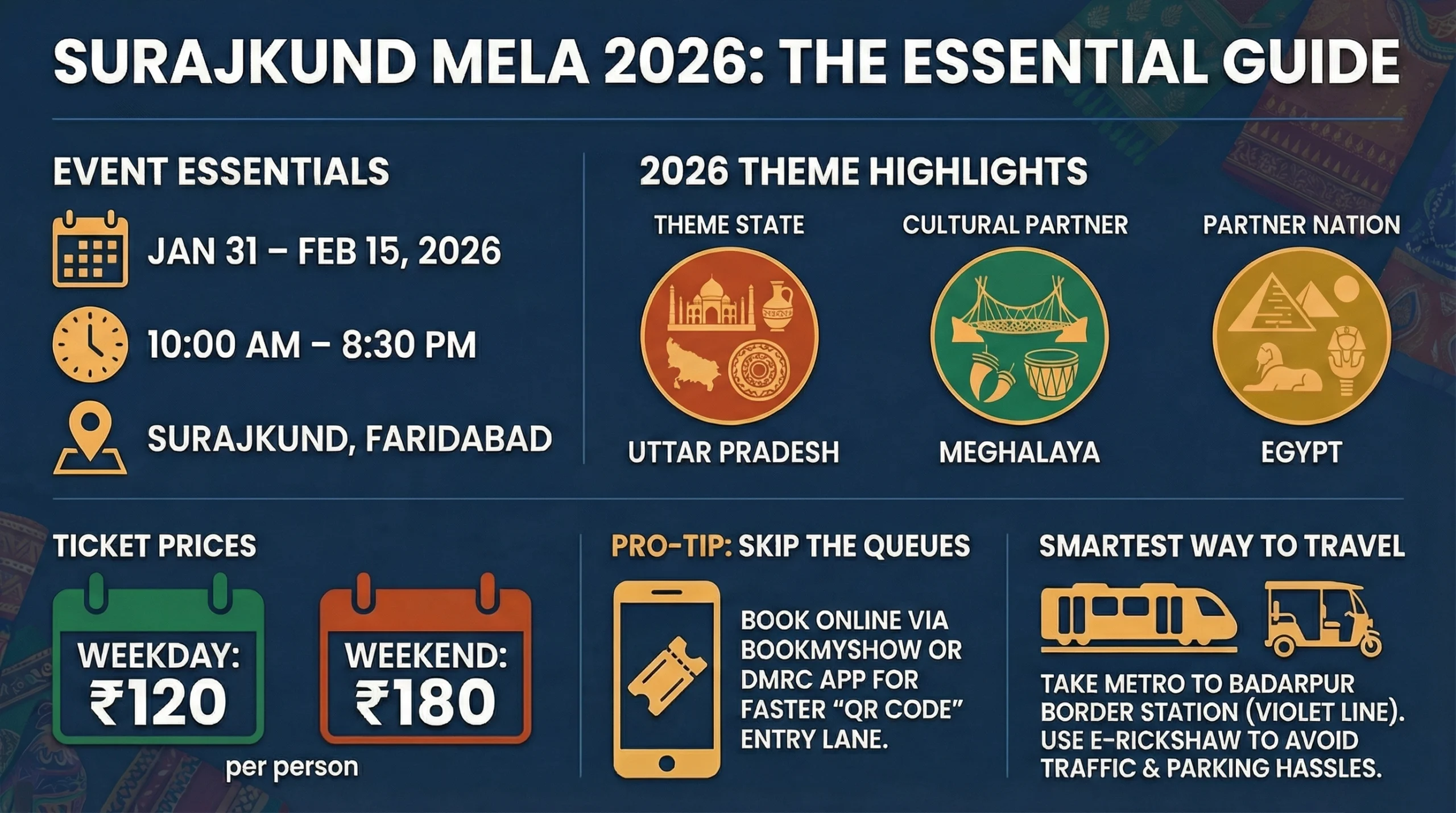
At a Glance: The 2026 Cheat Sheet
Let’s be honest—nobody likes scrolling through 3,000 words just to find the ticket price or the nearest metro station. If you are standing outside the venue or planning your trip in a hurry, this section is your lifeline.
Surajkund isn’t just a fair; it is a dust-filled, vibrant, chaotic celebration of India. To navigate it without losing your mind (or your wallet), you need the facts upfront. Here is the Surajkund Mela 2026 Fact Sheet—screenshot this, save it, or share it with your family group chat right now.
| Event Parameter | Confirmed Details for 2026 |
| Official Event | 39th Surajkund International Crafts Mela 2026 |
| Dates | January 31 – February 15, 2026 |
| Timings | 10:00 AM – 8:30 PM (Entry gates close at 7:30 PM) |
| Venue | Surajkund Mela Ground, Lakewood City, Faridabad |
| Theme States (2026) | Uttar Pradesh (Focus State) & Meghalaya (Cultural Partner) |
| Partner Nation | Egypt (Look for the Papyrus & Cotton stalls!) |
| Ticket Price | • Weekday (Mon-Fri): ₹120
• Weekend (Sat-Sun): ₹180 |
| Booking Mode | Online (BookMyShow / DMRC App) & Offline Counters |
| Nearest Metro | Badarpur Border (Violet Line) – 2 km from gate |
| Parking | Gate 1 (Delhi entry), Gate 2 & 3 (Faridabad entry) |
The “Insider” Breakdown: Why These Details Matter
You have the data, but here is the context that most news sites won’t tell you.
- The “Golden Window” for Visits
The Mela runs from Jan 31 to Feb 15. However, if you want to shop seriously, avoid the weekends. On Saturdays and Sundays, the footfall crosses 1.5 Lakh people per day. The dust kicks up, the mobile networks jam, and the food court queues can take 45 minutes.
My Recommendation: Plan your visit for a Tuesday or Wednesday. Reach exactly at 10:30 AM. You will get fresh stock, happy artisans willing to bargain, and empty selfie spots.
- The 2026 Theme: UP, Meghalaya & Egypt
This year is special. With Uttar Pradesh as the theme state, expect the food court to be dominated by Galouti Kebabs and Banarasi Paan. Culturally, this means the decoration will likely feature the Ghats of Varanasi or the Ayodhya Temple architecture. Meghalaya brings a rare treat—look for the black pottery (Longpi) and sustainable cane products which are usually hard to find in North India. And with Egypt as the partner nation, do not leave without checking out their authentic cotton scarves—they sell out fast!
- The Metro vs. Driving Debate
This is where most visitors mess up. The Badarpur Border Metro Station (Violet Line) is your best bet. Why? Because the traffic police often barricade the last 1.5 km stretch to the Mela for private cars due to congestion. If you take the metro, you can hop onto the electric rickshaws (₹20/seat) that zip through the traffic faster than cars.
If you must drive, aim for Parking near Gate 1 (Silver Jubilee Gate) if you are coming from Delhi/Gurgaon. It is the largest lot, but it fills up by 11:00 AM.
- Ticket Booking Hack
Do not stand in the physical queue. The lines are long and sunny. Use the DMRC (Delhi Metro) App or BookMyShow to buy tickets while you are on the way. The “QR Code” entry is separate and much faster.
The “World’s Largest” Experience
If you think you’ve seen crowded markets in India, think again. Surajkund isn’t just a market; it is a temporary city that rises from the dust of the Aravallis every February.
Officially, it is the 39th Surajkund International Crafts Mela 2026. But to the locals and the millions of tourists who flock here, it is a sensory explosion. We are talking about the largest crafts fair in the world—a title it holds not just on paper, but in the sheer magnitude of what you witness on the ground.
Imagine walking into a space that spans 40.5 hectares (that’s huge!). One moment, you are haggling for Pashmina shawls with an artisan from Kashmir, and ten steps later, you are smelling the aroma of Koshary (a lentil dish) from an Egyptian chef.
More Than Just Shopping: The Vibe of 2026
Why do over a million people visit this dusty corner of Faridabad every year? It’s because Surajkund offers something that our modern AC malls never can: Soul.
As you step through the massive gates—designed this year to reflect the architectural grandeur of Uttar Pradesh (the 2026 Theme State)—the first thing that hits you is the sound of the Nagadas (giant drums). The beat is infectious. It’s the heartbeat of the Mela.
You aren’t just a shopper here; you are a time traveler. You will walk past over 1,000 work huts where national award-winning artisans aren’t just selling products; they are creating them right in front of you. You watch a potter mold wet clay into a pot, a weaver work a handloom, and a painter fill colors into a Madhubani canvas.
“It is the only place in India where you can travel from the deserts of Kutch to the hills of Meghalaya, and then cross the border to the pyramids of Egypt—all in a single afternoon walk.”
The Global Village: Egypt Meets India
This year, the “World’s Largest” tag feels even heavier with Egypt joining as the Partner Nation. This isn’t just a diplomatic handshake; it’s a cultural exchange you can touch and feel.
In previous years, we’ve seen the influence of partner nations transform the Mela. I remember when Thailand was the partner, the orchid displays were breathtaking. In 2026, with Egypt, expect to see the Nile meets the Yamuna. You will find stalls selling authentic Papyrus art, Egyptian cotton (which rivals our own), and perhaps even cultural troupes performing the mesmerizing Tanoura dance at the Chaupal (the open-air theatre).
Why You Cannot Miss the 39th Edition
If you are tired of buying mass-produced “Made in China” decor for your home, Surajkund is your antidote. Every rupee you spend here goes directly to the hands that made the product.
But a fair warning to my readers: This is an “outdoor” experience in the truest sense. There is dust, there is walking (lots of it), and there is the glorious winter sun of Delhi NCR. It is chaotic, loud, and crowded—and that is exactly why it is beautiful.
So, tie your shoelaces, put on your sunglasses, and keep your UPI apps ready. You are about to enter the most colorful labyrinth in India.
Ticket Booking Guide: How to Skip the Queue
Let me paint a picture for you: It is Saturday, 11:30 AM. You have driven for an hour to reach Faridabad. You approach the gate, excited for the Mela, only to see a winding queue of 500 people standing in the winter sun, just to buy a paper ticket.
Do not be that person.
In 2026, standing in a ticket line at Surajkund is a rookie mistake. The authorities have pushed heavily for digitization, and frankly, the online experience is flawless if you know which app to use. Here is your step-by-step guide to breezing past the crowd like a VIP.
1. The Price Tag: What Are You Paying?
Before you book, know the rates. The prices have seen a marginal hike this year to manage the crowd.
- Weekdays (Monday – Friday): ₹120 per person.
- Weekends (Saturday & Sunday): ₹180 per person.
- Children: Kids below a certain height (usually 3-4 feet) enter free. (Always check the measuring scale at the gate).
2. How to Book Online
There are two primary platforms handling the ticketing for the 39th Surajkund International Crafts Mela.
Option A: BookMyShow (The Standard)
Most people use this. It is reliable, but it charges a small “convenience fee.”
- Open the BookMyShow App or Website.
- Search for “Surajkund International Crafts Mela 2026”.
- Select the Date and Number of Pax.
- Make the payment via UPI/Card.
- Crucial Step: You will receive a QR Code via email/SMS. Take a screenshot immediately. Do not rely on opening the app at the gate; the internet network there is notoriously slow due to the crowd.
Option B: DMRC ‘Delhi Sarthi 2.0’ / One Delhi App (The Commuter Choice)
If you are travelling by Metro, this is seamless. The DMRC app often allows you to book Mela tickets along with your QR journey ticket.
- Open the DMRC App.
- Look for the “Events” or “Surajkund Mela” banner on the home screen.
- Book the ticket. This QR code works at the specific scanners at the Mela gates.
3. Buying Offline: If You Must
If you are old school or buying for a large group with cash, physical counters are available.
- Locations: Counters are set up at Gate 1 (Shekhawati), Gate 2 (Kerala), and Gate 3 (Dhanteshwari).
- Timing: Counters open at 9:30 AM (30 mins before entry).
- The Trap: The queues at Gate 1 (Delhi side) are the longest. If you must buy offline, try walking to Gate 3, which usually has shorter lines.
4. Who Gets in For FREE? (Discounts & Exemptions)
Save money if you fall into these categories. You must carry a valid Government ID or proof to claim these at the gate.
- School Students: Free entry for school students if they are in school uniform and accompanied by a teacher (usually for school trips). For individual students with ID cards, a 50% discount is often applicable on weekdays (Subject to 2026 policy—ask at the “Enquiry” window).
- Senior Citizens: 50% discount on entry tickets (Carry Aadhaar Card for age proof).
- Differently-Abled (Divyangjan): 50% discount on tickets.
- Defense Personnel: Serving soldiers sometimes get concessions; carry your service ID.
⚠️ The “Scam” Warning:
You might find people selling tickets in the parking lot or near the metro station claiming to be “official vendors” to save you the walk. Ignore them. Fake tickets are a common hustle here. Only buy from the app or the box office window.
5. The “Scan & Enter” Protocol
Once you have your online ticket:
- Head straight to the lane marked “E-Ticket / Online Booking.” It is usually empty compared to the cash lane.
- Increase your phone brightness to 100%. The scanners struggle to read dim screens in the bright sunlight.
- Scan, grab a wristband (if they are giving them this year), and you are in!
How to Reach & Parking Survival Guide
If there is one thing that can dampen the Surajkund spirit, it is the legendary traffic on Mathura Road.
I will be blunt: Reaching the Mela on a weekend afternoon is a test of patience. The roads are jammed, the horns are blaring, and the diversions can be confusing. But don’t worry—I have navigated these roads for years.
Here is your survival guide to reaching the venue without losing your cool (or your car).
1. By Metro: The Smartest Choice
I cannot stress this enough: Take the Metro. It is faster, cheaper, and stress-free.
- The Station: You need to get off at Badarpur Border (on the Violet Line).
- Note: Some old guides might say Tughlakabad, but Badarpur Border is closer and has better shuttle frequency.
- The “Last Mile” (Metro to Gate):
- Once you exit the station, you don’t need to walk (it’s a dusty 1.5 km uphill trek).
- Electric Rickshaws: Hundreds of e-rickshaws line up outside. They charge ₹20–₹30 per seat on a sharing basis. They drop you right near the Silver Jubilee Gate.
- Official Shuttle Bus: Haryana Roadways often runs low-floor shuttle buses from the Metro station to the Mela grounds. Look for the buses marked “Mela Special.”
2. By Car: For the Brave & The Families
If you are travelling with elderly parents or kids and must drive, strategy is everything.
- Route A: From South Delhi (GK / Saket / Nehru Place)
- Take the route via Dr. Karni Singh Shooting Range (Surajkund Road). This is scenic and usually moves faster than the main highway.
- Warning: The police create a “One Way” loop near the venue. Follow the barricades; do not trust Google Maps blindly in the last 500 meters.
- Route B: From Noida / East Delhi
- You will come via Kalindi Kunj onto Mathura Road.
- The Choke Point: The Sarita Vihar underpass and the Badarpur flyover entry are major bottlenecks. Leave home by 9:00 AM to cross this stretch before the rush.
- Route C: From Gurgaon
- Take the Gurgaon-Faridabad Road. It is a smooth, winding highway (watch out for monkeys!). It lands you directly at the Surajkund roundabout near the Sidhdata Ashram.
3. The Parking Map: Where to Park?
The Mela grounds are huge, and parking is divided by Gates.
- Gate 1 Parking (Silver Jubilee Gate):
- Best for: Visitors coming from Delhi/Gurgaon.
- Capacity: Massive. It’s a giant open field.
- The Catch: It is a long walk (approx. 500-700 meters) from the car park to the actual ticket counter.
- Gate 2 & 3 Parking (Kerala / Dhanteshwari Gate):
- Best for: Visitors coming from Faridabad City.
- Capacity: Smaller, fills up faster.
- Advantage: Closer to the entry gates.
Estimated Parking Fees (2026):
- Cars: ₹200
- Two-Wheelers: ₹100
- Helmets: There is usually a helmet cloakroom near the bike parking (₹20 charge), but carry a lock just in case.
4. Three “Pro-Level” Parking Hacks
Nobody tells you this until you are stuck there.
- The “WhatsApp Location” Trick: The parking lots are just giant dust bowls with no numbered pillars. As soon as you park, drop a pin on WhatsApp to your family group. Finding your car in the dark at 8:00 PM among 5,000 other Maruti Swifts is a nightmare without a pin.
- Wear “Dust-Proof” Shoes: The walk from the car to the gate is not paved. It is loose soil. If you wear suede loafers or white sneakers, they will be brown by the time you reach the ticket counter.
- Exit Strategy: When leaving, if you are parked at Gate 1, do not try to U-turn back towards Delhi immediately. The police often force traffic towards Faridabad to prevent jams. Just go with the flow for 1 km and take a U-turn where the traffic thins out.
🚍 Public Transport Note for Locals:
If you are coming from Delhi, look for DTC buses with route numbers CS-13 or CS-14. They ply specifically towards the Surajkund area during the Mela.
The 2026 Theme: A Tale of Three Cultures
One of the reasons Surajkund never gets boring is that it changes its “skin” every year. The decor, the main gates, the stage backdrops, and even the food court menu are dictated by the Theme State and the Partner Nation.
In 2026, the organizers have pulled off a massive coup. We have a powerhouse combination: the grandeur of Uttar Pradesh, the serenity of Meghalaya, and the ancient mystique of Egypt.
Here is what this means for you as a visitor.
1. The Theme State: Uttar Pradesh (The Cultural Giant)
Uttar Pradesh (UP) is hosting the Mela this year, and if you know anything about UP, you know they don’t do things small. Expect the Mela grounds to be visually dominated by replicas of the Ram Mandir (Ayodhya), the Kashi Vishwanath Corridor, or the ghats of Varanasi.
What to Look For:
- The “Apna Ghar”: Every year, the theme state builds a traditional house called Apna Ghar. This year, expect a rustic UP village home—complete with a charpai, mud walls, and women cooking Makki ki Roti on a Chulha. It is the ultimate Instagram spot.
- The Crafts:
- Banarasi Silk: Don’t buy fakes from city markets. Here, weavers from Varanasi bring the real deal. Look for the “Handloom Mark.”
- Chikankari: Artisans from Lucknow will be present with intricate white-on-white embroidery.
- Moradabad Brass: Heavy, ornate brass lamps and statues.
- Khurja Pottery: Colorful, glazed ceramic planters and crockery that are dirt cheap compared to online stores.
- Ittar (Perfume): The Kannauj stall is a must-visit for natural, alcohol-free perfumes (try the Mitti scent—it smells like rain on dry earth).
2. The Cultural Partner: Meghalaya (The Abode of Clouds)
While UP brings the noise and grandeur, Meghalaya brings the “Zen.” The North-East region always gets a special focus at Surajkund, and Meghalaya’s pavilion is usually the most eco-friendly spot in the fair.
What to Look For:
- Bamboo Architecture: Look for structures mimicking the famous “Living Root Bridges.” The craftsmanship in their bamboo furniture is superior to anything you’ll find in furniture malls.
- Black Pottery (Longpi): This is a rare craft. These pots are made from crushed rock and clay, without a potter’s wheel. They turn black when fired and are excellent for slow cooking.
- Naga & Khasi Shawls: Thick, warm, and patterned with tribal motifs that tell stories of their clans.
- Turmeric: Meghalaya produces the world’s best turmeric (Lakadong). It has high curcumin content—grab a packet for your kitchen.
3. The Partner Nation: Egypt (The Pharaohs Arrive)
This is the international cherry on the cake. Egypt’s partnership means the international zone will be buzzing with Middle Eastern vibes.
What to Look For:
- Papyrus Art: You might see artists painting on actual Papyrus paper—the same way they did in ancient Egypt. These make for incredible wall art.
- Egyptian Cotton: Known as “White Gold,” their scarves and stoles are incredibly soft and durable.
- Alabaster Statues: Small replicas of the Sphinx, cats, and Pharaohs carved from stone.
- The Performance: Do not miss the Tanoura Dance at the Chaupal in the evening. This is the Sufi whirling dance with colorful, weighted skirts. It is hypnotic to watch.
💡 The Cultural “Mash-Up”:
The best part of the Mela is the juxtaposition. You will likely see a Haryanvi folk dancer jamming with an Egyptian drummer while a Meghalaya flute player watches. These impromptu jam sessions happen near the food court around 4:00 PM. Keep your camera ready.
Detailed Shopping Guide: The Hidden Gems
You are going to walk past 1,200 huts. It is overwhelming. If you don’t have a plan, you will end up buying a generic keychain and regretting it later.
I have curated this list based on the 2026 Theme (UP & Meghalaya) and the evergreen bestsellers that vanish from the stalls by the second week.
1. The “Uttar Pradesh” Haul
Since UP is the host, their artisans get the prime spots. Do not miss these:
- Chikankari Kurtas (Lucknow):
- Where to find: The stalls near the main “Apna Ghar” display.
- What to look for: Inspect the back of the fabric. Hand-embroidery will have knots; machine work will be smooth.
- 💰 Price Watch: ₹800 – ₹2,500 (depending on fabric quality).
- Khurja Pottery (Bulandshahr):
- The Vibe: Colorful, glazed ceramic planters, soup bowls, and coffee mugs. They are heavy but stunning.
- 💰 Price Watch: ₹50 – ₹150 for mugs; ₹300+ for planters.
- Brassware (Moradabad):
- What to buy: Vintage-style oil lamps, heavy brass padlocks, and idols.
- 💰 Price Watch: Small items start at ₹400.
- Ittar (Perfume) from Kannauj:
- The Gem: Ask for “Mitti Attar” (the smell of the first rain). It comes in tiny glass bottles and lasts for days.
- 💰 Price Watch: ₹150 – ₹500 per bottle.
2. The “Meghalaya” Treasures (Cultural Partner)
These items are rare in Delhi NCR. If you see them, buy them.
- Black Pottery (Longpi):
- The USP: This pottery is made from crushed rock and clay, without a potter’s wheel. It turns black naturally when fired. It is microwave safe and looks incredibly chic.
- 💰 Price Watch: ₹800 – ₹1,500 for serving bowls.
- Cane & Bamboo Baskets:
- The Craft: Meghalaya weavers create “conical baskets” (Khoh) that are virtually indestructible. Great for laundry or home decor.
- 💰 Price Watch: ₹400 onwards.
- Lakadong Turmeric:
- Why buy: It is known as the world’s best turmeric with high curcumin content. Look for the spice stalls in the North-East pavilion.
3. The “Egypt” Souvenirs (Partner Nation)
Walk to the International Zone (usually at the far end of the Mela).
- Papyrus Art: Paintings made on paper derived from the papyrus plant. They often depict pharaohs and hieroglyphics.
- Egyptian Cotton Scarves: Extremely soft, breathable, and durable.
- Alabaster Statues: Small white stone carvings of cats or the Sphinx.
4. The Evergreen Bestsellers
- Madhubani Paintings (Bihar):
- Look for the ones on handmade paper or cloth. A4 size paintings usually start at ₹300.
- Blue Pottery (Jaipur):
- The soap dispensers and plates are classic buys.
- Phulkari Dupattas (Punjab):
- Bright, heavy embroidery. Perfect for jazzing up a plain white kurta.
- Terracotta Horses (West Bengal):
- The “Bankura Horses” come in all sizes. The tiny ones (₹50) make great desk toys.
💡 The “Bargaining” Cheat Sheet
At Surajkund, the price on the sticker is rarely the final price. Here is how to play the game:
- The “60% Rule”: If they quote ₹1,000, start your offer at ₹600.
- The “Walk Away”: This is your strongest move. If they refuse your price, slowly walk away. 7 out of 10 times, they will call you back.
- Bulk Power: “Bhaiya, if I take three mugs, will you give it for ₹300?” works like a charm.
- No Bargaining Zones: The government-run stalls (like Khadi Gramodyog or Tribes India) usually have fixed prices. Do not embarrass yourself by bargaining there.
VII. The Food Court: From Litti Chokha to Koshary
If you think the shopping is exhausting, wait until you smell the food. The Surajkund Food Court is not a cafeteria; it is a battlefield of aromas. You will smell melting butter from Punjab, roasting meat from Lucknow, and spicy chutneys from Rajasthan all at once.
In 2026, the menu has expanded to include the royal kitchens of Uttar Pradesh and the tribal fires of Meghalaya, plus a rare treat from Egypt.
Here is your “Eat-List” so you don’t waste stomach space on average Chowmein.
1. The Host State Special: Uttar Pradesh (The Royal Feast)
Since UP is the theme state, their food zone is the star attraction this year. Expect authentic chefs from Lucknow and Varanasi.
- Galouti & Tunday Kebabs: Skip the generic rolls. Go to the stalls marked “Awadhi” or “Lucknow” for melt-in-the-mouth Galouti kebabs served on small Ulte Tawa ka Parathas.
- Mathura ke Pede & Petha: Fresh stocks arrive daily from Mathura and Agra. The Kesar Petha (saffron pumpkin sweet) is a must-buy for home.
- Banarasi Tamatar Chaat: A spicy, tangy tomato mash topped with crispy sev—a Varanasi winter specialty that will clear your sinuses!
- 💰 Price Watch: Kebabs Plate: ₹350 | Chaat: ₹150
2. The North-East Corner: Meghalaya (The Rare Find)
It is hard to find authentic Khasi food in Delhi NCR. Do not miss this chance.
- Jadoh: The signature dish of the Khasis. It’s rice cooked with meat (usually pork or chicken) and aromatic spices. It looks like pulao but tastes smoky and rich.
- Bamboo Shoot Curry: If you love bold flavors, try the pork or chicken cooked with fermented bamboo shoots.
- 💰 Price Watch: Jadoh Plate: ₹250 – ₹300
3. The International Treat: Egypt (Pharaoh’s Kitchen)
Walk to the Partner Nation food stalls for something different.
- Koshary: The national dish of Egypt. It’s a carb-loader’s dream—a mix of rice, macaroni, and lentils topped with a spiced tomato sauce and garlic vinegar.
- Egyptian Hibiscus Tea (Karkade): A bright red, tart, and refreshing drink perfect for the sunny afternoon.
- 💰 Price Watch: Koshary: ₹250 | Tea: ₹100
4. The Surajkund Legends (The Non-Negotiables)
These are the stalls that have been famous for 30 years. If you don’t eat here, did you even go to Surajkund?
- Gohana Ki Jalebi (Haryana): These are not normal jalebis. Each jalebi weighs 250 grams (yes, a quarter kilo!). They are thick, juicy, and fried in pure Desi Ghee. Warning: One is enough for a family of four.
- Siddu (Himachal Pradesh): Steamed wheat buns stuffed with poppy seeds and nuts, served with a generous pour of ghee. Perfect for the winter chill.
- Litti Chokha (Bihar): Roasted wheat balls dipped in ghee served with mashed spicy brinjal. The stalls near the Bihar pavilion usually have the best authentic taste.
- 💰 Price Watch: Jalebi: ₹100 per piece | Litti Chokha: ₹150
⚠️ The “Real” Food Court Survival Tips
- The Seating Struggle: The main food court tables are always full. Pro Tip: Walk behind the state pavilions (specifically near the North-East zone). There are often grassy patches or smaller charpais where you can sit peacefully.
- Bring Water: A 1-liter water bottle inside can cost ₹30-40 (above MRP). Carry your own bottle in a backpack; it is allowed.
- Hygiene Check: Stick to cooked/hot food. Avoid cut fruits or raw salads in the open dust.
- Digital Payment: The food stalls do have QR codes, but the network is terrible. Carry Cash. It is faster and saves you from the “Payment Failed” awkwardness.
Cultural Performances: The Beat of the Drums
If you hear the thumping of giant Nagadas (drums) echoing across the fairgrounds, follow that sound. It will lead you to the Chaupal.
The Chaupal is the open-air theatre and the beating heart of the Surajkund Mela. It is where the static crafts come alive through dance and music. The best part? It is completely free with your entry ticket.
In 2026, the stage is set for a cultural face-off between the rhythms of Uttar Pradesh, the tribal beats of Meghalaya, and the mystical tunes of Egypt.
1. The Main Chaupal
Located centrally (usually near the food court), this is where the magic happens after sunset.
-
The “Uttar Pradesh” Spectacle: Since UP is the host, expect grandeur.
-
Charkula Dance: Watch women from the Braj region balance heavy pyramids of 108 oil lamps on their heads while dancing. It is a breathtaking balancing act.
-
Kathak & Rasa Lila: Classical performances depicting the stories of Lord Krishna.
-
-
The “Egypt” Tanoura: This is the showstopper. The Egyptian troupe performs the Tanoura, a Sufi whirling dance. The dancer spins continuously for 15-20 minutes in a heavy, colorful skirt that lights up (literally, with LEDs) in the dark. It is hypnotic.
-
The “Meghalaya” Wangala: Also known as the “100 Drums Festival” dance. The synchronization of the drummers is powerful enough to shake your seat.
2. The Choti Chaupal (Street Vibes)
You don’t have to wait for the evening. The smaller stages (and sometimes just open patches of grass) host performances all day long.
-
Bhangra & Gidda: High-energy Punjabi dancers usually take over the streets around 4:00 PM. You will be pulled in to dance.
-
Kalbelia (Rajasthan): The snake-charmer dance performed by women in swirling black skirts.
-
Bahurupiyas: Keep an eye out for these traditional street performers dressed as mythological characters (like Hanuman or Shiva). They stand statue-still for hours—it’s spooky and fascinating!
3. Performance Schedule (Typical Timings)
While the schedule changes daily, here is the standard flow:
-
12:00 PM – 4:00 PM: Day performances at Choti Chaupal (Folk dances from different states).
-
4:00 PM – 5:30 PM: The “Fashion Show” (showcasing the handlooms of the Theme State – UP).
-
6:00 PM – 8:00 PM: The Grand Cultural Evening at the Main Chaupal. This is the prime time slot.
💡 The “Front Row” Hack:
The Main Chaupal has stone steps for seating (amphitheatre style). It fills up by 5:30 PM. If you want a seat for the evening show, grab your spot with a packet of popcorn before the sun sets. If you arrive at 6:30 PM, you will be standing at the back.
Practical “Human” Tips (The Stuff No One Tells You)
I have visited Surajkund for five years straight, and I have learned these lessons the hard way. Here is the unvarnished truth to save you from a headache.
1. The Dust is Real (The “Black Tissue” Test)
Surajkund is an open ground in the Aravalli hills. It is dusty.
- The Reality: By the time you leave, your shoes will be grey, and your face will feel gritty.
- The Fix:
- Wear Sunglasses (essential to keep dust out of your eyes).
- Avoid Suede or Velvet shoes. Wear leather or washable sneakers.
- Carry Wet Wipes. You will need them to wipe your face before eating.
- Mask Up: If you have dust allergies, wear a mask. It’s not for COVID; it’s for the soil.
2. The Network Blackout
When 1 lakh people gather in one spot, mobile towers give up.
- The Reality: Your 5G will drop to 2G. UPI payments often fail, and calls won’t connect.
- The Fix:
- Cash is King: Carry at least ₹2,000 in smaller denominations (₹100/₹200 notes). It is faster than waiting for a Paytm circle to load.
- Meeting Point: Decide on a physical meeting point (e.g., “The Giant Charkha near Gate 2”) before you separate. “I’ll call you” is a lie here.
3. The “Toilet” Strategy
Let’s be adults about this. Public toilets at fairs have a bad reputation.
- The Reality: The washrooms near the Food Court are the most crowded and… well, let’s say “experienced.”
- The Fix: Walk the extra mile. The Bio-Toilets near Gate 3 (VIP entry side) or behind the State Pavilions are usually cleaner and less crowded.
- BYO: Bring Your Own sanitizer and toilet paper/tissues. Soap dispensers are often empty by 2:00 PM.
4. Dress Code: The “Onion” Strategy
February weather in Delhi NCR is tricky.
- The Reality: It is scorching hot at 1:00 PM and freezing cold by 6:00 PM.
- The Fix: Dress in layers. Wear a light t-shirt with a jacket you can tie around your waist. If you plan to stay for the evening cultural show, that jacket is mandatory.
5. Safety & Security
- Pickpockets: Crowded stalls are a haven for pickpockets. Keep your wallet in your front pocket. Backpacks should be worn on the front in high-density areas.
- Lost Kids: It happens more often than you think. Put a slip of paper with your phone number in your child’s pocket or write it on their wristband.
Frequently Asked Questions: Surajkund Mela 2026 – FAQs
Still have questions? I’ve gathered the most common queries from visitors to save you a call to the helpline.
Q1: Is online ticket booking mandatory, or can I buy tickets at the gate?
A: It is not mandatory, but it is highly recommended.
While there are physical ticket counters at Gate 1, 2, and 3, the queues on weekends can take 40-60 minutes. Buying online via BookMyShow or the DMRC App allows you to use the “Fast Track” entry lanes.
- Pro Tip: If the network is down at the gate, you can still buy physical tickets, but carry cash as card machines often struggle with connectivity.
Q2: Is re-entry allowed if I leave the Mela grounds?
A: No. Once you exit the turnstiles, your ticket is invalid for re-entry.
If you forgot your jacket or wallet in the car, you will have to buy a fresh ticket to get back in. Double-check your backpack before you scan your ticket!
Q3: Are there ATMs inside the Mela grounds?
A: Yes, mobile ATM vans are usually parked near the Food Court and Gate 1.
However, they often run out of cash by 4:00 PM due to the massive crowd.
- The Reality: Do not rely on them. Withdraw cash before you reach the venue.
Q4: Can I bring my pet dog/cat to the Mela?
A: Strictly No. Pets are not allowed inside the Surajkund Mela grounds. The noise, dust, and crowds are stressful for animals, and the administration has a strict no-pet policy.
Q5: Is there a cloakroom to store helmets or luggage?
A: Yes, but facilities are limited.
There is usually a makeshift cloakroom near the Gate 1 Parking area specifically for motorcycle helmets (charge approx. ₹20-30).
- Warning: Avoid bringing heavy luggage or laptops. There are no secure lockers for expensive electronics, and carrying a suitcase inside the dusty ground is a nightmare.
Q6: What should I do if I lose my child or belongings?
A:
- For Lost Persons: Head immediately to the Control Room near the main stage (Chaupal). They make regular announcements on the PA system.
- For Lost Items: Submit a description at the Police Control Van near Gate 1.
- Pro Tip: Before entering, slip a piece of paper with your phone number into your child’s pocket or write it on their wristband.
Q7: Is the Mela safe for solo female travelers?
A: Yes. Surajkund Mela is heavily policed with CCTV surveillance and women police constables (Shakti Squad) on patrol.
However, it gets extremely crowded.
- Safety Tip: Avoid the isolated paths behind the state huts after sunset (7:00 PM). Stick to the main lit areas near the Food Court and Chaupal.
Q8: Can I bring outside food? (Detailed Policy)
A: The official rule is No Outside Food. Security guards will check your bags and confiscate tiffins, chips, or picnic baskets.
- The Exceptions: They are usually lenient with:
- Water bottles (plastic, not glass).
- Baby food/milk for infants.
- Diabetic essentials (small snacks like biscuits).
Q9: What are the photography rules? Can I bring a drone?
A:
- DSLRs/Mirroless Cameras: Allowed. You can shoot freely. In fact, it is a photographer’s paradise.
- Tripods: Generally allowed, but security may stop you if you block the path on a busy weekend.
- Drones: Strictly Banned. Flying a drone without police permission (which is rare to get) can lead to confiscation of your device and a fine.
Q10: Is the Mela wheelchair and stroller accessible?
A: Partially Yes.
- The Good: The main arterial roads are paved with bricks, making them accessible for wheelchairs and baby strollers.
- The Bad: The smaller lanes leading to specific craft huts are often uneven, dusty, or grassy.
- Facility: e-Rickshaws are available inside the ground to ferry senior citizens and the differently-abled from one zone to another (on a chargeable basis).
Q11: Are there medical facilities available inside?
A: Yes. There is a designated Dispensary/First Aid Tent usually located near the VIP Gate (Gate 3) and an ambulance on standby near Gate 1. If you feel dizzy or dehydrated (common due to the sun), approach any police personnel; they can radio for a medic golf cart.
Is It Worth the Hype?
Every year, I ask myself if I should skip it. Every year, I go anyway.
Despite the dust, the traffic, and the noise, Surajkund Mela is magical. It is the only place where the diversity of India isn’t just a textbook chapter—it is a living, breathing reality you can touch. Whether you are there to buy a ₹5,000 silk saree or just to eat a ₹50 Jalebi, you will leave with a story.
So, set your alarm, grab your sunglasses, and I will see you at the Chaupal!


Leave a Reply